
0.5ml Lip Filler: What to Expect from a Subtle Enhancement
A 0.5ml lip filler treatment is one of the most commonly requested starting points for patients who want a natural-looking improvement rather than a dramatic change. Half a millilitre is a conservative volume — roughly equivalent to a tenth of a teaspoon — and for many people it represents the ideal balance between visible enhancement and a result that remains understated. This article explains what 0.5ml of hyaluronic acid filler can realistically achieve, who it tends to suit, what the treatment involves, and what limitations to consider before booking a consultation.
Key Takeaways
- 0.5ml of lip filler is a small, conservative volume that typically produces subtle definition and mild volume rather than a significant size increase.
- Hyaluronic acid is the most widely used filler material for lips and is reversible with an enzyme called hyaluronidase.
- Results generally last between six and twelve months, though individual variation is significant.
- Swelling after treatment can temporarily make results appear more pronounced than the final outcome; the true result becomes clearer after one to two weeks.
- A thorough consultation with a qualified, experienced practitioner is essential to assess suitability and set realistic expectations.
What Does 0.5ml of Lip Filler Actually Mean?
Lip filler volume is measured in millilitres, and 0.5ml is half of a standard 1ml syringe. In practical terms, this is a small amount of product. When distributed across both lips, 0.5ml may add a modest degree of definition to the lip border, a subtle increase in projection, or a slight improvement in overall fullness — but it is unlikely to produce a dramatic volumising effect. For patients with naturally thin lips who want a significant size increase, 0.5ml alone may not be sufficient. For patients who want to restore volume lost through ageing, improve lip symmetry, or simply enhance their natural shape without obvious change, 0.5ml can be an appropriate starting point.
The filler material used in the vast majority of lip treatments is hyaluronic acid (HA), a naturally occurring substance found in skin and connective tissue. HA fillers attract and retain water, which contributes to the plumping effect. Different HA filler products vary in their consistency, cross-linking density, and behaviour in tissue, which means the same volume can produce slightly different results depending on the product chosen and the technique used by the practitioner.
Who May Be Suited to a 0.5ml Treatment?
A 0.5ml lip filler dose tends to be most appropriate for a specific group of patients. First-time patients who are uncertain about how filler will look on them often benefit from starting with a smaller volume, as it allows them to experience the treatment and assess the result before committing to more. Patients who already have reasonable lip volume and want only a subtle refinement — such as improved definition along the vermilion border or a slight lift to the cupid’s bow — may find that 0.5ml achieves their goal without overcorrection. Patients seeking to address mild asymmetry between the upper and lower lip may also find a conservative volume appropriate.
Patients with very thin lips who want a noticeable increase in size should discuss realistic expectations with their practitioner. In these cases, 0.5ml may produce a visible but modest improvement, and the practitioner may recommend a staged approach — beginning with 0.5ml and reassessing after the swelling has fully resolved before deciding whether additional volume is appropriate. This staged approach is considered good clinical practice because it avoids overfilling and allows the patient to adjust to the change gradually.
Suitability for any lip filler treatment also depends on medical history. Patients who are pregnant or breastfeeding are generally advised to avoid cosmetic filler treatments. Active infection, cold sores, or inflammatory skin conditions in or around the lips may require the treatment to be postponed. Patients with a history of severe allergic reactions, certain autoimmune conditions, or those taking blood-thinning medications should discuss this with their practitioner before proceeding. A thorough pre-treatment consultation is essential to identify any factors that may affect safety or outcome.
What Results Can 0.5ml Lip Filler Realistically Achieve?
Managing expectations is one of the most important aspects of a successful lip filler experience. With 0.5ml, patients can generally expect one or more of the following outcomes, depending on where the product is placed and what the starting anatomy looks like:
- Improved lip definition: Filler placed along the vermilion border can sharpen the outline of the lips, making them appear more defined without necessarily adding significant volume.
- Mild volume increase: A small amount of additional fullness in the body of the lips, most noticeable in the central area.
- Subtle projection: A slight forward projection of the lips, which can improve the appearance of the lips in profile.
- Improved symmetry: Targeted placement can address mild differences in size or shape between the upper and lower lip, or between the left and right sides.
- Hydration and texture improvement: Hyaluronic acid has a hydrating effect that can improve the overall appearance and texture of the lip surface.
What 0.5ml is unlikely to achieve is a dramatic transformation, a significant increase in lip size, or the correction of pronounced asymmetry. Patients who have seen heavily augmented lips on social media and want a similar result will generally need more product and should discuss this openly with their practitioner.
The Treatment Experience: What Happens During a Lip Filler Appointment
A lip filler appointment typically begins with a consultation, during which the practitioner assesses the patient’s lip anatomy, discusses their goals, reviews their medical history, and explains the procedure, expected results, and potential risks. Photographs are often taken before treatment for reference.
A topical anaesthetic cream is usually applied to the lips for approximately fifteen to thirty minutes before the injections begin. Most HA filler products used for lips also contain lidocaine, a local anaesthetic, within the formulation, which helps to reduce discomfort during the procedure. Despite these measures, some patients find lip injections uncomfortable, particularly around the cupid’s bow and the corners of the mouth. Discomfort is generally described as a sharp sensation or pressure rather than severe pain, and it is brief.
The injections themselves typically take between fifteen and thirty minutes. The practitioner may use a fine needle, a blunt-tipped cannula, or a combination of both, depending on their technique and the areas being treated. After the injections, the practitioner will usually gently massage the lips to distribute the product evenly and check the result. Patients are generally able to see an immediate change, though the presence of swelling means the final result will not be visible for at least one to two weeks.
Swelling, Bruising, and the Recovery Period
Swelling is the most common and expected side effect after lip filler treatment. Because the lips are highly vascular and the tissue is relatively loose, swelling can be pronounced in the first twenty-four to forty-eight hours. During this period, the lips may appear significantly larger than the intended final result, which can be alarming for patients who wanted only a subtle change. It is important to understand that this initial swelling is temporary and does not represent the true outcome of the treatment.
Bruising is also common and may appear at the injection sites or spread slightly across the lip area. The extent of bruising varies between individuals and can be influenced by factors such as skin fragility, medication use, and the technique used. Most bruising resolves within five to ten days. Patients who have an important event planned should ideally allow at least two weeks between their treatment and the event to ensure swelling and bruising have fully resolved.
Tenderness and firmness in the lips are normal in the first few days after treatment. The lips may feel slightly lumpy or uneven initially, which usually improves as the filler integrates with the surrounding tissue. Patients are generally advised to avoid strenuous exercise, excessive heat such as saunas or steam rooms, alcohol, and pressure on the lips for the first twenty-four to forty-eight hours. Sleeping with the head slightly elevated can help to reduce swelling in the first night or two.
The final result of a 0.5ml lip filler treatment is typically visible after one to two weeks, once swelling has fully resolved. At this point, patients can assess whether the outcome meets their expectations and discuss with their practitioner whether any adjustment is appropriate.
How Long Does 0.5ml Lip Filler Last?
The longevity of lip filler results varies between individuals and is influenced by several factors. As a general guide, hyaluronic acid lip filler tends to last between six and twelve months, though some patients may notice the results fading sooner and others may retain volume for longer. The lips are a highly mobile area — they move constantly during speaking, eating, and facial expression — which means filler in this location tends to break down more quickly than filler placed in less mobile areas such as the cheeks or jawline.
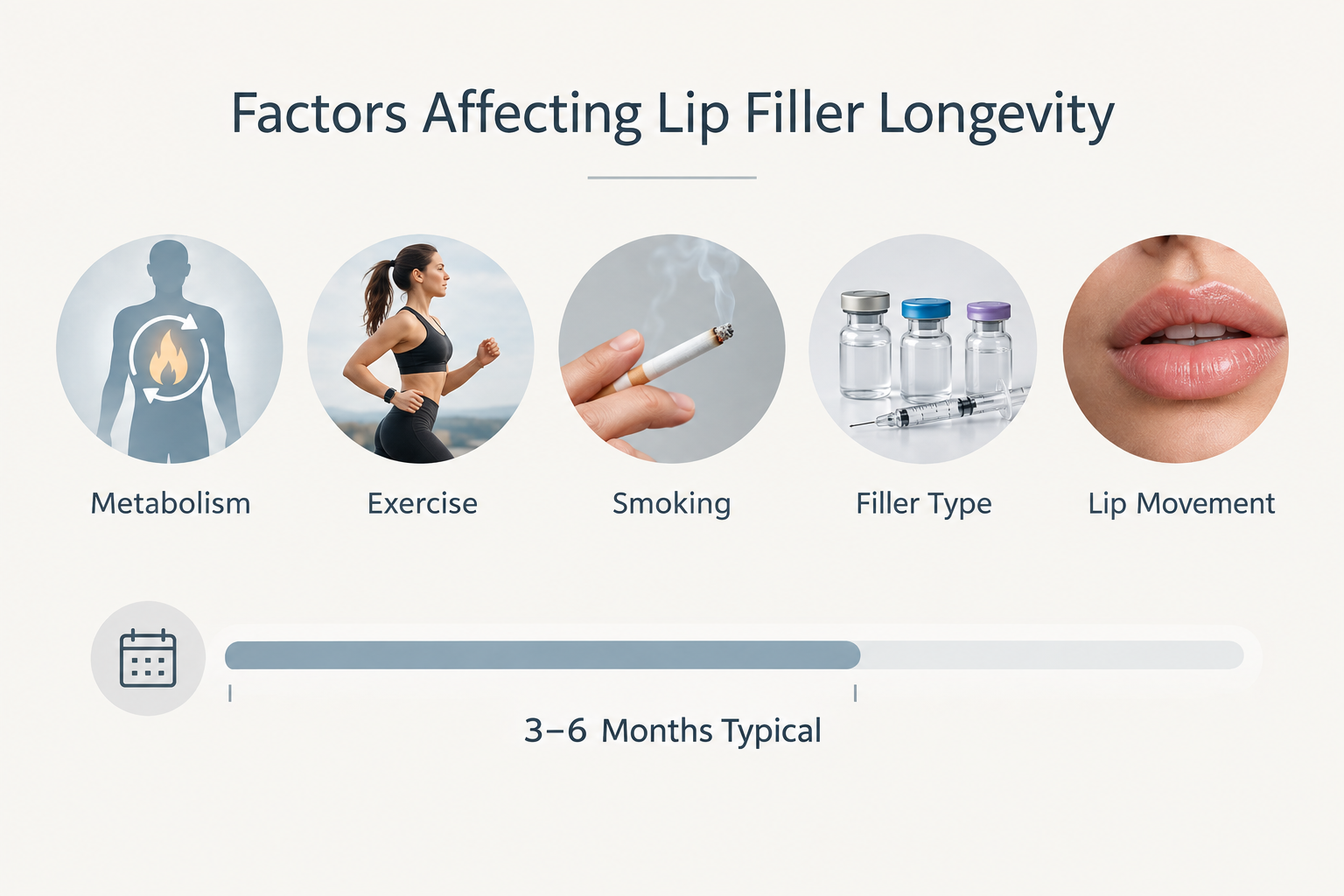
Smaller volumes such as 0.5ml may be metabolised more quickly than larger volumes, though this is not universally the case. Individual metabolic rate, lifestyle factors such as exercise intensity, and the specific HA product used can all influence how long the result lasts. Patients who exercise frequently at high intensity may find their results fade more quickly. Sun exposure and smoking may also affect the longevity of filler results, though the evidence on these factors is less definitive.
When the filler has been fully metabolised, the lips will gradually return to their pre-treatment appearance. There is no evidence that repeated HA filler treatments cause permanent stretching of the lip tissue when performed conservatively and by a qualified practitioner, though this is a question patients frequently raise and one worth discussing at consultation.
Risks and Side Effects of Lip Filler
Lip filler treatment carries risks that patients should understand before proceeding. The most common side effects — swelling, bruising, tenderness, and temporary lumpiness — are expected and generally resolve within one to two weeks. Less common but more significant risks include the following:
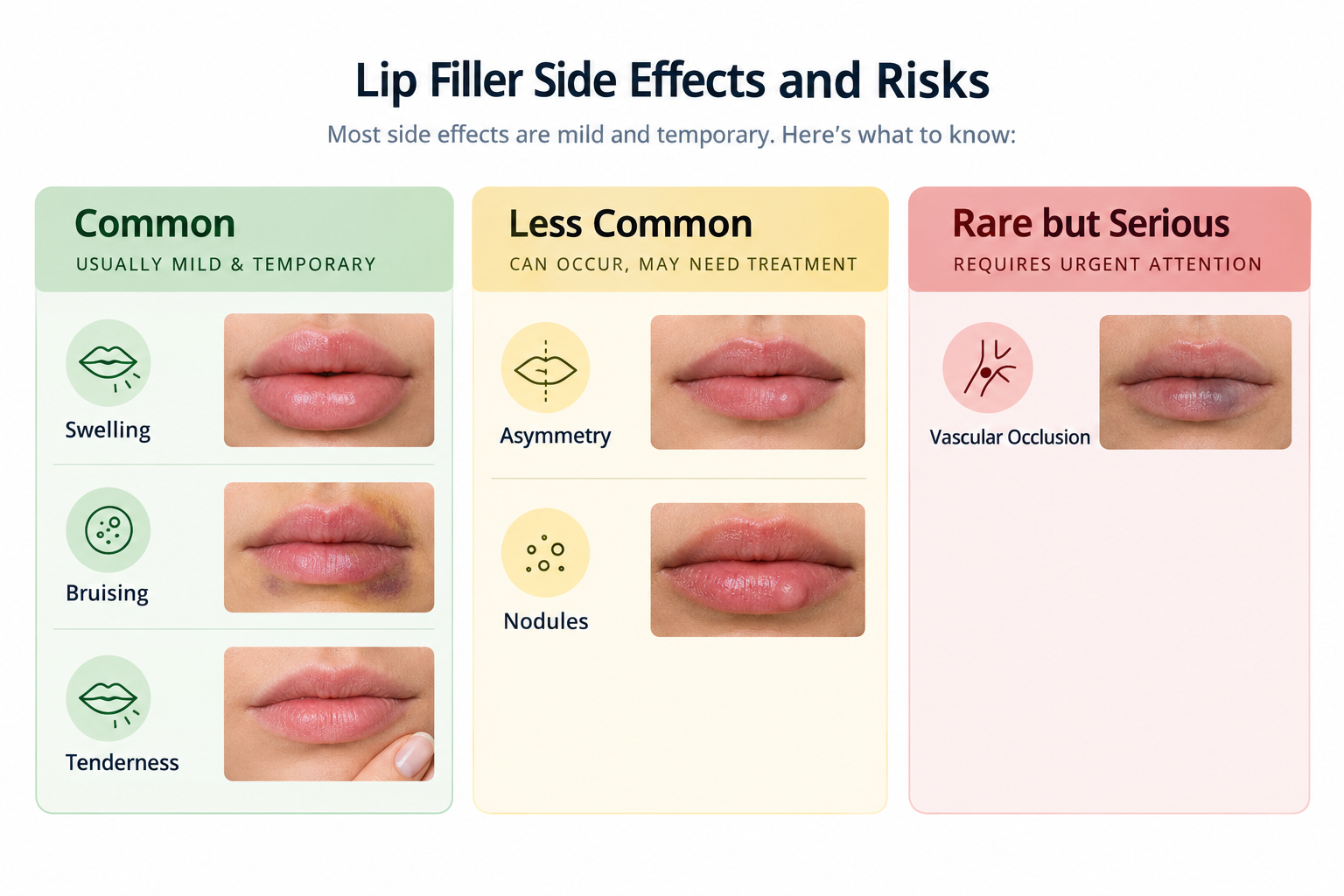
- Asymmetry: The lips may appear uneven after treatment, either due to unequal product distribution or differential swelling. Mild asymmetry often resolves as swelling settles; persistent asymmetry may require correction.
- Nodules or lumps: Occasionally, small lumps may persist beneath the lip surface. These may resolve spontaneously or may require treatment with hyaluronidase.
- Infection: Any injection carries a small risk of introducing bacteria. Signs of infection include increasing redness, warmth, pain, and swelling beyond the expected recovery period, and should be assessed promptly by a medical professional.
- Cold sore reactivation: Lip injections can trigger a reactivation of the herpes simplex virus in patients who carry it. Patients with a history of cold sores should discuss prophylactic antiviral treatment with their practitioner before the appointment.
- Allergic reaction: True allergy to hyaluronic acid filler is rare but possible. Delayed hypersensitivity reactions can occur weeks or months after treatment.
- Vascular occlusion: This is a rare but serious complication in which filler is inadvertently injected into or compresses a blood vessel, potentially compromising blood supply to the surrounding tissue. Symptoms include blanching, mottling, or severe pain during or shortly after injection. Vascular occlusion requires immediate treatment and is a medical emergency. Choosing a practitioner with appropriate training and access to hyaluronidase is an important safety consideration.
The reversibility of hyaluronic acid filler with hyaluronidase is an important safety advantage. If a result is unsatisfactory or a complication occurs, hyaluronidase can be injected to dissolve the HA filler relatively quickly. This does not eliminate all risks, but it does provide a meaningful option for correction that is not available with permanent or semi-permanent filler materials.
Alternatives to 0.5ml Lip Filler
Lip filler is not the only option for patients who want to improve the appearance of their lips. Understanding the alternatives can help patients make a more informed decision about which approach may suit their goals.
For patients who want to improve lip definition without adding volume, lip liner and makeup techniques remain a non-invasive option. While these do not produce lasting results, they carry no medical risk and allow the patient to experiment with different looks before committing to a treatment.
Lip flip treatments using botulinum toxin involve injecting a small amount of muscle-relaxing toxin into the orbicularis oris muscle around the upper lip. This causes the upper lip to relax slightly outward, creating the appearance of a fuller upper lip without adding volume. A lip flip does not add projection or significant volume, and the results typically last two to three months. It may suit patients who want a subtle upper lip enhancement without filler, or who want to reduce the appearance of a gummy smile.
For patients with significant volume loss due to ageing, a larger volume of filler — typically 1ml — may be more appropriate than 0.5ml. A practitioner can assess whether the degree of volume loss warrants a larger initial treatment or whether a staged approach starting with 0.5ml is more suitable.
Patients concerned primarily with lip lines and perioral wrinkles rather than lip volume may benefit from skin quality treatments such as skin boosters, polynucleotides, or resurfacing procedures, which address the texture and quality of the skin around the mouth rather than the volume of the lips themselves.
Choosing a Qualified Practitioner
The safety and quality of a lip filler result depend significantly on the skill, training, and clinical judgement of the practitioner performing the treatment. Lip filler injections carry real risks, including the rare but serious risk of vascular occlusion, and should only be performed by practitioners with appropriate medical training, a thorough understanding of facial anatomy, and access to hyaluronidase for emergency use.
Patients should look for practitioners who are willing to conduct a thorough consultation, discuss realistic expectations honestly, explain the risks clearly, and decline to treat patients for whom the procedure is not appropriate. A practitioner who pressures a patient into more volume than they requested, or who dismisses questions about risks, is not demonstrating good clinical practice. Regulatory requirements for who can legally administer filler vary by country, so patients should research the relevant standards in their location before booking.
Frequently Asked Questions
Will 0.5ml of lip filler look natural?
For many patients, 0.5ml produces a subtle result that is difficult for others to identify as filler. The outcome depends on the starting anatomy, the product used, and the technique of the practitioner. Patients with very thin lips may see a more noticeable change than those with moderate natural volume. Discussing the desired outcome clearly at consultation helps the practitioner tailor the treatment accordingly.
Is 0.5ml enough for a first-time lip filler treatment?
For many first-time patients, 0.5ml is a sensible starting point. It allows the patient to experience the treatment, assess how their lips respond, and decide whether they want more volume at a follow-up appointment. Some patients find 0.5ml achieves exactly what they wanted; others choose to add more at a later stage. A staged approach is generally considered safer than starting with a large volume.
How much does 0.5ml lip filler cost?
Pricing varies considerably depending on the country, clinic, practitioner experience, and the specific product used. In many markets, 0.5ml treatments are priced lower than 1ml treatments, though some clinics charge the same regardless of volume. Patients should be cautious of unusually low prices, as these may reflect less experienced practitioners or lower-quality products. Cost should be considered alongside practitioner qualifications and clinic standards rather than in isolation.
Can I dissolve 0.5ml lip filler if I don’t like the result?
Yes. Hyaluronic acid filler can be dissolved using hyaluronidase, an enzyme that breaks down HA. Dissolution is generally effective, though it may require more than one treatment session and can temporarily leave the lips looking deflated before the tissue settles. Patients should confirm that their chosen practitioner has access to hyaluronidase before proceeding with treatment.
How soon after treatment will I see the final result?
The final result of a 0.5ml lip filler treatment is typically visible after one to two weeks, once post-treatment swelling has fully resolved. Assessing the result before this point is not reliable, as swelling can make the lips appear larger or more uneven than the true outcome.
Does lip filler hurt?
Most patients experience some discomfort during lip filler injections. Topical anaesthetic cream applied before the procedure and lidocaine within the filler formulation help to reduce pain, but the lips remain a sensitive area. Discomfort is usually described as brief and manageable rather than severe. Patients with a low pain threshold should discuss this with their practitioner, who may be able to offer additional comfort measures.
Will my lips look the same after the filler wears off?
In most cases, when hyaluronic acid filler is fully metabolised, the lips return to their pre-treatment appearance. There is no strong clinical evidence that conservative HA lip filler treatments cause permanent changes to lip tissue when performed appropriately. Patients who have had repeated large-volume treatments over many years may notice some changes, but this is less relevant for patients considering a conservative 0.5ml treatment.
Is 0.5ml Lip Filler the Right Starting Point for You?
A 0.5ml lip filler treatment can be a well-suited option for patients who want a subtle, natural-looking enhancement — whether that means improved definition, mild volume, or a slight correction of asymmetry. It is a conservative volume that allows first-time patients to experience the treatment without committing to a dramatic change, and the reversibility of hyaluronic acid filler provides an additional layer of reassurance.
At the same time, 0.5ml has clear limitations. Patients with very thin lips who want a significant size increase, or those with pronounced asymmetry, may find that this volume alone does not fully meet their expectations. A staged approach — starting conservatively and reassessing after swelling has resolved — is a clinically sensible way to manage this, and a good practitioner will guide this process honestly.
The most important step before any lip filler treatment is a thorough consultation with a qualified, experienced practitioner who can assess your individual anatomy, discuss your goals realistically, explain the risks, and help you decide whether treatment is appropriate and what volume may be suitable. If you are considering 0.5ml lip filler, use that consultation to ask questions, express any concerns, and ensure you have a clear understanding of what the treatment can and cannot achieve for you specifically.


