Tear Trough Filler Migration: Why Filler Moves Under the Eyes
Tear trough filler migration is one of the most common complications reported after under-eye filler treatment. If you have noticed persistent puffiness, a bluish tint, or an unusual ridge beneath your eyes weeks or months after treatment, filler that has shifted from its original placement may be the cause. This guide explains why migration happens, how to distinguish it from other concerns, and what can realistically be done to correct it.
Key Takeaways
- Tear trough filler migration occurs when hyaluronic acid filler moves away from its intended injection site, most often due to superficial placement, overfilling, or an unsuitable filler product.
- The periorbital area is particularly prone to migration because the skin is extremely thin, the tissue planes are complex, and the orbicularis oculi muscle moves constantly with blinking and squinting.
- Common signs include persistent puffiness, a visible ridge or shelf under the eye, asymmetry, and the Tyndall effect — a bluish-grey discolouration visible through thin skin.
- Migrated hyaluronic acid filler can be dissolved safely using hyaluronidase, though the process requires careful assessment and may need more than one session.
- Prevention depends on correct filler selection, appropriate injection depth, conservative volumes, and thorough pre-treatment assessment by an experienced practitioner.
What Is Tear Trough Filler Migration?
The tear trough is the curved groove that runs from the inner corner of the eye towards the cheek, creating a shadow that can make a person look tired or older than they feel. Hyaluronic acid filler is commonly used to soften this hollow by adding volume beneath the skin. Migration refers to the movement of that filler away from where it was originally placed — typically downward onto the cheek, sideways towards the lower eyelid, or superficially towards the skin surface.
Migration is not always dramatic. In some cases it produces a subtle fullness that the patient initially mistakes for swelling. In others it creates a visible lump, a shelf-like ridge, or a colour change that persists long after any post-treatment swelling should have resolved. Because the under-eye skin is among the thinnest on the face — typically between 0.3 and 0.5 mm — even a small amount of displaced filler can become visible or palpable.
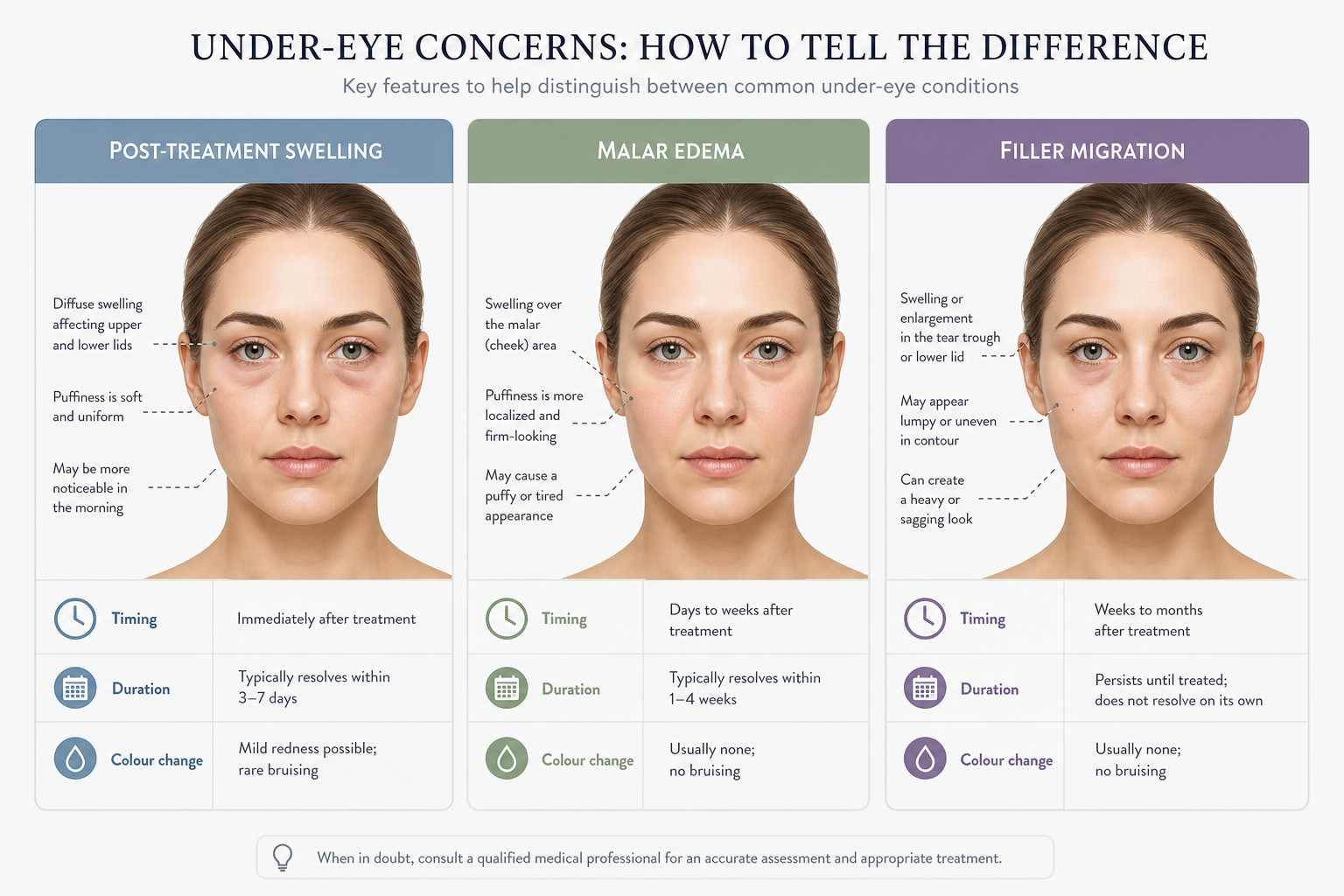
It is worth noting that not every change in appearance after tear trough treatment represents migration. Delayed swelling, malar edema, and orbital fat prolapse can all produce similar-looking results. Accurate diagnosis matters because the appropriate response differs depending on the actual cause.
Why the Tear Trough Is Particularly Prone to Complications
The periorbital anatomy is more complex than almost any other area treated with dermal filler. Several structural features make the tear trough uniquely challenging and help explain why migration occurs more readily here than in other facial zones.
The orbicularis retaining ligament
The orbicularis retaining ligament (ORL) is a fibrous structure that anchors the orbicularis oculi muscle to the underlying bone along the orbital rim. It acts as a natural boundary between the lower eyelid and the cheek. When filler is placed too superficially or in excessive volume, it can pool against this ligament rather than integrating smoothly into the tissue. Over time, the constant movement of the orbicularis oculi muscle — which contracts with every blink, squint, and smile — can push displaced filler further along the path of least resistance, typically downward or laterally.
Thin skin and poor lymphatic drainage
The skin overlying the tear trough is exceptionally thin, which means there is very little tissue to contain or conceal filler that has shifted position. The periorbital region also has relatively poor lymphatic drainage compared with other facial areas. This combination means that filler products with high hydrophilicity — the tendency to attract and retain water — can swell considerably in this zone, contributing to puffiness that is sometimes mistaken for migration but may in fact be malar edema, a distinct swelling response that has been reported in a meaningful proportion of patients treated in this area.
Constant muscle movement
The average person blinks approximately 15,000 times per day. Each blink involves contraction of the orbicularis oculi muscle, which runs in a ring around the eye. Filler placed in a superficial tissue plane — closer to the skin surface than to the bone — is subject to this repeated mechanical force. Over weeks and months, this movement can gradually displace filler from its original position, particularly if the product chosen has a low resistance to deformation.
The Main Causes of Tear Trough Filler Migration
Understanding why migration happens is important both for patients evaluating their own results and for anyone considering treatment for the first time. Several factors contribute, and in practice more than one is often present simultaneously.
Superficial injection plane
Injection depth is one of the most critical technical variables in tear trough treatment. The preferred approach for most patients is a deep, supraperiosteal plane — meaning the filler is placed directly above the periosteum, the membrane covering the bone. At this depth, the product is contained by surrounding tissue and is less susceptible to movement. When filler is placed in a more superficial plane, closer to the skin surface or within the orbicularis oculi muscle itself, it has far less structural support and is more likely to migrate over time.
Wrong filler product selection
Not all hyaluronic acid fillers behave the same way in tissue. Filler rheology — the physical properties of a product, including its stiffness (G-prime), viscosity, and hydrophilicity — determines how it integrates, spreads, and responds to mechanical forces. Products with high hydrophilicity absorb significantly more water after injection, which can cause swelling and displacement in the fluid-rich periorbital environment. High-viscosity, high-G-prime fillers designed for structural support in areas like the cheeks or jawline are generally inappropriate for the delicate tear trough. A low-density, low-hydrophilicity filler specifically suited to thin-skinned areas is typically the safer choice, though product selection should always be guided by the treating practitioner’s clinical assessment.
Overfilling and stacking filler
Overfilling — placing more product than the tissue can comfortably accommodate — is a significant driver of migration. The tear trough is a small anatomical space, and conservative volumes are generally recommended. When too much filler is injected in a single session, the excess product has nowhere to integrate and is more likely to shift. A related problem is stacking filler: injecting new product over retained filler from a previous treatment without first dissolving what remains. Hyaluronic acid filler under the eyes can persist far longer than patients are typically told — often for several years rather than the six to twelve months commonly quoted — meaning that cumulative volume can build up significantly over multiple treatment cycles.
Treating the wrong underlying problem
Tear trough filler is appropriate when the primary concern is genuine volume loss creating a hollow groove. It is not appropriate — and carries a substantially higher risk of poor outcomes including migration — when the underlying issue is orbital fat prolapse (bags caused by fat pushing forward through a weakened orbital septum), significant skin laxity, or pigmentation. Injecting filler into an area where fat is already prolapsing adds volume to a space that is already under pressure, increasing the likelihood of displacement and worsening the appearance. A thorough pre-treatment assessment is essential to distinguish between these different causes of under-eye concerns.
Patient behaviour after treatment
Certain behaviours in the days following treatment may increase migration risk, though this is less well studied than technical factors. Vigorous rubbing or massage of the treated area, applying significant pressure to the under-eye zone (for example, from certain sleep positions or tight eye masks), and intense physical activity that increases facial blood flow in the immediate post-treatment period are all factors that some practitioners advise patients to avoid. Following post-treatment care instructions carefully is a reasonable precaution.
How to Recognise Tear Trough Filler Migration
Identifying migration can be straightforward in obvious cases but genuinely difficult in subtle ones. The following signs are commonly associated with filler that has moved from its intended position.
- Persistent puffiness or pillowy fullness that does not resolve after the first two weeks post-treatment and does not fluctuate with hydration or sleep.
- The Tyndall effect — a bluish or grey-blue discolouration visible through the skin, caused by light scattering off filler that has migrated to a superficial position. This is distinct from the dark circles caused by pigmentation or vascular visibility.
- A visible ridge or shelf running horizontally beneath the eye, sometimes described as a ledge or step deformity at the lid-cheek junction.
- Asymmetry between the two eyes that was not present before treatment or that has developed gradually over time.
- Contour irregularity — lumps, bumps, or uneven texture that can be felt or seen, particularly when the face is animated.
- A paradoxically tired appearance despite adequate rest, caused by the shadow or distortion created by displaced product.
Migration, Swelling, or Malar Edema? How to Tell the Difference
| Feature | Post-treatment swelling | Malar edema | Filler migration |
|---|---|---|---|
| Typical onset | Immediately after treatment | Days to weeks after treatment | Weeks to months after treatment |
| Duration | Resolves within 1–2 weeks | May persist; fluctuates | Persistent; does not resolve spontaneously |
| Fluctuation | Reduces steadily | Worse in the morning, with salt intake, or alcohol | Stable; not affected by lifestyle factors |
| Colour change | Possible bruising (purple/yellow) | No colour change | Possible Tyndall effect (blue-grey) |
| Texture | Soft, diffuse | Soft, diffuse | May be firm, palpable, or have a defined edge |
| Response to hyaluronidase | Not applicable | May partially improve if HA-related | Resolves with appropriate dissolving |
Malar edema deserves particular attention because it is frequently misidentified. It refers to swelling in the malar (cheek) region that can develop after tear trough filler treatment, caused by disruption of lymphatic drainage pathways or the hydrophilic properties of the filler drawing fluid into the area. It tends to fluctuate — often worse in the morning or after alcohol consumption — which helps distinguish it from true migration, where the displaced product remains in a fixed position regardless of lifestyle factors. Clinical assessment by an experienced practitioner is the most reliable way to differentiate between these presentations.
A Note on Non-HA Fillers Under the Eyes
Hyaluronic acid is the only filler category that should be used in the tear trough. Calcium hydroxylapatite (such as Radiesse) and poly-L-lactic acid (such as Sculptra) are not appropriate for this area and should not be injected there. These products cannot be dissolved with hyaluronidase if complications arise, making any adverse outcome — including migration — significantly more difficult to manage. If you are considering tear trough treatment, confirming that only a suitable hyaluronic acid filler will be used is an important question to raise during your consultation.
How Long Does Under-Eye Filler Actually Last?
Patients are often told that tear trough filler lasts six to twelve months, but clinical experience and emerging evidence suggest the reality is frequently different. Hyaluronic acid filler in the periorbital region may persist for considerably longer — in some cases for several years — because the area has relatively low metabolic activity and limited mechanical breakdown compared with more mobile facial zones. This has important implications for anyone considering repeat treatment. If retained filler from a previous session is still present and new product is added on top, the cumulative volume increases with each treatment cycle, raising the risk of overfilling, contour irregularity, and migration. Ultrasound imaging is increasingly used by experienced practitioners to assess how much retained filler is present before deciding whether re-treatment is appropriate.
How Migrated Tear Trough Filler Is Corrected
The primary treatment for confirmed tear trough filler migration is dissolving with hyaluronidase, an enzyme that breaks down hyaluronic acid. When injected into or near the area of displaced filler, hyaluronidase degrades the HA chains, causing the product to break down and be reabsorbed by the body. The process is generally well tolerated, though it can cause temporary redness, swelling, and bruising at the injection site.
Several practical points are worth understanding before undergoing dissolving. First, hyaluronidase does not discriminate between injected filler and the body’s own naturally occurring hyaluronic acid, which means some temporary hollowing in the treated area is expected after dissolution. This hollowing typically improves over two to four weeks as the tissue normalises, but patients should be prepared for a period where the under-eye area may look more hollow than before any filler was placed. Second, heavily migrated or long-standing filler may require more than one dissolving session to achieve full clearance. Third, practitioners are increasingly using high-frequency ultrasound to map the precise location and extent of retained filler before treatment, which allows for more targeted and effective dissolving — particularly when filler has spread across a wide area or is located in an unexpected plane.
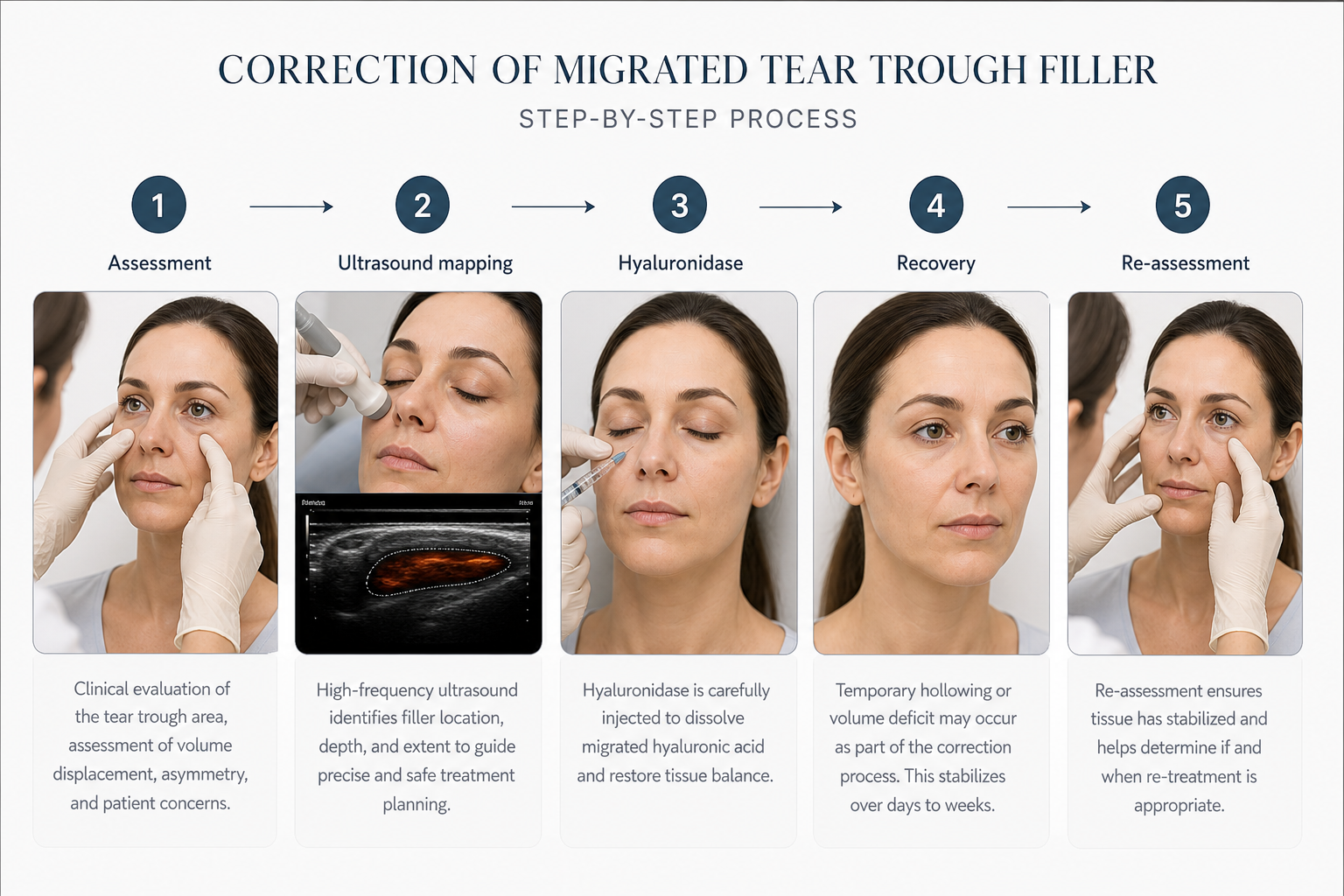
After successful dissolution and a suitable recovery period — typically at least four to six weeks, though individual assessment is required — re-treatment with an appropriate filler may be considered if genuine volume loss remains. The decision to re-treat should be made carefully, with attention to whether the original concern was truly suitable for filler in the first place.
In cases where the underlying problem is orbital fat prolapse rather than volume loss, lower eyelid blepharoplasty — a surgical procedure to reposition or remove prolapsed fat — may be a more appropriate long-term solution than repeated filler treatment. Regenerative approaches such as platelet-rich fibrin (PRF) are sometimes discussed as alternatives for patients who are not suitable candidates for filler, though the evidence base for these options in the tear trough specifically is still developing.
How to Reduce the Risk of Migration
While no technique eliminates risk entirely, several evidence-informed practices are associated with lower rates of migration and better outcomes in tear trough treatment.
- Thorough pre-treatment assessment: Identifying whether the concern is true volume loss, fat prolapse, skin laxity, or pigmentation before any filler is placed. Patients with significant fat prolapse or very thin, crepey skin may not be suitable candidates for filler.
- Appropriate filler selection: Using a low-density, low-hydrophilicity hyaluronic acid filler specifically suited to the periorbital area, rather than a product designed for structural support in other facial zones.
- Deep injection plane: Placing filler in the supraperiosteal plane, directly above the bone, where it is better contained and less subject to mechanical displacement.
- Conservative volumes: Using small amounts of product per pass and per session, with a staged approach that allows assessment of results before adding more volume.
- Cannula technique: Many experienced practitioners prefer a blunt-tipped cannula over a sharp needle for tear trough treatment, as it may reduce trauma to surrounding tissue and allow more controlled product placement, though both techniques can be performed safely by skilled injectors.
- Dissolving old filler before re-treating: Assessing and clearing retained product from previous sessions before adding new volume, to avoid cumulative overfilling.
- Choosing an experienced practitioner: The tear trough is widely regarded as one of the most technically demanding areas for filler treatment. Practitioner experience, anatomical knowledge, and injection technique are significant factors in outcome.
Frequently Asked Questions
Can filler migrate years after treatment?
Yes. Hyaluronic acid filler under the eyes can persist for considerably longer than the six to twelve months often quoted, and migration can occur or become more apparent over an extended period. Patients who had treatment several years ago and are now noticing changes in the under-eye area should seek assessment from a practitioner experienced in managing filler complications.
Can cheek filler migrate to the under-eye area?
This is possible, though less common than migration of filler placed directly in the tear trough. Filler injected in the mid-cheek or malar region can occasionally travel upward toward the lower eyelid, particularly if placed superficially or in large volumes. The same principles of careful product selection and injection depth apply to cheek treatment.
Is tear trough filler migration permanent?
Migration of hyaluronic acid filler is not permanent. Hyaluronidase can dissolve displaced product effectively in most cases, though multiple sessions may be needed for long-standing or widespread migration. The timeline for full resolution varies between individuals.
Will dissolving filler leave me looking worse than before?
Temporary hollowing after hyaluronidase treatment is expected and normal. Most patients find that the hollowing improves over two to four weeks as the tissue settles. In some cases, the area may look similar to how it appeared before any filler was placed. Whether re-treatment is appropriate depends on individual anatomy and the original indication for treatment.
How do I know if my practitioner is experienced enough to treat the tear trough?
Relevant questions to ask include how many tear trough treatments the practitioner performs, what their approach is to managing complications, whether they can dissolve filler if needed, and whether they use ultrasound assessment. A practitioner who is willing to discuss risks openly and who does not pressure you toward treatment is generally a more reassuring choice than one who minimises the complexity of the procedure.
What if my concern is not actually volume loss?
If the under-eye concern is caused by orbital fat prolapse, skin pigmentation, or skin laxity rather than genuine hollowness, filler is unlikely to produce a satisfactory result and may worsen the appearance. A thorough consultation with a practitioner who can accurately assess the cause of your concern — and who is willing to recommend alternatives or no treatment when appropriate — is the most important first step.
What to Do If You Think Your Filler Has Migrated
If you are concerned that tear trough filler has migrated, the most important step is to seek assessment from a practitioner with specific experience in managing filler complications — ideally someone who can offer hyaluronidase dissolving and, where available, ultrasound-guided assessment. Avoid attempting to massage or manipulate the area yourself, as this is unlikely to help and may worsen displacement. Avoid adding more filler to the area before the existing product has been properly assessed and, if necessary, cleared.
Tear trough filler migration is a manageable complication when identified and treated appropriately. Understanding the causes, recognising the signs, and knowing what questions to ask before and after treatment puts you in a much stronger position to make informed decisions about your care — and to seek help promptly if something does not look or feel right.