
Choosing a Skin Clinic on Harley Street: What to Look For Before You Book
Harley Street has been synonymous with specialist medical care in London for well over a century, and today it is home to a significant concentration of skin clinics, aesthetic practitioners, and cosmetic dermatologists. For anyone researching skin treatments in the capital, the area naturally appears at the top of search results — but the Harley Street address alone does not guarantee clinical quality, safety, or the right treatment for your individual concerns. Choosing the right skin provider requires a more considered approach than simply booking the nearest or most prominently advertised clinic.
Key Takeaways
- A Harley Street address is a useful starting point, but practitioner qualifications, regulatory registration, and clinical approach matter far more than location alone.
- Reputable skin clinics should offer a thorough consultation before recommending any treatment, and should be transparent about realistic outcomes, risks, and alternatives.
- The range of treatments available in this area is broad — from medical-grade facials and injectables to laser resurfacing and prescription skincare — and the right option depends on your specific skin concern and medical history.
- Regulatory oversight of aesthetic medicine in the UK is evolving; understanding which practitioners are regulated and how can help you make a safer choice.
- Cost should be considered in the context of clinical expertise and safety standards, not as the primary deciding factor.
Why Harley Street Became a Centre for Skin and Aesthetic Medicine
The concentration of medical specialists in the Harley Street and Marylebone area of London developed throughout the nineteenth and twentieth centuries, initially around surgical and general medical consultants. As aesthetic and cosmetic medicine grew into a recognised clinical discipline, many practitioners — including consultant dermatologists, plastic surgeons, and specialist aesthetic doctors — established practices in the same area, partly because of its established reputation and partly because of proximity to major London teaching hospitals. Today, the term “Harley Street skin clinic” is used broadly and can refer to anything from a consultant-led dermatology practice to a standalone aesthetic clinic offering non-surgical treatments. Understanding this distinction is an important first step when evaluating your options.
Understanding Who Can Legally Provide Skin Treatments in the UK
The regulatory landscape for aesthetic and cosmetic procedures in the United Kingdom is more complex than many patients realise. Some treatments — including the prescription and administration of botulinum toxin, dermal fillers, and certain prescription-only skincare — are legally restricted to qualified healthcare professionals. Following the Health and Care Act 2022, botulinum toxin and filler injections in England became restricted to individuals who are either registered healthcare professionals or working under the supervision of one, with further licensing requirements being introduced by local authorities. However, many non-invasive treatments such as certain laser procedures, chemical peels, and skin needling are not yet subject to the same level of statutory regulation, which means the burden of due diligence falls significantly on the patient.
When evaluating a skin clinic on Harley Street or elsewhere in London, it is worth confirming whether the practitioners performing or overseeing your treatment are registered with a recognised regulatory body. In the UK, these include the General Medical Council (GMC) for doctors, the Nursing and Midwifery Council (NMC) for nurses and nurse practitioners, the General Dental Council (GDC) for dentists, and the Health and Care Professions Council (HCPC) for allied health professionals. Registration can be verified directly on each body’s public register. Clinics that are transparent about their practitioners’ credentials and registration status are generally a more reliable choice.
What a Reputable Skin Clinic Should Offer Before Treatment
A thorough pre-treatment consultation is one of the clearest indicators of a clinically responsible skin provider. At a reputable clinic, the consultation should involve a detailed review of your medical history, current medications, allergies, and any previous aesthetic treatments. The practitioner should assess your skin in person — not simply ask you to describe your concerns over a brief phone call — and should explain the treatment options relevant to your specific concern, including their mechanisms, expected outcomes, limitations, and potential risks.
Informed consent is a legal and ethical requirement for any medical or aesthetic procedure. Before any treatment begins, you should receive clear written information about what the procedure involves, what results are realistic, what side effects or complications may occur, and what the recovery process typically looks like. A practitioner who discourages questions, rushes the consultation, or applies pressure to book immediately is not demonstrating the standard of care that a responsible skin clinic should provide. Equally, a clinic that offers a meaningful consultation at no charge or at a clearly stated fee — and does not make that fee conditional on booking a treatment — is generally operating more transparently.
Common Skin Treatments Available at Harley Street Clinics
The range of treatments offered by skin clinics in the Harley Street area is extensive, and the appropriate option for any individual depends on their specific skin concern, skin type, medical history, and treatment goals. The following overview covers the most commonly available categories.
Injectable Treatments
Botulinum toxin injections — commonly known by brand names such as Botox, Dysport, or Azzalure — are used to temporarily reduce the appearance of dynamic facial lines, including forehead lines, frown lines between the brows, and crow’s feet around the eyes. These treatments work by temporarily relaxing the underlying facial muscles responsible for repetitive movement. Results typically become visible within a few days to two weeks and generally last between three and six months, depending on the individual, the area treated, and the dose used. Botulinum toxin is a prescription-only medicine in the UK, meaning it must be prescribed and administered by or under the supervision of a qualified healthcare professional.
Dermal fillers are injectable gels — most commonly based on hyaluronic acid — used to restore volume, soften deeper lines, or enhance facial contours. Common treatment areas include the lips, cheeks, nasolabial folds, and under-eye hollows. Results are typically immediate and may last from six months to over a year depending on the product used, the area treated, and individual metabolism. Dermal filler treatments carry meaningful risks if performed incorrectly, including bruising, swelling, asymmetry, and in rare but serious cases, vascular complications. Choosing a practitioner with appropriate anatomical knowledge and training in managing complications is particularly important for filler treatments.
Laser and Light-Based Treatments
Laser skin treatments available at specialist clinics in London include ablative and non-ablative resurfacing lasers, fractional laser treatments, Q-switched lasers for pigmentation, and vascular lasers for conditions such as rosacea and thread veins. Intense pulsed light (IPL) devices are also widely used for pigmentation, sun damage, and skin tone concerns. The appropriate laser or light-based treatment depends on your skin concern, skin tone, and Fitzpatrick skin type — a classification system used to assess how skin responds to UV light and laser energy. Darker skin tones require careful device selection and settings to minimise the risk of post-inflammatory hyperpigmentation, and this is an area where clinical experience and appropriate equipment matter considerably.
Skin Rejuvenation and Medical Facials
Medical-grade facials and skin rejuvenation treatments offered at skin clinics differ from standard beauty salon treatments in that they are typically performed or supervised by trained clinicians and may use higher-concentration active ingredients or more advanced delivery methods. Treatments in this category include chemical peels using glycolic, salicylic, lactic, or trichloroacetic acid; microneedling or collagen induction therapy; HydraFacial and similar multi-step hydradermabrasion treatments; and polynucleotide injections used to support skin quality and hydration. Each of these has a different mechanism, evidence base, and suitability profile, and a responsible clinic will help you understand which approach is most appropriate for your concern rather than recommending the most expensive option by default.
Prescription Skincare and Dermatological Treatments
Some skin clinics on Harley Street operate with consultant dermatologists or doctors who can prescribe treatments not available over the counter, including topical retinoids, azelaic acid formulations, prescription-strength hydroquinone for pigmentation, and oral medications for conditions such as acne or rosacea. If your skin concern has a medical component — such as persistent acne, eczema, psoriasis, or suspected skin cancer — a clinic with dermatological medical expertise is likely to be more appropriate than one focused exclusively on cosmetic treatments. It is worth clarifying before booking whether the clinic you are considering has the clinical scope to address your specific concern.
Body Contouring and Non-Surgical Treatments
Many skin clinics in the Harley Street area also offer non-surgical body contouring treatments, including fat reduction procedures such as cryolipolysis and injectable fat dissolving treatments, as well as muscle stimulation devices and skin tightening technologies. It is important to understand that body contouring treatments are designed to address localised areas of concern and are not a treatment for obesity or a substitute for lifestyle changes. Results vary between individuals, and a responsible clinic will be clear about what these treatments can and cannot achieve before recommending them.
Red Flags to Watch For When Choosing a Skin Provider
Certain patterns of behaviour or clinic presentation should prompt caution regardless of location or marketing. A clinic that makes guarantees about specific results — rather than explaining what outcomes are realistic and variable — is not setting appropriate expectations. Similarly, a provider who does not take a medical history before treatment, does not discuss risks and alternatives, or does not obtain written informed consent is not meeting the standard of care expected of a responsible aesthetic or medical practice.
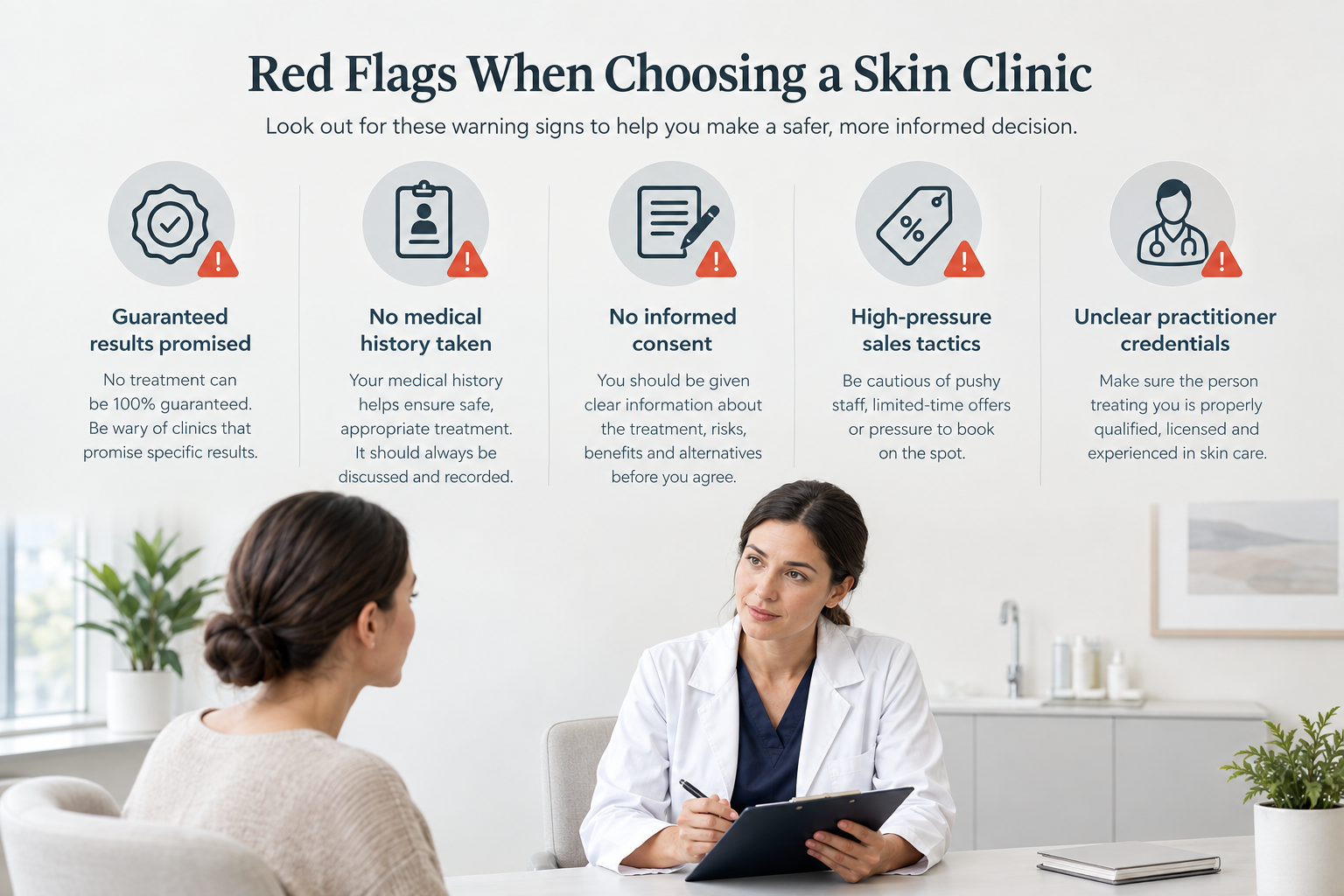
Heavily discounted treatment packages promoted through flash-sale platforms have been associated with higher rates of patient dissatisfaction and complications in the aesthetic sector, partly because the commercial model can create pressure to treat quickly and at volume rather than carefully. This does not mean that all promotional pricing is inappropriate, but it is worth considering whether the pricing model is consistent with the level of clinical care you would expect. Transparency about who will actually perform your treatment — as opposed to who is named on the clinic’s website — is also important, particularly in larger multi-practitioner clinics.
Questions to Ask Before Booking a Consultation
Asking the right questions before committing to a consultation or treatment can help you assess whether a skin clinic is the right fit for your needs. Consider asking the following:
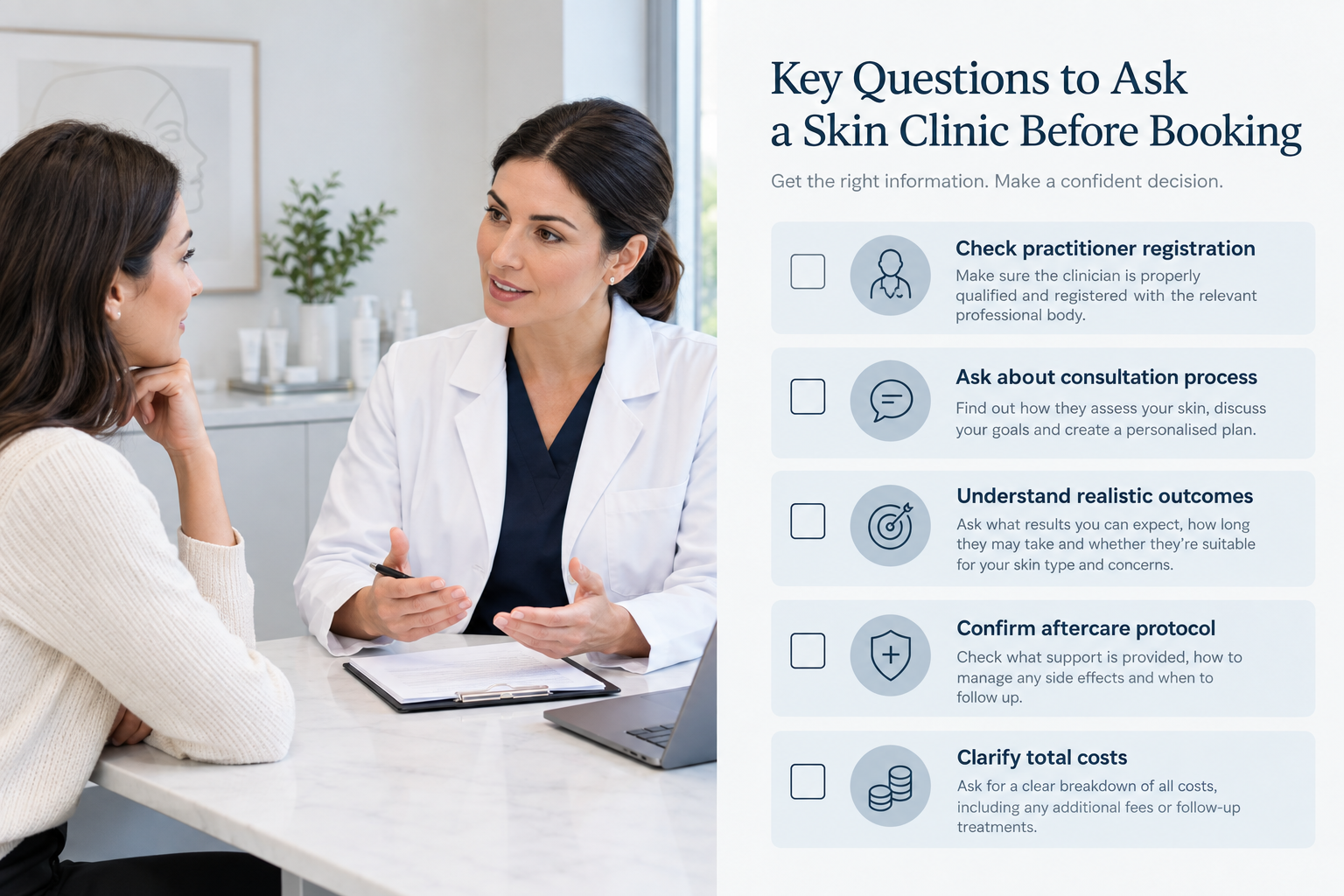
- What are the qualifications and regulatory registration of the practitioner who will assess and treat me?
- How long has the practitioner been performing this specific treatment?
- What does the consultation involve, and will I have time to ask questions before any treatment is recommended?
- What are the realistic outcomes for someone with my skin type and concern?
- What are the possible side effects, risks, and complications of the recommended treatment?
- What happens if I experience a complication — does the clinic have a clear aftercare and complication management protocol?
- Are there alternative treatments that might address my concern, and why is this one being recommended?
- What is the total cost, including any follow-up appointments or maintenance sessions?
A practitioner who answers these questions clearly and without defensiveness is demonstrating the kind of clinical transparency that is associated with responsible practice.
How to Assess Clinical Credentials and Experience
Verifying a practitioner’s credentials does not require specialist knowledge. The GMC, NMC, GDC, and HCPC all maintain publicly searchable registers that confirm whether a practitioner is currently registered and in good standing. For doctors, the GMC register also indicates the practitioner’s specialty and whether they hold a licence to practise. Membership of professional bodies such as the British Association of Dermatologists (BAD), the British College of Aesthetic Medicine (BCAM), or the British Association of Aesthetic Plastic Surgeons (BAAPS) can indicate a commitment to ongoing professional development and adherence to professional standards, though membership alone does not guarantee clinical quality.
Experience with your specific concern and treatment type is also relevant. A practitioner who regularly treats patients with your skin type and concern is likely to have a more refined clinical approach than one who offers a very broad range of treatments with limited depth in any particular area. Asking how frequently the practitioner performs the specific treatment you are considering is a reasonable and appropriate question.
The Role of Aftercare and Follow-Up
Responsible skin clinics provide clear aftercare instructions following any treatment and make it straightforward for patients to contact the clinic if they have concerns during recovery. For injectable treatments in particular, access to a practitioner who can assess and manage potential complications is an important safety consideration. Before booking, it is worth understanding what the clinic’s aftercare protocol involves, whether a follow-up appointment is included, and how to reach the clinic outside of normal hours if a concern arises. Clinics that provide detailed written aftercare information and a direct contact route for post-treatment concerns are generally operating to a higher standard of patient safety.
Frequently Asked Questions
Does a Harley Street address mean a clinic is regulated or accredited?
No. The Harley Street address is a geographical location and does not confer any regulatory status or accreditation. Regulation depends on the qualifications and registration of the individual practitioners and, for certain clinic types, registration with the Care Quality Commission (CQC). Always verify practitioner credentials independently rather than relying on location or marketing.
How do I know if a treatment is suitable for my skin type?
Suitability for any skin treatment depends on a range of factors including your skin type, Fitzpatrick classification, medical history, current medications, and the specific concern you want to address. A qualified practitioner should assess these factors during a consultation before recommending any treatment. Self-assessing suitability based on online information alone is not a reliable approach.
What is the difference between a cosmetic clinic and a dermatology clinic?
A dermatology clinic is typically led by a consultant dermatologist — a doctor who has completed specialist postgraduate training in skin diseases and conditions — and can diagnose and treat both medical and cosmetic skin concerns. A cosmetic or aesthetic clinic may be led by practitioners with a range of backgrounds and is generally focused on non-surgical cosmetic treatments. Some clinics combine both, with dermatologists and aesthetic practitioners working alongside each other. If your concern has a medical component, a clinic with dermatological expertise is usually more appropriate.
Are non-surgical skin treatments on Harley Street safe?
Non-surgical skin treatments carry varying levels of risk depending on the treatment type, the practitioner’s training and experience, and the individual patient’s suitability. No aesthetic treatment is entirely without risk. Choosing a qualified, registered practitioner who conducts a thorough consultation, obtains informed consent, and has clear protocols for managing complications significantly reduces — but does not eliminate — the risk of adverse outcomes.
How much should I expect to pay for a consultation at a Harley Street skin clinic?
Consultation fees at specialist skin clinics in the Harley Street area vary considerably depending on the practitioner’s qualifications and the nature of the consultation. Consultant dermatologist appointments typically carry higher fees than consultations with aesthetic practitioners. Some clinics offer complimentary consultations for certain treatments, while others charge a fee that may or may not be redeemable against treatment. Be cautious of free consultations that feel more like a sales appointment than a clinical assessment.
Can I get a prescription skincare treatment at an aesthetic skin clinic?
Only if the clinic has a prescribing practitioner — such as a doctor, nurse prescriber, or dentist with prescribing authority — on the team. Not all aesthetic clinics have prescribing capability. If prescription skincare is part of what you are looking for, confirm before booking that the clinic can provide this service.
Making an Informed Choice About Your Skin Provider
Choosing a skin clinic on Harley Street — or anywhere in London — is ultimately a decision about clinical trust as much as it is about treatment options or location. The concentration of experienced practitioners in the Harley Street area means that genuinely high-quality care is available, but it also means that the area’s reputation can be used as a marketing tool by clinics that may not meet the same standard. Taking the time to verify practitioner credentials, ask detailed questions during consultation, and understand what realistic outcomes look like for your specific concern is the most reliable way to make a well-informed decision.
If you are uncertain where to start, seeking a consultation with a consultant dermatologist or a practitioner registered with a recognised professional body is a reasonable first step. A good practitioner will help you understand your options clearly, will not pressure you into treatment, and will refer you elsewhere if your concern falls outside their clinical scope. That kind of transparency is one of the most meaningful indicators of a skin provider worth trusting.


