
Laser Skin Resurfacing Explained: What to Expect, Results and Recovery
Laser skin resurfacing is one of the most established skin rejuvenation treatments available in aesthetic medicine, used to address concerns ranging from fine lines and acne scarring to uneven skin tone and sun damage. If you have been searching for laser skin resurfacing near you, this guide explains how different laser technologies work, what the treatment experience involves, realistic outcomes, recovery expectations, and the factors that determine whether you may be a suitable candidate.
Key Takeaways
- Laser skin resurfacing uses focused light energy to remove or remodel damaged skin, stimulating collagen production and improving texture, tone, and surface irregularities.
- Ablative lasers remove the outer skin layer for more significant results but require longer downtime; non-ablative and fractional lasers offer a gentler approach with less recovery time.
- Results vary depending on the laser type, the concern being treated, skin type, and individual healing response — multiple sessions may be needed for some approaches.
- Risks include redness, swelling, pigmentation changes, and, less commonly, scarring or infection; a thorough clinical assessment is essential before treatment.
- Alternatives such as chemical peels, microneedling, and intense pulsed light (IPL) may suit patients for whom laser resurfacing is not appropriate.
What Is Laser Skin Resurfacing?
Laser skin resurfacing is a medical aesthetic procedure that uses concentrated beams of light energy to treat the skin’s surface and underlying layers. The term covers a broad family of technologies rather than a single device or technique. What these approaches share is the use of laser wavelengths that interact with water or pigment in skin tissue, producing controlled thermal injury that triggers the body’s natural repair processes, including new collagen formation and the replacement of damaged skin cells.
The treatment has been used clinically for several decades, and the evidence base for its effectiveness in improving fine lines, wrinkles, acne scars, sun-damaged skin, and uneven pigmentation is well established. Advances in laser technology have expanded the range of available options, allowing practitioners to tailor treatment intensity, depth, and recovery time to individual patient needs and skin concerns.
Types of Laser Used in Skin Resurfacing
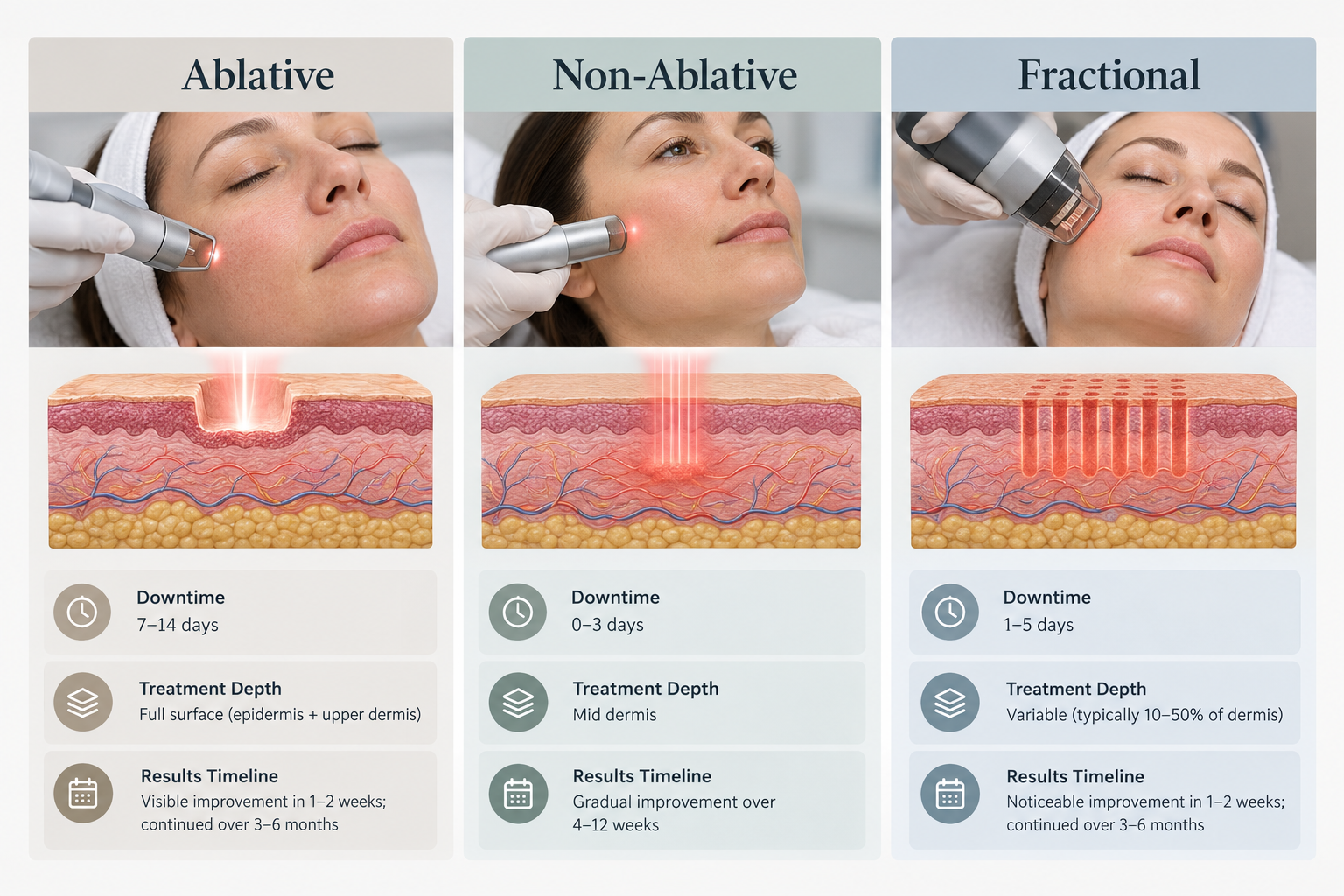
Understanding the main categories of laser resurfacing helps clarify why different patients may be recommended different approaches. The key distinction is between ablative, non-ablative, and fractional laser treatments.
Ablative Laser Resurfacing
Ablative lasers remove the outermost layer of skin, known as the epidermis, while simultaneously heating the deeper dermis to stimulate collagen remodelling. The two most widely used ablative laser types are the carbon dioxide (CO2) laser and the erbium:YAG laser. CO2 laser resurfacing is associated with more significant results for deeper wrinkles and pronounced scarring, but it also involves the longest recovery period, typically two to four weeks of visible healing. Erbium:YAG lasers cause less thermal damage to surrounding tissue, which can mean a shorter recovery while still delivering meaningful skin improvement, particularly for moderate surface concerns.
Non-Ablative Laser Resurfacing
Non-ablative lasers deliver heat energy into the dermis without removing the surface skin layer. Because the epidermis remains intact, downtime is considerably shorter — often limited to mild redness for a day or two. The trade-off is that results are generally more gradual and less dramatic than ablative approaches. Non-ablative treatments are often used for mild to moderate skin laxity, early fine lines, and diffuse redness or pigmentation. Multiple sessions are typically required to achieve noticeable improvement.
Fractional Laser Resurfacing
Fractional laser technology, available in both ablative and non-ablative forms, treats only a fraction of the skin surface at each session, leaving surrounding tissue intact. This approach, used in devices such as fractional CO2 and fractional erbium lasers, accelerates healing compared with fully ablative treatment while still delivering meaningful collagen stimulation. Fractional resurfacing has become widely used because it offers a middle ground between the significant results of full ablative treatment and the minimal downtime of non-ablative approaches. Recovery after fractional ablative treatment typically ranges from five to ten days, depending on the intensity used.
What Conditions Can Laser Resurfacing Address?
Laser skin resurfacing may be used to improve a range of skin concerns, though the suitability of a specific laser type depends on the nature and severity of the concern, as well as the patient’s skin characteristics.
- Fine lines and wrinkles: Particularly around the eyes, mouth, and forehead, where collagen loss and repeated muscle movement contribute to surface creasing.
- Acne scarring: Atrophic (depressed) acne scars, including rolling and boxcar subtypes, may respond well to ablative or fractional laser treatment, which remodels the scar tissue and stimulates new collagen.
- Sun damage and age spots: Laser energy can target excess melanin in sun-damaged skin, improving uneven pigmentation and the appearance of solar lentigines (flat brown spots).
- Uneven skin texture: Rough or irregular skin surface caused by enlarged pores, mild scarring, or cumulative environmental damage may be smoothed through resurfacing.
- Skin laxity: Mild to moderate skin looseness, particularly around the lower face and neck, may benefit from the collagen-stimulating effects of laser treatment, though significant laxity is generally better addressed through other means.
- Rosacea and diffuse redness: Certain laser wavelengths can target vascular components of rosacea, reducing persistent facial redness and visible capillaries.
It is important to note that laser resurfacing does not address all skin concerns equally. Deep structural changes, significant volume loss, or dynamic wrinkles caused by muscle movement may require complementary treatments such as dermal fillers or botulinum toxin alongside laser work.
Who May Be Suitable for Laser Skin Resurfacing?
Suitability for laser resurfacing depends on a careful clinical assessment. Patients who tend to respond well include those with fair to medium skin tones who have realistic expectations about the degree of improvement achievable, and who are in good general health without active skin infections or inflammatory skin conditions in the treatment area.
Skin type is a particularly important consideration. Patients with darker skin tones face a higher risk of post-inflammatory hyperpigmentation — a darkening of the skin that can occur as a response to laser-induced injury. This does not mean laser resurfacing is unavailable to patients with darker skin, but it does mean that laser selection, settings, and pre-treatment preparation require greater care. Some laser types and wavelengths carry a lower risk of pigmentation changes in darker skin, and an experienced practitioner will discuss this in detail during consultation.
Factors that may affect suitability or require careful discussion include:
- History of keloid scarring or abnormal wound healing
- Active acne or skin infection in the treatment area
- Recent use of isotretinoin (a medication for acne), which may impair healing
- History of cold sores (herpes simplex), as laser treatment can trigger an outbreak — antiviral medication is often prescribed as a precaution
- Pregnancy or breastfeeding
- Certain autoimmune conditions or medications that affect immune response or healing
- Previous radiation therapy to the face
- Unrealistic expectations about the degree of improvement possible
What Happens During a Laser Resurfacing Appointment?
Before the procedure, a qualified practitioner will conduct a thorough consultation to assess skin type, discuss concerns and goals, review medical history, and recommend the most appropriate laser approach. Pre-treatment preparation may include a skincare regimen to condition the skin and reduce the risk of complications, particularly for patients with darker skin tones or a history of pigmentation issues.
On the day of treatment, the skin is thoroughly cleansed. Depending on the laser type and treatment intensity, anaesthesia options range from topical numbing cream for lighter non-ablative treatments to local anaesthetic injections or sedation for more intensive ablative procedures. The practitioner passes the laser handpiece over the treatment area in a controlled pattern, with the duration of the session depending on the size of the area and the depth of treatment — typically between 30 minutes and two hours.
During the procedure, patients commonly describe a sensation of heat or a snapping feeling against the skin. More intensive ablative treatments may cause greater discomfort, which is managed through the anaesthesia approach chosen. After the session, the skin is cooled and a protective ointment or dressing may be applied.
Recovery and Downtime: What to Realistically Expect
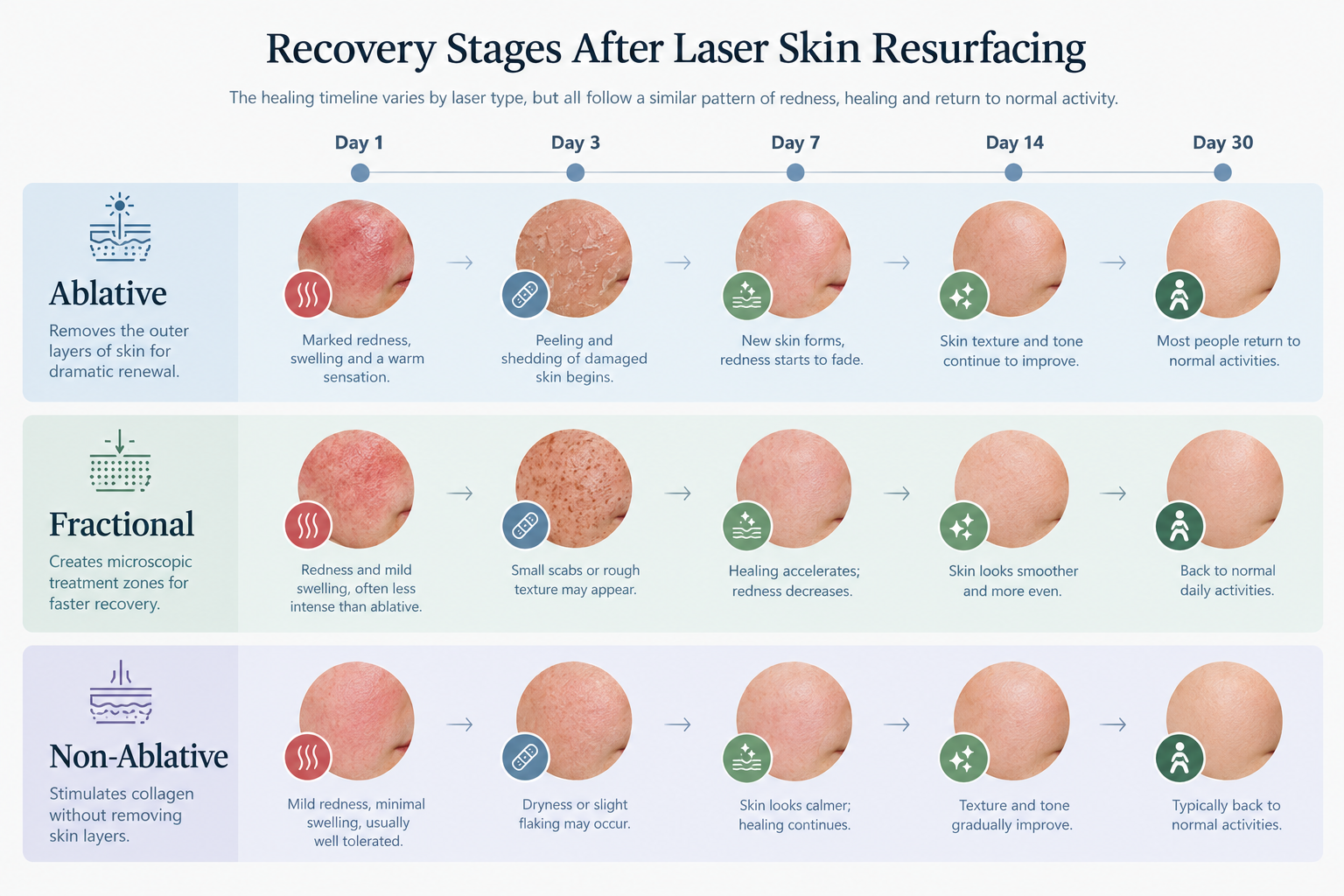
Recovery after laser skin resurfacing varies considerably depending on the type and intensity of treatment. Understanding the likely recovery timeline before committing to a procedure helps patients plan appropriately and avoid unrealistic expectations.
Ablative Laser Recovery
Full ablative CO2 laser resurfacing typically involves the most significant recovery period. In the first few days, the skin will be red, swollen, and may weep or crust as it heals. Most patients require between ten days and three weeks before they feel comfortable returning to social or professional settings, and residual pinkness can persist for several weeks to months. Strict sun avoidance and diligent skincare are essential during this period. The results achievable with full ablative treatment are generally the most pronounced, which is why some patients accept the longer recovery.
Fractional Ablative Laser Recovery
Fractional ablative laser resurfacing typically involves five to ten days of visible recovery, with redness, swelling, and a sandpaper-like skin texture as the treated micro-columns heal. Most patients can return to work within a week, though makeup coverage may be needed for residual redness. Sun protection is critical for several months after treatment.
Non-Ablative Laser Recovery
Non-ablative laser treatments generally involve minimal downtime. Redness and mild swelling may be present for one to two days, and most patients can resume normal activities the following day. Because the skin surface is not disrupted, the healing process is less visible, though results develop more gradually over a series of sessions.
When Will Results Become Visible?
The timeline for visible improvement after laser skin resurfacing depends on the treatment type and the concern being addressed. With ablative and fractional ablative treatments, initial improvement in skin texture and tone may be noticeable once the skin has healed, typically within two to four weeks. However, the most significant results — particularly improvements in collagen density, skin firmness, and scar remodelling — develop gradually over three to six months as new collagen matures.
Non-ablative laser treatments produce more gradual changes, and meaningful improvement is usually seen after a course of three to six sessions spaced several weeks apart. Patients should be aware that laser resurfacing improves the appearance of skin concerns rather than eliminating them entirely, and the degree of improvement varies between individuals.
How Long Do Results Last?
Laser skin resurfacing results are not permanent in the sense that the skin continues to age naturally after treatment. However, the collagen remodelling and skin renewal stimulated by the procedure can produce improvements that last for several years, particularly when patients maintain a consistent skincare routine and protect the skin from ultraviolet exposure.
Factors that influence the longevity of results include the patient’s age, skin type, lifestyle habits such as smoking and sun exposure, and the specific concern treated. Acne scar improvement, for example, tends to be long-lasting because the structural remodelling of scar tissue is durable. Fine lines and skin laxity may gradually return as the ageing process continues, and some patients choose maintenance treatments at intervals of one to several years.
Risks and Side Effects of Laser Skin Resurfacing
Laser skin resurfacing is a medical procedure with a well-documented safety profile when performed by a qualified and experienced practitioner using appropriate equipment. However, it carries real risks that every prospective patient should understand before proceeding.
Common and expected side effects include redness, swelling, itching, and skin sensitivity during the healing period. These are a normal part of the recovery process and resolve as the skin heals. Less common but clinically significant risks include:
- Post-inflammatory hyperpigmentation: Darkening of the treated skin, more common in patients with medium to dark skin tones. This can often be managed with appropriate pre- and post-treatment skincare but may take months to resolve.
- Hypopigmentation: Lightening of the skin in the treated area, which can be permanent. This risk is higher with more aggressive ablative treatments and in patients with darker skin.
- Infection: Bacterial, viral, or fungal infection can occur during the healing period. Antiviral prophylaxis is commonly prescribed for patients with a history of cold sores, and practitioners provide detailed aftercare instructions to minimize infection risk.
- Scarring: Although uncommon when treatment is performed correctly, scarring is a recognized risk, particularly with aggressive settings or in patients with a history of abnormal healing.
- Prolonged redness: Some patients experience persistent erythema (redness) for several months after ablative treatment.
- Acne flares: Some patients experience a temporary worsening of acne or milia (small white cysts) during healing.
Choosing a practitioner with appropriate medical training, experience with the specific laser technology, and a thorough pre-treatment assessment process significantly reduces the risk of complications.
Alternatives to Laser Skin Resurfacing
Laser resurfacing is not the only approach to skin rejuvenation, and for some patients, alternative treatments may be more appropriate, more accessible, or better suited to their specific concerns and recovery tolerance.
- Chemical peels: Chemical exfoliation using acids such as glycolic acid, trichloroacetic acid (TCA), or phenol can address similar concerns to laser resurfacing, including fine lines, pigmentation, and skin texture. Superficial peels involve minimal downtime, while deeper peels carry recovery requirements comparable to ablative laser treatment.
- Microneedling: Controlled micro-injuries created by fine needles stimulate collagen production and can improve acne scarring, skin texture, and mild laxity. Microneedling is generally associated with lower risk of pigmentation changes than laser treatment, making it a useful option for patients with darker skin tones.
- Intense pulsed light (IPL): IPL uses broad-spectrum light rather than a single laser wavelength to target pigmentation and vascular concerns. It is not a laser, but it can be effective for sun damage, redness, and diffuse pigmentation with minimal downtime.
- Radiofrequency skin tightening: Devices that deliver radiofrequency energy into the dermis stimulate collagen and may improve mild to moderate skin laxity without the surface disruption of ablative laser treatment.
- Topical retinoids and medical-grade skincare: For patients with mild concerns or those not yet ready for a procedure, a structured skincare programme using retinoids, vitamin C, and broad-spectrum sun protection can produce meaningful improvement over time.
The most appropriate treatment depends on the individual’s skin concerns, skin type, medical history, downtime tolerance, and budget. A qualified practitioner can help determine which approach, or combination of approaches, is most likely to achieve the desired outcome safely.
Frequently Asked Questions
How many laser resurfacing sessions will I need?
The number of sessions depends on the laser type and the concern being treated. A single ablative or fractional ablative session may produce significant improvement for concerns such as acne scarring or pronounced wrinkles. Non-ablative treatments typically require a course of three to six sessions to achieve comparable results. Your practitioner will recommend a treatment plan based on your individual assessment.
Is laser skin resurfacing painful?
The level of discomfort varies with the intensity of treatment. Non-ablative and light fractional treatments are generally well tolerated with topical numbing cream. More intensive ablative procedures may require stronger anaesthesia. Most patients describe the sensation as heat or a snapping feeling rather than sharp pain, though individual pain tolerance varies.
Can laser resurfacing be used on the neck and chest?
Laser resurfacing can be performed on areas beyond the face, including the neck, chest (décolletage), and hands. However, skin on these areas is generally thinner and heals more slowly than facial skin, which means the risk of complications is higher and treatment settings must be adjusted accordingly. Not all laser types are suitable for off-face treatment.
How should I prepare my skin before laser resurfacing?
Pre-treatment preparation varies by practitioner and patient profile, but commonly includes avoiding sun exposure for several weeks before treatment, discontinuing certain skincare ingredients such as retinoids and exfoliating acids in the days before the procedure, and in some cases using a skin-conditioning regimen to reduce the risk of pigmentation complications. Your practitioner will provide specific instructions tailored to your skin type and the laser being used.
Will laser resurfacing remove acne scars completely?
Laser resurfacing can produce meaningful improvement in the appearance of atrophic acne scars, but complete elimination is not a realistic expectation for most patients. The degree of improvement depends on the scar type, depth, and distribution, as well as the laser technology used. Multiple sessions may be needed, and some patients benefit from combining laser treatment with other approaches such as subcision or dermal fillers for deeper scars.
Is there a risk of making my skin worse?
When performed by a qualified practitioner with appropriate training and equipment, the risk of a poor outcome is low but not zero. Complications such as pigmentation changes, prolonged redness, or scarring are uncommon but recognized. Choosing a practitioner who conducts a thorough pre-treatment assessment, uses medically approved equipment, and provides clear aftercare guidance significantly reduces this risk.
Is Laser Skin Resurfacing the Right Choice for Your Skin Concerns?
Laser skin resurfacing offers a clinically supported approach to improving a range of skin concerns, from acne scarring and sun damage to fine lines and uneven texture. The range of available laser technologies means that treatment can often be tailored to balance the degree of improvement with an acceptable recovery period for each individual patient. However, it is not a universal solution, and realistic expectations are essential — results vary, downtime is real, and risks exist even when treatment is performed well.
The most important step before committing to any laser treatment is a thorough consultation with a qualified medical practitioner who can assess your skin type, discuss your concerns and goals, explain the most appropriate options, and outline the realistic outcomes and risks for your specific situation. If you are considering laser skin resurfacing, seeking a consultation with an experienced aesthetic medicine practitioner is the most reliable way to determine whether this treatment is appropriate for you and, if so, which approach is most likely to deliver safe and meaningful results.


