
How to Identify Your Face Shape: A Practical Guide
Understanding your face shape is one of the most practical steps you can take before exploring any aesthetic treatment, hairstyle change, or cosmetic enhancement. While face shape alone does not determine which treatments you need or how you should look, it provides a useful framework for understanding facial proportions, balance, and the areas where subtle changes may have the most visible impact. This guide explains how to identify your face shape accurately, describes the main categories clinicians and aesthetic practitioners use, and explains why this knowledge matters in a clinical context.
Key Takeaways
- Face shape is determined by the relative width of the forehead, cheekbones, and jawline, combined with the overall length of the face.
- The most commonly recognised face shapes are oval, round, square, heart, oblong, diamond, and triangle — though many people fall between categories.
- Accurate identification requires simple measurements rather than subjective impression alone.
- Aesthetic practitioners use face shape as one of several factors when planning treatments such as dermal fillers, contouring, or jawline definition.
- Face shape is a guide, not a prescription — individual anatomy, skin quality, and personal goals always take priority in any clinical assessment.
Why Face Shape Matters in Aesthetic Medicine
Face shape analysis has been used in aesthetic medicine, plastic surgery, and cosmetic dermatology for decades as a way to assess facial proportions and identify areas of asymmetry or volume change. Practitioners trained in facial anatomy use measurements and visual assessment together to understand how the underlying bone structure, soft tissue distribution, and fat compartments contribute to overall appearance. This is not about conforming to a single ideal — it is about understanding the individual architecture of a face so that any intervention, whether surgical or non-surgical, can be planned with precision.
Volume loss, for example, affects different face shapes in different ways. A person with a naturally round face may notice that age-related fat redistribution creates a different pattern of hollowing compared with someone who has a more angular, square face. Similarly, treatments such as dermal fillers for cheek augmentation, jawline contouring with botulinum toxin, or chin projection with hyaluronic acid filler are planned with the patient’s existing facial geometry in mind. Knowing your face shape before a consultation helps you engage more meaningfully with your practitioner and set realistic expectations.
How to Measure Your Face Shape at Home
Identifying your face shape accurately requires four key measurements: forehead width, cheekbone width, jawline width, and face length. You can take these measurements yourself using a flexible tape measure or a ruler held against a mirror, though a clinical assessment by a trained practitioner will always be more precise.
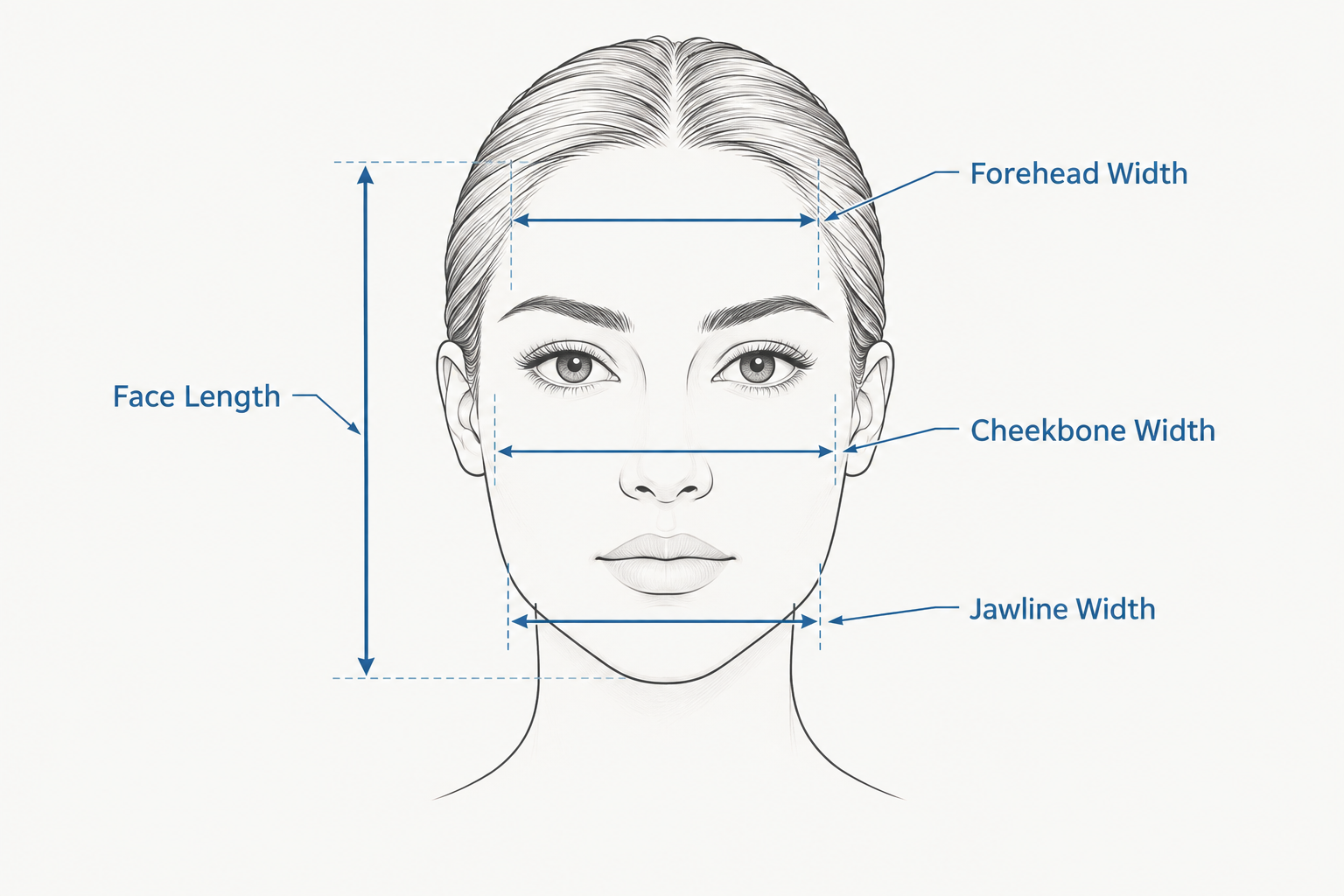
The Four Key Measurements
- Forehead width: Measure across the widest point of your forehead, typically halfway between your hairline and your eyebrows.
- Cheekbone width: Measure from the outer corner of one eye to the outer corner of the other, passing across the bridge of the nose. Alternatively, measure from the most prominent point of one cheekbone to the other.
- Jawline width: Measure from the tip of your chin to the angle of your jaw on one side, then double that figure. This gives the total jaw width.
- Face length: Measure from the centre of your hairline to the tip of your chin.
Once you have these four figures, compare them to identify which face shape category most closely matches your proportions. It is worth noting that very few people have measurements that fit perfectly into a single category. Most faces are a blend of two shapes, and this is entirely normal. The goal is to identify the dominant pattern, not to force your face into a rigid classification.
Using a Photograph
If you find physical measurement difficult, a straight-on photograph taken in good, even lighting can be a useful alternative. Pull your hair back so that your hairline, ears, and jaw are fully visible. Look directly into the camera with a neutral expression. You can then use photo-editing software or simply observe the proportions on screen. The photograph method is less precise than direct measurement but can give a reasonable indication of your dominant face shape, particularly when you are comparing forehead width to jaw width or assessing the overall length-to-width ratio of your face.
The Main Face Shape Categories
Aesthetic practitioners and cosmetic dermatologists typically work with seven recognised face shape categories. Each is defined by a specific pattern of proportions across the forehead, cheekbones, jawline, and face length. Understanding the defining characteristics of each shape helps you identify where your own measurements place you.
Oval Face Shape
An oval face shape is characterised by a face length that is approximately one and a half times the width, with the cheekbones being the widest point. The forehead is slightly wider than the jawline, and the jaw has a gently rounded appearance without sharp angles. The overall outline tapers softly from the cheekbones downward. In aesthetic medicine, the oval face is often used as a reference point for balanced proportions, though this does not mean it is the only desirable shape or that other shapes require correction.
Round Face Shape
A round face shape has similar measurements for face length and width, with the cheekbones being the widest point and the jawline appearing soft and curved rather than angular. The forehead is also rounded, and there are few sharp angles anywhere in the facial outline. People with round faces may notice that age-related volume changes in the mid-face or jowl area become particularly visible because the existing softness of the contour is altered. Treatments aimed at adding definition to the jawline or chin are sometimes discussed in this context, though suitability always depends on individual anatomy and goals.
Square Face Shape
A square face shape is defined by roughly equal measurements across the forehead, cheekbones, and jawline, combined with a face length that is similar to or only slightly greater than the width. The jawline is angular with a relatively flat bottom edge, and the jaw angles are prominent. The overall impression is one of strong, defined structure. In aesthetic consultations, people with square faces sometimes enquire about softening the jaw angles, which may be addressed with botulinum toxin injections into the masseter muscle — though this is a clinical decision that depends on the underlying cause of jaw prominence and the patient’s goals.
Heart Face Shape
A heart face shape features a wider forehead and cheekbone area that tapers to a narrow, often pointed chin. The hairline may have a central peak, sometimes called a widow’s peak, which contributes to the heart-shaped outline. The jawline is narrow and the chin is relatively prominent in proportion to the jaw width. Volume changes in the lower face can be particularly noticeable in people with heart-shaped faces because the lower third is naturally less full. Chin and lower face treatments are sometimes considered in this context, though individual assessment is essential.
Oblong or Rectangle Face Shape
An oblong or rectangle face shape has a face length that is noticeably greater than the width, with the forehead, cheekbones, and jawline all measuring at similar widths. The overall impression is of a long, narrow face with relatively straight sides. Unlike the oval shape, the oblong face does not taper significantly at the jaw. People with oblong faces sometimes find that hairstyle choices and makeup contouring techniques can visually alter the perceived length-to-width ratio, and aesthetic practitioners may consider mid-face volume or temporal area treatments when relevant to the patient’s concerns.
Diamond Face Shape
A diamond face shape is characterised by narrow forehead and jawline measurements combined with wide, prominent cheekbones. The face is widest at the cheekbone level and tapers both upward toward the forehead and downward toward the chin. The chin is often narrow and pointed. This is one of the less common face shapes and is sometimes confused with the heart shape, though the key distinction is the narrow forehead — in a heart shape, the forehead is wide, while in a diamond shape, it is narrow. Aesthetic treatments for diamond-shaped faces may focus on adding width to the forehead or jaw area to create a more balanced appearance, depending on the patient’s goals.
Triangle or Pear Face Shape
A triangle or pear face shape is the inverse of the heart shape: the jawline is the widest measurement, the cheekbones are moderately wide, and the forehead is the narrowest point. The face widens toward the lower third. This shape is less commonly discussed in mainstream guides but is a recognised category in clinical facial analysis. Aesthetic considerations for triangular faces may include treatments that add volume or width to the upper face, such as temporal filler or forehead contouring, though these are specialist decisions that require careful assessment.
Facial Proportions and the Golden Ratio
Some aesthetic practitioners and surgeons refer to the concept of facial proportions when planning treatments, including the idea of the golden ratio — a mathematical relationship in which certain proportions are considered visually harmonious. In facial analysis, this is sometimes applied to the relationship between face width and length, or to the vertical thirds of the face: the distance from hairline to brow, brow to nose base, and nose base to chin. While these frameworks can be useful planning tools, they are not universal standards of beauty and should not be applied rigidly. Individual variation in bone structure, ethnicity, age, and personal aesthetic preference all influence what constitutes a balanced and attractive appearance for any given person.
Aesthetic practitioners who use proportion-based analysis do so as a starting point for discussion, not as a fixed target. The goal of any well-planned aesthetic treatment is to enhance the individual’s natural features in a way that aligns with their personal goals, rather than to impose an external ideal.
How Face Shape Changes With Age
Face shape is not entirely fixed throughout life. While the underlying bone structure remains relatively stable, the soft tissue changes that occur with ageing — including fat redistribution, volume loss, skin laxity, and changes in muscle tone — can alter the perceived shape of the face significantly. A person who had a clearly oval face in their twenties may notice that their face appears rounder or more rectangular in their forties due to jowl formation and mid-face descent. Conversely, someone with a naturally full, round face may find that age-related volume loss creates a more angular appearance over time.
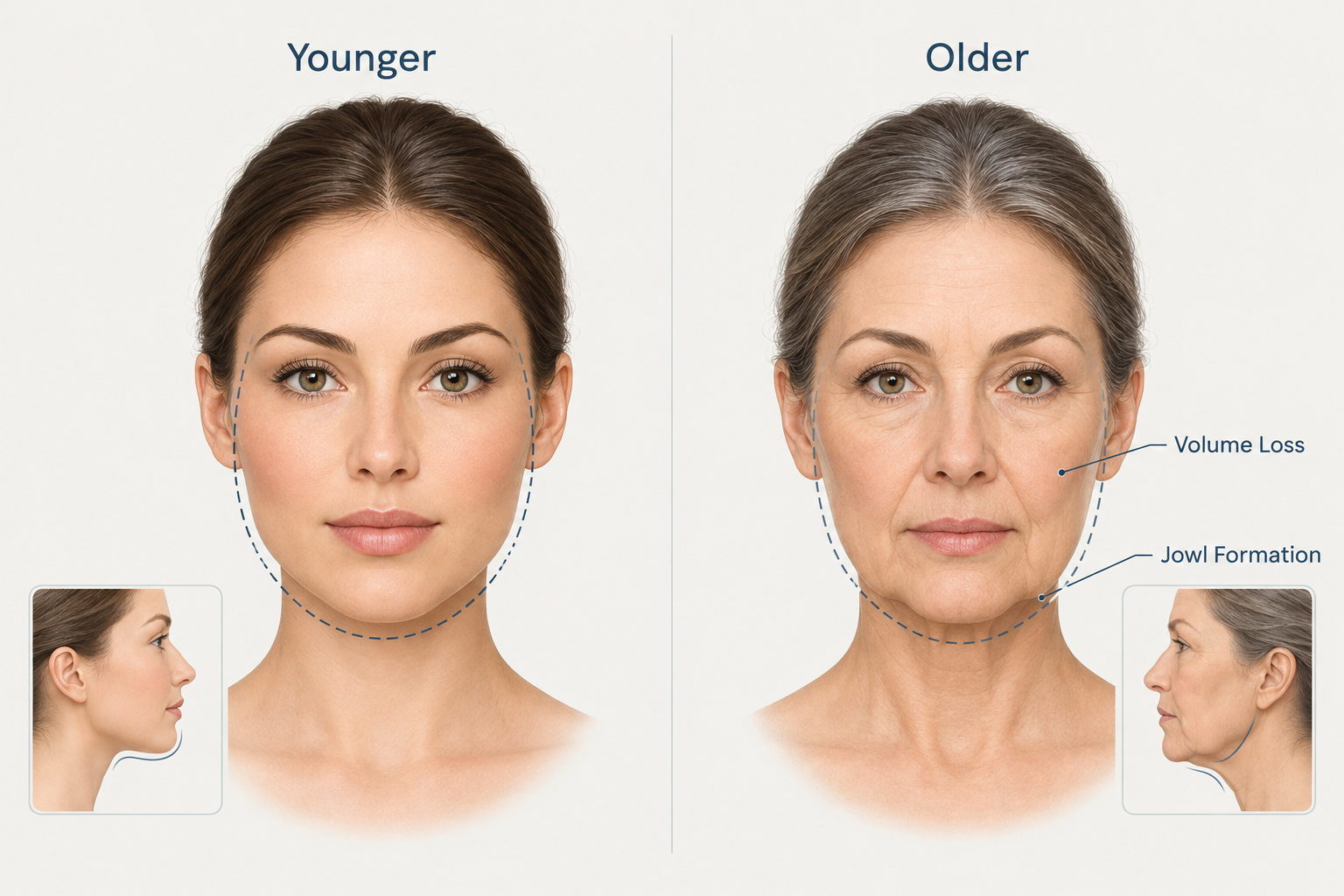
Understanding how your face shape may change with age is relevant when considering aesthetic treatments. Practitioners who assess facial ageing look at the current face shape alongside photographs from earlier years to understand the direction of change and to plan treatments that restore or maintain natural proportions rather than simply adding volume without context. This is one reason why a thorough consultation, including a review of facial history and anatomy, is important before any injectable or surgical procedure.
Face Shape and Aesthetic Treatment Planning
Face shape is one of several factors that aesthetic practitioners consider when planning non-surgical treatments. It is not the only factor, and it does not determine which treatments a person needs. Other important considerations include skin quality, degree of volume loss, muscle activity, bone structure, symmetry, and the patient’s specific concerns and goals. That said, face shape analysis can help guide decisions in a number of practical ways.
Dermal Fillers
Hyaluronic acid dermal fillers are commonly used to restore volume, enhance contour, or add definition to specific areas of the face. The choice of treatment area — whether the cheeks, chin, jawline, temples, or lips — is influenced by the patient’s face shape and the proportional changes they wish to address. For example, adding volume to the cheekbones of a round face without addressing the jawline may not achieve the balanced result the patient is hoping for. A practitioner who understands facial geometry will assess the whole face rather than treating individual areas in isolation.
Botulinum Toxin
Botulinum toxin injections are used not only for dynamic lines and wrinkles but also for facial contouring purposes, such as reducing the bulk of the masseter muscle to soften a wide or square jaw. This treatment is sometimes discussed in the context of square or round face shapes where jaw prominence is a concern. However, masseter reduction with botulinum toxin is a clinical procedure that requires careful assessment of the underlying cause of jaw width — whether it is due to muscle hypertrophy, bone structure, or both — because botulinum toxin can only address the muscular component.
Chin and Jawline Treatments
Chin projection and jawline definition are areas where face shape analysis is particularly relevant. A person with a heart-shaped face and a recessed chin may benefit from chin filler to improve lower face balance, while someone with a triangular face and a wide jaw may be interested in treatments that reduce jaw prominence or add width to the upper face. These are nuanced decisions that depend on the individual’s anatomy, the degree of change they are seeking, and the realistic outcomes of available treatments.
Common Misconceptions About Face Shapes
One of the most persistent misconceptions about face shapes is that certain shapes are more desirable than others, or that aesthetic treatments should aim to transform one shape into another. This is not how responsible aesthetic medicine works. The goal of treatment is to enhance the individual’s natural features and address specific concerns, not to impose a standardised ideal. Every face shape has its own aesthetic qualities, and the most successful outcomes in aesthetic medicine are those that respect and work with the patient’s existing structure.
Another common misconception is that face shape is easy to identify by eye alone. In practice, many people misjudge their own face shape because they are looking at their face from a habitual angle, with hair covering part of the outline, or under lighting that creates shadows and distorts proportions. Taking accurate measurements or having a clinical assessment is a more reliable approach than relying on a quick visual impression.
It is also worth noting that face shape categories are descriptive tools, not diagnostic labels. They describe a pattern of proportions and are useful for communication and planning, but they do not capture the full complexity of an individual face. Asymmetry, which is present to some degree in virtually every face, is not accounted for in standard face shape categories, and it is often asymmetry rather than overall shape that is the primary concern in an aesthetic consultation.
Frequently Asked Questions
Can my face shape change over time?
Yes, the perceived shape of your face can change with age due to soft tissue changes including fat redistribution, volume loss, and skin laxity. The underlying bone structure remains relatively stable, but these tissue changes can significantly alter the facial outline. This is why face shape assessment in an aesthetic context considers both current appearance and the direction of age-related change.
What if my measurements don’t fit neatly into one category?
This is very common. Most people have proportions that fall between two face shape categories. The categories are descriptive tools rather than rigid classifications, and the goal is to identify the dominant pattern rather than to force an exact match. A qualified aesthetic practitioner will assess your face as a whole rather than relying solely on category labels.
Does knowing my face shape tell me which aesthetic treatments I need?
No. Face shape is one useful piece of information, but it does not determine which treatments are appropriate for you. Treatment suitability depends on your specific concerns, medical history, anatomy, skin condition, and personal goals. A thorough clinical consultation is always required before any aesthetic procedure.
Is the oval face shape considered the most desirable?
The oval face shape is sometimes used as a reference point for balanced proportions in aesthetic planning, but this does not mean it is universally more attractive or that other shapes require correction. Aesthetic ideals vary across cultures, individuals, and time periods. Responsible aesthetic medicine focuses on enhancing individual features rather than conforming to a single standard.
Can face shape analysis be done remotely or from a photograph?
A photograph taken in good lighting with hair pulled back can give a reasonable indication of face shape, but it is less accurate than direct measurement or in-person clinical assessment. Lighting, camera angle, and lens distortion can all affect how proportions appear in a photograph. For aesthetic treatment planning, an in-person consultation is always preferable.
How does asymmetry affect face shape identification?
Facial asymmetry, which is present to some degree in almost everyone, is not captured by standard face shape categories. When asymmetry is significant, it may be a more relevant factor in aesthetic planning than overall face shape. A practitioner will assess symmetry separately as part of a comprehensive facial analysis.
Using Face Shape Knowledge Before Your Aesthetic Consultation
Arriving at an aesthetic consultation with a basic understanding of your face shape and the proportions you would like to address can make the conversation more productive. It helps you articulate your concerns more clearly, understand the practitioner’s reasoning when they discuss treatment areas, and set realistic expectations about what non-surgical treatments can and cannot achieve. Face shape analysis is a starting point, not a treatment plan — the clinical assessment, which takes into account your full medical history, anatomy, skin condition, and goals, is what guides any actual recommendation.
If you are considering any aesthetic treatment, whether dermal fillers, botulinum toxin, skin treatments, or other non-surgical procedures, choosing a qualified and experienced practitioner who takes a thorough, individualised approach to facial assessment is the most important step you can take. Face shape is one useful lens through which to understand your face — but it is the practitioner’s clinical expertise, combined with your own informed input, that leads to outcomes you will be satisfied with.


