
How Long Does Filler Last? A Guide to Longevity by Treatment Area
Dermal filler longevity varies considerably depending on where it is placed, which product is used, and how an individual’s body metabolises the material. Most hyaluronic acid fillers last somewhere between six months and two years, but this range is wide enough to be misleading without context. Understanding why filler duration differs by area — and what factors influence how quickly it breaks down — helps set realistic expectations before treatment and makes it easier to plan maintenance appointments sensibly.
Key Takeaways
- Filler longevity depends heavily on the treatment area, with high-movement zones such as the lips typically lasting six to nine months and lower-movement areas such as the temples or jawline often lasting twelve to twenty-four months.
- The type and density of the filler product, the volume injected, and individual metabolic rate all influence how long results are maintained.
- Hyaluronic acid fillers are the most widely used type and are reversible with an enzyme called hyaluronidase; other filler types such as calcium hydroxylapatite and poly-L-lactic acid have different longevity profiles and are not reversible in the same way.
- Results vary between patients, and published duration ranges are averages rather than guarantees.
- A qualified practitioner can advise on the most appropriate product and schedule for your specific anatomy and goals.
What Are Dermal Fillers and How Do They Work?
Dermal fillers are injectable substances used to restore volume, smooth lines, define contours, or improve the appearance of specific facial and body areas. The most commonly used fillers contain hyaluronic acid, a naturally occurring sugar molecule found in skin and connective tissue. Hyaluronic acid fillers work by attracting and retaining water within the tissue, creating a volumising or smoothing effect at the injection site. Because hyaluronic acid is gradually broken down by the body’s own enzymes, the results are temporary.
Other filler types include calcium hydroxylapatite, which is a mineral-like compound that also stimulates collagen production; poly-L-lactic acid, a biostimulator that works primarily by encouraging the body to produce new collagen over time; and polymethylmethacrylate, a semi-permanent option used in specific clinical contexts. Each material has a different mechanism, longevity profile, and risk consideration. This article focuses primarily on hyaluronic acid fillers because they represent the majority of treatments performed and have the most established safety and reversibility data.
Why Filler Duration Varies by Area
The rate at which filler breaks down is influenced by several interconnected factors, and the treatment area is one of the most significant. Areas of the face that experience frequent and repetitive movement — such as the lips during speaking and eating, or the nasolabial folds during facial expression — subject the filler to mechanical stress that accelerates its breakdown. By contrast, areas with less movement, such as the temples or the under-eye region, tend to retain filler for longer because the product is not being physically disrupted as often.
Tissue density and vascularity also play a role. Highly vascular areas with rich blood supply may metabolise hyaluronic acid more quickly. The depth of injection matters too: filler placed superficially in the dermis may behave differently from filler placed deeper in the subcutaneous layer or against bone. Practitioners select filler products with different rheological properties — meaning different degrees of firmness, elasticity, and cohesivity — to match the specific requirements of each area, and these product characteristics also affect how long the result is maintained.
Individual metabolic rate is another meaningful variable. Some patients consistently find that filler breaks down faster than average, while others retain results for longer. Factors such as exercise intensity, sun exposure, smoking, and general skin health may contribute to this variation, though the precise relationship between lifestyle and filler longevity is not fully established in the clinical literature.
Filler Longevity by Treatment Area
Lips
Lip filler is among the shortest-lasting of all filler treatments, typically maintaining visible results for approximately six to nine months. The lips are one of the most dynamic structures on the face, moving constantly during speech, eating, and expression. This continuous mechanical activity accelerates the breakdown of hyaluronic acid. The relatively thin tissue of the lips and their high vascularity may also contribute to faster metabolism of the product. Patients who want to maintain lip volume or definition generally require top-up treatments two to three times per year, though this varies between individuals.
Nasolabial Folds
The nasolabial folds — the lines running from the sides of the nose to the corners of the mouth — are a common treatment area where filler typically lasts between nine and twelve months. These folds are subject to moderate movement during facial expression, which contributes to gradual product breakdown. The depth of placement and the volume used can influence how long the correction is maintained. Some patients find that repeated treatments over time lead to a cumulative improvement in the area, as collagen stimulation from the filler may contribute to longer-lasting structural support.
Marionette Lines
Marionette lines run downward from the corners of the mouth toward the chin and are often treated alongside the nasolabial folds. Filler in this area generally lasts between nine and twelve months, similar to the nasolabial folds. The degree of movement in this region is somewhat lower than in the lips, which may contribute to slightly more sustained results in some patients.
Cheeks
Cheek augmentation or volumisation is one of the longer-lasting filler applications, with results commonly maintained for twelve to eighteen months and sometimes up to twenty-four months. The cheek area experiences relatively little repetitive movement compared to the perioral region, and filler is typically placed at a deeper level — often against the periosteum or within the deep fat compartments — where mechanical disruption is minimal. Denser, more cohesive filler products are generally selected for cheek treatment, and these formulations tend to resist breakdown more effectively than softer products used in more superficial areas.
Jawline and Chin
Jawline definition and chin augmentation using filler can produce results lasting twelve to twenty-four months in many patients. These areas involve relatively low movement, and filler is typically placed at a deeper structural level. The firmness of the products used in this region also contributes to their durability. Patients seeking a more defined lower face contour may find that jawline filler is among the more cost-effective options in terms of longevity relative to the number of treatments required per year.
Tear Troughs and Under-Eye Area
The tear trough — the hollow area beneath the eye — is a technically demanding treatment area where filler longevity can range from nine to eighteen months. The thin skin and delicate anatomy of the under-eye region require careful product selection, typically a soft, low-viscosity hyaluronic acid filler placed precisely to avoid visible lumps or the Tyndall effect, which is a bluish discolouration that can occur when filler is placed too superficially in this area. Because the under-eye region has relatively low movement, the filler is not subject to the same mechanical breakdown as lip or fold treatments. However, the delicate nature of this area means that practitioner experience and product choice are particularly important for both safety and longevity.
Temples
Temple hollowing is a common sign of facial volume loss with age, and filler placed in the temples can last between twelve and twenty-four months. The temporal region experiences minimal movement and the filler is placed at a deeper level, both of which support longer duration. Temple filler can contribute meaningfully to overall facial balance and is sometimes overlooked as a treatment area despite its impact on the appearance of the upper face.
Nose (Non-Surgical Rhinoplasty)
Non-surgical rhinoplasty using filler — sometimes called a liquid nose job — typically produces results lasting nine to twelve months, though some patients report longer duration. The nose is not a high-movement area, but the relatively small volumes used and the precision required for this treatment mean that subtle changes may become less noticeable before the filler is fully metabolised. Non-surgical rhinoplasty carries specific risks related to the vascular anatomy of the nose, and this treatment should only be performed by practitioners with advanced training in this area.
Hands
Hand rejuvenation using filler to restore volume and reduce the visibility of tendons and veins can last between nine and eighteen months. The hands are subject to frequent movement and environmental exposure, which may contribute to faster breakdown in some patients. Hyaluronic acid and calcium hydroxylapatite fillers are both used in this area, with the latter sometimes preferred for its collagen-stimulating properties.
Filler Type and Its Effect on Longevity
Not all fillers are equal in terms of how long they last. Within the hyaluronic acid category, products vary in their degree of cross-linking — a manufacturing process that determines how resistant the filler is to enzymatic breakdown. More heavily cross-linked fillers tend to last longer but are also firmer, making them more suitable for structural areas such as the cheeks, jawline, and chin. Softer, less cross-linked products are used in areas requiring subtle, natural-looking results, such as the lips or tear troughs, but these break down more quickly.
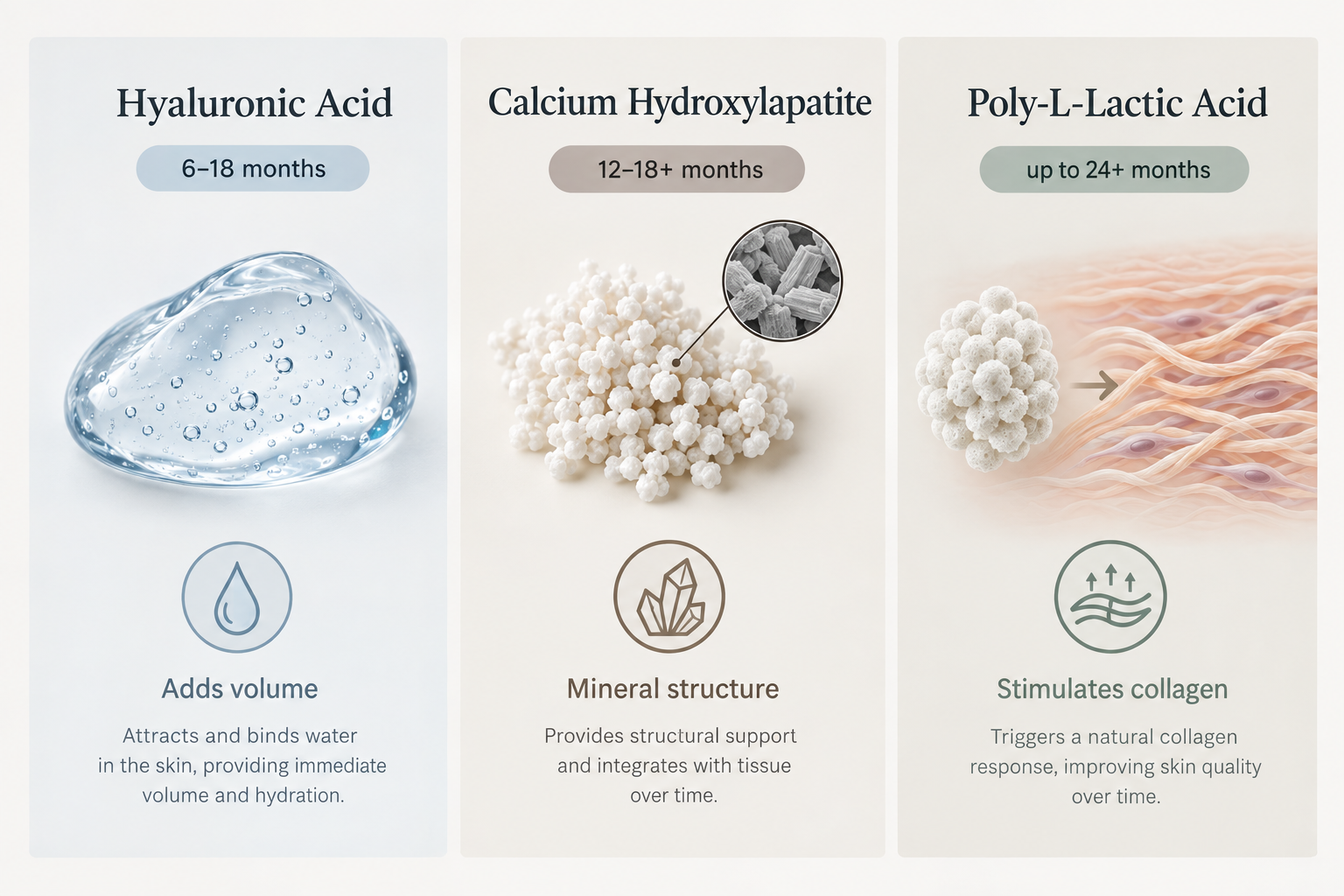
Calcium hydroxylapatite fillers, such as Radiesse, are generally reported to last twelve to eighteen months or longer in some areas, partly because of their collagen-stimulating effect. Poly-L-lactic acid, marketed as Sculptra, works differently from conventional fillers: it stimulates the body’s own collagen production gradually over several months, and the results can last up to two years or more, though multiple treatment sessions are typically required to achieve the desired outcome. These biostimulator treatments are not reversible in the same way as hyaluronic acid fillers, which can be dissolved using hyaluronidase if needed.
Factors That May Shorten Filler Longevity
Several patient-related and lifestyle factors may contribute to faster breakdown of dermal filler, though the evidence for some of these is based on clinical observation rather than large controlled studies.

- High metabolic rate: Patients with faster metabolisms, including those who exercise intensively and regularly, may find that filler breaks down more quickly than average.
- Sun exposure: Chronic ultraviolet exposure accelerates skin ageing and may contribute to faster degradation of hyaluronic acid in the skin.
- Smoking: Smoking is associated with reduced skin quality and impaired collagen synthesis, which may affect how well filler integrates and how long results are maintained.
- Facial movement: As discussed, areas of high repetitive movement experience faster mechanical breakdown of filler.
- Volume injected: Smaller volumes may be metabolised more quickly than larger deposits, though this relationship is not linear and depends on the area and product used.
- Previous filler history: In some cases, patients who have had repeated filler treatments over many years may notice that results last longer over time, possibly due to cumulative collagen stimulation, though this is not universally observed.
Risks and Limitations of Dermal Filler
Dermal filler treatment carries risks that patients should understand before proceeding. Common side effects include temporary swelling, bruising, redness, and tenderness at the injection site, which typically resolve within a few days to two weeks depending on the area treated. More significant complications, though less common, include infection, nodule formation, migration of filler from the original injection site, and allergic or hypersensitivity reactions.
The most serious risk associated with dermal filler is vascular occlusion, which occurs when filler is inadvertently injected into or compresses a blood vessel, potentially restricting blood flow to surrounding tissue. In rare cases this can lead to tissue necrosis or, in the most severe instances, vision changes or blindness if a vessel supplying the eye is affected. This risk underscores the importance of choosing a qualified, experienced practitioner who understands facial anatomy and is trained to recognise and manage complications promptly.
Filler is not suitable for everyone. Patients who are pregnant or breastfeeding are generally advised to avoid treatment. Those with active skin infections, certain autoimmune conditions, bleeding disorders, or a history of severe allergic reactions should discuss their medical history thoroughly with a practitioner before proceeding. Patients taking blood-thinning medications may have an increased risk of bruising.
What to Expect During and After Treatment
A dermal filler appointment typically begins with a consultation to assess the treatment area, discuss goals, and review medical history. The skin is usually cleaned and a topical anaesthetic cream may be applied to reduce discomfort. Many filler products also contain lidocaine, a local anaesthetic, within the formulation, which helps improve comfort during injection. The injection process itself is relatively brief, often taking between fifteen and forty-five minutes depending on the number of areas treated.
Immediately after treatment, some swelling and redness is expected and is a normal response to the injections. Bruising is possible, particularly in areas with higher vascularity such as the lips. Most patients can return to normal daily activities the same day, though strenuous exercise, alcohol, and significant heat exposure are generally recommended to be avoided for twenty-four to forty-eight hours. Final results are usually visible once initial swelling has settled, which may take one to two weeks in some areas.
Alternatives to Dermal Filler
Dermal filler is one of several options for addressing volume loss, lines, and contour concerns. Alternatives worth discussing with a practitioner include:
- Botulinum toxin injections: Effective for dynamic lines caused by muscle movement, such as forehead lines and crow’s feet, but do not add volume. Often used alongside filler for comprehensive facial rejuvenation.
- Polynucleotides: Injectable treatments that aim to improve skin quality, hydration, and tissue regeneration rather than add volume. May be suitable for patients seeking skin quality improvement rather than structural correction.
- Profhilo and skin boosters: Highly fluid hyaluronic acid treatments designed to improve skin hydration and elasticity rather than provide structural volumisation. Results typically last three to six months.
- Thread lifts: Dissolvable sutures placed under the skin to lift and reposition tissue. May suit patients with mild to moderate skin laxity who are not ready for surgical intervention.
- Surgical options: Procedures such as fat transfer or facelift surgery offer longer-lasting or potentially permanent results for volume restoration and tissue repositioning, with correspondingly greater recovery requirements and surgical risks.
Frequently Asked Questions
Can filler be made to last longer?
There is no reliably proven method to significantly extend filler longevity beyond what the product and area naturally allow. Protecting skin from sun damage, avoiding smoking, and maintaining good general skin health may support overall skin quality, but these measures are unlikely to dramatically change how quickly the body metabolises hyaluronic acid. Some practitioners suggest that consistent maintenance treatments over time may lead to a cumulative improvement in the area, potentially reducing the volume needed at each appointment.
Does filler completely disappear when it breaks down?
Hyaluronic acid filler is gradually broken down by the body’s own hyaluronidase enzyme and is metabolised naturally. In most cases the filler does dissipate fully over time, returning the area to its pre-treatment appearance. However, in some patients — particularly those who have had repeated treatments over many years — there may be residual filler present for longer than expected, which is one reason why a thorough assessment before each treatment session is important.
Is it safe to keep having filler top-ups?
Repeated filler treatments are common and are generally considered safe when performed by a qualified practitioner using appropriate products and volumes. However, cumulative filler build-up over many years is a recognised concern, and some practitioners recommend periodic assessment to evaluate whether dissolving existing filler before retreating is appropriate. Overfilling can lead to an unnatural appearance and, in some cases, tissue changes that are difficult to reverse.
How do I know when my filler needs topping up?
The most straightforward indicator is that the treated area begins to return to its pre-treatment appearance — for example, lip volume reduces, cheek contour softens, or lines become more visible again. Some patients prefer to schedule maintenance appointments at regular intervals based on the expected longevity of their treatment area, while others wait until they notice a visible change. A follow-up consultation with your practitioner can help determine the right timing for your specific situation.
Can filler be dissolved if I am unhappy with the result?
Hyaluronic acid fillers can be dissolved using an injectable enzyme called hyaluronidase, which breaks down hyaluronic acid relatively quickly. This is one of the key safety advantages of hyaluronic acid fillers over non-reversible alternatives. Dissolution is also used in the management of certain complications. Non-hyaluronic acid fillers such as calcium hydroxylapatite and poly-L-lactic acid cannot be dissolved in the same way, which is an important consideration when choosing a filler type.
Does filler look natural as it breaks down?
In most cases, hyaluronic acid filler breaks down gradually and evenly, so the transition back to the pre-treatment appearance is relatively subtle rather than sudden. However, in some areas or with certain products, uneven breakdown can occasionally lead to an irregular appearance as the filler diminishes. This is more likely in areas where the filler was placed superficially or where significant movement occurs. If you notice an uneven result as filler breaks down, a consultation with your practitioner is advisable.
Planning Filler Maintenance Realistically
Understanding how long filler lasts in each area makes it easier to plan treatments and budget for maintenance in a realistic way. Patients who treat multiple areas simultaneously — for example, lips and cheeks — will find that different areas require top-ups at different intervals, since lip filler may need refreshing every six to nine months while cheek filler may last eighteen months or more. Discussing a personalised treatment schedule with a qualified practitioner, rather than following a fixed calendar, tends to produce the most natural and cost-effective outcomes over time. A thorough consultation that considers your anatomy, skin quality, lifestyle, and aesthetic goals is the most reliable starting point for any filler treatment plan.


