
Hip Dip Filler: Smoothing Hip Contour Hollows
Hip dip filler is a non-surgical treatment that uses injectable dermal filler to add volume to the inward curves that sit between the hip bone and the upper thigh. These hollows — sometimes called violin hips or trochanteric depressions — are a normal anatomical feature, but some people find them aesthetically noticeable and seek ways to create a smoother, more rounded hip silhouette. This article explains how the treatment works, what results may realistically look like, who may be suitable, and what risks and alternatives are worth understanding before a consultation.
Key Takeaways
- Hip dip filler uses hyaluronic acid or other injectable fillers to add volume to the lateral hip hollows, creating a smoother outer contour.
- Results are temporary, typically lasting between 12 and 24 months depending on the product used and individual factors.
- The treatment carries meaningful risks in this anatomical area, including vascular complications, and should only be performed by an experienced, medically qualified practitioner.
- Hip dips are a normal anatomical variation caused by bone structure; filler can soften their appearance but cannot change underlying skeletal anatomy.
- Alternatives such as body contouring, fat transfer, and exercise-based muscle development may suit different goals and budgets.
What Are Hip Dips and Why Do They Occur?
Hip dips are the inward curves on the outer side of the body, located roughly between the iliac crest (the upper rim of the pelvis) and the greater trochanter of the femur (the bony prominence of the upper thigh). The depth and visibility of hip dips vary considerably between individuals and are primarily determined by skeletal anatomy — specifically the width of the pelvis, the angle of the femur, and the distance between these two bony landmarks. Because the underlying cause is structural, hip dips cannot be eliminated through diet or exercise alone, though building the gluteus medius muscle may reduce their visual prominence in some people.
Subcutaneous fat distribution also plays a role. People with less fat over the lateral hip area tend to have more visible hollowing. Skin laxity and overall body composition can influence how noticeable the indentation appears. Understanding this anatomy is important when considering any treatment, because it sets realistic expectations: no injectable treatment can alter bone position, and the degree of improvement achievable with filler depends on the depth of the hollow and the surrounding tissue characteristics.
How Hip Dip Filler Works
Hip dip filler treatment involves injecting a volumising agent into the subcutaneous tissue overlying the lateral hip hollow to physically fill the depression and create a smoother lateral curve. The most commonly used products are hyaluronic acid (HA) fillers, which are the same class of injectable gel used for facial volumisation. Hyaluronic acid is a naturally occurring substance in the body, and HA fillers are reversible using an enzyme called hyaluronidase, which is an important safety consideration for a high-risk anatomical area.
Some practitioners use biostimulatory fillers such as poly-L-lactic acid (PLLA) or calcium hydroxylapatite (CaHA) for hip contouring. These products work differently: rather than providing immediate volume, they stimulate the body’s own collagen production over several weeks, with results developing gradually. Biostimulatory fillers are not reversible in the same way as hyaluronic acid, which is a relevant factor when assessing risk in this area. The choice of product depends on the practitioner’s assessment of the patient’s anatomy, the depth of correction required, and the patient’s preferences regarding onset, longevity, and reversibility.
The volume of filler required for meaningful hip contouring is substantially greater than for facial treatments. Depending on the degree of hollowing, practitioners may use anywhere from several millilitres to considerably more per side, which affects both cost and the risk profile of the procedure. Large-volume injections in the hip area require careful technique and a thorough understanding of the local vascular anatomy to minimise the risk of serious complications.
What the Treatment Appointment Involves
A hip dip filler appointment typically begins with a detailed consultation, during which the practitioner assesses the patient’s anatomy, discusses goals, reviews medical history, and explains the realistic scope of improvement. Photographs are usually taken for reference. The treatment area is cleaned and a topical anaesthetic cream may be applied to reduce discomfort, though many practitioners also use filler products that contain lidocaine, a local anaesthetic, within the formulation.
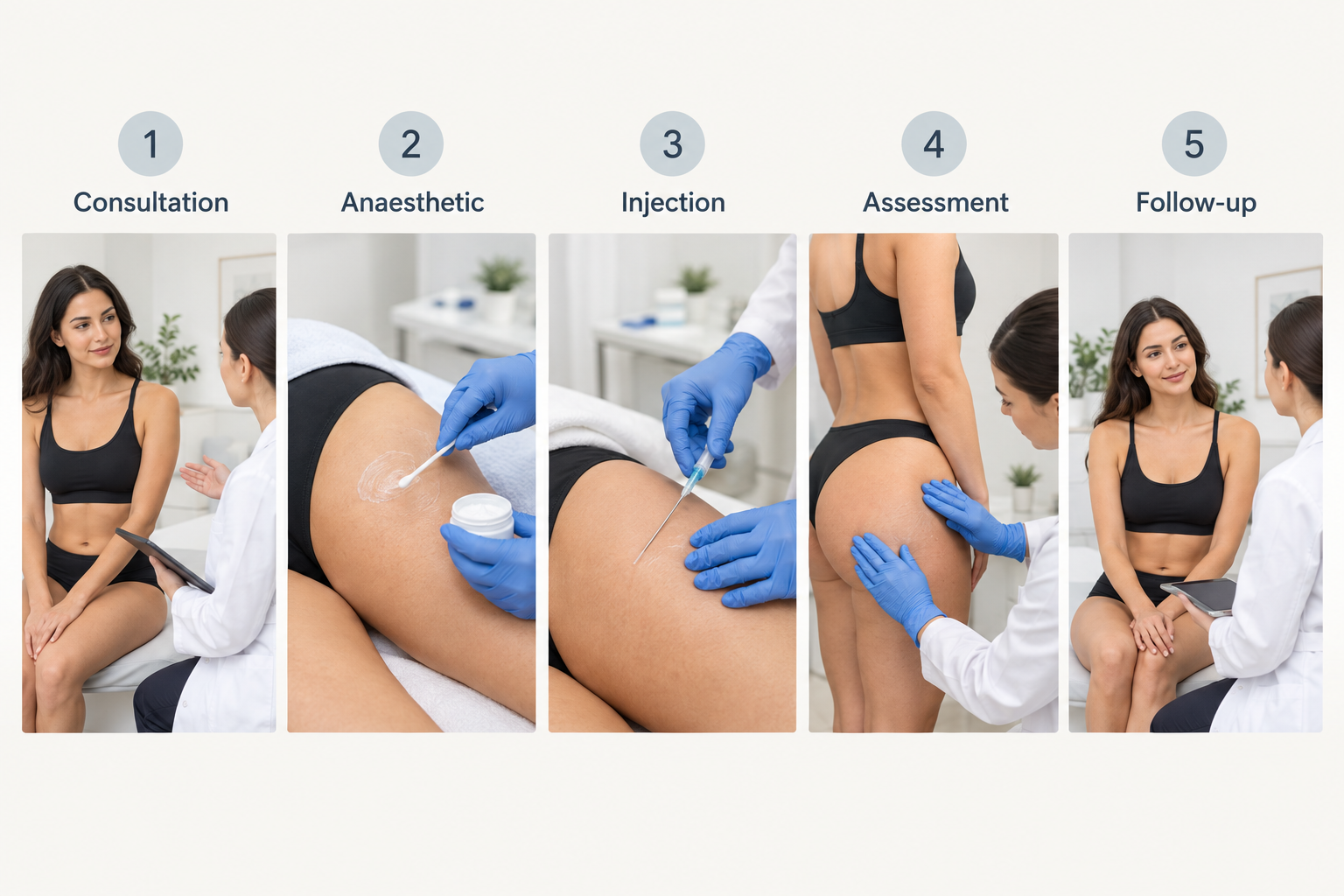
The injections are administered using a needle or a blunt-tipped cannula. Cannulas are often preferred in this area because they can be manoeuvred through a single entry point to deposit filler across a wider area, potentially reducing bruising and the risk of inadvertent vascular injury compared with multiple needle passes. The practitioner will mould and assess the result during the appointment. The session typically takes between 30 and 60 minutes depending on the volume being placed and the technique used.
Patients are usually able to leave the clinic shortly after treatment. The practitioner will provide aftercare instructions, which commonly include avoiding strenuous exercise, pressure on the treated area, and tight clothing for a specified period. A follow-up appointment is often recommended to assess the result once initial swelling has settled and to determine whether any additional volume is needed.
Expected Results and How Long They May Last
Immediately after hip dip filler treatment, the area will appear fuller, but initial swelling means the result at this stage does not accurately reflect the final outcome. Swelling typically subsides over one to two weeks, after which the true shape of the correction becomes clearer. Bruising is common and may take a similar period to resolve. The final result is generally assessed at around four to six weeks post-treatment.
When performed by an experienced practitioner on a suitable candidate, hip dip filler may create a smoother lateral hip contour, reducing the visual depth of the hollow and contributing to a more continuous curve from the waist to the thigh. The degree of improvement varies depending on the depth of the original hollow, the volume of filler used, and individual tissue characteristics. Patients with very deep or structurally pronounced hip dips may achieve a noticeable but partial improvement rather than complete elimination of the indentation.
Longevity depends on the type of filler used. Hyaluronic acid fillers in the hip area are generally reported to last between 12 and 18 months, though this varies between individuals and products. Biostimulatory fillers may produce effects lasting 18 to 24 months or longer as collagen stimulation continues. Body movement, metabolism, and the large volume of product involved can all influence how quickly the filler is broken down. Maintenance treatments are typically required to sustain the result over time.
Risks and Side Effects
Hip dip filler carries a meaningful risk profile that patients should understand clearly before proceeding. Common side effects include bruising, swelling, tenderness, and temporary asymmetry, most of which resolve within one to two weeks. Lumps or irregularities in the filler distribution can occur and may require massage or, in the case of hyaluronic acid fillers, dissolution with hyaluronidase.
More serious risks are associated with the vascular anatomy of the lateral hip and gluteal region. The superior and inferior gluteal arteries, along with their branches, supply blood to the surrounding tissue. Inadvertent injection of filler into or near these vessels can cause vascular occlusion, leading to tissue ischaemia (reduced blood supply) or, in severe cases, skin necrosis. Embolisation — where filler enters the bloodstream and travels to distant sites — is a rare but potentially life-threatening complication that has been reported with large-volume filler injections in the gluteal region. This risk underscores the importance of choosing a practitioner with specific training and experience in this anatomical area, and one who has access to hyaluronidase for emergency reversal of HA filler if needed.
Infection is a risk with any injectable procedure. Granuloma formation — a chronic inflammatory reaction to the filler material — can occur, particularly with non-HA products, and may be difficult to treat. Migration of filler from the intended area is also possible over time. Patients should be informed that the hip and gluteal region is considered a higher-risk area for filler injection than many facial zones, and that the evidence base for this specific treatment is less established than for facial filler procedures.
Who May Be Suitable for Hip Dip Filler
Hip dip filler may be worth discussing with a qualified practitioner if you have visible lateral hip hollowing that affects your confidence, you are in good general health, and you have realistic expectations about the degree of improvement achievable. Suitable candidates are typically adults with stable body weight, since significant weight fluctuation after treatment can affect the distribution and appearance of the filler result.
A thorough medical history review is essential before treatment. Factors that may affect suitability include active skin infection or inflammation in the treatment area, a history of severe allergic reactions, autoimmune conditions, bleeding disorders, or use of anticoagulant medications. Pregnancy and breastfeeding are contraindications to elective filler treatment. Patients with a history of keloid scarring or previous adverse reactions to dermal fillers should discuss these factors with their practitioner.
Body weight and composition are relevant considerations. Hip dip filler is not a treatment for weight loss or generalised body contouring, and it is not appropriate for patients seeking significant changes to overall body shape. The treatment is best suited to individuals who are close to their stable weight and are seeking targeted improvement in a specific area of lateral hip hollowing.
Who May Not Be Suitable
Hip dip filler is not appropriate for everyone. Patients who are pregnant or breastfeeding should not undergo elective injectable treatments. Those with active infection, significant skin disease, or inflammation in the hip area should wait until these conditions have resolved. A history of hypersensitivity to filler components, including lidocaine if present in the formulation, is a contraindication.
Patients with unrealistic expectations — for example, those hoping to achieve a dramatic change in body shape or to replicate results seen in heavily edited social media images — may not be well served by this treatment. A responsible practitioner will discuss what is and is not achievable and may decline to treat patients whose goals cannot be safely or realistically met with injectable filler. Patients who are significantly overweight or underweight may also find that results are less predictable, and a practitioner may recommend addressing body composition before considering filler treatment.
Alternatives to Hip Dip Filler
Several alternatives exist for those seeking to address the appearance of hip dips, and the most appropriate option depends on individual anatomy, goals, budget, and tolerance for downtime or risk.

Autologous fat transfer (fat grafting) involves removing fat from one area of the body using liposuction and re-injecting it into the hip hollows. This approach uses the patient’s own tissue, which some consider an advantage, and results may be longer-lasting than synthetic filler. However, fat transfer is a surgical procedure requiring anaesthesia and recovery time, and a proportion of the transferred fat is typically reabsorbed by the body, making the final volume less predictable. It is generally performed by a plastic surgeon rather than in a non-surgical aesthetic clinic.
Gluteus medius muscle development through targeted resistance exercise — such as lateral raises, hip abduction exercises, and certain squat variations — can increase the muscle mass in the area adjacent to the hip dip, potentially reducing its visual depth. This approach is gradual, requires consistent effort, and may not produce sufficient change for those with pronounced skeletal hollowing, but it carries no medical risk and has broader health benefits.
Body contouring treatments such as high-intensity focused electromagnetic (HIFEM) devices, which stimulate muscle contractions, may contribute to gluteal muscle development over a course of sessions, though evidence specifically for hip dip improvement with these devices is limited. These treatments are non-invasive and carry a lower risk profile than injectable procedures.
Shapewear and clothing choices offer an immediate, non-permanent way to alter the visual appearance of hip dips without any medical intervention. While not a treatment, they are worth acknowledging as a practical option for those who are uncertain about pursuing a clinical procedure.
Choosing a Practitioner for Hip Dip Filler
The hip and gluteal region is considered a higher-risk area for injectable filler than most facial zones, and practitioner selection is particularly important. Patients should seek a medically qualified practitioner — such as a doctor, nurse prescriber, or dentist with appropriate aesthetic training — who has specific experience with large-volume body filler treatments and a thorough understanding of the vascular anatomy of the gluteal region.
Before booking, it is reasonable to ask about the practitioner’s qualifications, their experience with hip contouring specifically, the products they use and why, their approach to managing complications, and whether they have access to hyaluronidase for emergency reversal. A practitioner who is willing to discuss risks openly, who does not pressure you to proceed, and who conducts a thorough consultation before recommending treatment is a positive indicator of a responsible practice.
Regulatory frameworks for aesthetic practitioners vary by country, so patients should verify that their chosen practitioner meets the relevant professional standards in their region. In the United Kingdom, for example, ongoing regulatory changes are intended to restrict certain injectable procedures to qualified healthcare professionals.
Frequently Asked Questions
Is hip dip filler painful?
Most patients describe the procedure as uncomfortable rather than severely painful. Topical anaesthetic cream is usually applied beforehand, and many filler products contain lidocaine to reduce discomfort during injection. The hip area has less dense nerve endings than some facial zones, but the volume of product required means the treatment takes longer than a typical facial filler appointment. Individual pain tolerance varies.
How much filler is needed for hip dips?
The volume required depends on the depth and width of the hollow and the patient’s anatomy. Hip dip correction typically requires considerably more filler than facial treatments — often several millilitres per side. A practitioner will assess this during consultation. Larger volumes increase both cost and the importance of careful technique.
Can hip dip filler be dissolved if I am unhappy with the result?
If hyaluronic acid filler is used, it can be dissolved using hyaluronidase, an enzyme that breaks down HA. This is one reason many practitioners prefer HA fillers for this area, as reversibility provides an important safety option. Biostimulatory fillers such as poly-L-lactic acid or calcium hydroxylapatite cannot be dissolved in the same way, which is a relevant consideration when choosing a product.
Will hip dip filler look natural?
When performed by an experienced practitioner using an appropriate volume and technique, hip dip filler can produce a natural-looking improvement in lateral hip contour. Overfilling or poor technique can result in an unnatural appearance or visible irregularities. Viewing before-and-after photographs from the specific practitioner you are considering, and discussing your aesthetic goals clearly during consultation, can help align expectations.
How soon can I return to normal activities after treatment?
Most patients can resume light daily activities shortly after treatment. Strenuous exercise, prolonged pressure on the treated area, and tight clothing are typically advised against for at least one to two weeks. Specific aftercare guidance will be provided by your practitioner based on the products used and the volume injected.
Are the results of hip dip filler permanent?
No. Hip dip filler results are temporary. Hyaluronic acid fillers typically last 12 to 18 months in this area, while biostimulatory fillers may last somewhat longer. Maintenance treatments are needed to sustain the result. Permanent fillers are not recommended for this area due to the difficulty of managing complications if they arise.
Is Hip Dip Filler Worth Considering for You?
Hip dip filler can offer a meaningful improvement in lateral hip contour for carefully selected patients, but it is not a straightforward or low-risk procedure. The treatment addresses a normal anatomical feature rather than a medical condition, and the decision to pursue it is personal. For some patients, the improvement in silhouette and the associated confidence benefit may make the treatment worthwhile. For others, the temporary nature of results, the cost of repeated maintenance, and the risk profile of large-volume filler in the gluteal region may make alternatives more appropriate.
The most important step before proceeding is a thorough consultation with a medically qualified, experienced practitioner who can assess your individual anatomy, explain what is realistically achievable, and discuss the full range of risks and alternatives. Patients who approach this treatment with clear, realistic expectations and who choose their practitioner carefully are best placed to make an informed decision. If you are considering hip dip filler, use the consultation as an opportunity to ask detailed questions and to ensure you feel confident in both the proposed treatment plan and the practitioner delivering it.


