
Fat Dissolving Injections for the Chin: What to Expect
A pocket of fat beneath the chin — often called a double chin or submental fat — is one of the most common aesthetic concerns among adults. It can persist despite a healthy diet and regular exercise, and for many people it affects how they feel about their profile. Fat dissolving injections offer a non-surgical option for reducing this localised fat deposit, and the chin area is one of the most clinically studied treatment sites. This article explains how the treatment works, what the experience involves, what results are realistic, and what limitations and risks you should understand before booking a consultation.
Key Takeaways
- Fat dissolving injections use a synthetic form of deoxycholic acid to break down fat cells beneath the chin, producing a gradual reduction in submental fullness over several weeks.
- Most patients require between two and four treatment sessions, spaced at least four weeks apart, to achieve a meaningful result.
- Swelling, bruising, and tenderness under the chin are expected after each session and typically resolve within one to two weeks.
- Results may be long-lasting once the target fat cells are destroyed, but individual outcomes vary and a clinical assessment is required to determine suitability.
- The treatment is not a weight loss method and is most appropriate for adults with a moderate, localised fat deposit rather than generalised weight gain.
What Is Submental Fat and Why Is It Difficult to Treat?
Submental fat is the layer of adipose tissue that sits beneath the chin and above the neck. Genetics play a significant role in how much fat accumulates in this area and how readily the body mobilises it. For many people, submental fullness is inherited and remains present regardless of overall body weight. This is why some individuals who are otherwise slim still notice a persistent double chin, while others who carry more weight elsewhere have a defined jawline.
Because the body does not selectively burn fat from specific areas during exercise or caloric restriction — a concept sometimes called spot reduction — targeted lifestyle changes rarely resolve a genetically predisposed submental fat deposit. This creates a genuine gap that non-surgical body contouring treatments, including fat dissolving injections, are designed to address. It is important to distinguish submental fat reduction from weight loss: these injections reduce a localised fat deposit and are not a treatment for obesity or generalised excess weight.
How Do Fat Dissolving Injections Work?
The active ingredient in the most widely studied fat dissolving injections for the chin is deoxycholic acid, a bile acid that occurs naturally in the body and plays a role in the digestion and absorption of dietary fat. When a synthetic version of deoxycholic acid is injected directly into submental fat tissue, it disrupts the cell membrane of fat cells, causing them to break down. The cellular debris is then cleared gradually by the body’s immune and lymphatic systems over the following weeks.
Because deoxycholic acid destroys fat cells rather than simply shrinking them, the cells that are eliminated cannot regenerate. This is the basis for the claim that results may be long-lasting, provided the patient does not experience significant weight gain that causes remaining fat cells to enlarge. The treatment does not affect muscle, bone, or overlying skin in the same way, though some practitioners report that the inflammatory response triggered by the injections may have a modest secondary effect on skin firmness in the treated area — evidence for this specific benefit remains limited.
Kybella is the brand name most associated with injectable deoxycholic acid for submental fat and holds regulatory approval in the United States for this indication. Other injectable fat dissolving products are available in different markets, including formulations that combine deoxycholic acid with additional compounds. Regulatory status, licensed indications, and available brands vary by country, so it is important to discuss which specific product is being used and whether it is appropriately licensed in your region.
Who May Be a Suitable Candidate?
Fat dissolving injections for the chin tend to produce the most satisfying outcomes in adults who have a moderate, pinchable layer of submental fat and reasonably good skin elasticity. A practitioner will typically assess the amount and distribution of fat beneath the chin, the quality and laxity of the overlying skin, and the overall anatomy of the neck and jawline before recommending treatment.
Candidates who may benefit include adults who:
- have a visible submental fat deposit that has not responded to diet and exercise;
- are at or near a stable, healthy body weight;
- have adequate skin elasticity to accommodate the gradual volume reduction;
- understand that results develop slowly over multiple sessions;
- are not pregnant or breastfeeding;
- do not have active infection, inflammation, or skin disease in the treatment area.
Patients with significant skin laxity in the neck and lower face may not be ideal candidates, because reducing the underlying fat volume without addressing loose skin can sometimes make skin redundancy more noticeable. In these cases, a practitioner may recommend combining fat dissolving treatment with a skin tightening procedure, or may suggest an alternative approach altogether. A thorough consultation is essential to determine whether the treatment is appropriate for your specific anatomy and goals.
Who May Not Be Suitable?
Certain medical and anatomical factors may make fat dissolving injections for the chin unsuitable or require careful consideration. These include:
- pregnancy or breastfeeding;
- active infection, cysts, or skin conditions in the submental area;
- a history of difficulty swallowing or relevant neurological conditions affecting the neck;
- previous surgical procedures in the neck or chin area, including liposuction or thyroid surgery, which may alter anatomy and increase procedural risk;
- bleeding disorders or use of anticoagulant medications that increase bruising risk;
- known allergy to any component of the injectable product;
- unrealistic expectations about the degree of change achievable without surgery.
This list is not exhaustive. A qualified practitioner will take a full medical history and assess your anatomy before confirming suitability. Do not proceed with treatment from a provider who does not conduct a thorough pre-treatment assessment.
What Happens During a Treatment Session?
A fat dissolving injection appointment for the chin typically begins with a consultation or review of your previous assessment, followed by cleansing and marking of the treatment area. The practitioner will map out the injection sites across the submental fat deposit, usually using a grid pattern to ensure even distribution of the product.
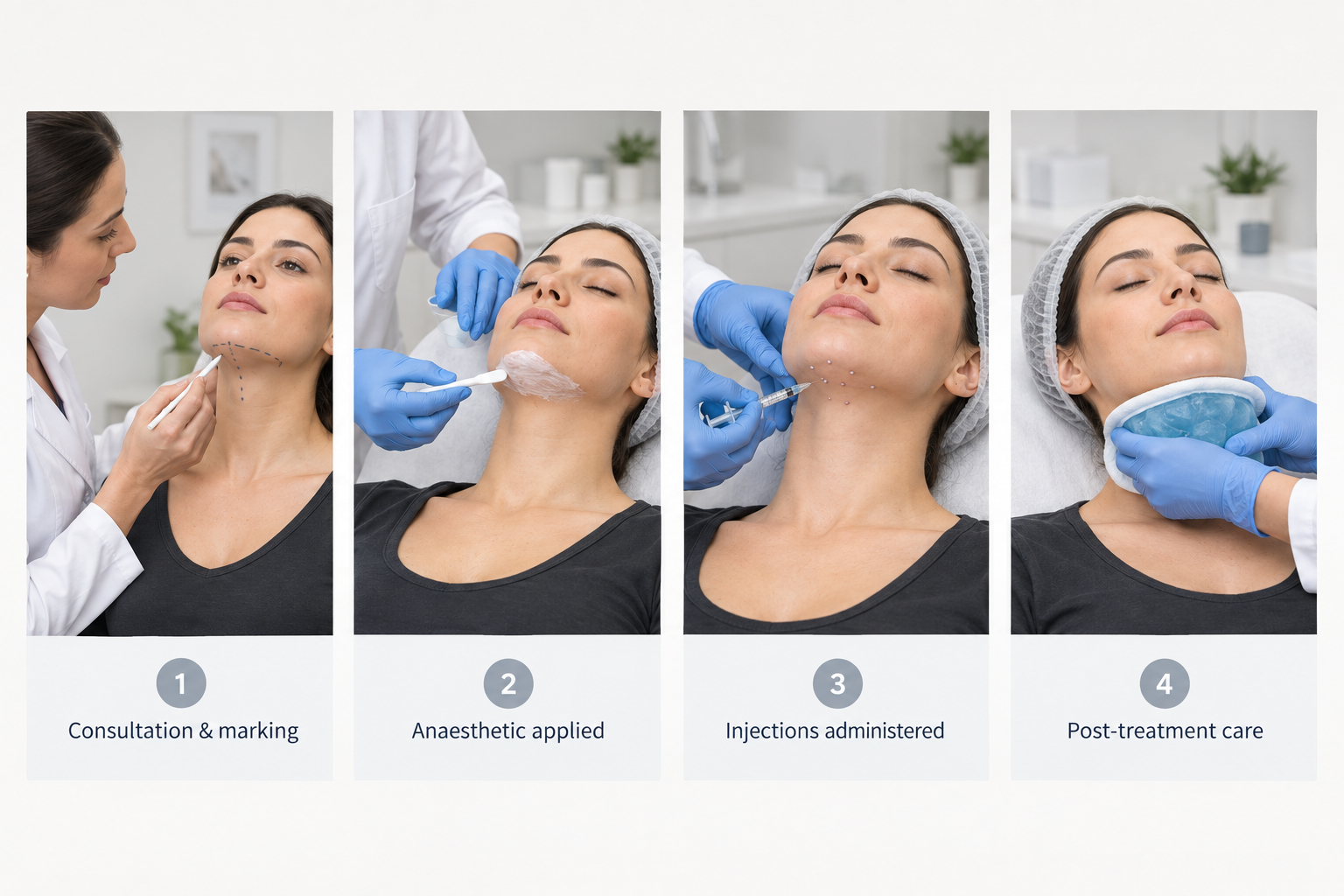
A topical anaesthetic cream may be applied beforehand to reduce discomfort, and some practitioners also use ice to numb the area. The injections themselves are administered using a fine needle at multiple points across the marked area. The number of injection points varies depending on the size of the fat deposit and the product being used. Most patients describe the sensation as a series of brief stinging or burning feelings during the injections, followed by a warming or aching sensation as the product begins to work.
The appointment itself is generally completed within thirty to forty-five minutes, including preparation time. There is no requirement for general anaesthesia or sedation. Patients can usually return to normal daily activities the same day, though visible swelling and tenderness will be present.
Recovery and Downtime After Chin Fat Dissolving Injections
Swelling beneath the chin is the most consistent and predictable effect after each treatment session, and it can be substantial. Many patients experience significant puffiness in the days immediately following treatment, which can temporarily make the chin and neck area appear larger before the fat reduction becomes visible. This swelling is a normal part of the inflammatory process through which the body clears the disrupted fat cells.
Typical post-treatment effects include:
- Swelling: usually peaks within the first two to three days and gradually subsides over one to two weeks, though mild swelling may persist longer after early sessions;
- Bruising: common and may be visible for several days to a week;
- Tenderness and numbness: the treated area is often sensitive to touch and may feel numb or have an altered sensation for several weeks;
- Firmness or hardness: the submental tissue may feel firm or nodular during the healing phase as the body processes the treated fat cells;
- Redness and warmth: typically resolve within a few days.
Most people find that the visible effects of each session are manageable but may prefer to schedule treatment before a period when they do not have important social or professional commitments. Strenuous exercise and alcohol are generally advised against for the first day or two after treatment. Your practitioner will provide specific aftercare guidance.
When Will Results Become Visible?
Because fat dissolving injections work through a gradual biological process — the body must clear the disrupted fat cells through the lymphatic system — results do not appear immediately. Most patients begin to notice a visible reduction in submental fullness approximately four to six weeks after a session, once the initial swelling has fully resolved and the body has had time to process the treated tissue.
The full result of a complete course of treatment is typically assessed around four to six weeks after the final session. This timeline means that patience is an important part of the process, and patients who expect rapid transformation may find the gradual nature of the results frustrating. Photographs taken before treatment and at follow-up appointments are a useful way to objectively compare the change, since the improvement develops slowly enough that it can be easy to underestimate day to day.
How Many Sessions Are Typically Needed?
Clinical studies and real-world practice consistently indicate that most patients require more than one treatment session to achieve a satisfying reduction in submental fat. The number of sessions depends on the volume of fat present, the product used, and individual response to treatment. A common range is two to four sessions, though some patients with a larger fat deposit may require up to six sessions.
Sessions are typically spaced a minimum of four weeks apart to allow adequate healing and to assess the response before proceeding. A practitioner should reassess the treatment area at each visit and adjust the approach based on the progress observed. Committing to a full course of treatment — rather than stopping after one session — is generally necessary to achieve a meaningful and visible result.
How Long Do Results Last?
Because deoxycholic acid destroys fat cells rather than temporarily reducing their size, the reduction in submental fat achieved through a complete course of treatment may be long-lasting. Fat cells that have been eliminated do not regenerate. However, remaining fat cells in the area can still enlarge with significant weight gain, which may partially diminish the result over time.
Maintaining a stable body weight after treatment is therefore relevant to preserving the outcome. Results are not guaranteed to be permanent for every patient, and individual factors including genetics, age-related changes in skin laxity, and overall weight fluctuation will influence how the treated area looks over the longer term. Most patients who maintain a stable weight report that their results remain visible for several years, but long-term data beyond a few years is more limited than short-term clinical evidence.
Risks and Side Effects
Fat dissolving injections for the chin carry a range of possible side effects and risks that every prospective patient should understand before proceeding. The most common effects — swelling, bruising, tenderness, and numbness — are expected and generally resolve without intervention. Less common but more significant risks include:
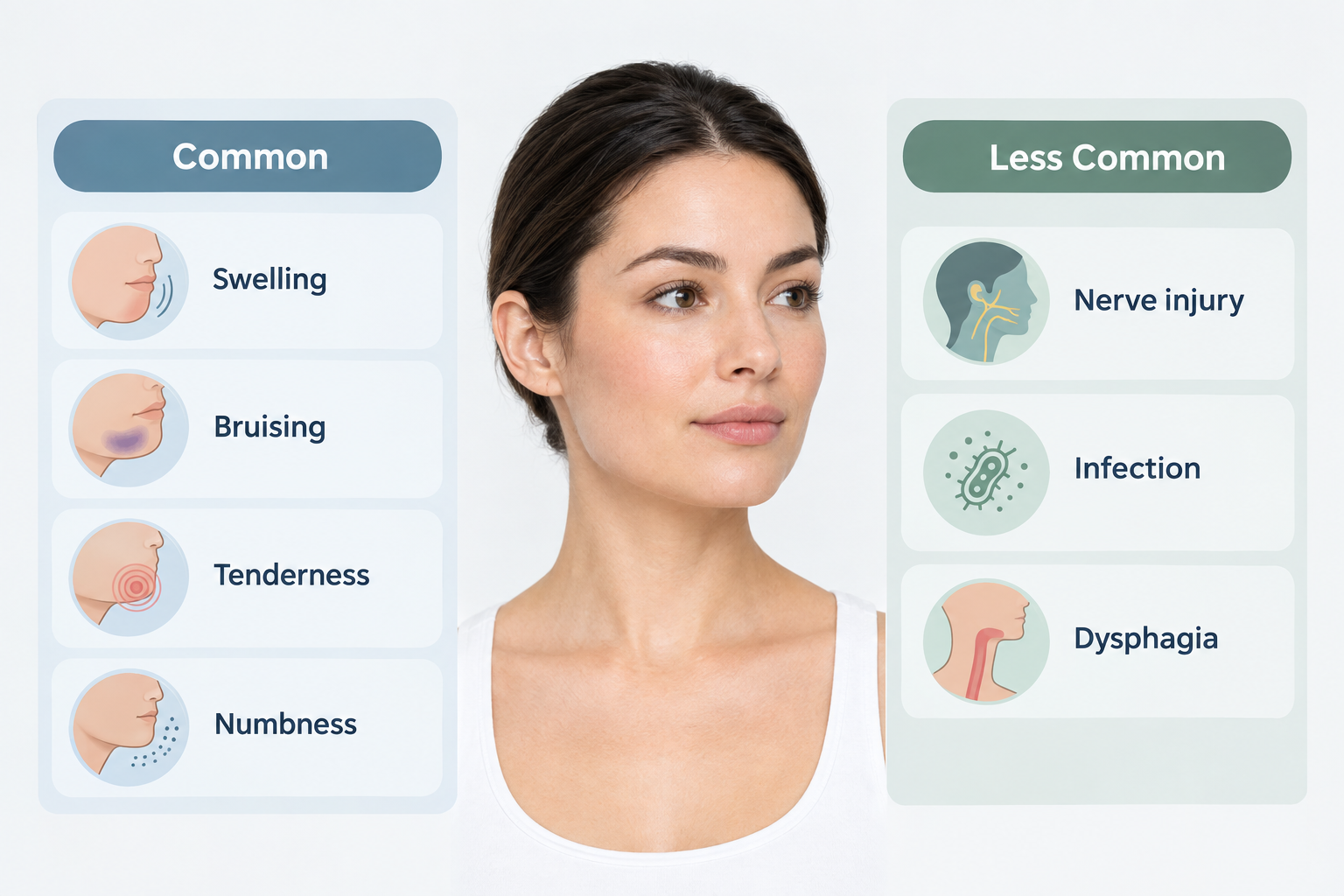
- Nerve injury: the marginal mandibular nerve, which controls movement of the lower lip, runs in proximity to the submental treatment area. Injury to this nerve can cause temporary weakness or asymmetry of the lower lip. This complication is uncommon when treatment is performed by an experienced practitioner with a thorough understanding of facial anatomy, but it has been reported in clinical trials and real-world use. In most documented cases, the effect is temporary and resolves within weeks to months.
- Skin ulceration or necrosis: rare but serious, this can occur if the product is injected outside the intended fat layer or into a blood vessel.
- Dysphagia (difficulty swallowing): temporary difficulty swallowing has been reported and is thought to relate to swelling or, in rare cases, proximity of the injection to relevant structures.
- Alopecia: hair loss in the treated area has been reported in rare cases.
- Infection: as with any injectable procedure, there is a small risk of infection at injection sites.
- Unsatisfactory result or asymmetry: uneven fat reduction or an outcome that does not meet the patient’s expectations is possible.
Choosing a qualified and experienced practitioner who has a thorough knowledge of submental anatomy significantly reduces the risk of serious complications. Always ask about the practitioner’s training, experience with this specific treatment, and what protocols are in place if a complication occurs.
Alternatives to Fat Dissolving Injections for the Chin
Fat dissolving injections are one of several non-surgical options for addressing submental fat, and they are not the only approach worth considering. Understanding the alternatives helps you have a more informed conversation with your practitioner about which option may be most appropriate for your anatomy and goals.
CoolSculpting (cryolipolysis) uses controlled cooling to freeze and destroy fat cells in the submental area. A small applicator designed for the chin is used, and the treatment involves no injections. Swelling and temporary numbness are common after treatment. Results develop over two to three months as the body clears the treated fat cells. CoolSculpting for the chin may suit patients who prefer to avoid injections, though the applicator size limits its use to specific anatomical profiles.
High-intensity focused ultrasound (HIFU) and radiofrequency treatments are primarily skin tightening technologies rather than fat reduction treatments, but they may be relevant for patients whose main concern is skin laxity in the neck and lower face rather than a significant fat deposit. These technologies stimulate collagen production and can improve skin firmness over time.
Surgical liposuction of the submental area remains the most established and predictable method for removing submental fat. It is performed under local or general anaesthesia and involves a small incision beneath the chin. Recovery is longer than with non-surgical options, but the degree of fat removal achievable in a single procedure is typically greater. For patients with a large fat deposit or significant skin laxity, a surgical consultation may be worth considering alongside non-surgical options.
Neck lift surgery addresses both excess fat and skin laxity simultaneously and may be the most appropriate option for patients with significant loose skin in the neck and lower face.
No single treatment is universally superior. The most appropriate option depends on the volume and distribution of fat, the degree of skin laxity, the patient’s tolerance for downtime, and individual goals.
Questions to Ask Your Practitioner Before Treatment
A thorough consultation is an important part of the process. Consider asking your practitioner the following before committing to treatment:
- Which specific product will be used, and is it appropriately licensed for this use in this country?
- What is your experience and training in administering fat dissolving injections to the submental area?
- Based on my anatomy, how many sessions do you estimate I will need?
- What results are realistic for my specific anatomy, and what are the limitations?
- What are the risks I should be aware of, and how would you manage a complication?
- Am I a suitable candidate, or would an alternative treatment better match my goals?
- What aftercare will I need, and what should I avoid after each session?
Frequently Asked Questions
Are fat dissolving injections for the chin painful?
Most patients experience a stinging or burning sensation during the injections and a warming or aching feeling immediately afterwards. Topical anaesthetic and ice are commonly used to reduce discomfort during the procedure. The treated area is typically tender and sore for several days after each session, which most patients manage with over-the-counter pain relief if needed.
Can fat dissolving injections tighten loose skin under the chin?
Fat dissolving injections primarily target fat cells and are not a skin tightening treatment. Some practitioners suggest that the inflammatory response may have a modest secondary effect on skin firmness, but evidence for this is limited. Patients with significant skin laxity may find that reducing the underlying fat volume makes loose skin more noticeable, and a combined approach or alternative treatment may be more appropriate.
How much swelling should I expect after each session?
Swelling after chin fat dissolving injections can be significant and is a normal part of the treatment process. It typically peaks within the first two to three days and gradually resolves over one to two weeks. The swelling may temporarily make the chin and neck area appear larger before the fat reduction becomes visible. Planning treatment around social or professional commitments is advisable.
Will I need to repeat the treatment in the future?
Once a complete course of treatment has been completed and fat cells have been destroyed, those specific cells do not regenerate. However, significant weight gain can cause remaining fat cells to enlarge, which may partially reduce the visible result. Maintaining a stable body weight helps preserve the outcome. Most patients do not need to repeat the full course, though individual circumstances vary.
Is there a difference between Kybella and other fat dissolving products?
Kybella is a brand of injectable deoxycholic acid that holds regulatory approval in the United States specifically for the treatment of submental fat. Other fat dissolving products available in different markets may use deoxycholic acid alone or in combination with other compounds, and their regulatory status and licensed indications vary by country. Your practitioner should be able to explain which product they use and its approval status in your region.
Can fat dissolving injections be used on areas other than the chin?
While deoxycholic acid injections are most extensively studied and most commonly licensed for the submental area, some practitioners use fat dissolving products off-label for other small, localised fat deposits such as jowls, bra fat, or inner knees. Off-label use means the treatment is being used outside its formally approved indication, which carries different considerations regarding evidence and risk. This article focuses specifically on the chin and submental area.
Is a Fat Dissolving Injection Course Right for Your Chin Concerns?
Fat dissolving injections for the chin offer a clinically studied, non-surgical option for reducing a localised submental fat deposit that has not responded to lifestyle changes. For suitable candidates — those with a moderate, pinchable fat deposit, reasonable skin elasticity, and realistic expectations — the treatment can produce a meaningful and potentially long-lasting improvement in chin and neck profile without surgery or significant downtime.
The treatment is not appropriate for everyone. Patients with significant skin laxity, a large fat deposit, or expectations of dramatic rapid change may find that surgical options or alternative non-surgical technologies better match their goals. The gradual nature of the results, the need for multiple sessions, and the predictable post-treatment swelling are all factors worth weighing carefully before committing to a course of treatment.
If you are considering fat dissolving injections for the chin, a consultation with a qualified practitioner who has specific experience in submental treatments and a thorough understanding of facial anatomy is the appropriate starting point. A good consultation will assess your anatomy honestly, explain what is and is not achievable, and help you decide whether this treatment — or an alternative — is the most sensible path toward your goal.


