
Dermal Fillers in London: What to Expect, Benefits, Risks and Results
Dermal fillers are one of the most widely requested non-surgical aesthetic treatments in London, used to restore volume, soften lines, and reshape facial contours without the need for surgery. If you are researching your options, this guide explains how fillers work, which concerns they may address, what a treatment appointment involves, realistic results, potential risks, and the questions worth asking before you book a consultation.
Key Takeaways
- Dermal fillers are injectable gels, most commonly made from hyaluronic acid, used to add volume, smooth lines, or enhance facial contours.
- Results are temporary and typically last between six and eighteen months depending on the product, treatment area, and individual factors.
- Serious complications are uncommon but can occur; treatment should only be performed by a qualified, trained medical or aesthetic practitioner.
- A thorough consultation and facial assessment are essential before any filler treatment to determine suitability and agree on realistic goals.
- Fillers are not suitable for everyone; medical history, medications, and individual anatomy all influence whether treatment is appropriate.
What Are Dermal Fillers?
Dermal fillers are injectable substances placed beneath the skin to add volume, smooth depressions, or alter the shape of facial features. The most widely used type contains hyaluronic acid (HA), a naturally occurring sugar molecule found in skin and connective tissue. Hyaluronic acid attracts and retains water, which gives it a plumping effect when injected. Because HA is found naturally in the body, it is generally well tolerated, and its effects can be partially reversed using an enzyme called hyaluronidase if needed.
Other filler materials exist, including calcium hydroxylapatite and poly-L-lactic acid, which work differently and tend to be used for specific indications. These are not reversible in the same way as HA fillers. The choice of filler type, formulation, and consistency depends on the treatment area, the depth of injection, and the clinical goal. A practitioner will select the appropriate product during your consultation rather than applying a one-size-fits-all approach.
How Do Dermal Fillers Work?
Hyaluronic acid fillers work primarily by physically occupying space beneath the skin, restoring volume that has been lost through the natural ageing process or redistributing tissue to create a desired shape. As the face ages, fat compartments reduce, bone remodels, and collagen production slows, leading to hollowing, sagging, and the deepening of lines and folds. Strategically placed filler can compensate for some of these changes by supporting overlying tissue and restoring a more youthful structural foundation.
Some hyaluronic acid formulations may also stimulate a degree of collagen production over time, though the primary mechanism is volumetric. Biostimulatory fillers such as poly-L-lactic acid work differently, acting mainly as a collagen stimulator rather than an immediate volumiser, with results developing gradually over several weeks. Understanding the mechanism of the specific product being used helps set realistic expectations about when results will appear and how long they may last.
Common Treatment Areas in London Clinics
Dermal fillers can be used across a range of facial areas, and experienced London practitioners often tailor treatment to the individual’s anatomy and aesthetic goals rather than treating isolated features in isolation. The most frequently requested areas include the following.
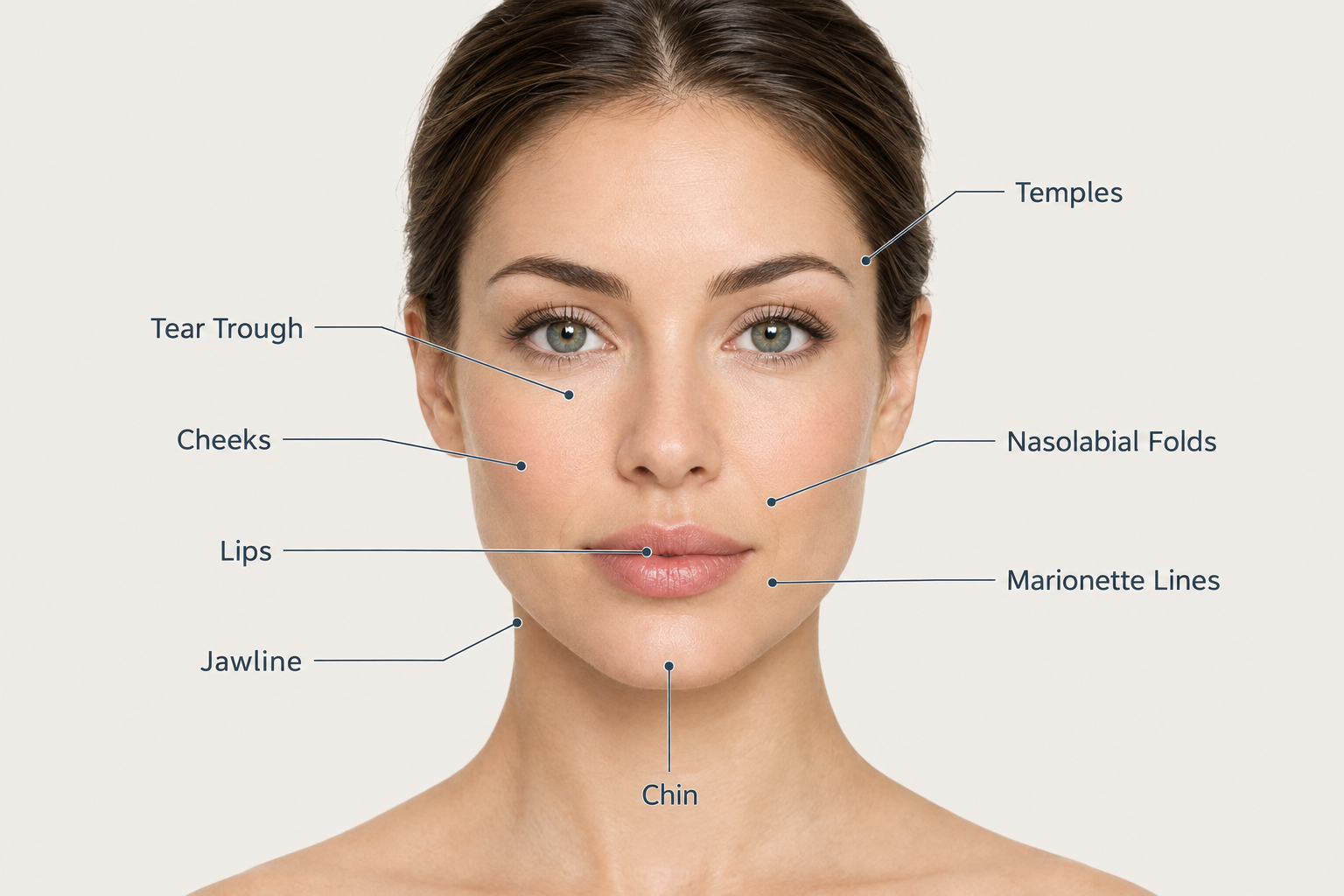
- Lips: Filler can add volume, define the lip border, correct asymmetry, or restore volume lost with age. Lip augmentation remains one of the most popular filler treatments in London.
- Nasolabial folds: The lines running from the sides of the nose to the corners of the mouth can be softened with carefully placed filler, though results depend on the underlying cause of the fold.
- Cheeks: Cheek filler can restore midface volume, lift the lower face indirectly, and improve facial proportions. This is one of the areas where a subtle, well-placed treatment can have a significant overall effect.
- Under-eyes (tear trough): Hollowing beneath the eyes can create a tired appearance. Tear trough filler is a technically demanding treatment that requires careful patient selection and an experienced injector, as the under-eye area carries a higher risk of complications and visible irregularities.
- Jawline and chin: Filler placed along the jawline or at the chin can improve definition, balance facial proportions, and create a more structured lower face without surgery.
- Temples: Volume loss in the temples is a common but often overlooked sign of facial ageing. Temple filler can restore a more youthful facial frame.
- Nose (non-surgical rhinoplasty): Small amounts of filler can be used to camouflage bumps, lift the tip, or improve nasal symmetry. This is a high-risk area and should only be performed by practitioners with specific training and experience.
- Marionette lines and mouth corners: Filler can soften the lines running downward from the corners of the mouth and address a downturned appearance.
What Happens During a Dermal Filler Appointment?
A responsible dermal filler appointment in London begins with a consultation, which may be a separate visit or take place on the same day depending on the clinic’s protocol. During the consultation, the practitioner will review your medical history, discuss your concerns and goals, assess your facial anatomy, and explain which treatment approach may be appropriate. Photographs are usually taken for clinical records.
Before the injections begin, a topical anaesthetic cream is typically applied to the treatment area and left for a period of time to reduce discomfort. Many filler products also contain lidocaine, a local anaesthetic, within the gel itself, which helps to improve comfort during injection. The injections are administered using a fine needle or a blunt-tipped cannula, depending on the area and the practitioner’s technique. A cannula involves a single entry point and may reduce bruising risk in certain areas, though both approaches are used in clinical practice.
The appointment itself is usually completed within thirty to sixty minutes, though this varies with the number of areas being treated. After the injections, the practitioner will assess the result, make any immediate adjustments, and provide aftercare instructions. A follow-up appointment is often recommended to review the outcome once any initial swelling has settled.
Does the Treatment Hurt?
Most patients describe dermal filler injections as mildly uncomfortable rather than significantly painful. The degree of discomfort varies depending on the treatment area, the individual’s pain threshold, and whether topical anaesthetic has been applied. The lips tend to be more sensitive than areas such as the cheeks or jawline. The lidocaine contained in most modern filler formulations helps to reduce discomfort as the treatment progresses. Practitioners can also use additional local anaesthetic techniques for more sensitive areas if required.
Recovery and Downtime After Dermal Fillers
Dermal filler treatments are generally described as having minimal downtime, though this does not mean there are no visible after-effects in the short term. Swelling is the most common immediate response and is expected in virtually all patients. It is usually most noticeable in the first twenty-four to forty-eight hours and tends to resolve within one to two weeks, though this varies by area. Lip filler, in particular, can cause significant initial swelling that may look disproportionate before settling.
Bruising is also common and may appear at injection sites or spread slightly to surrounding tissue. The likelihood and extent of bruising depend on the area treated, the technique used, and individual factors such as skin fragility and any medications that affect clotting. Tenderness and mild redness at injection sites are normal in the first day or two. Most patients are able to return to work and social activities relatively quickly, though many prefer to allow a few days before attending events where appearance matters.
Aftercare advice typically includes avoiding strenuous exercise, alcohol, and excessive heat for twenty-four to forty-eight hours, and refraining from touching or massaging the treated area unless specifically instructed to do so by the practitioner.
How Long Do Dermal Filler Results Last?
The longevity of dermal filler results depends on several factors, including the type of filler used, the treatment area, the volume injected, the individual’s metabolism, and lifestyle factors. Hyaluronic acid fillers in the lips typically last between six and twelve months, as the lips are a high-movement area where the product breaks down more quickly. Fillers placed in areas of lower movement, such as the cheeks or temples, may last twelve to eighteen months or longer in some patients.
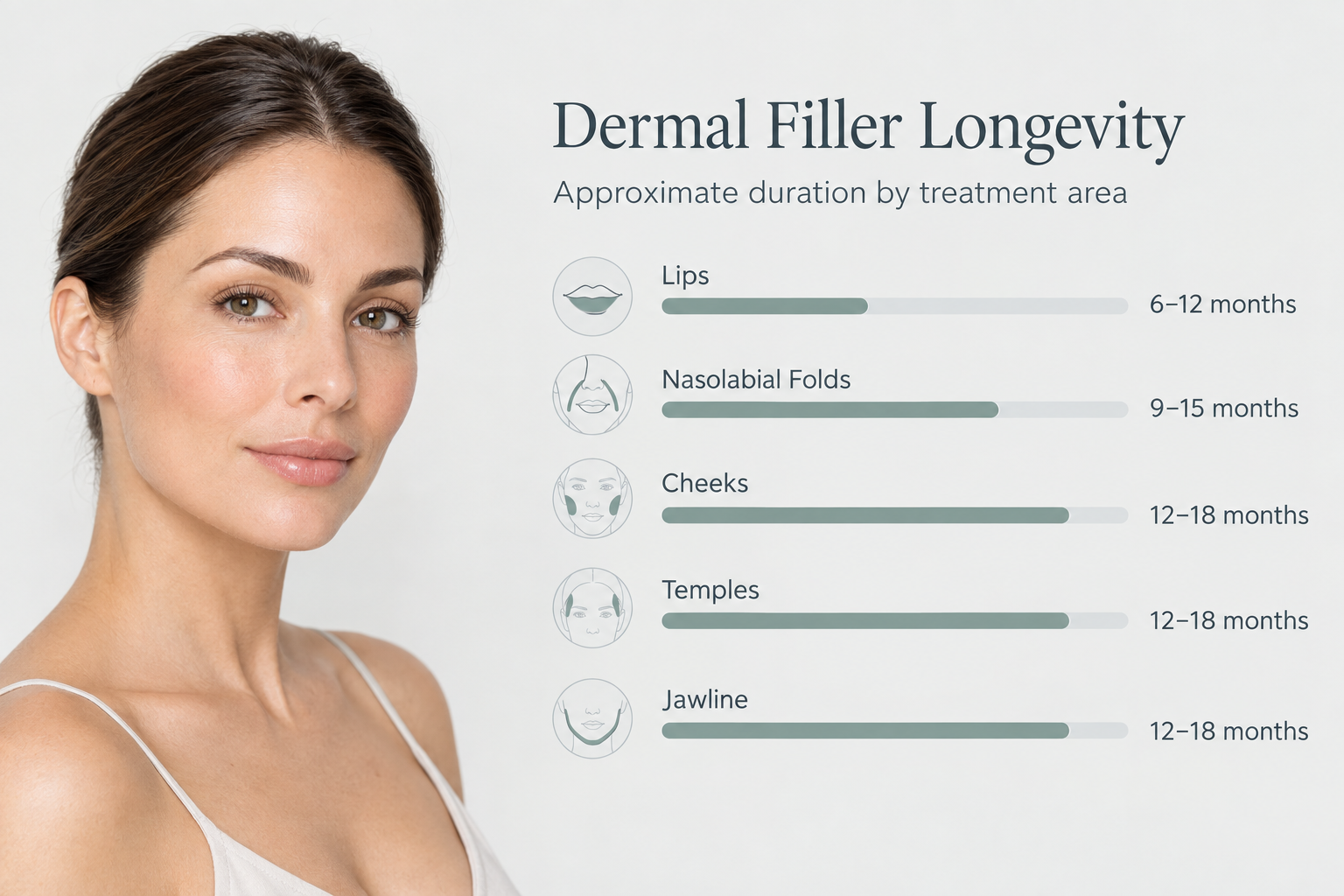
It is worth noting that the visible result may appear to diminish before the filler has fully degraded, because the body gradually absorbs the product and the original concern reasserts itself. Repeat treatments are usually required to maintain results over time. Some patients find that with consistent treatment over several years, they require less product to achieve the same effect, possibly because of cumulative collagen stimulation, though this varies between individuals and is not guaranteed.
Realistic Benefits of Dermal Fillers
When performed by a qualified practitioner on a suitable patient, dermal fillers can produce meaningful aesthetic improvements that are visible relatively quickly. Key potential benefits include the following.
- Restoration of volume in areas affected by age-related fat loss, such as the cheeks, temples, and under-eyes.
- Softening of deep lines and folds, particularly nasolabial folds and marionette lines, where volume loss is a contributing factor.
- Enhancement of lip volume, shape, and definition.
- Improved facial proportions and symmetry through strategic placement in areas such as the chin and jawline.
- A refreshed appearance without the recovery period associated with surgical procedures.
- Reversibility of hyaluronic acid fillers using hyaluronidase, which provides a degree of safety not available with permanent or semi-permanent alternatives.
It is important to approach these benefits with realistic expectations. Fillers work best when used to address specific, well-defined concerns in patients whose anatomy is suited to the treatment. They are not a substitute for surgical procedures in patients with significant skin laxity or structural changes that cannot be adequately addressed with volume alone.
Risks and Side Effects
Dermal fillers carry a range of potential side effects and risks, and patients should be fully informed before proceeding with treatment. Common side effects, which are generally temporary, include swelling, bruising, redness, tenderness, and mild asymmetry in the days following treatment. These typically resolve without intervention.
Less common but more significant risks include the following.
- Nodules and lumps: Filler can occasionally form palpable or visible lumps beneath the skin, which may require massage, hyaluronidase, or time to resolve.
- Tyndall effect: Superficially placed hyaluronic acid filler can create a bluish discolouration visible through the skin, most commonly seen in the under-eye area.
- Infection: Any injectable treatment carries a risk of infection. Signs of infection require prompt medical assessment.
- Delayed inflammatory reactions: Some patients experience delayed swelling or nodule formation weeks or months after treatment, sometimes triggered by illness or dental procedures. These reactions are uncommon but require clinical management.
- Vascular occlusion: This is the most serious potential complication of dermal filler treatment. If filler is inadvertently injected into or compresses a blood vessel, it can restrict blood flow to surrounding tissue, potentially causing tissue damage or, in rare cases, vision changes or blindness if it affects vessels near the eye. Vascular occlusion is a medical emergency requiring immediate treatment with hyaluronidase. The risk is higher in certain anatomical areas, including the nose, glabella, and around the eyes. Choosing a practitioner with appropriate training, anatomical knowledge, and access to emergency hyaluronidase is essential.
The overall risk of serious complications is low when treatment is performed by a trained and experienced practitioner, but it is not zero. Patients should be provided with clear aftercare instructions and emergency contact information in case of concerns after treatment.
Who May Be Suitable for Dermal Fillers?
Dermal fillers may be suitable for adults who have specific, realistic aesthetic concerns that can be addressed with volume or contouring, and who are in good general health. Suitable candidates are typically those who understand that results are temporary, are not seeking a surgical outcome, and have had a thorough consultation with a qualified practitioner.
Factors that may affect suitability include the following.
- Pregnancy and breastfeeding: fillers are generally not recommended during these periods.
- Active skin infections, cold sores, or inflammatory skin conditions in the treatment area.
- Certain autoimmune conditions or a history of severe allergic reactions.
- Blood-thinning medications, which may increase bruising risk.
- Previous permanent filler treatments in the same area, which may complicate assessment and increase complication risk.
- Unrealistic expectations or body dysmorphic disorder, where treatment is unlikely to be appropriate.
A thorough medical history and facial assessment at consultation will help determine whether filler treatment is appropriate for an individual patient.
Choosing a Qualified Practitioner in London
The quality and safety of dermal filler treatment depends significantly on the practitioner’s training, anatomical knowledge, and clinical judgement. In the United Kingdom, the regulation of aesthetic injectables has historically been inconsistent, though regulatory changes are ongoing. Patients seeking dermal fillers in London should look for practitioners who hold recognised medical, dental, or nursing qualifications, have completed specific training in aesthetic injectables and facial anatomy, work in a clinical environment with appropriate hygiene standards, conduct a thorough consultation before treatment, and carry emergency hyaluronidase on-site.
Asking about a practitioner’s qualifications, experience with the specific treatment area, and what happens in the event of a complication are reasonable and important questions. A reputable practitioner will welcome these questions rather than discourage them. Be cautious of unusually low prices, high-pressure sales tactics, or practitioners who do not conduct a proper consultation before proceeding.
Alternatives to Dermal Fillers
Dermal fillers are one option within a broader range of non-surgical and surgical treatments available in London. Depending on the concern being addressed, alternatives or complementary treatments may include the following.
- Botulinum toxin (anti-wrinkle injections): Used to relax muscles responsible for dynamic lines such as forehead lines, frown lines, and crow’s feet. Botulinum toxin and dermal fillers address different types of concerns and are often used together for a more comprehensive result.
- Polynucleotides: Injectable treatments that may improve skin quality, hydration, and fine lines through biostimulation. These are increasingly used as an alternative or complement to fillers, particularly in the under-eye area.
- Skin boosters: Highly hydrophilic hyaluronic acid formulations injected superficially to improve skin texture and hydration rather than add structural volume.
- Radiofrequency and ultrasound treatments: Non-injectable devices that may improve skin laxity and stimulate collagen, offering an alternative for patients who prefer to avoid injections.
- Surgical options: For patients with significant skin laxity or structural changes, surgical procedures such as a facelift may produce more durable results than fillers alone. A qualified practitioner should be able to advise honestly when a non-surgical approach is unlikely to meet a patient’s goals.
Frequently Asked Questions
How much do dermal fillers cost in London?
The cost of dermal filler treatment in London varies considerably depending on the clinic, the practitioner’s experience, the product used, and the number of areas treated. Prices for a single area typically range from several hundred pounds upward. Unusually low prices may reflect less experienced practitioners or lower-quality products, and cost should not be the primary factor when choosing a provider for an injectable treatment.
Can dermal fillers be dissolved if I am unhappy with the result?
Hyaluronic acid fillers can be partially or fully dissolved using an enzyme called hyaluronidase, which breaks down the filler material. This provides a degree of reversibility that is not available with non-HA fillers. Dissolution is also used as an emergency treatment in the event of vascular occlusion. Not all clinics carry hyaluronidase on-site, so it is worth confirming this before treatment.
Will dermal fillers make me look unnatural?
Overfilled or poorly placed filler can produce an unnatural appearance, which is why practitioner skill and conservative treatment planning matter. A well-executed filler treatment should enhance your features in a way that looks refreshed rather than obviously altered. Discussing your goals clearly at consultation and choosing a practitioner who takes a measured approach can help reduce this risk.
How soon will I see results after dermal filler treatment?
The volumetric effect of hyaluronic acid filler is visible immediately after treatment, though initial swelling means the result will not look settled for one to two weeks. The final outcome is best assessed at a follow-up appointment once swelling has fully resolved.
Are dermal fillers safe?
Dermal fillers have an established safety profile when used by trained practitioners in appropriate patients. Serious complications are uncommon but can occur, and the risk is higher in certain anatomical areas and with less experienced injectors. No injectable treatment is entirely without risk, and patients should be fully informed of potential side effects and complications before consenting to treatment.
How many sessions will I need?
Many patients achieve their initial goal in a single treatment session, though some concerns may benefit from a staged approach, particularly when significant volume restoration is needed. Maintenance treatments are typically required every six to eighteen months to sustain results, depending on the area and the individual’s response.
Making an Informed Decision About Dermal Fillers in London
Dermal fillers can be an effective non-surgical option for patients with realistic goals and concerns that are well-suited to injectable treatment. The range of available products and techniques means that a skilled London practitioner can address a variety of concerns, from subtle lip enhancement to more significant facial volume restoration, with results that are visible relatively quickly and do not require surgical recovery.
The most important factors in a safe and satisfying outcome are choosing a qualified and experienced practitioner, having a thorough consultation that includes an honest discussion of what filler can and cannot achieve for your specific anatomy, and understanding the realistic longevity, maintenance requirements, and potential risks involved. Patients who approach treatment with clear, proportionate goals and a willingness to follow professional advice tend to have the most positive experiences.
If you are considering dermal fillers in London, a consultation with a medically qualified aesthetic practitioner is the appropriate starting point. A responsible practitioner will assess your suitability, explain the options available to you, and help you decide whether filler treatment is the right approach for your concerns.


