Chin Botox Injection Points Explained: Placement, Technique and What to Expect
Chin Botox has become one of the more nuanced treatments in lower face aesthetics, targeting specific muscles to smooth chin dimpling, soften a horizontal crease, or address downturned mouth corners. Understanding where injections are placed, why those sites are chosen, and what the realistic outcomes are can help you have a more informed conversation with your practitioner before booking a consultation.
Key Takeaways
- The primary target for chin Botox is the mentalis muscle, a paired cone-shaped muscle responsible for chin dimpling and labiomental crease deepening when overactive.
- Injection points vary by indication — chin dimpling, a horizontal chin crease, and downturned mouth corners each involve slightly different placement strategies.
- The depressor anguli oris (DAO) and depressor labii inferioris (DLI) are nearby muscles that influence placement decisions and carry specific complication risks if inadvertently affected.
- Results typically appear within 3–7 days and may last 3–4 months, with individual variation depending on muscle mass, metabolism, and treatment frequency.
- Chin Botox is not a treatment for submental fat or a recessed chin — a thorough dynamic assessment is essential to confirm suitability before treatment.
Lower Face Anatomy: Why It Matters for Chin Botox
Precise placement of botulinum toxin in the chin area depends on a clear understanding of lower face anatomy. Several muscles occupy a relatively small, overlapping region, and the proximity of these structures means that even small variations in injection depth or position can affect adjacent muscles unintentionally.
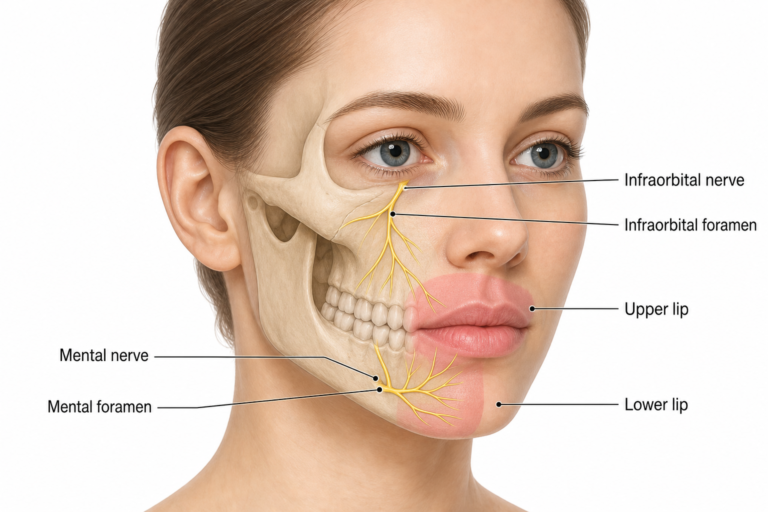
The mentalis muscle is the central target for most chin Botox treatments. It is a paired muscle — meaning it consists of two separate bellies, one on each side of the midline — with a small fat pad sitting between them. Each belly originates from the incisive fossa of the mandible (the lower jawbone) and inserts into the skin of the chin. When the mentalis contracts, it elevates and wrinkles the chin skin, producing the characteristic dimpled or cobblestone texture often described as pebble chin or orange peel chin. In patients with a hyperactive mentalis, this contraction is exaggerated and persistent, deepening the labiomental crease and creating visible surface irregularity even at rest.
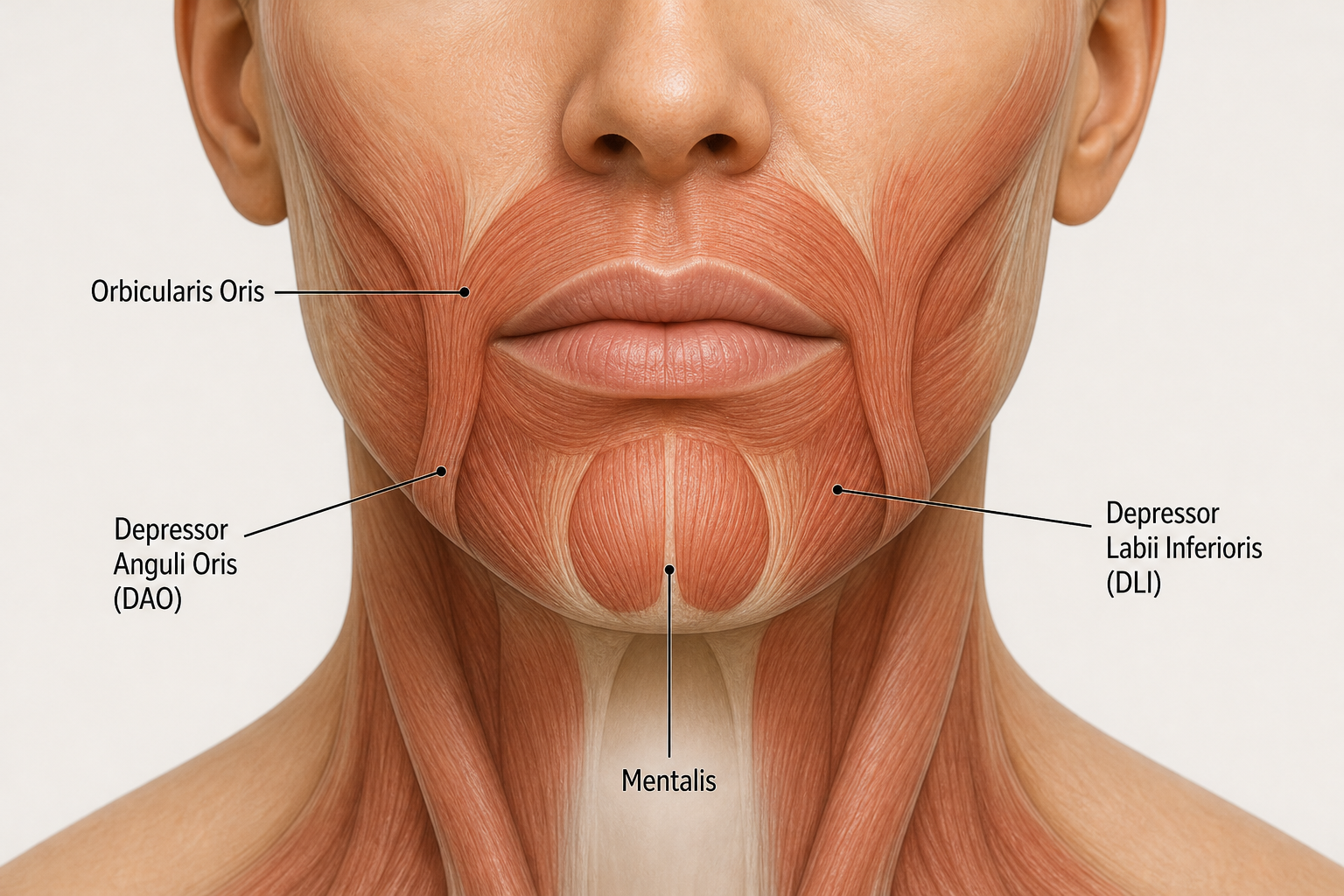
Lateral to the mentalis sit two muscles that are relevant to chin and lower face treatment. The depressor anguli oris (DAO) runs from the mandible up to the oral commissure (the corner of the mouth) and pulls the mouth corners downward, contributing to a downturned or sad-looking expression. The depressor labii inferioris (DLI) lies between the mentalis and the DAO, depressing the lower lip. The DLI is a critical safety consideration: it sits in a zone where toxin diffusion from either a mentalis injection or a DAO injection can reach it, potentially causing lower lip asymmetry or heaviness if inadvertently weakened.
Above the mentalis, the orbicularis oris encircles the mouth. Injections placed too superiorly risk weakening this muscle, which could impair lip movement and function. Understanding these anatomical relationships is why a thorough dynamic assessment — observing the chin and lower face at rest, during speech, smiling, pouting, and lip pursing — is considered essential before any injection is placed.
What Conditions Can Chin Botox Address?
Botulinum toxin in the chin region is used for several distinct concerns, and the appropriate injection points differ depending on which problem is being treated.
Chin Dimpling and Pebble Chin
The most common indication is chin dimpling — the bumpy, uneven texture sometimes called pebble chin, cobblestone chin, golf ball chin, or peau d’orange. This appearance results from a hyperactive mentalis contracting repeatedly, pulling the overlying skin into irregular folds. Botulinum toxin relaxes the mentalis, allowing the skin surface to smooth. This is a dynamic concern, meaning it is caused by muscle activity rather than by skin laxity or volume loss, which makes it well suited to neuromodulator treatment.
Horizontal Chin Crease
A deep horizontal crease running across the chin — sometimes called the labiomental crease or mental crease — can be worsened by mentalis hyperactivity. When the muscle repeatedly contracts and elevates the chin pad, it deepens this fold over time. Relaxing the mentalis may soften the crease, though a very deep static crease (present even without muscle contraction) may also benefit from chin filler as a complementary treatment.
Downturned Mouth Corners
A persistently downturned expression at the oral commissure is often driven by an overactive depressor anguli oris pulling the corners of the mouth downward. Botulinum toxin placed into the DAO can reduce this downward pull, allowing the corners to rest in a more neutral or slightly elevated position. This is a separate injection site from the mentalis, though both areas are sometimes treated in the same session.
Chin Botox Injection Points by Indication
The specific injection points chosen by a practitioner depend on the indication, the patient’s anatomy, and the findings of the dynamic assessment. The following describes the general approach for each concern — this is educational context, not procedural instruction.
Mentalis Injection Points for Chin Dimpling
For chin dimpling and pebble chin, the mentalis muscle belly is the target. Because the mentalis is a paired muscle with two distinct bellies separated by a midline fat pad, practitioners typically use either a single midline point, a two-point technique placing one injection into each belly, or a four-point diamond pattern for more thorough coverage of the muscle. The choice between these approaches depends on the size and strength of the muscle, the distribution of dimpling, and the practitioner’s assessment of where the muscle is most active.
Injection depth is an important technical consideration. The mentalis is a relatively superficial muscle, and the target is the muscle belly itself — an intramuscular injection at approximately 2–3 mm depth. Injecting too superficially risks intradermal placement with poor diffusion into the muscle; injecting too deeply risks reaching the periosteum or missing the muscle entirely. The angle of approach also matters: some practitioners prefer a 45-degree angle directed toward the muscle fibers, which may improve accuracy compared to a purely perpendicular approach that risks passing through the muscle without depositing toxin within it.
The patient is typically asked to contract the mentalis — by pressing the lower lip against the upper teeth or making a pouting expression — so the practitioner can palpate the muscle belly and confirm the injection site before needle placement. Marking the skin with the patient upright and animating helps ensure accuracy.
DAO Injection Points for Downturned Mouth Corners
For downturned mouth corners, the depressor anguli oris is targeted lateral to the mentalis, typically at a point along the mandible below and slightly lateral to the oral commissure. The DAO is a triangular muscle, and the injection is usually placed into its body rather than its superior insertion near the mouth corner, to reduce the risk of affecting the orbicularis oris or causing lip asymmetry.
When treating both the mentalis and the DAO in the same session, practitioners must consider the cumulative proximity of these injection sites to the DLI. The depressor labii inferioris lies between these two muscles, and toxin diffusion from both sites could converge on the DLI, increasing the risk of lower lip weakness. This is one reason why experienced practitioners may choose to treat these areas separately or use conservative dosing when combining them.
Dosing: How Many Units Are Used?
Dosing for chin Botox varies depending on the muscle being treated, the patient’s muscle mass and strength, and whether multiple areas are being addressed in the same session. The following ranges reflect general clinical practice and are intended as educational context only — actual dosing decisions are made by the treating practitioner based on individual assessment.
| Target Muscle | Indication | Typical Unit Range (Botox) | Injection Approach |
|---|---|---|---|
| Mentalis | Chin dimpling, pebble chin, labiomental crease | 4–10 units total | Single midline, two-point, or four-point technique |
| Depressor anguli oris (DAO) | Downturned mouth corners | 2–5 units per side | One point per side, lateral to mentalis |
Male patients generally require higher doses than female patients due to greater muscle mass and stronger mentalis contraction. A practitioner may start conservatively and adjust at a two-week review appointment, which is standard practice for lower face botulinum toxin treatments where small dosing differences can have visible functional effects.
It is worth noting that units are not interchangeable between different botulinum toxin brands. A unit of Botox (onabotulinumtoxinA) is not equivalent to a unit of Dysport (abobotulinumtoxinA) or other formulations. Dosing guidance always refers to a specific product, and your practitioner will work with the brand they are trained and experienced with.
The Dynamic Assessment: How Practitioners Identify the Right Injection Sites
One of the most important steps before any chin Botox treatment is a structured dynamic assessment — observing the lower face in motion rather than simply at rest. A practitioner will typically ask the patient to perform a sequence of expressions: resting face, speaking, smiling, pouting, pursing the lips, and pressing the lower lip against the upper teeth. This sequence reveals which muscles are overactive, where the dimpling or crease originates, and whether the concern is truly dynamic (driven by muscle contraction) or partly structural.
This assessment also helps identify pre-existing asymmetry. Many patients have a degree of natural asymmetry in their lower face that becomes more apparent when the muscles are relaxed by botulinum toxin. Identifying and documenting this before treatment is important so that any post-treatment asymmetry can be correctly attributed — either to a pre-existing difference or to a treatment effect that may need adjustment.
A patient with a weak or recessed chin due to skeletal anatomy rather than muscle hyperactivity is unlikely to benefit from botulinum toxin alone. In such cases, chin filler or a structural assessment may be more appropriate. The dynamic assessment is what distinguishes a hyperactive mentalis — the right candidate for chin Botox — from a chin concern with a different underlying cause.
Risks, Side Effects, and Complications
Chin Botox carries a specific set of risks that are worth understanding before treatment. Most side effects are temporary and resolve as the toxin wears off, but some can be distressing in the short term.
Crooked Smile or Smile Asymmetry
One of the most commonly discussed complications is a crooked smile or asymmetric smile. This can occur if the botulinum toxin affects the depressor labii inferioris unevenly, or if there is inadvertent spread to muscles involved in lip movement. A crooked smile typically resolves as the toxin metabolises, but it can persist for several weeks. In some cases, a corrective injection into the contralateral DLI may be considered to balance the effect, though this requires careful assessment by an experienced practitioner.
Lower Lip Heaviness or Droop
If toxin diffusion reaches the DLI or orbicularis oris, the lower lip may feel heavy, move asymmetrically, or appear slightly drooped. This is more likely when higher doses are used, when injection points are placed too superiorly, or when both the mentalis and DAO are treated in the same session without accounting for cumulative diffusion toward the DLI.
Paradoxical Chin Bulging
A less commonly discussed but clinically important complication is paradoxical chin bulging — where the chin appears more prominent or rounded after treatment rather than smoother. This can occur when only part of the mentalis muscle is relaxed, leaving the untreated portion to contract more forcefully in compensation. Ensuring that the injection covers the full extent of the active muscle belly, rather than a single superficial point, may reduce this risk.
Chin Flattening or Loss of Projection
Excessive relaxation of the mentalis can reduce the natural forward projection of the chin tip, making the chin appear flatter. This is more likely with higher doses and is a reason why conservative dosing with a review appointment is generally preferred for first-time treatments.
Baseline Asymmetry
Pre-existing facial asymmetry is common and may become more noticeable after treatment. A thorough pre-treatment assessment and photographic documentation help distinguish a pre-existing difference from a treatment-related change.
What to Expect: Results, Onset, and Duration
Botulinum toxin does not produce immediate results. After chin Botox, most patients begin to notice softening of chin dimpling or reduced muscle activity within 3–7 days. The full effect is usually visible at 10–14 days, which is why a two-week review appointment is standard practice — it allows the practitioner to assess the outcome and make any minor adjustments if needed.
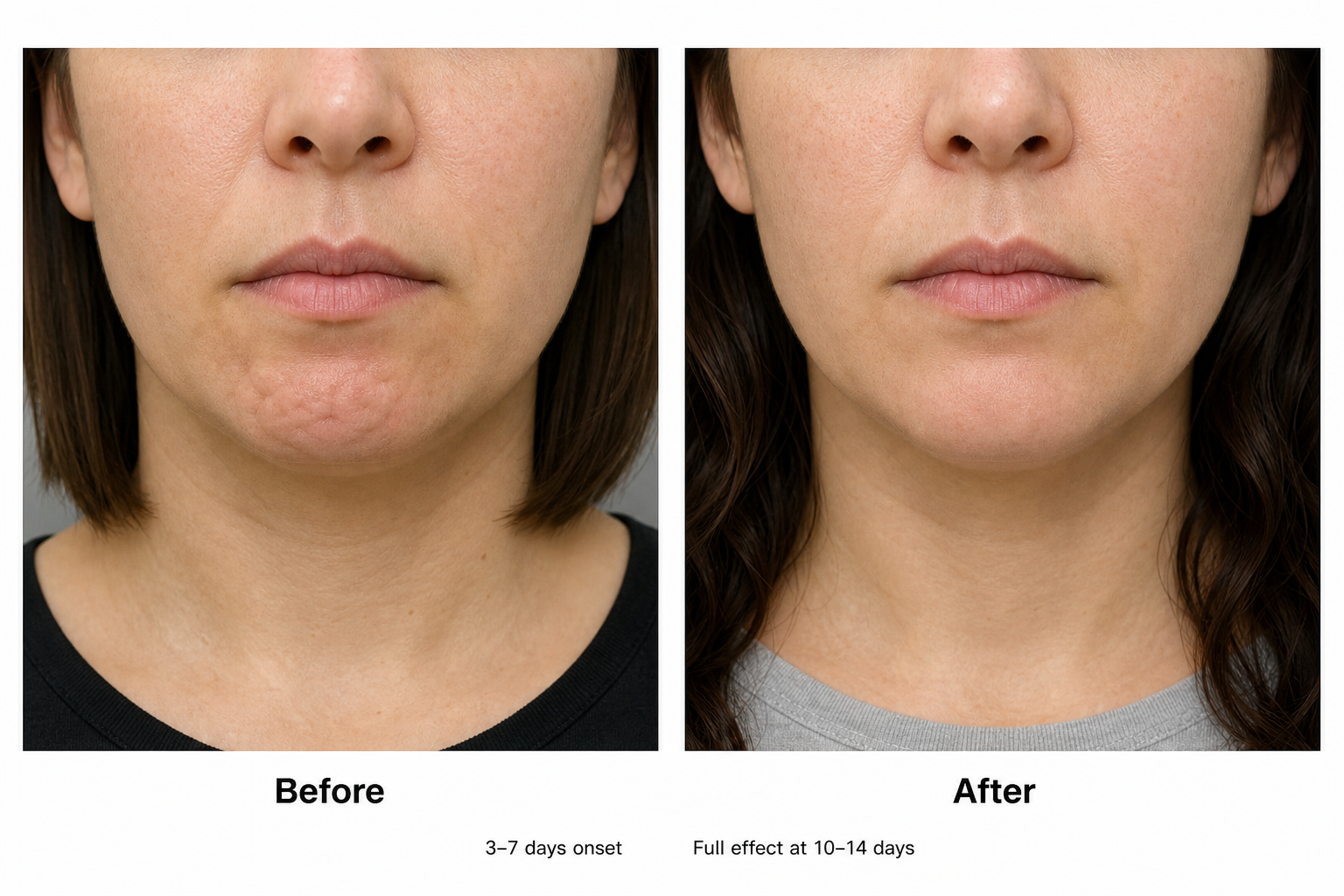
Results typically last 3–4 months for most patients, though some may experience effects for up to 6 months. Duration is influenced by individual metabolism, the strength of the mentalis muscle, the dose used, and how frequently the area has been treated previously. Patients who have regular maintenance treatments over time may find that the muscle gradually weakens, potentially extending the interval between sessions.
Aftercare following chin Botox is straightforward. Patients are generally advised to remain upright for approximately four hours after treatment, avoid rubbing or massaging the injection sites, refrain from strenuous exercise for 24 hours, and avoid alcohol on the day of treatment. These precautions are intended to minimise the risk of toxin migration to unintended areas.
Who May Be a Suitable Candidate?
Chin Botox may be worth discussing with a practitioner if you have visible chin dimpling, a pebble chin texture, or a deepening labiomental crease that is clearly driven by muscle activity — confirmed on dynamic assessment. Patients with downturned mouth corners caused by an overactive DAO may also be candidates for targeted treatment in that area.
Chin Botox is generally not appropriate for patients with a structurally recessed or weak chin, where the concern is skeletal rather than muscular. It is also not suitable during pregnancy or breastfeeding, for patients with certain neuromuscular conditions, or for those with a known allergy to botulinum toxin or its components. A full medical history review is part of any responsible pre-treatment consultation.
Chin Botox vs Chin Filler: Understanding the Difference
Chin Botox and chin filler are often discussed together but address fundamentally different concerns. Understanding the distinction helps set realistic expectations.
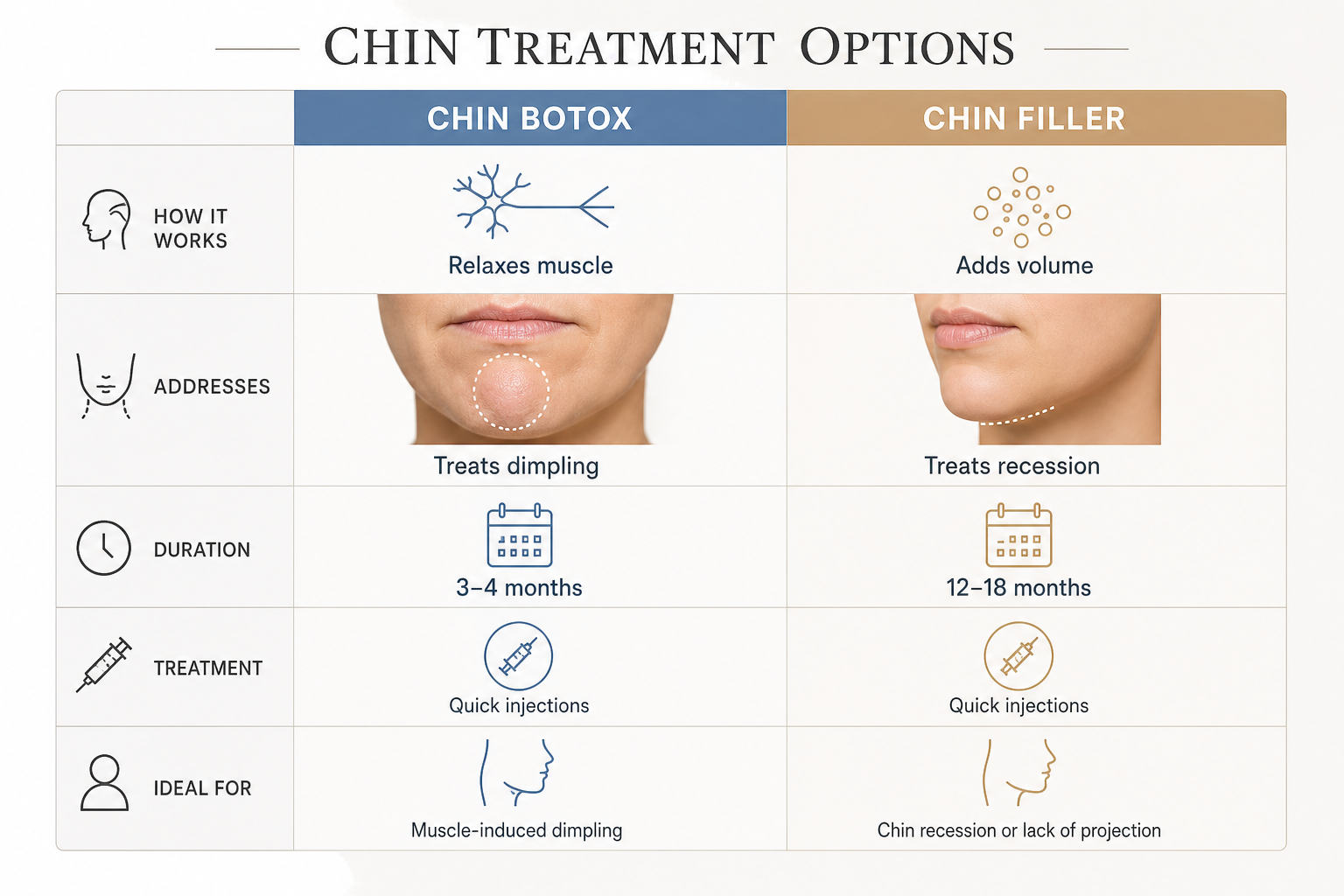
| Feature | Chin Botox | Chin Filler (Dermal Filler) |
|---|---|---|
| Mechanism | Relaxes overactive mentalis muscle | Adds volume and structural support to chin |
| Primary indication | Chin dimpling, pebble chin, labiomental crease deepening | Recessed chin, chin projection, static creases |
| Onset | 3–7 days | Immediate |
| Duration | 3–4 months typically | 12–18 months typically (varies by product) |
| Reversible? | Yes — wears off naturally | Hyaluronic acid fillers can be dissolved with hyaluronidase |
| Can be combined? | Yes — often used together for comprehensive lower face improvement | |
It is also worth clarifying a common misconception: chin Botox does not treat submental fat — the fat beneath the chin that creates a double chin appearance. Submental fat is a volume concern, not a muscle concern, and is addressed by different treatments such as deoxycholic acid injections or other fat reduction approaches. Botulinum toxin has no effect on fat tissue.
Frequently Asked Questions
How many units of botulinum toxin are typically used for chin Botox?
For the mentalis muscle, the typical range is 4–10 units of Botox in total, divided between injection points. For the depressor anguli oris, 2–5 units per side is a common starting range. Actual dosing depends on muscle strength, the patient’s anatomy, and the practitioner’s assessment. Male patients often require higher doses due to greater muscle mass.
Can chin Botox cause a crooked smile?
Yes, this is a recognised risk. A crooked smile can occur if botulinum toxin affects the depressor labii inferioris or other lip-depressing muscles unevenly, altering the symmetry of lip movement. The risk is higher when injection points are placed too close to the DLI or when doses are too high. An experienced practitioner will take steps to minimise this risk, but it cannot be entirely eliminated. The effect is temporary and resolves as the toxin wears off.
How is chin Botox different from treatment for a double chin?
Chin Botox targets the mentalis muscle to address surface texture and muscle-related creasing. A double chin is caused by submental fat accumulation beneath the chin, which is a volume concern unrelated to muscle activity. Botulinum toxin does not reduce fat. Treatments for submental fat include deoxycholic acid injections and other fat reduction approaches — a practitioner can advise which may be appropriate after assessment.
How long does chin Botox last?
Most patients find that results last approximately 3–4 months, though some experience effects for up to 6 months. Duration varies with individual metabolism, muscle mass, and treatment history. Regular maintenance treatments may gradually reduce muscle activity over time, potentially extending the interval between sessions.
Is chin Botox painful?
Most patients describe the injections as mildly uncomfortable rather than painful. A fine-gauge needle (typically 30–34G) is used, and the treatment takes only a few minutes. Topical anaesthetic cream can be applied beforehand if preferred, though many patients find it unnecessary for this area.
Can chin Botox be combined with other treatments?
Yes. Chin Botox is frequently combined with chin filler for patients who have both muscle-related dimpling and a structurally recessed chin. It may also be combined with DAO treatment for downturned mouth corners in the same session, though practitioners will consider the cumulative proximity of injection sites to the DLI when planning a combined approach.
Is Chin Botox the Right Approach for Your Concern?
Chin Botox can be an effective, well-tolerated option for patients whose chin dimpling, pebble chin texture, or labiomental crease deepening is driven by a hyperactive mentalis muscle. When the concern is confirmed on dynamic assessment and the injection points are chosen with careful attention to lower face anatomy — particularly the relationship between the mentalis, DAO, and DLI — results can be natural-looking and meaningful, with minimal downtime.
However, chin Botox is not a universal solution for all lower face concerns. It does not address structural chin recession, submental fat, or deep static creases that exist independently of muscle activity. A thorough consultation with a qualified and experienced practitioner is the most important step — one who will assess your anatomy dynamically, discuss realistic outcomes, explain the specific risks relevant to your treatment plan, and tailor the injection points and dosing to your individual needs rather than applying a one-size-fits-all approach.
If you are considering chin Botox, look for a practitioner with demonstrable experience in lower face botulinum toxin treatments and a clear approach to pre-treatment assessment and post-treatment review.