What Is a Liquid Facelift? Non-Surgical Lifting with Filler Explained
A liquid facelift is a non-surgical facial rejuvenation approach that uses injectable treatments — primarily dermal fillers and sometimes neuromodulators — to restore lost volume, soften deep lines, and improve facial contour without incisions or general anaesthesia. It has become one of the most requested minimally invasive procedures in aesthetic medicine, but the name can be misleading: a liquid facelift does not lift tissue in the same way surgery does, and understanding exactly what it can and cannot achieve is essential before deciding whether it is the right option for you.
Key Takeaways
- A liquid facelift uses strategically placed dermal fillers — and often neuromodulators — to restore volume, soften lines, and improve facial contour without surgery.
- Results are temporary; depending on the products used, they typically last between 6 months and 2 years, and maintenance treatments are required.
- It works best for mild-to-moderate volume loss and early facial ageing; it cannot remove excess skin, address significant jowling, or replicate the tissue repositioning of a surgical facelift.
- Safety depends heavily on injector qualifications — choosing a medically trained, experienced practitioner with a thorough understanding of facial anatomy is the single most important decision you will make.
- Cumulative maintenance costs over several years can approach or exceed the cost of a surgical facelift, so long-term financial planning is worth considering.
What Is a Liquid Facelift?
The term liquid facelift describes a customised combination of injectable treatments designed to address multiple signs of facial ageing in a single session or series of appointments. Rather than removing or repositioning tissue, the approach works by replacing volume that has been lost through the natural ageing process, relaxing muscles that create dynamic wrinkles, and improving the structural support of the face using carefully selected products placed at precise depths within the skin and soft tissue.
Ageing affects the face in several ways simultaneously: fat compartments shrink and shift downward, bone resorbs, collagen production slows, and skin loses elasticity. The result is a face that appears deflated, shadowed, and less defined — not simply one that has developed lines. A liquid facelift addresses the volume and structural component of this process. By restoring fullness to areas such as the cheeks, temples, and jawline, a skilled injector can create the appearance of a subtle lift and improved proportion, even though no tissue has physically moved.
The procedure is sometimes called a lunchtime facelift because it can be completed in 30 to 60 minutes with minimal downtime, though this label somewhat undersells the complexity of a well-executed treatment plan.
Which Products Are Used?
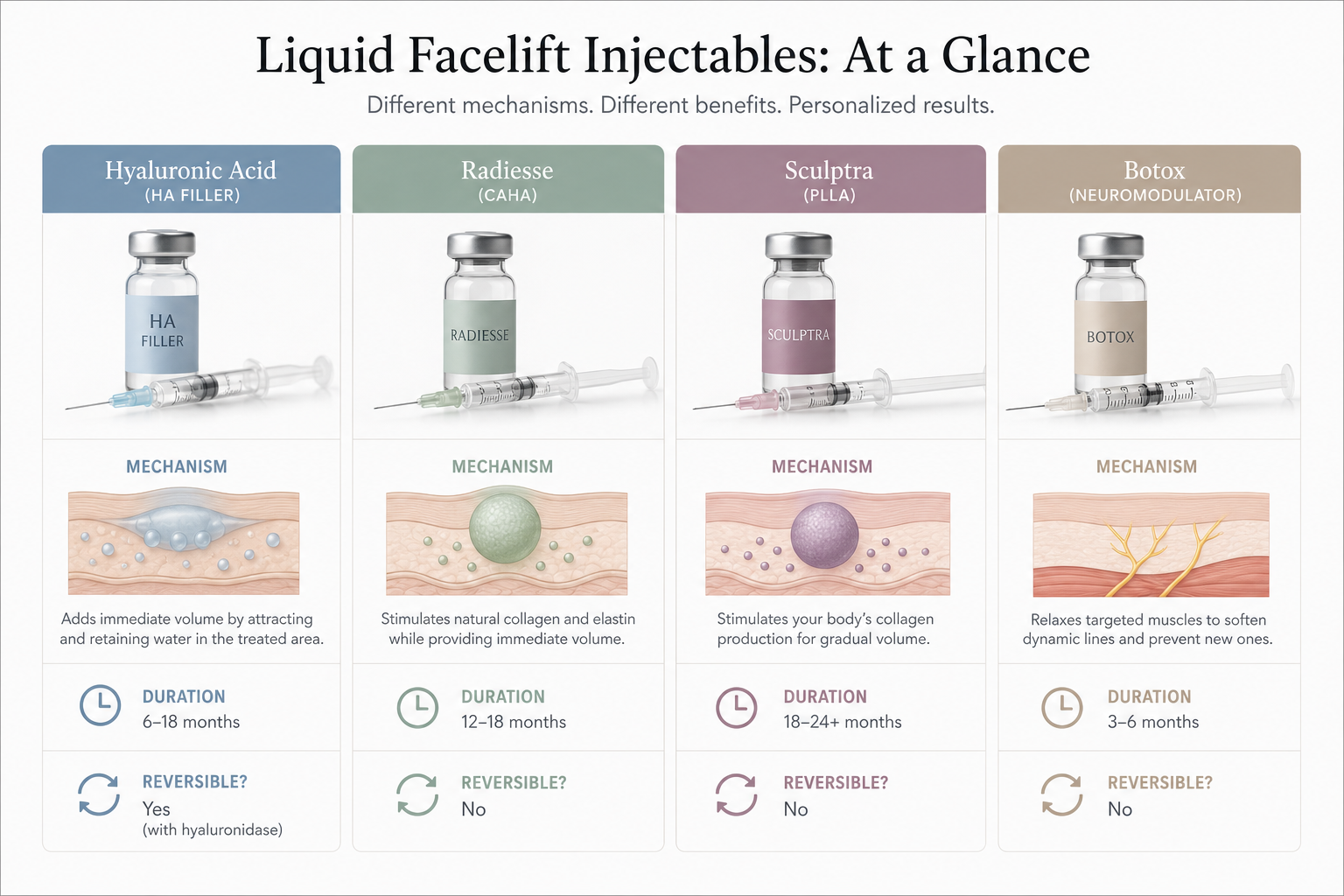
A liquid facelift is not a single product — it is a treatment strategy. The products selected depend on the areas being treated, the degree of volume loss, the patient’s anatomy, and the desired outcome. The most commonly used categories are described below.
| Product Type | Examples | Mechanism | Duration | Reversible? | Best Used For |
|---|---|---|---|---|---|
| Hyaluronic acid (HA) filler | Juvederm, Restylane, Belotero, RHA | Adds immediate volume; attracts water | 6–18 months | Yes — with hyaluronidase | Lips, nasolabial folds, under-eyes, cheeks, fine lines |
| Calcium hydroxylapatite | Radiesse | Immediate structure + stimulates collagen production | 12–18 months | No | Cheeks, jawline, hands, deeper structural support |
| Poly-L-lactic acid (PLLA) | Sculptra | Gradual collagen stimulator; no immediate volume | Up to 2 years | No | Diffuse volume loss, temples, cheeks — requires multiple sessions |
| Neuromodulators | Botox, Dysport, Xeomin | Temporarily relaxes muscles causing dynamic wrinkles | 3–4 months | No (wears off naturally) | Forehead lines, crow’s feet, brow position, jaw slimming |
Hyaluronic acid fillers are the most widely used because they provide immediate, visible results and carry an important safety advantage: they can be dissolved with an enzyme called hyaluronidase if the result is unsatisfactory or if a complication arises. This reversibility makes HA fillers the preferred starting point for many patients and practitioners. Radiesse and Sculptra, by contrast, are not reversible — a factor worth discussing carefully with your injector before treatment, particularly if you are new to injectables.
Sculptra works differently from conventional fillers. As a collagen stimulator, it does not add immediate volume but instead triggers the body’s own collagen production over several weeks. Results build gradually and can last up to two years, but typically require two to three treatment sessions spaced several weeks apart. This makes Sculptra a longer-term investment rather than an instant result.
When neuromodulators such as Botox or Dysport are included in a liquid facelift plan, they address the dynamic component of facial ageing — the wrinkles caused by repeated muscle movement — while fillers address the static, structural component. Used together, they can produce a more comprehensive result than either treatment alone.
The 8-Point Facelift Technique
One structured approach to the liquid facelift is the 8-point facelift, a technique that targets eight specific anatomical zones of the face to create a balanced, lifted appearance. The eight points typically include the cheekbones, the lateral cheek, the anterior cheek, the nasolabial fold, the jowl area, the pre-jowl sulcus, the jawline, and the chin. By addressing each of these zones in a coordinated way, the injector aims to restore the triangular shape associated with a youthful face — broader at the cheekbones and narrowing toward the chin — rather than simply filling individual lines.
The 8-point approach is a framework, not a rigid protocol. A skilled practitioner will adapt the number and location of injection points to each patient’s unique anatomy and concerns. The value of the concept lies in its emphasis on treating the face as a three-dimensional structure rather than targeting isolated wrinkles in isolation.
Treatment Areas
A liquid facelift can address a wide range of facial zones, and the specific areas treated will be determined during a thorough consultation. Commonly treated areas include:
- Cheeks and midface: Restoring cheek volume lifts the midface and reduces the appearance of nasolabial folds indirectly by supporting the overlying tissue.
- Temples: Temple hollowing is a common but often overlooked sign of ageing; filling this area restores a more youthful facial frame.
- Under-eyes (tear trough): Hollowness beneath the eyes can create a tired appearance; HA filler placed carefully in this area can reduce shadowing, though this is a technically demanding zone requiring significant injector experience.
- Nasolabial folds: The lines running from the nose to the corners of the mouth can be softened with filler, though addressing the underlying cheek volume often produces a more natural result than treating the fold directly.
- Marionette lines: Lines running downward from the corners of the mouth can be softened with filler placed along the jawline and pre-jowl area.
- Jawline and jowls: Filler along the jawline can improve definition and partially camouflage early jowling by restoring the structural frame of the lower face.
- Chin: Chin projection and shape can be refined with filler to improve overall facial balance.
- Mouth corners: Downturned corners of the mouth can be gently lifted with small amounts of filler.
What Happens During the Procedure?
A liquid facelift appointment typically follows a structured sequence, though the exact steps will vary depending on the clinic and the products being used.
- Consultation and assessment: A thorough consultation should precede any treatment. Your practitioner will assess your facial anatomy, discuss your concerns and goals, review your medical history, and develop a personalised treatment plan. Photographs are usually taken for reference.
- Preparation: The skin is cleansed and a topical numbing cream containing lidocaine is applied to the treatment areas. This is left in place for 20 to 30 minutes to reduce discomfort. Many modern fillers also contain lidocaine within the formulation itself.
- Injection: The practitioner uses a fine needle or a blunt-tipped cannula — a flexible tube that can be threaded beneath the skin — to place filler at the appropriate depth in each treatment zone. Cannulas are often preferred in certain areas because they reduce the risk of bruising and allow the injector to work across a wider area through a single entry point.
- Assessment and adjustment: After each area is treated, the practitioner assesses symmetry and result, making adjustments as needed. This is an iterative process, and a conservative approach — using less product initially and reviewing the result — is generally safer than over-treating in a single session.
- Aftercare guidance: You will receive specific aftercare instructions before leaving the clinic.
The full appointment typically takes between 30 and 90 minutes depending on the number of areas treated and the products used.
Recovery, Aftercare, and What to Expect Immediately
One of the most frequently cited advantages of a liquid facelift is that it involves minimal downtime. Most patients can return to normal daily activities the same day or the following day. However, the immediate post-treatment period does require some care, and it is important to have realistic expectations about what you will see in the first few days.
Common immediate side effects include redness, swelling, tenderness, and bruising at the injection sites. These are normal responses to the injections and typically resolve within a few days to two weeks, depending on the individual and the areas treated. Swelling can temporarily make the result appear more pronounced than the final outcome, so it is worth waiting at least one to two weeks before assessing the full result.
Practical aftercare guidelines generally include:
- Avoid strenuous exercise for 24 to 48 hours after treatment.
- Avoid alcohol for at least 24 hours, as it can increase bruising and swelling.
- Do not apply pressure to treated areas — avoid sleeping face-down and avoid facial massage for at least two weeks unless advised otherwise.
- Sleep with your head slightly elevated for the first night or two to help reduce swelling.
- Avoid applying makeup to injection sites for 12 to 24 hours.
- Avoid extreme heat — saunas, steam rooms, and very hot showers — for 24 to 48 hours.
- Attend any follow-up appointments recommended by your practitioner.
Your clinic will provide specific guidance tailored to the products used and the areas treated. Follow their instructions rather than general advice if there is any discrepancy.
How Long Does a Liquid Facelift Last?
Longevity varies considerably depending on the products used, the areas treated, the individual’s metabolism, and lifestyle factors such as sun exposure and smoking. As a general guide:
- Hyaluronic acid fillers: 6 to 18 months, depending on the specific product and the area treated. Denser fillers used in structural areas tend to last longer than lighter fillers used in more mobile areas.
- Radiesse (calcium hydroxylapatite): Approximately 12 to 18 months.
- Sculptra (poly-L-lactic acid): Results can last up to two years, though multiple initial sessions are required to build the effect.
- Botox and other neuromodulators: Typically 3 to 4 months, requiring the most frequent maintenance of all the products used.
Because different products degrade at different rates, a liquid facelift is not a one-time treatment. It requires an ongoing relationship with your practitioner and a commitment to maintenance treatments to sustain the result. This is an important practical and financial consideration that is worth planning for before you begin.
Liquid Facelift vs. Surgical Facelift
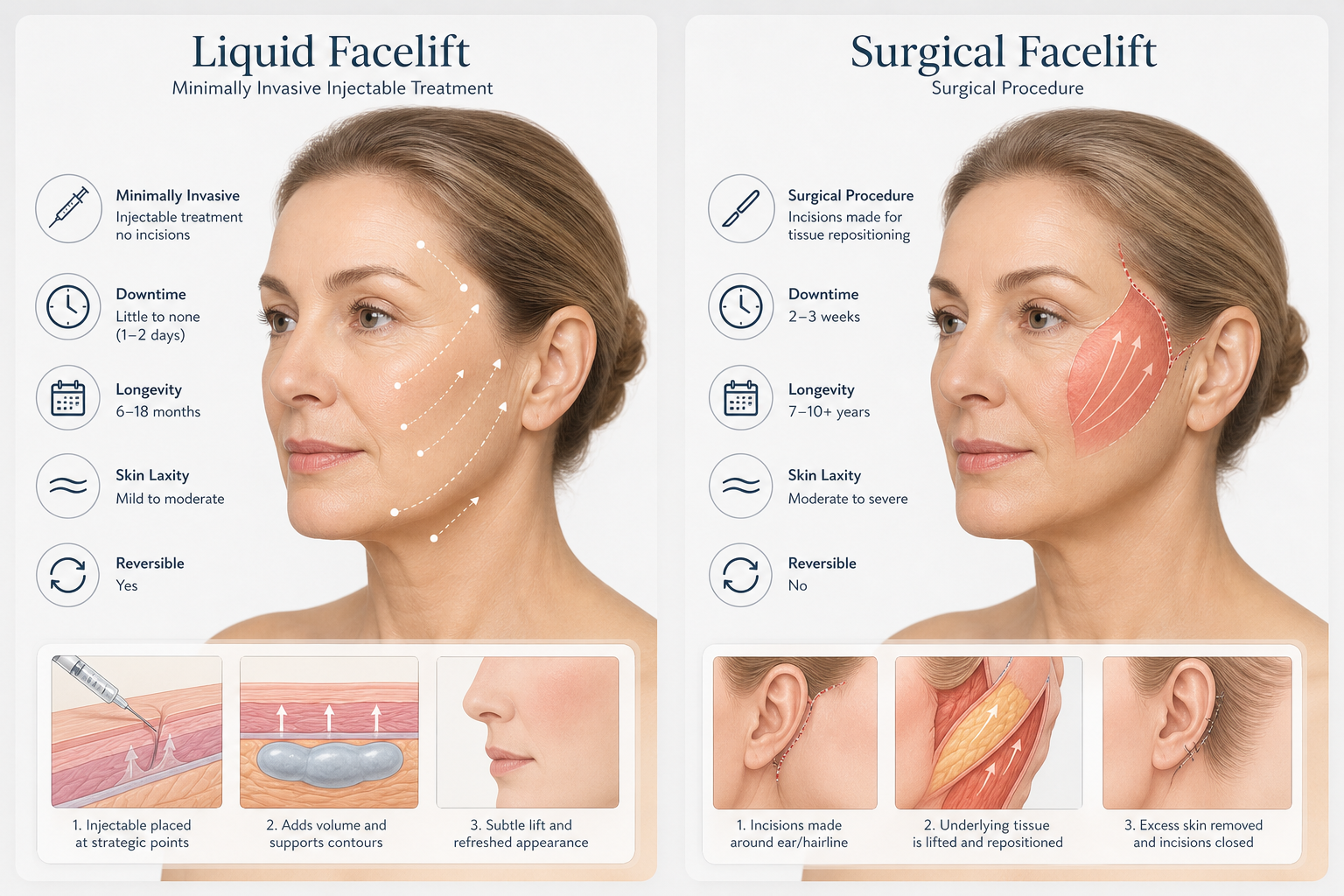
Understanding the difference between a liquid facelift and a surgical facelift is essential for making an informed decision. They address different aspects of facial ageing and are not interchangeable.
| Characteristic | Liquid Facelift | Surgical Facelift (Rhytidectomy) |
|---|---|---|
| Mechanism | Restores volume; improves contour with injectables | Repositions SMAS tissue; removes excess skin |
| Anaesthesia | Topical numbing cream / local anaesthetic | General anaesthesia or sedation |
| Downtime | Minimal — days | Significant — 2 to 4 weeks or more |
| Results onset | Immediate (with settling over 1–2 weeks) | Visible after swelling resolves — several weeks |
| Longevity | 6 months to 2 years depending on product | 7 to 10+ years |
| Addresses skin laxity | No — cannot tighten or remove loose skin | Yes — removes excess skin |
| Addresses true jowls | Partially — can camouflage early jowling | Yes — repositions tissue causing jowls |
| Reversibility | HA fillers reversible; others are not | Not reversible |
| Upfront cost | Lower (£2,000–£8,000+) | Higher (£10,000–£20,000+) |
| Long-term cost | Accumulates with repeat treatments | One-time cost with minimal maintenance |
| Best suited for | Mild-to-moderate ageing, volume loss, early jowling | Moderate-to-significant sagging, excess skin, advanced jowling |
A surgical facelift physically repositions the underlying SMAS (superficial musculoaponeurotic system) layer of the face and removes excess skin — something no injectable treatment can replicate. For patients with significant skin laxity, true jowling, or loose neck skin, surgery remains the most effective long-term solution. A liquid facelift can delay the need for surgery in some patients, but it cannot replace it, and attempting to compensate for significant tissue laxity with large volumes of filler risks an unnatural, overfilled appearance rather than a lifted one.
What a Liquid Facelift Cannot Do
Most promotional content focuses on what a liquid facelift can achieve. Equally important is understanding its limitations clearly before committing to treatment.
- It cannot remove excess or sagging skin. If skin laxity is the primary concern, injectables will not address it meaningfully.
- It cannot reposition descended tissue. True jowls are caused by tissue that has descended below the jawline; filler can partially camouflage this but cannot move the tissue back.
- It cannot replicate SMAS repositioning. The deep structural lift achieved by surgery is not achievable with injectables.
- It cannot address neck laxity. Loose skin on the neck and under the chin requires surgical intervention or energy-based devices.
- More filler does not equal a better lift. Overfilling — using excessive volumes in an attempt to compensate for tissue laxity — leads to an unnatural, heavy appearance sometimes described as “pillow face”. A skilled injector uses restraint and works with the patient’s anatomy rather than against it.
Who May Be a Suitable Candidate?
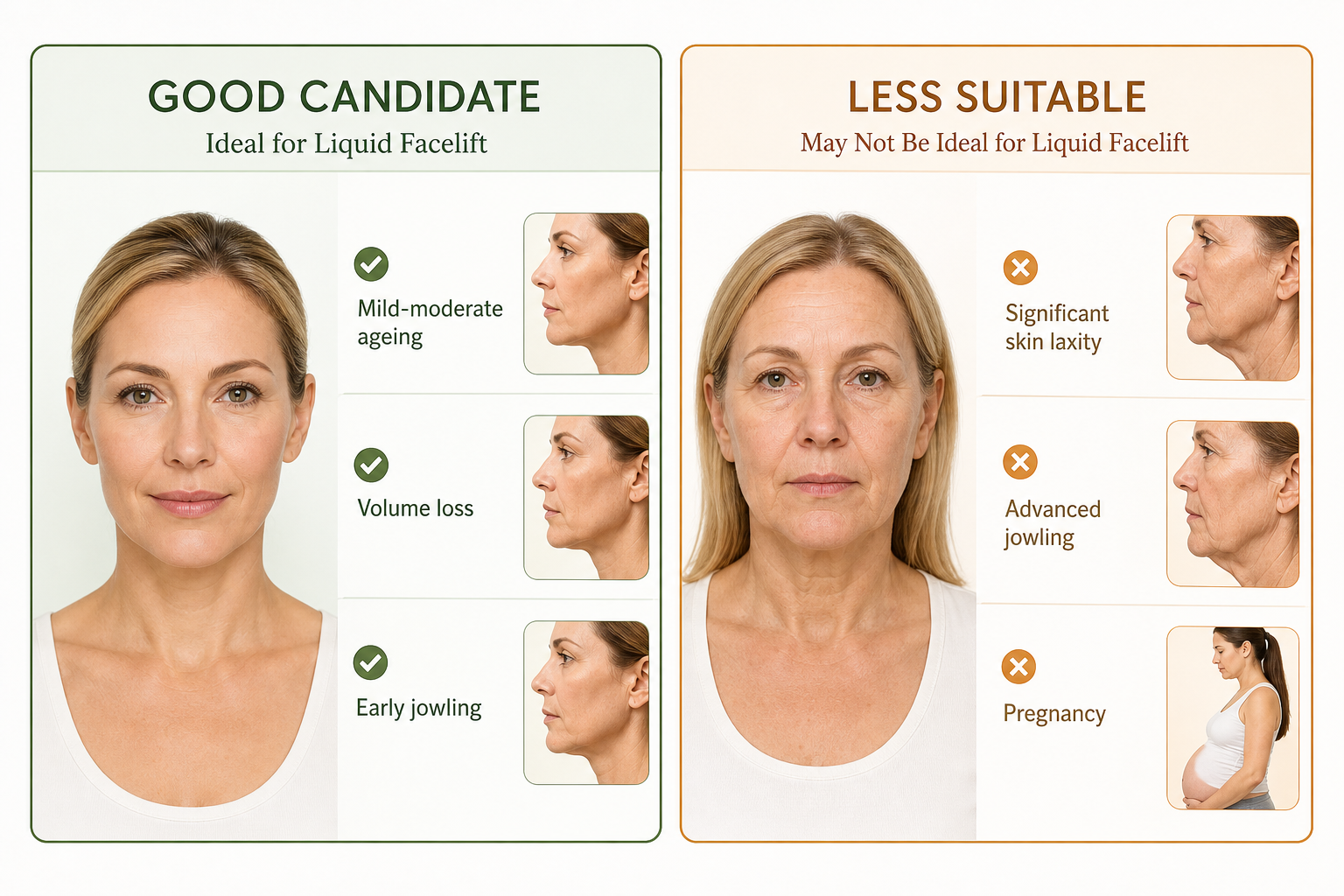
A liquid facelift may be worth discussing with a qualified practitioner if you:
- Are in your 30s, 40s, or 50s and are noticing early-to-moderate signs of facial ageing
- Have experienced noticeable volume loss in the cheeks, temples, or lower face
- Have mild-to-moderate nasolabial folds or marionette lines
- Have early jowling without significant skin excess
- Are not ready for or do not wish to undergo surgery
- Have realistic expectations about what injectable treatments can achieve
- Are in good general health with no active skin infections in the treatment area
A liquid facelift is generally less suitable for patients who:
- Have significant skin laxity or substantial excess skin
- Have advanced jowling or significant neck laxity
- Are pregnant or breastfeeding
- Have a history of severe allergic reactions or anaphylaxis
- Are taking blood-thinning medications (which increase bruising risk — discuss with your practitioner)
- Have unrealistic expectations or are seeking a result equivalent to surgery
Men are also suitable candidates for liquid facelift treatments, though male facial anatomy differs from female anatomy in meaningful ways — including greater bone density, different fat distribution, and different aesthetic goals. An injector experienced with male patients will approach the treatment plan differently, typically prioritising structural definition over softening.
Risks and Side Effects
A liquid facelift is a minimally invasive procedure, but it is not without risk. Understanding the possible side effects and complications is an important part of informed consent.
Common side effects — which are expected and usually temporary — include bruising, swelling, redness, and tenderness at the injection sites. These typically resolve within a few days to two weeks.
Less common but possible complications include:
- Asymmetry: Uneven results that may require correction with additional product or, in the case of HA fillers, dissolution with hyaluronidase.
- Nodules or lumps: Small lumps beneath the skin, which may resolve on their own or require treatment.
- Tyndall effect: A bluish discolouration that can occur if HA filler is placed too superficially, particularly in the under-eye area.
- Infection: Rare but possible; requires prompt medical attention.
- Allergic reaction: Uncommon with modern HA fillers but possible.
Rare but serious complications include vascular occlusion — where filler inadvertently enters or compresses a blood vessel, potentially causing tissue damage or, in very rare cases, vision changes or blindness if it affects vessels near the eye. This is a medical emergency. The risk is significantly reduced — though not eliminated — by choosing an injector with thorough knowledge of facial anatomy, who uses appropriate technique and has access to hyaluronidase for emergency use. This is one of the most important reasons why injector qualifications matter enormously.
Choosing the Right Injector
The safety and quality of a liquid facelift depend more on the person performing it than on the products used. When evaluating practitioners, look for:
- A medical background — doctor, dentist, nurse prescriber, or equivalent — with specific training in aesthetic injectables and facial anatomy
- Membership of a recognised professional body or aesthetic medicine organisation
- A thorough consultation process that includes a full medical history, discussion of risks, and a personalised treatment plan — not a one-size-fits-all approach
- A clinic that stocks hyaluronidase on-site for emergency use
- Before and after photographs of their own patients (not stock images)
- Transparent pricing and no pressure to purchase additional treatments
Red flags include practitioners who offer very low prices without explanation, who do not conduct a proper consultation, who cannot clearly explain the products they are using, or who promise results that sound too good to be true. A board-certified injector with genuine expertise will always prioritise your safety and a natural-looking result over volume of product used.
How Much Does a Liquid Facelift Cost?
Cost varies considerably depending on the clinic, the practitioner’s experience, the geographic location, and the number of products and syringes used. As a general guide, individual syringes of dermal filler typically cost between £300 and £700 each in the UK, and a comprehensive liquid facelift using multiple products across several areas may require four to eight or more syringes, placing the total cost anywhere from approximately £2,000 to £8,000 or more for a full treatment plan.
It is worth considering the long-term cost picture. Because results are temporary and maintenance treatments are required — typically every 12 to 18 months for most fillers, and every 3 to 4 months for neuromodulators — the cumulative cost over five years can approach or exceed the cost of a surgical facelift, which, while more expensive upfront, may last a decade or longer without significant maintenance. This does not make one option better than the other, but it is a practical consideration that is rarely discussed openly and deserves honest reflection before you begin a treatment programme.
Frequently Asked Questions
Is a liquid facelift safe?
When performed by a qualified, medically trained practitioner with thorough knowledge of facial anatomy, a liquid facelift has a well-established safety profile. Serious complications are rare but possible, and the risk is meaningfully reduced by choosing an experienced injector who uses appropriate technique and has emergency protocols in place. No injectable procedure is entirely without risk, and a thorough consultation should include an honest discussion of the potential side effects relevant to your treatment plan.
How long does a liquid facelift last?
Results vary by product: hyaluronic acid fillers typically last 6 to 18 months, Radiesse around 12 to 18 months, Sculptra up to 2 years, and neuromodulators 3 to 4 months. Because a liquid facelift usually combines products, different elements of the result will fade at different rates, and a maintenance schedule will be needed to sustain the overall outcome.
Can a liquid facelift replace surgery?
No. A liquid facelift and a surgical facelift address different aspects of facial ageing. Surgery repositions tissue and removes excess skin — something injectables cannot do. For patients with significant skin laxity, true jowling, or neck looseness, surgery remains the more effective long-term solution. A liquid facelift can delay the need for surgery in some patients and may be a useful option for those not yet ready for an operation, but it is not a permanent or equivalent alternative.
Will I look natural after a liquid facelift?
In experienced hands, a liquid facelift should produce a refreshed, natural-looking result rather than an obviously treated appearance. The risk of an unnatural outcome — including overfilling or asymmetry — increases when excessive volumes of product are used or when the injector lacks sufficient anatomical knowledge. Choosing a practitioner who prioritises restraint and works with your individual facial structure is the most important factor in achieving a natural result.
Can HA filler be dissolved if I am unhappy with the result?
Yes. Hyaluronic acid filler can be dissolved using an enzyme called hyaluronidase, which breaks down the filler relatively quickly. This is one of the key safety advantages of HA-based products. Radiesse and Sculptra are not reversible in the same way, which is why many practitioners recommend starting with HA fillers, particularly for patients who are new to injectables.
How many syringes will I need?
This depends entirely on your individual anatomy, the degree of volume loss, and the areas being treated. A comprehensive liquid facelift may use anywhere from two to eight or more syringes across multiple areas. Your practitioner should give you a clear estimate during your consultation, and a conservative approach — starting with less and reviewing — is generally preferable to over-treating in a single session.
Is a Liquid Facelift the Right Choice for You?
A liquid facelift can be a genuinely effective option for the right patient — someone with mild-to-moderate facial ageing, noticeable volume loss, and realistic expectations about what injectable treatments can achieve. In experienced hands, using a thoughtful combination of hyaluronic acid fillers, collagen stimulators, and neuromodulators, it is possible to create a meaningful improvement in facial contour, softness, and overall appearance without surgery, anaesthesia, or significant recovery time.
However, it is not a universal solution. It cannot address significant skin laxity, true jowling, or neck looseness, and attempting to compensate for these concerns with large volumes of filler is more likely to produce an unnatural result than a lifted one. The temporary nature of the results and the cumulative cost of maintenance treatments are also important practical factors that deserve honest consideration alongside the upfront appeal of a minimally invasive procedure.
If you are considering a liquid facelift, the most valuable first step is a thorough consultation with a medically qualified, experienced injector who will assess your anatomy honestly, explain what is and is not achievable, and develop a personalised treatment plan based on your goals rather than a standard protocol. That conversation — not the treatment itself — is where the most important decisions are made.