Hair Botox Price: What You’ll Pay and Why Costs Vary
Hair botox pricing varies considerably depending on where you live, how long your hair is, and the quality of the product used — so a single national average rarely tells the full story. This guide breaks down the realistic cost range for salon hair botox treatments, explains the specific factors that push prices up or down, compares professional salon services with at-home kits, and helps you evaluate whether the cost makes sense for your hair goals.
Key Takeaways
- Salon hair botox typically costs between $150 and $350 in the US, with prices in major cities such as New York, Miami, and Los Angeles often reaching $400–$500 or more.
- Hair length, hair density, damage level, product formula quality, and stylist expertise are the main factors that determine your individual cost per session.
- At-home hair botox kits are available for $30–$90, but professional-grade products and application technique significantly affect results and longevity.
- Results typically last 2–4 months, meaning most people need 3–4 sessions per year — a factor worth including when comparing annual treatment cost against alternatives.
- Unusually low prices can signal diluted or lower-quality formulas; understanding what drives cost helps you evaluate value rather than simply choosing the cheapest option.
What Is Hair Botox and Why Does It Have Nothing to Do with Needles?
Despite the name, hair botox contains no botulinum toxin and involves no injections. The term is a marketing label for a category of intensive deep conditioning treatment designed to smooth the hair cuticle, reduce frizz, and restore the appearance of damaged or over-processed hair. Professional formulas typically combine amino acids, hyaluronic acid, collagen, B vitamins, and in some premium products, caviar oil or keratin derivatives. These ingredients work by filling gaps in the hair shaft — a process sometimes called protein filling — which temporarily improves texture, shine, and manageability.
Hair botox is applied to clean, dry or towel-dried hair, left to process for a set period, and then sealed using heat from a flat iron. The treatment is formaldehyde-free in most reputable modern formulas, which distinguishes it from older keratin smoothing treatments. Because the process is purely topical and does not chemically alter the hair’s structure, it is generally considered lower-risk than chemical relaxers or traditional keratin treatments — though results are also less dramatic and less permanent.
Average Hair Botox Cost: What to Expect
In the United States, the average hair botox cost at a professional salon falls between $150 and $350 per session. This range covers the majority of mid-market salons serving clients with shoulder-length to long hair. At the lower end, you are more likely to find smaller independent salons in suburban or rural areas using mid-tier product lines. At the upper end, you will typically find established salons in urban centres, stylists with specialist training, or treatments using premium professional-grade product formulas.
In high-demand cities, prices frequently exceed this range. Salons in New York City, Miami, and Los Angeles commonly charge $200–$500 or more for a single session, reflecting higher operating costs, greater stylist demand, and the use of premium formulas. Internationally, the picture shifts significantly: salons in Turkey charge approximately $80–$150 for comparable treatments, while Canadian salons in Toronto and Montreal typically charge CAD $150–$440, and UK salons generally price sessions at £80–£200.
| Location | Typical Price Range |
|---|---|
| US national average | $150–$350 |
| New York City / Miami / Los Angeles | $200–$500+ |
| Canada (Toronto / Montreal) | CAD $150–$440 |
| United Kingdom | £80–£200 |
| Turkey | $80–$150 |
Factors That Affect Hair Botox Price
No two hair botox appointments are priced identically because several variables interact to determine the final cost. Understanding these factors helps you anticipate your own quote and evaluate whether a price is reasonable for what is being offered.
Hair Length Tiers
Hair length is the most consistent pricing variable across salons. Most salons use a tiered pricing structure based on four broad categories: short (above the chin), medium (chin to shoulder), long (shoulder to mid-back), and extra long (below mid-back). Longer hair requires more product and more time to apply and heat-seal, both of which increase cost. The table below shows typical US price ranges by hair length tier.
| Hair Length | Approximate US Price Range | Typical Treatment Time |
|---|---|---|
| Short (above chin) | $100–$180 | 1.5–2 hours |
| Medium (chin to shoulder) | $150–$250 | 2–2.5 hours |
| Long (shoulder to mid-back) | $200–$350 | 2.5–3.5 hours |
| Extra long (below mid-back) | $300–$500+ | 3.5–4.5 hours |
Hair Density and Thickness
Hair density — the number of strands per square centimetre of scalp — affects how much product a stylist needs to use. A client with fine, low-density hair may require significantly less product than someone with thick, high-density hair of the same length. Many salons factor this into their pricing either through a surcharge for thick or dense hair or by quoting after an in-person assessment. If you have particularly thick or coarse hair, expect your quote to sit toward the upper end of the length-tier range.
Hair Damage Level and Porosity
Hair porosity — how readily the hair shaft absorbs and retains moisture — is a less commonly discussed but meaningful pricing variable. Severely damaged, bleached, or highly porous hair often requires more product to achieve adequate saturation, and in some cases a longer processing time. Color-treated hair and over-processed hair may also need a pre-treatment clarifying step, which can add time and cost. Stylists who assess hair condition before quoting are generally providing a more accurate and honest price than those who offer a flat rate without examining the hair first.
Product Formula and Brand Quality
The product used during your treatment is one of the most significant cost drivers, yet it is rarely explained clearly to clients. Professional-grade formulas from established brands contain higher concentrations of active ingredients — hyaluronic acid, amino acids, collagen, B5, and in premium lines, caviar oil or plant-derived proteins. These ingredients cost more to source and formulate, and they tend to produce more noticeable frizz-free results with better treatment longevity. A salon using a budget formula may charge less per session, but if results fade after six weeks rather than three to four months, the cost-per-month value is actually worse. When comparing quotes, it is reasonable to ask which product brand and formula will be used.
Stylist Expertise and Salon Reputation
Stylist expertise directly influences pricing. A stylist with specialist training in smoothing treatments, extensive experience with different hair types, or a strong portfolio of results will typically charge more than a generalist. Salon reputation — built through reviews, word of mouth, and visible results — also commands a premium. This is not simply a prestige surcharge: experienced stylists are more likely to apply the product evenly, use the correct heat-sealing technique, and advise accurately on aftercare, all of which affect how long your results last.
Salon Location and Geographic Demand
Salon location affects pricing in two ways: operating costs and local demand. Urban salons in high-rent areas pass higher overheads on to clients. Geographic demand also plays a role — in cities with high humidity such as Miami or Houston, frizz management treatments are in greater demand year-round, which can support higher pricing. Rural and suburban salons generally have lower overheads and face less competitive pressure on premium pricing, which is often reflected in more accessible rates.
Add-On Services and Hidden Costs
The quoted price for a hair botox treatment does not always represent the total cost of your appointment. Hidden costs worth clarifying before booking include a blowout or blow-dry finish (sometimes charged separately), a haircut or trim if required before treatment, a pre-treatment clarifying shampoo service, and a post-treatment product kit recommended by the salon. Some salons also charge a consultation fee, though many apply this toward the treatment cost if you proceed. Tipping is customary in US salons and typically ranges from 15–20% of the service total, which can add $25–$70 to a mid-range appointment. Asking for a fully itemised quote before your appointment avoids surprises.
Salon Hair Botox vs. At-Home Kits: Cost Comparison
At-home hair botox kits are widely available from brands including Inoar, Nutree Professional, GK Hair, and Felps, with retail prices typically ranging from $30 to $90 per kit. A single kit usually provides one to two applications depending on hair length, making the per-application cost significantly lower than a salon visit. For budget-conscious consumers, this is an appealing option.
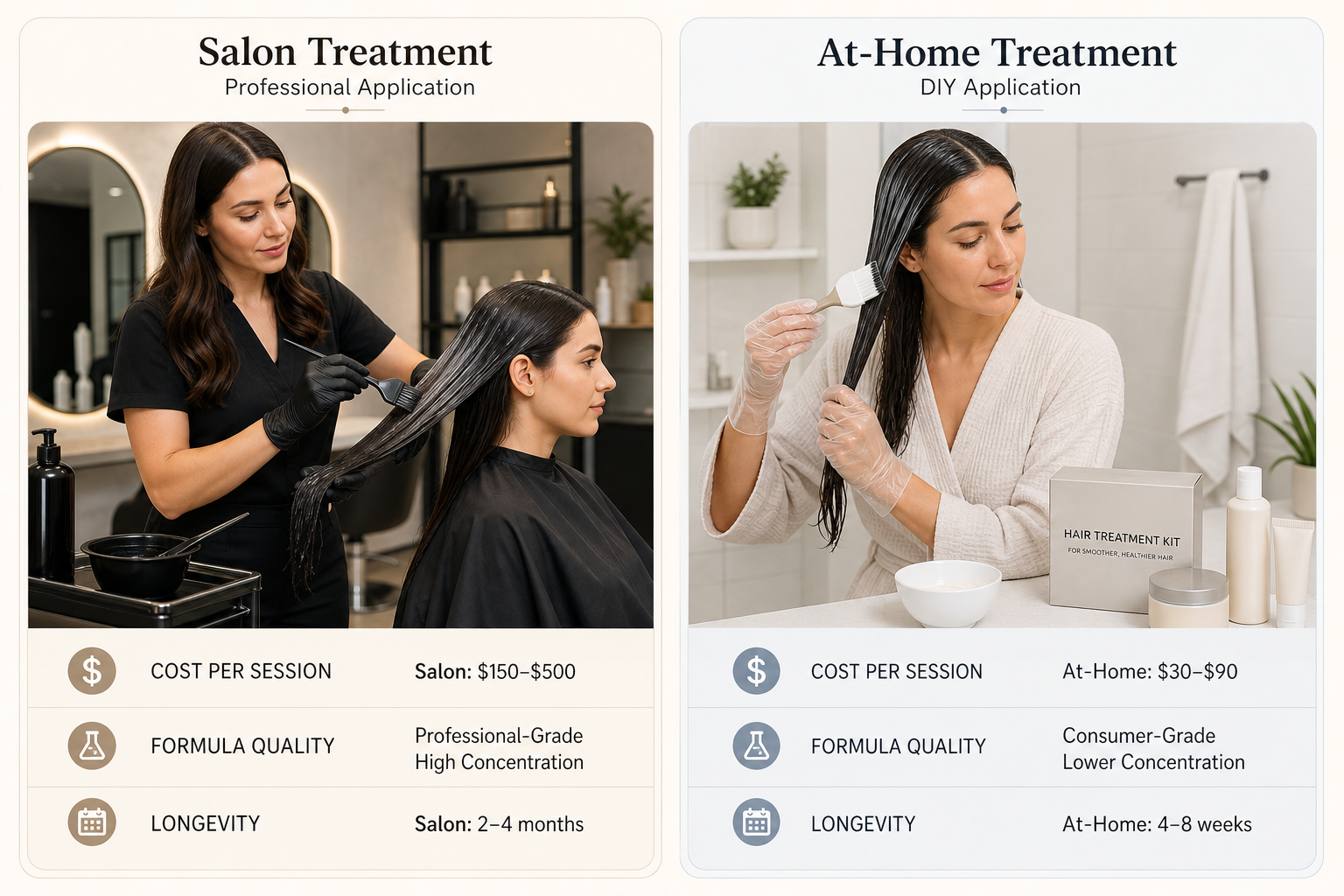
However, the comparison is not straightforward. At-home kits use consumer-grade formulas with lower active ingredient concentrations than professional salon products, which typically cost salons $15–$30 per application at wholesale. The heat-sealing step — critical for locking in the treatment — requires a professional-grade flat iron and the technique to use it correctly. Uneven application or incorrect heat settings can result in patchy results or, in some cases, unnecessary heat damage. For clients with color-treated hair, highly porous hair, or significant damage, professional application is generally the more reliable choice.
| Salon Treatment | At-Home Kit | |
|---|---|---|
| Typical cost per session | $150–$500+ | $30–$90 |
| Formula quality | Professional-grade | Consumer-grade |
| Application technique | Trained stylist | Self-applied |
| Expected longevity | 2–4 months | 4–8 weeks typically |
| Suitable for damaged/porous hair | Generally yes | With caution |
| Annual cost (3–4 sessions) | $450–$2,000+ | $90–$360 |
Cost-Per-Month Value: A More Useful Way to Compare
Because hair botox results typically last 2–4 months, calculating cost per month gives a clearer picture of value than comparing session prices alone. A $250 salon treatment that delivers three months of frizz-free results costs approximately $83 per month. A $90 at-home kit that fades after six weeks costs roughly $60 per month — a smaller difference than the headline prices suggest, particularly when you factor in the time and effort of self-application and the likelihood of less consistent results.
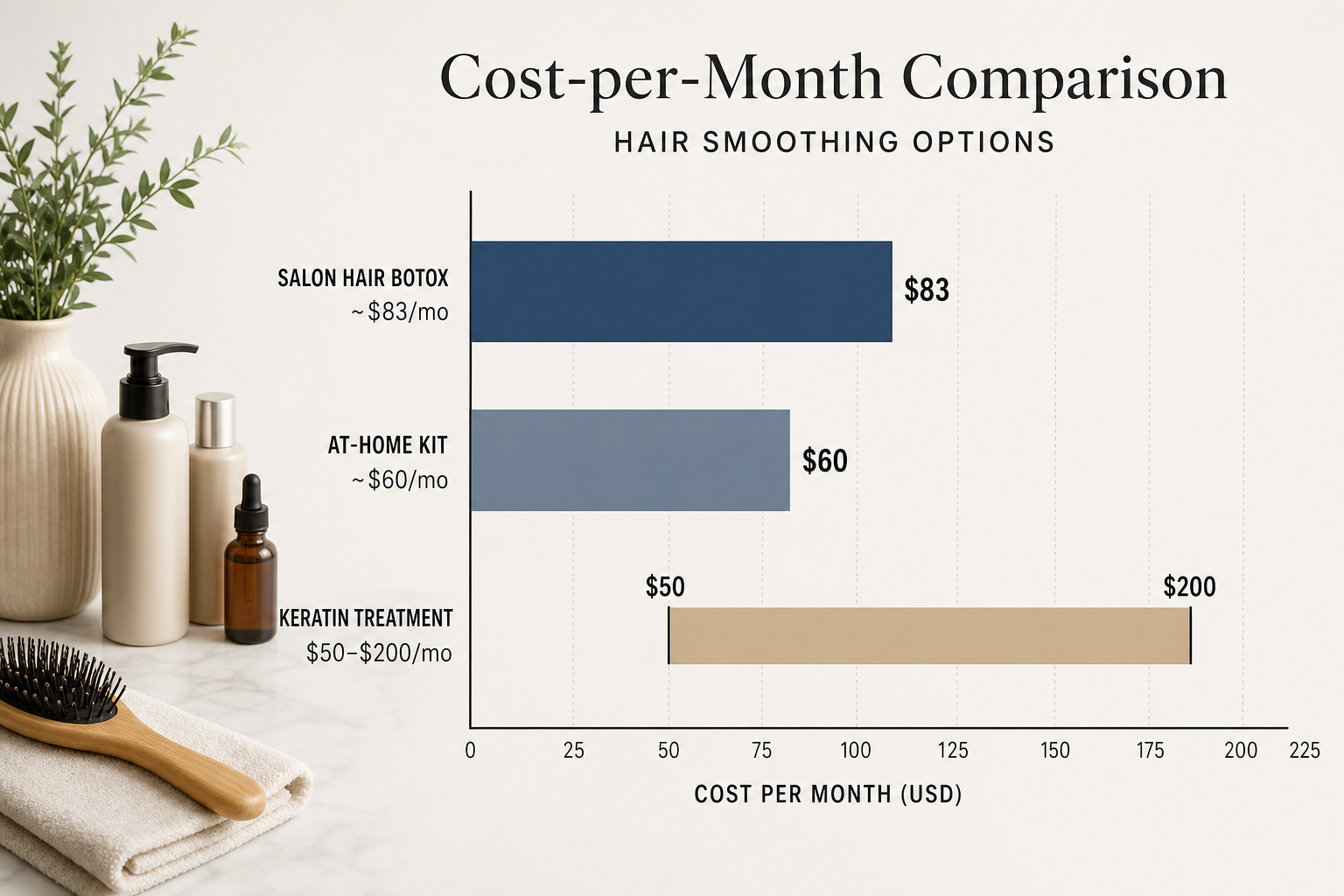
This framing also helps when comparing hair botox against keratin treatments. A professional keratin treatment typically costs $300–$800 per session but may last four to six months, producing a cost-per-month figure of $50–$200 depending on the salon and formula. Keratin treatments generally deliver more dramatic smoothing and longer-lasting results, but they involve stronger chemicals, longer processing times, and in some formulas, formaldehyde or formaldehyde-releasing agents. Hair botox, being formaldehyde-free and less chemically intensive, suits clients who want meaningful frizz reduction without committing to a full chemical smoothing process.
Hair Botox vs. Keratin Treatment: Which Costs More Overall?
Keratin treatments and hair botox are frequently compared because both target frizz and improve manageability, but they differ in mechanism, intensity, and cost structure. Keratin treatments chemically bond a keratin protein layer to the hair shaft, producing more lasting structural change. Hair botox fills and coats the cuticle without chemically altering the hair’s bonds, making it a gentler option with a shorter result window.
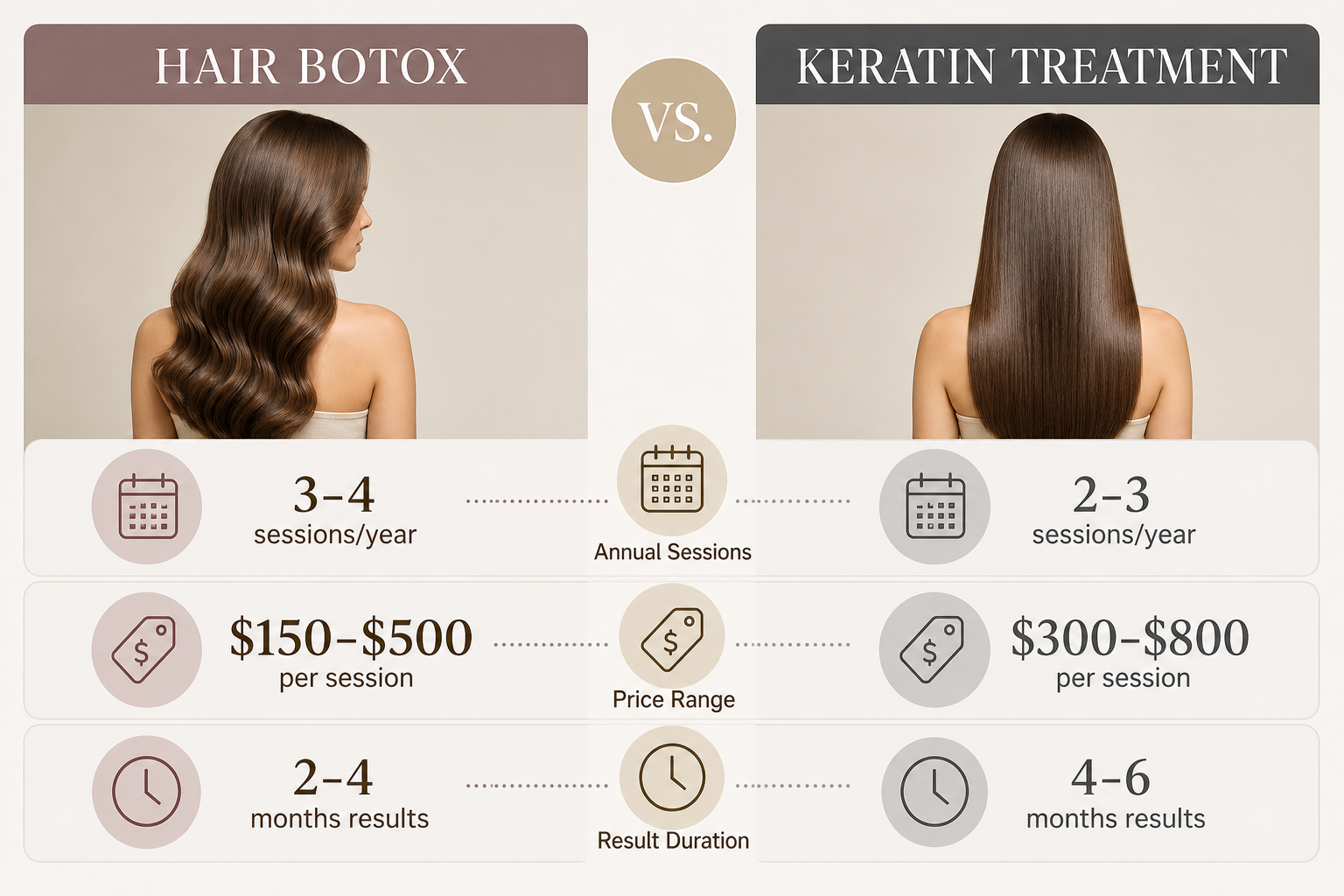
| Hair Botox | Keratin Treatment | |
|---|---|---|
| Typical cost per session | $150–$500 | $300–$800 |
| Results duration | 2–4 months | 4–6 months |
| Sessions per year | 3–4 | 2–3 |
| Approximate annual cost | $450–$2,000 | $600–$2,400 |
| Formaldehyde-free options | Yes (most formulas) | Varies by brand |
| Effect on curl pattern | Minimal to moderate | Moderate to significant |
| Suitable for damaged hair | Generally yes | Caution with very damaged hair |
Annual treatment cost for hair botox and keratin treatments can be comparable when you account for the difference in session frequency. The right choice depends on your hair type, how much smoothing you want, your sensitivity to chemicals, and your budget for individual sessions versus annual spend.
Red Flags: When a Low Price Is a Warning Sign
Unusually low prices for salon hair botox — particularly deals significantly below the local market rate — are worth approaching with caution. Deeply discounted treatments may use diluted formulas, budget products with minimal active ingredients, or shortened processing times that reduce effectiveness. In some cases, products marketed as hair botox contain ingredients that are not formaldehyde-free, which poses a health concern in poorly ventilated spaces. A treatment priced at $50–$80 in a market where comparable services cost $200 or more warrants a direct question about which product is being used and whether the formula has been independently verified as safe.
This does not mean that affordable salons are unreliable — smaller salons with lower overheads can offer genuine value. The concern is specifically with prices that are implausibly low relative to the local market, or with heavily discounted voucher deals that do not specify the product or formula being used.
Men’s Hair Botox Pricing
Men’s hair botox is an increasingly available service at salons that offer smoothing treatments, and it is typically priced differently from women’s services. Because men generally have shorter hair, the per-session cost is often lower — commonly $80–$180 for short to medium-length hair. However, men with longer hair, thick density, or significant scalp coverage may find their quotes align more closely with standard length-tier pricing. Some salons list men’s hair botox as a distinct service category with its own pricing; others simply apply the standard hair length tiers regardless of gender.
How to Get Better Value Without Compromising Quality
Several practical approaches can reduce the cost of hair botox without sacrificing results. Booking during off-peak times — weekday mornings or early afternoons — may make you eligible for promotional pricing at salons that use dynamic scheduling. Some salons offer package deals for clients who commit to three or four sessions in advance, reducing the per-session cost by 10–20%. Loyalty programmes at established salons can also accumulate meaningful discounts over time for repeat clients.
Extending the interval between sessions through careful aftercare is another effective way to reduce annual treatment cost. Using a sulfate-free aftercare shampoo and conditioner, avoiding washing hair for 48–72 hours after treatment, and minimising heat styling between sessions can meaningfully extend treatment longevity — sometimes pushing a two-month result closer to three or four months. This alone can reduce the number of sessions needed per year from four to three, saving $150–$350 annually at mid-market prices.
Frequently Asked Questions
How long does hair botox last?
Hair botox results typically last 2–4 months, depending on hair type, the formula used, and how well aftercare instructions are followed. Fine or low-porosity hair may retain results longer, while highly porous or frequently washed hair may see fading sooner. Using a sulfate-free shampoo and avoiding chlorinated water can help extend longevity.
Is hair botox the same as a keratin treatment?
No. Hair botox is a deep conditioning treatment that coats and fills the hair cuticle using ingredients such as amino acids, hyaluronic acid, and collagen. Keratin treatments chemically bond a protein layer to the hair shaft, producing more lasting structural smoothing. Hair botox is generally gentler, formaldehyde-free in most modern formulas, and better suited to clients who want frizz reduction without significant curl alteration.
Can I do hair botox at home to save money?
At-home hair botox kits are available and cost considerably less than salon treatments. However, consumer-grade formulas contain lower concentrations of active ingredients, and correct heat-sealing technique is important for results. For healthy hair with mild frizz concerns, an at-home kit may be a reasonable option. For color-treated, bleached, or significantly damaged hair, professional application is generally more reliable and reduces the risk of uneven results.
Does hair botox work on color-treated hair?
Hair botox is generally considered compatible with color-treated hair and is often recommended as a restorative treatment for hair that has been weakened by coloring or bleaching. However, the condition of the hair matters: severely over-processed hair may require a stylist assessment before treatment to determine whether the hair is strong enough to tolerate the heat-sealing step. Always inform your stylist of any recent chemical services before booking.
Should I tip for a hair botox treatment?
Tipping is standard practice in US salons. A tip of 15–20% of the service total is customary. On a $250 treatment, this adds $37–$50. If your appointment includes add-on services such as a blowout or trim, tipping on the full service total is appropriate. Some clients tip the stylist and any assisting staff separately.
How many sessions per year will I need?
Most clients require 3–4 sessions per year to maintain consistent results, as hair botox typically lasts 2–4 months. Clients with very porous or frequently washed hair may need sessions closer to every 8–10 weeks. Careful sulfate-free aftercare can extend the interval between sessions and reduce annual treatment cost.
Are there any risks or side effects with hair botox?
Hair botox is generally well tolerated. The most common concerns are scalp sensitivity to specific formula ingredients and the risk of heat damage if the flat iron step is performed incorrectly or at too high a temperature. Allergic reactions to formula ingredients are uncommon but possible; a patch test is advisable if you have a history of product sensitivities. Choosing a reputable formaldehyde-free formula from a verified brand reduces the risk of chemical irritation.
Is Hair Botox Worth the Cost for Your Hair Goals?
Whether hair botox represents good value depends on what you are trying to achieve and how you weigh cost against convenience, longevity, and the alternatives. For clients with frizzy, dry, or mildly damaged hair who want a noticeable improvement in texture and manageability without committing to a chemical smoothing process, hair botox offers a reasonable cost-per-month value — particularly when aftercare is followed consistently. The formaldehyde-free profile of most modern formulas also makes it a more accessible option for clients who have concerns about chemical exposure.
For clients seeking more dramatic or longer-lasting smoothing, a keratin treatment may deliver better value despite the higher per-session cost, because fewer annual sessions are needed. For those with a very limited budget, a quality at-home hair botox kit used correctly can provide meaningful improvement, though results will generally be less consistent and shorter-lived than professional treatment.
The most reliable way to assess whether hair botox is appropriate for your hair type and condition is to consult with an experienced stylist who can evaluate your hair’s porosity, damage level, and texture before recommending a treatment plan and providing an accurate, itemised quote. A stylist who takes time to assess your hair before quoting is generally a more trustworthy choice than one who offers a flat rate without examination.