Exercise After Rhinoplasty: A Week-by-Week Guide to Returning to the Gym
Returning to exercise after rhinoplasty is one of the most common concerns for active patients, and for good reason — the restrictions are more specific, and last longer, than most people expect. This guide explains exactly why exercise is limited after a nose job, provides a practical week-by-week timeline, covers individual activities from walking and yoga to weight lifting and contact sports, and highlights the warning signs that mean you should stop and rest. Whether you are a casual gym-goer or a competitive athlete, understanding the physiology behind the restrictions will help you protect your rhinoplasty results while minimising deconditioning during recovery.
Key Takeaways
- Most patients can resume light walking within the first few days, but strenuous exercise should be avoided for at least six weeks after rhinoplasty.
- Elevated blood pressure and heart rate are the primary concerns — both increase nasal swelling, the risk of nosebleeds, and pressure on healing nasal structures.
- A gradual return to exercise, guided by your surgeon’s clearance at each follow-up, is the safest approach for protecting your result.
- Contact sports after rhinoplasty require a minimum of three months before resumption, due to the risk of accidental trauma to the nose.
- Individual timelines vary depending on the extent of the procedure, whether osteotomies were performed, and your general health and fitness level.
Why Exercise Is Restricted After Rhinoplasty
Rhinoplasty involves reshaping bone, cartilage, and soft tissue inside and around the nose. During the first six to eight weeks, the nasal bones are actively healing and remain more vulnerable to displacement than they will be once fully consolidated. The cartilage and surrounding soft tissues are also in an active remodelling phase that continues for up to twelve months. Any activity that significantly raises your heart rate or blood pressure during this period creates a cascade of effects that can compromise the outcome.
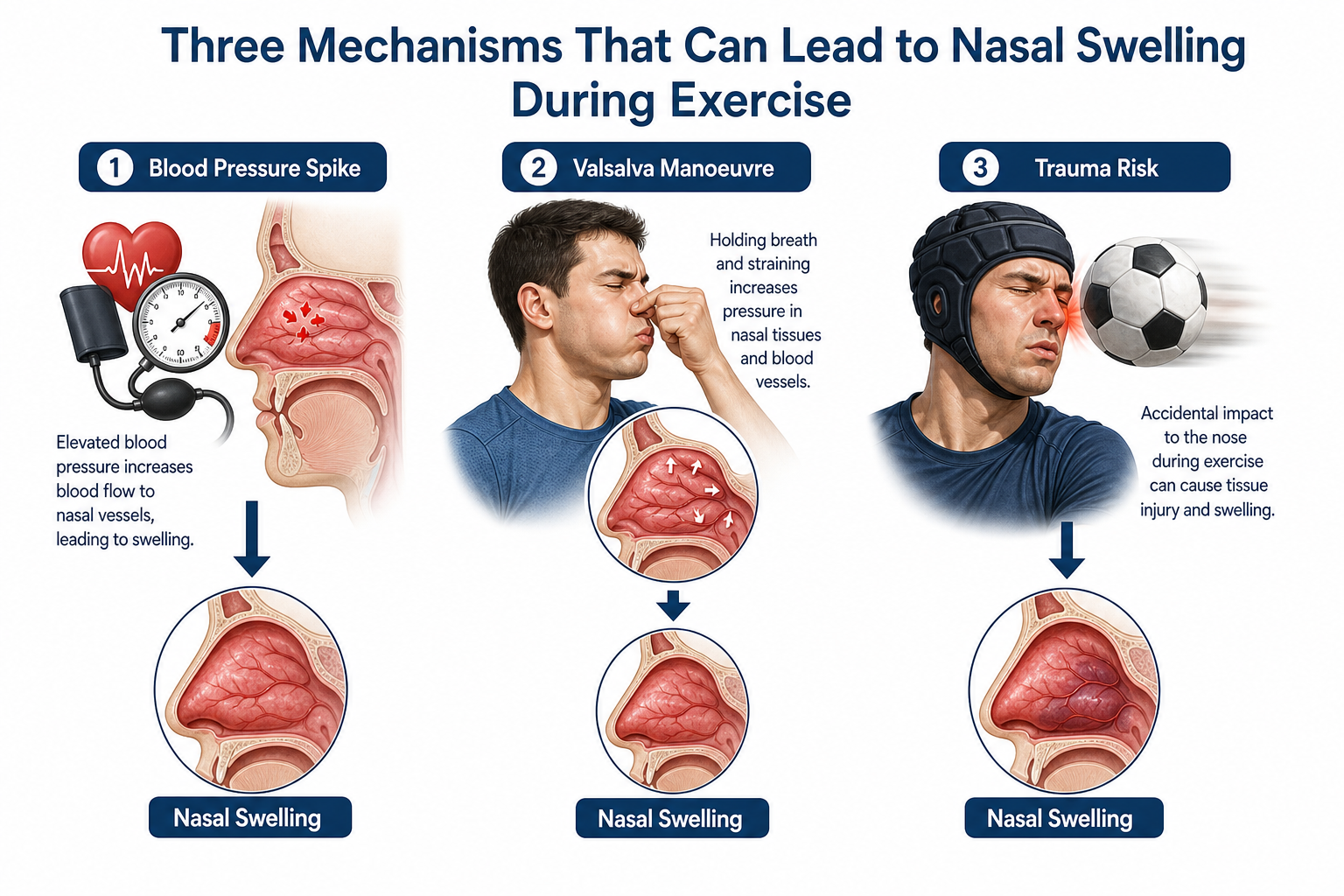
When blood pressure rises during exercise, blood flow to the face increases substantially. This worsens post-operative swelling and bruising, and can trigger nosebleeds from fragile healing vessels. Prolonged or repeated episodes of elevated blood pressure may also slow the resolution of oedema, meaning swelling that would otherwise settle in weeks can persist for months. Beyond swelling, there is a direct mechanical risk: a fall, collision, or even an accidental knock during exercise can displace healing nasal bones or cartilage before they have consolidated — potentially altering the surgical result.
A less commonly explained mechanism is the Valsalva manoeuvre — the involuntary breath-holding and straining that occurs during heavy lifting, intense resistance training, or maximal effort. This manoeuvre sharply increases intrathoracic and intracranial pressure, which in turn spikes pressure within the nasal tissues. For healing nasal structures, this pressure surge is particularly problematic in the first four to six weeks. It is one of the main reasons weight lifting and high-intensity exercise carry a higher risk than low-impact cardio during early recovery.
Finally, intense exercise diverts metabolic resources — oxygen, nutrients, and growth factors — toward working muscles and away from healing tissues. While the body is capable of managing both, reducing the competition for these resources during the critical early weeks supports faster, cleaner healing.
Week-by-Week Exercise Timeline After Rhinoplasty
The following timeline reflects general guidance used across surgical practice. Your own surgeon’s recommendations take precedence, and you should always obtain surgeon’s clearance before progressing to a new activity level. Individual factors — including the complexity of your procedure, your fitness baseline, and how your recovery is progressing — will influence the appropriate pace.
| Recovery Stage | What You Can Do | What to Avoid | Key Reason |
|---|---|---|---|
| Week 1 | Rest; gentle indoor light walking (5–10 min); head elevation | All formal exercise; bending head below heart level | Acute swelling and bruising; nasal bones most vulnerable |
| Weeks 2–3 | Gentle outdoor walking (15–20 min); very light stretching (upright only) | Jogging, cycling, resistance training, yoga inversions | Blood pressure still easily elevated; oedema resolving |
| Weeks 3–4 | Brisk walking; stationary cycling at low resistance; treadmill walking | Running, weight training, HIIT, swimming | Nasal bones still consolidating; infection risk from pools |
| Weeks 4–6 | Light cardio (elliptical, stationary bike at moderate effort); bodyweight squats; upright yoga poses | Heavy lifting, running, HIIT, swimming, road cycling | Valsalva risk with loaded exercises; fall risk outdoors |
| Week 6+ (with clearance) | Light jogging; light dumbbell training; most gym machines; swimming (if incisions fully healed) | Contact sports; maximal lifting; high-impact HIIT | Bone healing largely complete but remodelling continues |
| 3 Months+ | Full training intensity; contact sports; martial arts; team sports | Unprotected contact sports (consider protective gear) | Full structural consolidation; trauma risk remains real |
Activity-by-Activity Breakdown
Different types of exercise carry different levels of risk after rhinoplasty. Understanding which activities are safest — and why specific ones require a longer wait — helps you plan a structured return to your fitness routine without guesswork.
Walking
Light walking is the one form of exercise that is generally safe from the first day or two after rhinoplasty. Short, gentle walks promote circulation, reduce the risk of blood clots, and support overall recovery without meaningfully raising blood pressure. Begin with five to ten minutes indoors and gradually increase duration over the first two weeks. Avoid walking in direct sun during early recovery, as heat and UV exposure can worsen swelling and affect incision healing.
Running and Jogging
Running after rhinoplasty should be avoided for at least four to six weeks. The jarring, repetitive impact of running raises heart rate significantly and creates rhythmic pressure changes in the head and face. Most surgeons recommend waiting until the six-week mark and then beginning with light jogging on a flat surface, monitoring the nose carefully after each session. If you notice increased nasal swelling or a throbbing sensation, reduce intensity and allow more recovery time before trying again.
Weight Lifting and Resistance Training
Heavy lifting after rhinoplasty carries a specific risk beyond general cardiovascular strain. The Valsalva manoeuvre — the breath-holding and bearing-down that naturally accompanies maximal or near-maximal lifts — creates sharp pressure spikes that can affect healing nasal tissue. For this reason, most surgeons advise avoiding weight training for a minimum of six weeks. When you do return to the gym, use lighter dumbbells rather than barbells (which are harder to safely lower if you lose control), focus on controlled breathing throughout each repetition, and avoid any exercise that requires you to hold your breath or strain.
HIIT and High-Intensity Cardio
HIIT after rhinoplasty should be avoided for at least six weeks, and ideally until your surgeon confirms that healing is progressing well. High-intensity interval training combines rapid heart rate elevation with explosive movements, both of which increase blood pressure and the risk of nasal swelling or bleeding. When you return to HIIT, begin with lower-intensity intervals and longer rest periods, and build back gradually over several weeks rather than returning to your pre-surgery intensity immediately.
Swimming
Swimming after rhinoplasty is typically restricted for four to six weeks. The primary concerns are infection risk from pool chemicals and open water entering healing nasal passages, and the physical effort of swimming laps, which raises heart rate substantially. Once your surgeon confirms that all incisions are fully healed and closed, swimming in a clean pool is generally acceptable — but avoid diving, which creates sudden pressure changes, for at least three months.
Yoga
Yoga after rhinoplasty can be reintroduced in stages. Gentle, upright poses and breathing exercises are generally safe from around weeks two to three. However, yoga inversions — poses such as downward dog, headstand, shoulder stand, or any position where the head drops below the level of the heart — should be avoided for at least four to five weeks. Inversions increase blood flow to the face and raise nasal pressure, which can worsen swelling and bruising. When you return to a full yoga practice, inform your instructor about your recovery so they can suggest modifications.
Cycling
Stationary cycling at low resistance is one of the earlier cardio options available during rhinoplasty recovery, typically from around weeks three to four. Road cycling and outdoor cycling carry an additional risk of falls, which could result in accidental trauma to the nose, and are generally better deferred until at least six weeks post-operatively. Always wear a properly fitted helmet when you return to outdoor cycling.
Contact Sports
Contact sports after rhinoplasty — including football, basketball, boxing, martial arts, rugby, and hockey — require the longest waiting period of any activity. A minimum of three months is the standard recommendation, and some surgeons advise longer depending on the extent of the procedure. Even after three months, the nose remains at risk of injury from direct impact, and wearing appropriate protective equipment is strongly advisable. If you compete at a high level, discuss a sport-specific return-to-play plan with your surgeon well in advance.
Factors That Affect Your Individual Timeline
The week-by-week timeline above reflects general guidance, but several individual factors can shift the appropriate pace of your return to exercise after rhinoplasty.
- Open vs. closed rhinoplasty recovery: Open rhinoplasty involves an external incision across the columella (the strip of tissue between the nostrils), while closed rhinoplasty uses incisions entirely inside the nose. In practice, the exercise timeline is broadly similar for both techniques. Closed rhinoplasty may produce slightly less early tip swelling in some patients, but this does not meaningfully accelerate the return to strenuous exercise, because the underlying bone and cartilage healing follows the same biological timeline regardless of approach.
- Whether osteotomies were performed: An osteotomy involves controlled fracturing and repositioning of the nasal bones to narrow or straighten the nose. If your rhinoplasty included osteotomies, the nasal bones require additional time to consolidate, and your surgeon may recommend a more conservative exercise timeline during the first six weeks.
- Extent of the procedure: A limited tip refinement rhinoplasty generally involves less structural disruption than a full structural rhinoplasty addressing the bridge, tip, and septum simultaneously. More extensive procedures typically warrant a more cautious return to exercise.
- Revision rhinoplasty: Revision procedures — performed to refine or correct a previous rhinoplasty — often involve more complex tissue manipulation and scar tissue management. Recovery from revision rhinoplasty can be slower, and the exercise timeline may need to be extended beyond the standard guidance for a primary procedure. Discuss this specifically with your surgeon.
- Combined septoplasty: Some patients undergo septoplasty (correction of a deviated septum) at the same time as rhinoplasty. The addition of internal septal work does not dramatically change the exercise timeline, but nasal congestion and restricted airflow during early recovery may limit your exercise capacity more than the structural healing alone.
- Your general health and fitness level: Patients who are highly fit before surgery tend to recover efficiently, but this does not mean they can return to exercise sooner — the healing biology of nasal bone and cartilage is not accelerated by cardiovascular fitness. What fitness does help with is tolerating the deconditioning period and rebuilding capacity more quickly once cleared.
Breathing During Exercise After Rhinoplasty
Many patients underestimate how much nasal congestion affects their ability to exercise during early recovery. Rhinoplasty causes temporary swelling of the nasal lining, which can significantly restrict airflow through the nose for several weeks. This means that even low-intensity exercise may feel more effortful than usual, because you may be breathing predominantly through your mouth. This is normal and temporary. Avoid the temptation to push harder to compensate — the perceived effort is a useful signal to keep intensity moderate. As swelling resolves over weeks four to eight, nasal airflow typically improves, and exercise capacity returns closer to your pre-surgery baseline.
Does Sweating Affect Rhinoplasty Healing?
Sweating itself does not directly harm rhinoplasty healing. Sweat does not penetrate closed incisions or damage healing cartilage. The concern with exercise is not the sweat — it is the blood pressure spike and elevated heart rate that accompany the activity producing the sweat. That said, if you are exercising outdoors in warm conditions, excessive heat can worsen facial swelling and increase sun exposure to healing skin, both of which are worth avoiding in the first four to six weeks. If you return to the gym before your incisions are fully mature, keep the environment cool and avoid steam rooms and saunas, which raise skin temperature and can increase swelling.
Practical Tips for Returning to the Gym After Rhinoplasty
A structured, gradual return to exercise is far safer than attempting to resume your previous routine all at once. The following practical measures help protect your rhinoplasty results while you rebuild fitness.
- Start conservatively and build slowly. Begin with 15 to 20 minutes of low-impact exercise per session and increase duration by approximately five minutes per week as tolerated. Monitor how your nose looks and feels after each session before progressing.
- Inform your personal trainer. If you work with a trainer, explain your recovery status and the restrictions in place. A good trainer can modify your programme to avoid contraindicated exercises and help you maintain strength and conditioning within safe parameters.
- Use dumbbells rather than barbells for early resistance work. Dumbbells are easier to lower safely if you lose control, reducing the risk of a sudden strain or Valsalva manoeuvre. Keep loads light and focus on controlled breathing — exhale on the effort, inhale on the return, and never hold your breath.
- Keep your head above your heart. Avoid any exercise that requires you to bend forward with your head below heart level, including certain stretches, deadlifts, and bent-over rows, until your surgeon confirms it is safe to do so.
- Wear protective eyewear carefully. If you normally wear glasses or sports goggles during exercise, be aware that frames resting on the nasal bridge can put pressure on healing structures. Many surgeons advise avoiding glasses on the nose for four to six weeks; tape-supported frames or contact lenses are common alternatives during this period.
- Protect your nose from sun exposure. Outdoor exercise exposes healing skin to UV radiation, which can worsen post-inflammatory pigmentation and slow skin remodelling. Apply a high-SPF sunscreen to the nose and surrounding area whenever exercising outdoors after the first two weeks.
- Attend all follow-up appointments. Your post-op appointments are the appropriate time to ask about progressing your exercise routine. Do not rely on general timelines alone — your surgeon can assess your individual healing and give specific clearance for the next stage of activity.
Warning Signs to Stop Exercising
Even when following a conservative return-to-exercise plan, certain symptoms indicate that you should stop immediately and contact your surgical team. These warning signs suggest that the activity is placing too much stress on healing nasal structures or the cardiovascular system.
- A throbbing or pulsing sensation in or around the nose during or after exercise
- A sudden or noticeable increase in nasal swelling after a workout
- A nosebleed during or after exercise
- Lightheadedness, dizziness, or feeling faint
- Pain or significant tenderness in the nose after physical activity
- Any change in the appearance of the nose that concerns you
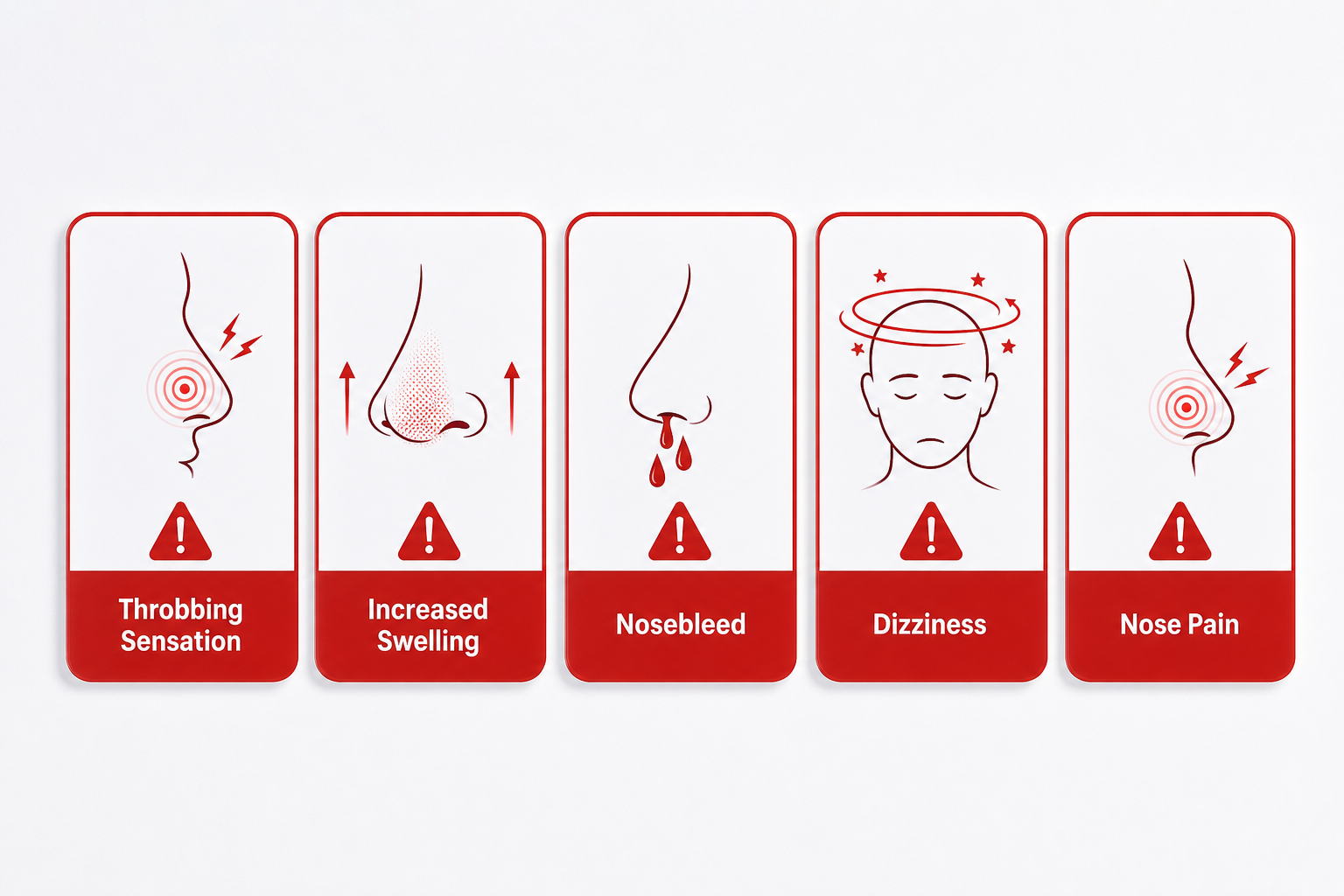
If any of these occur, rest, apply a cold compress gently to the cheeks (not directly on the nose), and contact your surgeon’s office. Do not resume exercise until you have been assessed and cleared to do so.
Maintaining Fitness During Rhinoplasty Recovery
One of the most underserved aspects of rhinoplasty recovery advice is how to minimise deconditioning during the weeks when strenuous exercise is restricted. Complete inactivity is not necessary, and a structured approach to low-impact movement can preserve a meaningful proportion of your cardiovascular and muscular fitness.
In the first two weeks, gentle walking is your primary tool. Gradually increasing walk duration from five minutes to thirty minutes over the first fortnight maintains basic cardiovascular function and supports circulation without raising blood pressure to problematic levels. From weeks three to four, adding stationary cycling at low resistance provides a meaningful aerobic stimulus while keeping impact and blood pressure elevation minimal. From weeks four to six, light lower-body bodyweight exercises — such as bodyweight squats, seated leg raises, and calf raises — can help maintain lower-body muscle tone without the Valsalva risk associated with loaded resistance training. Upper-body isolation exercises with very light weights and strict breathing control may be appropriate from around week five or six for some patients, subject to surgeon’s clearance. The goal during recovery is not to maintain peak performance — it is to arrive at the six-week clearance point with enough baseline fitness to rebuild efficiently, rather than starting from zero.
Frequently Asked Questions
When can I go back to the gym after rhinoplasty?
Most patients can return to the gym for light, low-impact exercise from around six weeks post-operatively, provided their surgeon has given clearance at a follow-up appointment. Returning to the gym does not mean resuming your full pre-surgery routine — begin with light cardio and low-weight resistance work, and build intensity gradually over the following weeks.
Can I do squats after rhinoplasty?
Bodyweight squats are generally acceptable from around weeks four to five, as they do not require breath-holding and keep blood pressure elevation moderate. Weighted squats — particularly with a barbell — should be avoided until at least six weeks, because the loading encourages the Valsalva manoeuvre, which spikes nasal pressure. When you return to weighted squats, use lighter loads than usual and focus on exhaling through the effort phase.
When can I run after rhinoplasty?
Light jogging is typically appropriate from around six weeks post-operatively, once your surgeon has confirmed that healing is progressing well. Begin on a flat surface at a comfortable pace, keep sessions short initially, and monitor your nose for any increase in swelling or discomfort after each run. Avoid trail running or uneven terrain until you are confident in your balance and the risk of a fall is low.
Can I swim after rhinoplasty?
Swimming is generally restricted for four to six weeks after rhinoplasty. Pool chemicals and open water carry an infection risk for healing nasal passages, and the physical effort of swimming laps raises heart rate significantly. Once your surgeon confirms that all incisions are fully healed, swimming in a clean pool is usually acceptable. Avoid diving for at least three months.
Does open rhinoplasty require a longer exercise restriction than closed rhinoplasty?
In most cases, the exercise timeline is broadly similar for both open and closed rhinoplasty. The underlying bone and cartilage healing follows the same biological schedule regardless of the incision approach. Your surgeon may have specific guidance based on the details of your procedure, so always follow their individual recommendations rather than assuming a shorter timeline applies.
Is it safe to do yoga after rhinoplasty?
Gentle upright yoga poses are generally safe from around weeks two to three. Yoga inversions — including downward dog, headstand, and shoulder stand — should be avoided for at least four to five weeks, as they increase blood flow to the face and raise pressure in the nasal tissues. Inform your yoga instructor about your recovery so they can suggest appropriate modifications.
When can I return to contact sports after rhinoplasty?
Contact sports after rhinoplasty require a minimum of three months before resumption. Sports such as boxing, martial arts, football, basketball, and rugby carry a significant risk of direct nasal trauma, which can displace healing structures even after the six-week bone consolidation milestone. Protective equipment is strongly advisable when you do return, and a sport-specific return-to-play discussion with your surgeon is recommended for competitive athletes.
Planning Your Return to Exercise: What to Discuss With Your Surgeon
A gradual return to exercise after rhinoplasty is achievable for the vast majority of active patients, and the restrictions — while frustrating — exist to protect a result that took considerable surgical skill and your own recovery effort to achieve. The six-week milestone is a meaningful turning point for most patients, but it is a starting point for rebuilding exercise intensity, not a green light to resume everything at once. Patients who progress too quickly risk prolonged swelling, increased bruising, and in rare cases, displacement of healing nasal structures that may require revision.
Before your rhinoplasty, it is worth discussing your specific fitness routine with your surgeon so they can give you a personalised timeline rather than generic guidance. Competitive athletes, bodybuilders, and patients who train at high intensity may benefit from a written return-to-sport plan that accounts for their specific activities. At each post-operative appointment, ask specifically about the next stage of exercise — your surgeon can assess your healing directly and give clearance that is appropriate for your individual recovery, rather than a one-size-fits-all answer. Listening to your body throughout the process, and erring on the side of caution when symptoms suggest you are pushing too hard, remains the most reliable way to protect your rhinoplasty results while returning to the active lifestyle you enjoy.