Before and After Chin Filler: What Results Really Look Like
Chin filler has become one of the most requested non-surgical facial treatments, largely because small changes to the chin can produce a meaningful shift in overall facial balance. Before and after chin filler results can range from subtle profile refinement to a more defined jawline and lower face contour — but understanding what actually changes, how quickly, and for how long is essential before deciding whether this treatment is right for you.
Key Takeaways
- Chin filler uses hyaluronic acid to improve chin projection, facial symmetry, and lower face contour without surgery.
- Results are visible immediately but take approximately two weeks to fully settle as swelling resolves.
- Most patients can expect results to last between 9 and 18 months depending on the product used, volume, and individual metabolism.
- Chin filler is a reversible treatment — hyaluronidase can dissolve hyaluronic acid filler if needed.
- Outcomes depend heavily on the injector’s skill, the volume used, and whether the treatment matches your facial anatomy and goals.
What Chin Filler Actually Changes
Hyaluronic acid filler injected into the chin area works by adding volume and structure to a specific point on the lower face. The most common goal is increased chin projection — moving the chin tip forward relative to the lips and nose to create a more balanced side profile. In patients with a recessed chin or weak chin, even a modest increase in projection can significantly alter the perceived proportions of the entire face, making the nose appear less prominent and the jawline appear more defined.
Beyond simple projection, chin filler can also address chin asymmetry, where one side sits higher or further forward than the other. It can soften mentalis dimpling — the orange peel texture that sometimes appears on the chin surface due to overactive mentalis muscle activity — and it can improve the chin-neck transition by adding structure that creates a cleaner shadow between the jaw and neck. These are distinct goals that require different placement techniques, which is why a thorough consultation with a qualified injector is important before treatment.
What chin filler cannot do is meaningfully reduce a double chin caused by submental fat, significantly lengthen a very short lower face, or replicate the structural change achievable with a surgical chin implant or osseous genioplasty. Understanding these limits is part of setting realistic expectations.
Before and After Chin Filler: What the Visual Changes Look Like
The most consistent change seen in before and after chin filler comparisons is improved side profile. When viewed from the side, a receding chin creates a slope from the lower lip downward without a clear stopping point, which can make the neck appear to begin too early. After treatment, the chin point becomes more defined, creating a cleaner transition and a stronger jawline silhouette. This change is often more dramatic in photographs taken from a three-quarter or profile angle than from the front.
From the front, the changes are typically more subtle. Patients with a round face shape may notice that adding chin projection creates the appearance of a slightly more oval face, because the lower face now has a more defined endpoint. Patients with chin asymmetry may see improved symmetry, though perfect symmetry is rarely achievable with filler alone. The chin shadow — the natural shadow that falls beneath the chin and defines the jaw-neck boundary — often becomes more visible after treatment, which contributes to the impression of a sharper jawline definition.
For patients with mentalis dimpling or orange peel chin texture, filler placed superficially can smooth the skin surface, reducing the appearance of these irregularities. This is a separate use case from projection enhancement and requires precise, shallow placement technique.
How Volume Affects the Outcome
The amount of filler used has a direct relationship with the degree of visible change. Approximately 0.5ml of hyaluronic acid filler typically produces a subtle refinement — useful for mild asymmetry correction or minor projection improvement in patients who want a conservative result. Around 1ml is the most common starting volume for patients with a noticeable recessed chin, and it tends to produce a clearly visible improvement in profile without looking overdone. Volumes of 1.5ml to 2ml may be appropriate for patients with more significant structural deficit or for those combining chin treatment with jawline filler, but higher volumes carry a greater risk of an unnatural appearance if placement is not precise.
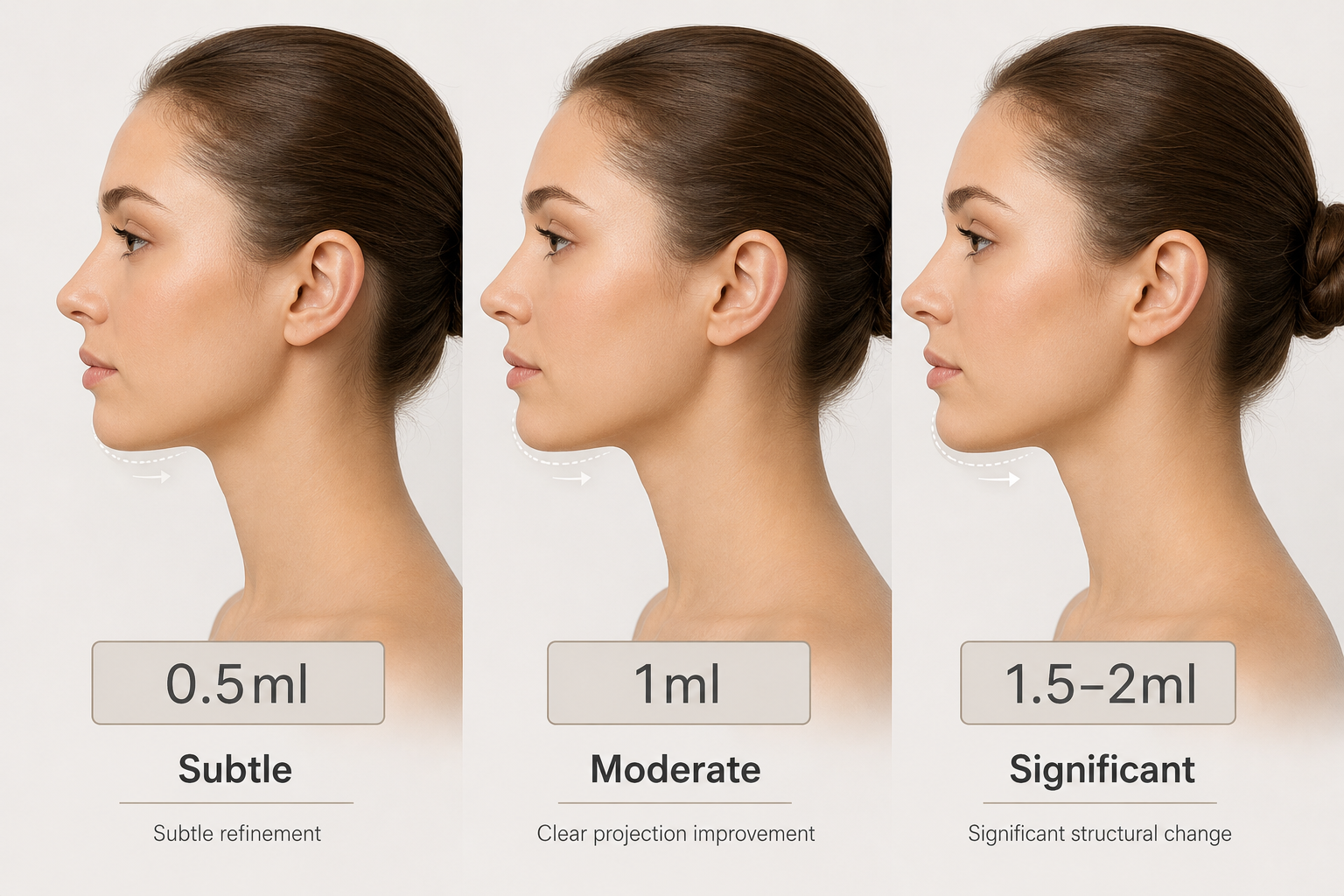
It is worth noting that the same volume of filler can produce different visual results depending on the product’s rheological properties — its thickness, elasticity, and ability to hold shape. Products such as Juvederm Voluma and Restylane Lyft are commonly used in the chin because they are firmer and provide better structural support than softer fillers designed for superficial lines. Your injector’s product choice matters as much as the volume.
The Results Timeline: Immediate vs. Final
One of the most important things to understand about chin filler results is that what you see immediately after treatment is not the final outcome. Immediately after injection, the chin will appear augmented and the projection improvement will be visible — but the area will also be swollen, and the filler will not yet have fully integrated with the surrounding tissue.
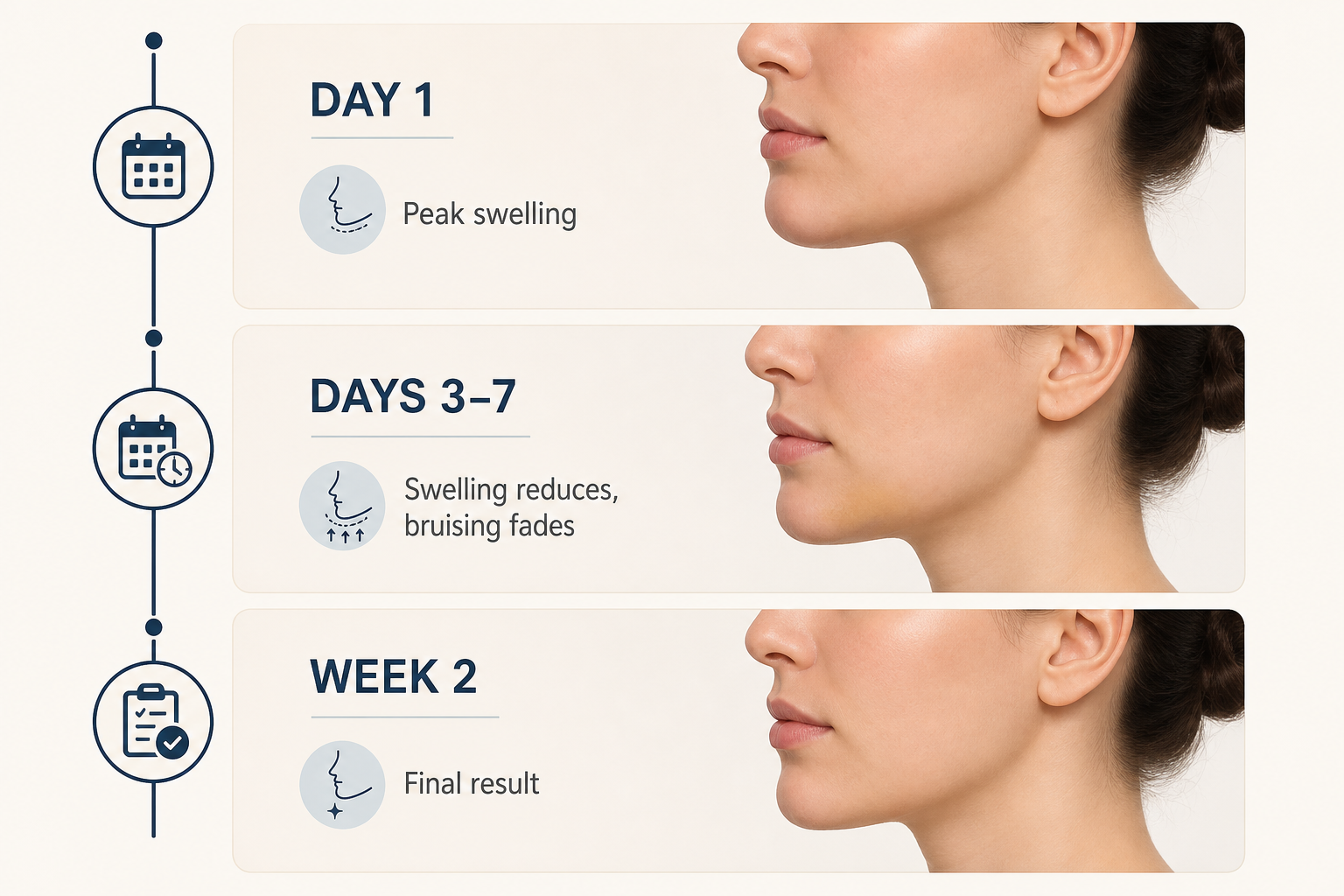
Swelling Stages After Chin Filler
In the first 24 to 48 hours, swelling is typically at its peak. The chin may feel firm, look slightly larger than intended, and there may be mild bruising at the injection sites. This is a normal inflammatory response to the injection process and does not indicate a problem. Applying a cold compress intermittently during the first day can help reduce swelling, and sleeping with the head slightly elevated may minimize fluid accumulation overnight.
Between days three and seven, swelling begins to resolve noticeably. The filler starts to soften and integrate, and the result begins to look more natural. Any bruising typically fades during this period. Most patients feel comfortable returning to normal social activities within two to five days, though this varies depending on individual healing response and the volume injected.
By the two-week mark, the settling period is largely complete. Swelling has resolved, the filler has distributed evenly within the tissue, and the result reflects what the treatment has genuinely achieved. This is the point at which a review appointment is most useful — it allows the injector to assess the outcome accurately and determine whether any refinement is needed.
Natural-Looking Results vs. Overdone Outcomes
The difference between natural-looking results and an overdone appearance in chin filler comes down to three main factors: volume, placement, and patient selection. When too much filler is used relative to the patient’s facial anatomy, the chin can appear disproportionately large, project too far forward, or develop an unnatural rounded shape that does not match the rest of the face. This is sometimes described as a “shelf” appearance at the chin point.
Poor placement — for example, filler injected too superficially or spread too widely — can create visible lumps, an irregular surface, or a widened chin that looks out of proportion when viewed from the front. Chin filler migration, where filler moves away from the intended placement area over time, is more likely when superficial injection techniques are used or when the patient applies significant pressure to the area during the early healing phase.
Patient selection also matters. Chin filler produces the most natural-looking results in patients with a genuinely recessed or mildly asymmetric chin who want a proportionate improvement. Patients who request very large volume increases or who have unrealistic expectations about what filler can achieve structurally are at greater risk of dissatisfaction. A qualified injector will discuss these factors honestly during consultation and may recommend a conservative starting volume with the option to add more at a review appointment.
Gender-Specific Results
Before and after chin filler results differ meaningfully between male and female patients, and this distinction is often underemphasized. In female patients, the aesthetic goal is typically a refined, slightly pointed chin tip that enhances facial harmony without creating a strong or angular appearance. Filler is usually placed centrally to add forward projection while maintaining a soft, feminine lower face contour.
In male patients, the goals are generally different. A stronger, wider, and more square chin projection is typically preferred, reflecting masculine facial proportions. This may involve placing filler across a broader area of the chin, using a firmer product, and sometimes using a higher volume to achieve the desired structural effect. The risk of an overdone result in male patients is often lower at higher volumes because the target aesthetic allows for more pronounced definition — but this still requires an injector with experience in gender-appropriate facial anatomy.
Chin Filler for Specific Concerns
Recessed or Weak Chin
A recessed chin — where the chin sits behind the vertical line drawn from the upper lip — is the most common indication for chin filler. Non-surgical chin augmentation with hyaluronic acid filler can bring the chin forward to a more balanced position relative to the lips and nose, improving the side profile without surgery. This is one of the clearest use cases for the treatment, and before and after results in this group tend to be among the most visually striking.
Chin Dimpling and Orange Peel Texture
Mentalis dimpling — the puckered or orange peel texture that appears on the chin surface — can be caused by overactive mentalis muscle contraction or by thin overlying skin. Hyaluronic acid filler placed carefully in the superficial layers of the chin can smooth this texture by providing a cushioning effect beneath the skin. In some cases, botulinum toxin injected into the mentalis muscle is used alongside filler to reduce the muscular activity contributing to the dimpling. Results for this concern tend to be subtle but can be meaningful for patients who find the texture bothersome.
Chin Shadow and Jaw-Neck Transition
Some patients seek chin filler not primarily for projection but to improve the chin-neck shadow — the definition between the lower jaw and the neck. Adding structure to the chin point can create a cleaner visual separation between the face and neck, which is particularly noticeable in photographs and video. This is a nuanced use case that requires careful assessment, as the underlying cause of a poorly defined chin-neck transition may involve submental fat or skin laxity rather than chin structure alone.
Chin Filler as a Surgical Preview
One underutilized application of chin filler is as a temporary trial before committing to a permanent surgical procedure such as a silicone chin implant or sliding genioplasty. Because hyaluronic acid filler is a reversible treatment, patients can experience what improved chin projection looks and feels like in their own face before making a surgical decision. If the result is satisfying, it may confirm that surgery is worth pursuing. If the result feels too prominent or does not achieve the desired change, the filler can be dissolved with hyaluronidase and the patient can reconsider their options without permanent consequences. This approach is particularly useful for patients who are uncertain about the degree of change they want.
Chin Filler vs. Chin Implant
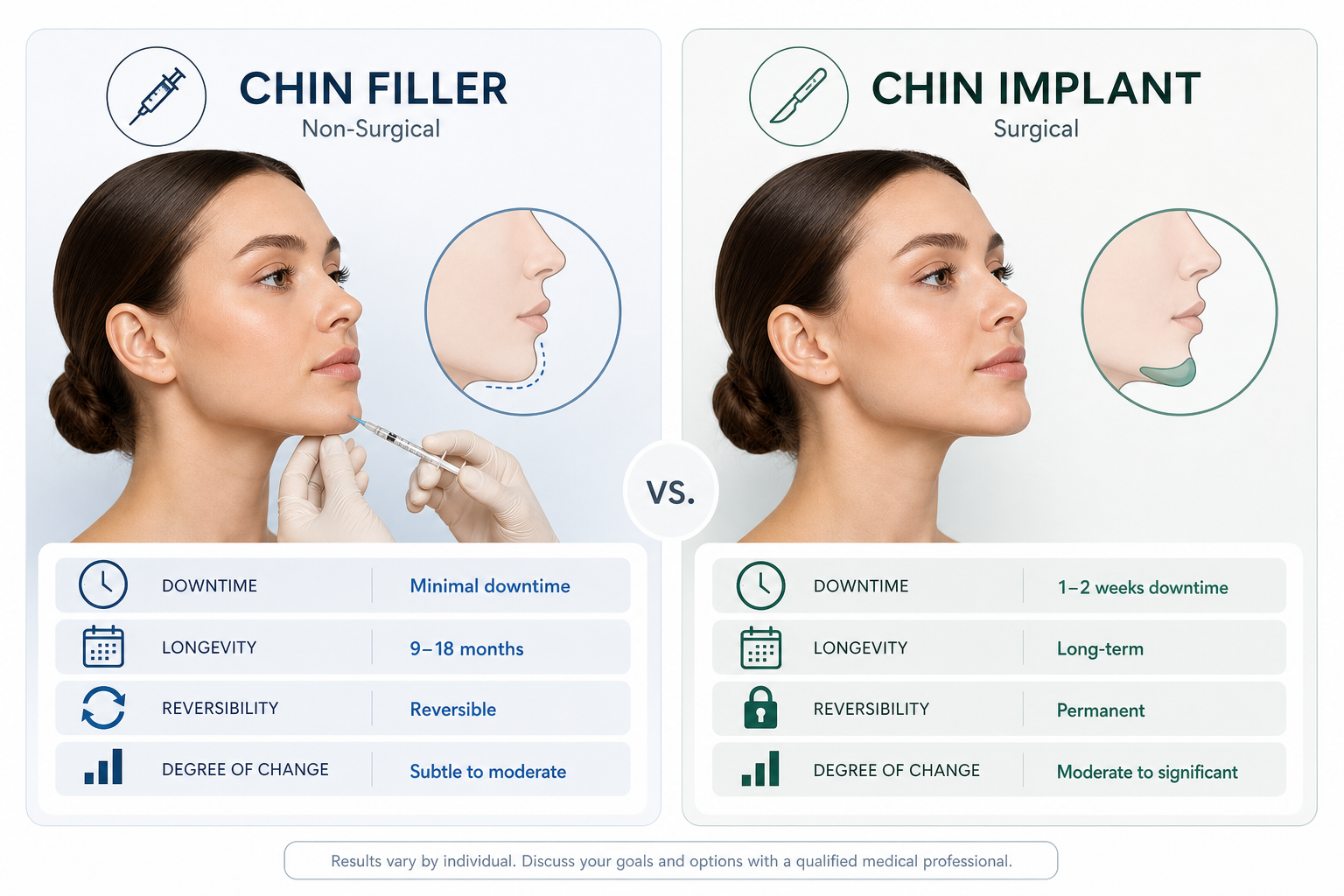
| Factor | Chin Filler | Chin Implant (Surgery) |
|---|---|---|
| Procedure type | Non-surgical injection | Surgical procedure under anaesthesia |
| Downtime | Minimal (2–5 days social downtime) | 1–2 weeks or more |
| Results onset | Immediate, final at ~2 weeks | Visible after swelling resolves (weeks) |
| Longevity | 9–18 months typically | Permanent (unless removed) |
| Reversibility | Yes — dissolvable with hyaluronidase | No (requires further surgery to remove) |
| Degree of change | Moderate — limited by soft tissue | Greater structural change possible |
| Risk profile | Vascular risk, migration, lumps | Surgical risks, implant displacement, infection |
| Maintenance | Top-up treatments required | None typically required |
| Cost over time | Recurring cost per treatment | Higher upfront, no ongoing cost |
Chin filler suits patients who want a reversible, low-downtime option with moderate improvement, or who want to trial a result before surgery. A chin implant or sliding genioplasty may be more appropriate for patients seeking a larger, permanent structural change. These are not competing treatments so much as options suited to different goals and circumstances — a consultation with both an aesthetic practitioner and a surgeon may help clarify which path is appropriate.
How Long Do Chin Filler Results Last?
Chin filler longevity varies between patients, but most hyaluronic acid fillers used in the chin area last between 9 and 18 months. The chin is a relatively low-movement area compared to the lips or nasolabial folds, which means filler tends to degrade more slowly here. Firmer, higher-density products such as those used for structural support in the chin may also persist longer than softer formulations.
Individual metabolism plays a significant role. Patients who exercise intensively, have a faster metabolic rate, or have previously had filler dissolve quickly in other areas may find that chin filler results fade toward the lower end of the expected range. Maintenance treatments — typically a top-up appointment every 12 months or so — can sustain the result over time. Some patients find that after several treatment cycles, less filler is needed to maintain the same outcome, possibly because residual product remains in the tissue.
Risks and Limitations to Understand Before Treatment
Chin filler carries risks that should be discussed openly before treatment. The most serious risk associated with any dermal filler injection is vascular occlusion — where filler inadvertently enters or compresses a blood vessel, potentially restricting blood flow to surrounding tissue. The chin area has a relatively lower vascular risk profile compared to areas such as the nose or glabella, but the risk is not zero. This is one of the most important reasons to choose a qualified injector with thorough knowledge of facial anatomy and emergency protocols.
More common but less serious risks include bruising, swelling, tenderness, and temporary asymmetry during the settling period. Lumps or nodules can occur if filler is placed unevenly or if the patient experiences a delayed inflammatory reaction. Chin filler migration — where filler moves from the intended placement site — is possible, particularly with softer products or superficial injection. All of these complications can be assessed and managed by an experienced practitioner, and hyaluronidase can dissolve hyaluronic acid filler if correction is needed.
Chin filler is generally not recommended during pregnancy or breastfeeding, in the presence of active skin infection at the treatment site, or in patients with certain autoimmune conditions. A full medical history review at consultation will identify any relevant contraindications.
Aftercare: What to Do After Chin Filler
Following aftercare guidance in the days after chin filler helps protect the result and reduce the risk of complications. In the first 24 to 48 hours, avoid applying significant pressure to the chin — this includes sleeping face-down, resting your chin on your hand, or wearing tight face masks. Avoid strenuous exercise for 24 to 48 hours, as increased blood flow and body temperature can worsen swelling. Alcohol and caffeine may also contribute to inflammation and are best avoided for the first day or two.
Dental procedures — including routine check-ups involving pressure around the jaw — are generally best avoided for at least two weeks after chin filler, as manipulation of the area could displace filler before it has fully integrated. Facial massage, saunas, steam rooms, and extreme heat should also be avoided during the first week. If you notice any unusual firmness, skin colour changes, or pain beyond normal tenderness, contact your practitioner promptly.
Frequently Asked Questions
How soon can I see results after chin filler?
Results are visible immediately after treatment, but the chin will be swollen and the filler will not yet have settled into its final position. The true outcome becomes clear at around the two-week mark, once swelling has fully resolved and the filler has integrated with the surrounding tissue.
Does chin filler hurt?
Most patients find chin filler tolerable. A topical numbing cream is typically applied before treatment, and many hyaluronic acid fillers contain lidocaine, a local anaesthetic, within the formulation. Patients usually describe the sensation as mild pressure or a brief sharp feeling at the injection site rather than significant pain.
Can chin filler make my face look slimmer?
Adding chin projection can create the visual impression of a more oval or elongated lower face, which some patients perceive as a slimming effect. This is a proportional change rather than a physical reduction in face width, and the degree of effect depends on the patient’s existing face shape and the volume used.
What happens if I don’t like the result?
Hyaluronic acid chin filler is a reversible treatment. If you are unhappy with the outcome, hyaluronidase — an enzyme that breaks down hyaluronic acid — can be injected to dissolve the filler. Dissolution is typically effective within a few days, though some residual swelling may persist briefly after the dissolving treatment.
Is chin filler suitable for men?
Yes. Chin filler is used in male patients, though the aesthetic goals and injection approach differ from female treatment. Male patients typically seek stronger, wider chin projection to enhance masculine facial proportions. An injector experienced in gender-appropriate facial aesthetics will adapt the technique and product choice accordingly.
How does chin filler compare in cost to a chin implant?
Chin filler has a lower upfront cost than surgical chin augmentation, but because results are temporary and maintenance treatments are needed every 9 to 18 months, the cumulative cost over several years may approach or exceed the one-time cost of a surgical implant. Cost should be considered alongside goals, reversibility preference, and tolerance for ongoing treatments when making a decision.
Can chin filler be combined with other treatments?
Chin filler is frequently combined with jawline filler, botulinum toxin to the mentalis muscle, or lip filler as part of a lower face balancing treatment plan. Combining treatments can enhance overall facial harmony, but each addition carries its own considerations and should be discussed individually during consultation.
Is Chin Filler the Right Choice for Your Profile Goals?
Before and after chin filler results can be genuinely impressive for the right candidate — particularly patients with a recessed chin, mild asymmetry, or chin surface irregularities who want a non-surgical, reversible option with minimal downtime. The treatment offers a meaningful improvement in side profile, lower face contour, and facial balance without the recovery or permanence of surgery.
That said, chin filler is not a universal solution. It works within the limits of soft tissue augmentation, requires maintenance to sustain results, and carries risks that are best managed by a qualified injector with strong anatomical knowledge. Patients seeking a large or permanent structural change may ultimately be better served by a surgical consultation. For those who are uncertain, using filler as a temporary preview of improved chin projection is a practical and reversible way to inform that decision.
If you are considering chin filler, a thorough consultation with an experienced aesthetic practitioner — one who will assess your facial anatomy, discuss realistic outcomes, and explain the risks honestly — is the most important first step toward a result you will be satisfied with.