Lip Filler Migration Correction: Causes, Signs, and How to Fix It
Lip filler migration is one of the most common concerns patients raise when something looks or feels wrong after a lip augmentation treatment. The filler has moved beyond its intended placement, creating a blurred lip line, a visible shelf above the upper lip, or an unnatural fullness that no longer resembles the original lip shape. Understanding why migration happens, how to recognise it, and what a realistic correction process looks like can help you approach the situation calmly and make an informed decision about next steps.
Key Takeaways
- Migrated lip filler occurs when hyaluronic acid gel moves beyond the vermilion border into the surrounding perioral skin, altering the natural lip shape.
- The most reliable correction is enzymatic reversal using hyaluronidase, which dissolves the displaced filler; non-HA fillers such as silicone cannot be dissolved this way.
- Overfilling, superficial injection depth, repeated filler stacking, and low-cohesivity products are the most common contributing factors.
- A dissolve-and-restart approach — waiting two to four weeks after dissolution before re-treating — generally produces the most predictable long-term result.
- Choosing a qualified injector with specific experience in correction cases is as important as the correction technique itself.
What Is Lip Filler Migration?
Lip filler migration describes the displacement of injectable filler material away from its original placement site. In the context of lip augmentation, this typically means hyaluronic acid gel that was injected into or along the lip has spread upward into the perioral skin above the vermilion border — the defined edge that separates the lip from the surrounding skin. Once filler occupies this area, it can create a visible ledge or filler shelf, a loss of definition along the natural lip border, and in more pronounced cases, a shadow or ridge that patients sometimes describe as a filler mustache. The Cupid’s bow may appear flattened or puffy, and the overall lip shape can look disproportionate or unnatural, sometimes referred to colloquially as duck lips.
Migration is not the same as normal post-treatment swelling. Swelling typically peaks within 24 to 72 hours and resolves within two weeks, after which the lip settles into its treated shape. Migration, by contrast, produces changes that persist or worsen beyond that initial healing window. If a blurred lip line or shelf effect is still present at the two-to-three-week mark, migration is a more likely explanation than residual swelling.
What Does Migrated Lip Filler Look Like?
Recognising migration early makes correction more straightforward. The signs vary depending on how much filler has displaced and how long it has been present, but the most consistent visual indicators include:
-
- A visible ridge or ledge of tissue sitting above the upper lip, sometimes called a filler shelf
- Loss of the sharp, defined edge of the vermilion border, producing a blurred lip line
- Fullness or puffiness that extends into the philtrum area or toward the nasolabial folds rather than sitting within the lip itself
- A flattened or obscured Cupid’s bow
- Firmness or lumps that can be felt above the lip border when pressing gently
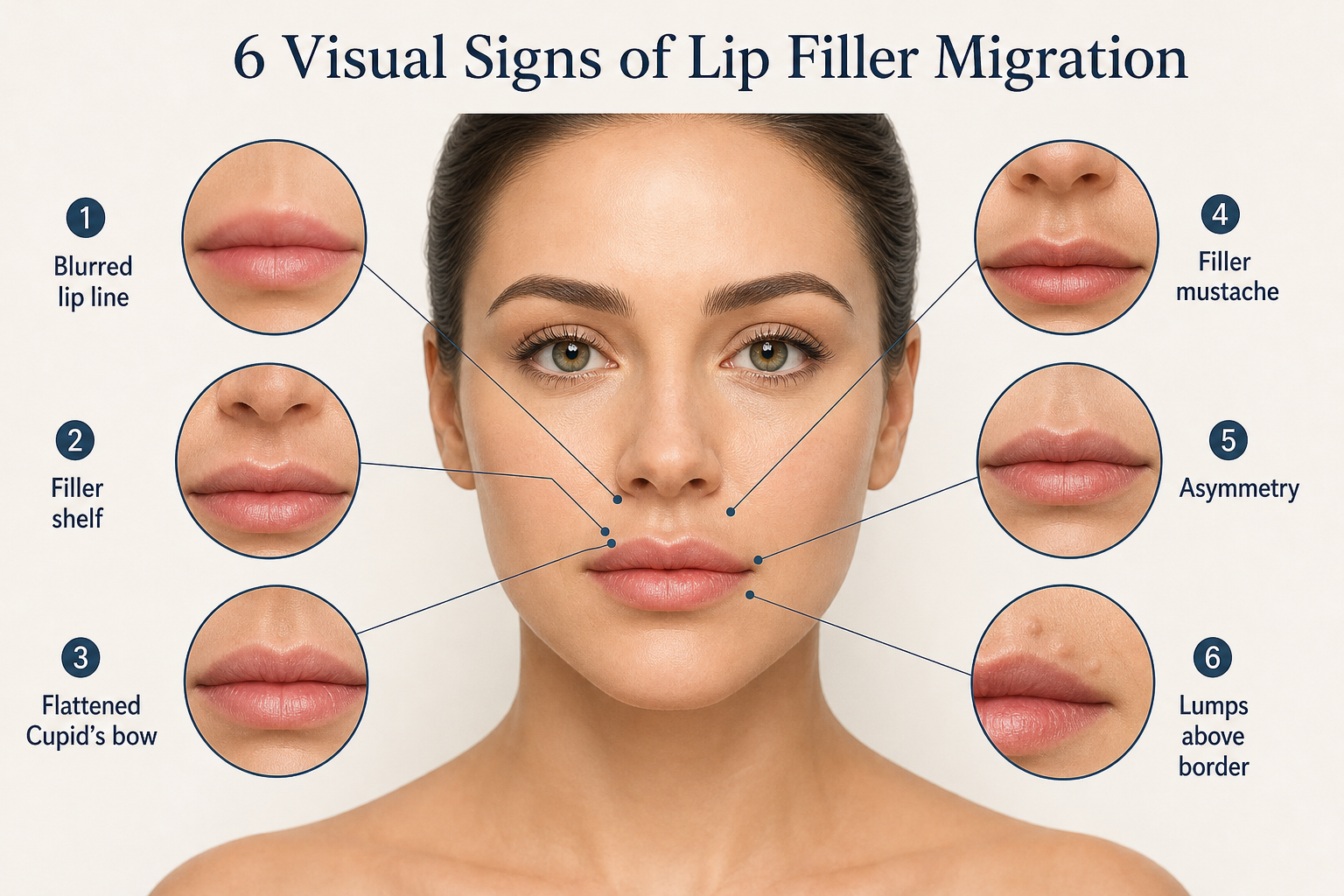
- Asymmetry that was not present immediately after treatment
- An overall appearance that looks swollen or unnatural rather than augmented
If you are uncertain whether what you are seeing is migration or normal variation, a consultation with a qualified injector is the appropriate next step. A practitioner can assess the tissue, feel for displaced product, and distinguish migration from other concerns such as filler lumps within the lip itself or asymmetry related to injection technique.
What Causes Lip Filler to Migrate?
Migration rarely has a single cause. In most cases, several contributing factors interact, and understanding them helps both in correcting the current situation and in preventing recurrence.
Overfilling and Filler Stacking
Overfilling — placing more volume than the lip tissue can comfortably accommodate — is one of the most significant risk factors. When the lip is under pressure from excess product, the path of least resistance is outward into the surrounding perioral skin. Filler stacking compounds this problem: adding new product on top of existing, undissolved filler across multiple sessions progressively increases the total volume in the tissue. The orbicularis oris muscle, which surrounds the mouth and is responsible for lip movement, contracts repeatedly during speaking, eating, and expression, and this mechanical pressure can accelerate displacement when volume is excessive.
Injection Depth and Tissue Plane
Correct injection depth is critical. Filler placed too superficially — closer to the skin surface rather than within the appropriate tissue plane — is more susceptible to migration because it lacks the structural support of deeper tissue. The intended anatomical plane for most lip augmentation techniques sits within the lip mucosa or along the vermilion border, not in the thin skin above it. When the injection depth is incorrect, the product has less resistance to movement and is more likely to spread over time.
Filler Type and Cohesivity
Not all hyaluronic acid fillers behave identically. Cohesivity refers to how well the gel holds together as a unit rather than spreading through surrounding tissue. Lower-cohesivity, more hydrophilic fillers — those that attract and absorb water — tend to expand after injection and carry a higher migration risk, particularly in high-mobility areas like the lips. Some formulations within the Juvederm and Restylane product families differ meaningfully in their cohesivity and water-absorption characteristics, and product selection should reflect the specific anatomy and treatment goal. A practitioner experienced in lip work will choose a filler density appropriate for the area and the volume being placed.
The Russian Lip Technique and Migration Risk
The Russian lip technique, which places filler in a more vertical orientation to create height and a pronounced Cupid’s bow, involves injections that are generally more superficial than traditional approaches. While the technique can produce a distinctive aesthetic result, the shallower tissue plane increases the theoretical risk of migration over time, particularly when repeated across multiple sessions. Patients who have had this technique performed repeatedly should discuss this history with any practitioner assessing them for correction.
Frequency of Treatment
Returning for top-up treatments before existing filler has fully metabolised is a meaningful risk factor. Each additional session adds volume to tissue that may already contain residual product, and the cumulative effect can exceed what the anatomy can support. Spacing treatments at least nine to twelve months apart and allowing full assessment of the existing filler before adding more is a standard recommendation among experienced practitioners.
What Happens If Migrated Filler Is Left Untreated?
Some patients hope that migrated lip filler will resolve on its own over time. Hyaluronic acid does gradually break down through natural enzymatic processes, but this can take twelve to eighteen months or longer for cross-linked filler, and the breakdown is not always uniform. In the meantime, the displaced product can become more fibrous and harder to dissolve effectively, meaning that correction attempted later may require higher concentrations of hyaluronidase or multiple treatment sessions. There is also evidence that long-standing filler in the perioral area can cause subtle changes to the surrounding tissue, making a fresh-start result harder to achieve. Addressing migration sooner rather than later generally produces a more straightforward correction.
How Is Lip Filler Migration Corrected?
The primary and most reliable correction method for migrated hyaluronic acid filler is enzymatic reversal using hyaluronidase. This enzyme breaks down the cross-linked hyaluronic acid gel, allowing the body to reabsorb it. The approach can be tailored depending on the extent and location of migration.
Partial Versus Full Dissolution
Not every case requires complete removal of all lip filler. When migration is limited — for example, a small amount of product has shifted above the vermilion border while the majority of filler remains well-placed within the lip — a targeted partial dissolution may be appropriate. The practitioner injects hyaluronidase specifically into the area of displaced product, aiming to correct the migration while preserving the augmentation that is sitting correctly. This approach requires precise assessment and a practitioner with strong anatomical knowledge, as over-dissolution can remove well-placed filler along with the migrated product.
In cases where migration is extensive, where filler has been stacked across many sessions, or where the total volume is difficult to assess, a full dissolve-and-restart approach is often the more predictable option. This involves dissolving all existing filler, allowing the tissue to settle, and then re-treating from a clean baseline using conservative volume and appropriate technique.
The Hyaluronidase Process
Hyaluronidase is injected directly into the area containing the displaced filler. The procedure itself typically takes ten to fifteen minutes. Dissolution begins within hours, and most of the breakdown occurs within 24 to 48 hours, though the full result — including resolution of any post-procedure swelling — is usually assessed at the two-week mark. Older, more heavily cross-linked filler may require a higher enzyme concentration or more than one treatment session to dissolve fully, which is one reason why addressing migration early tends to produce a cleaner outcome.
Patients with a known allergy to bee stings should inform their practitioner before hyaluronidase treatment, as there is a theoretical cross-reactivity risk. A patch test or pre-treatment assessment may be recommended in these cases. Swelling and bruising after dissolution are common and typically resolve within a few days.
Re-treatment Timing After Dissolution
Re-treatment timing is an important part of the correction plan. Most practitioners recommend waiting two to four weeks after hyaluronidase treatment before re-injecting filler. This allows residual swelling to resolve, the tissue to return to its natural resting state, and the practitioner to accurately assess the lip’s baseline shape before adding new volume. Re-treatment after correction should use conservative volume — often half a syringe or less — and gradual augmentation over subsequent appointments if more volume is desired.
Can Migration Be Fixed Without Dissolving?
Some patients ask whether massage, time, or additional filler placed elsewhere can correct migration without dissolving the displaced product. The honest answer is that these approaches have significant limitations. Massage has a very limited effect on established, cross-linked filler and is not a reliable correction method. Adding filler to other areas to balance the appearance does not address the underlying displaced product and risks compounding the problem. Hyaluronidase remains the only clinically established method for removing migrated hyaluronic acid filler.
What to Expect After Hyaluronidase Treatment
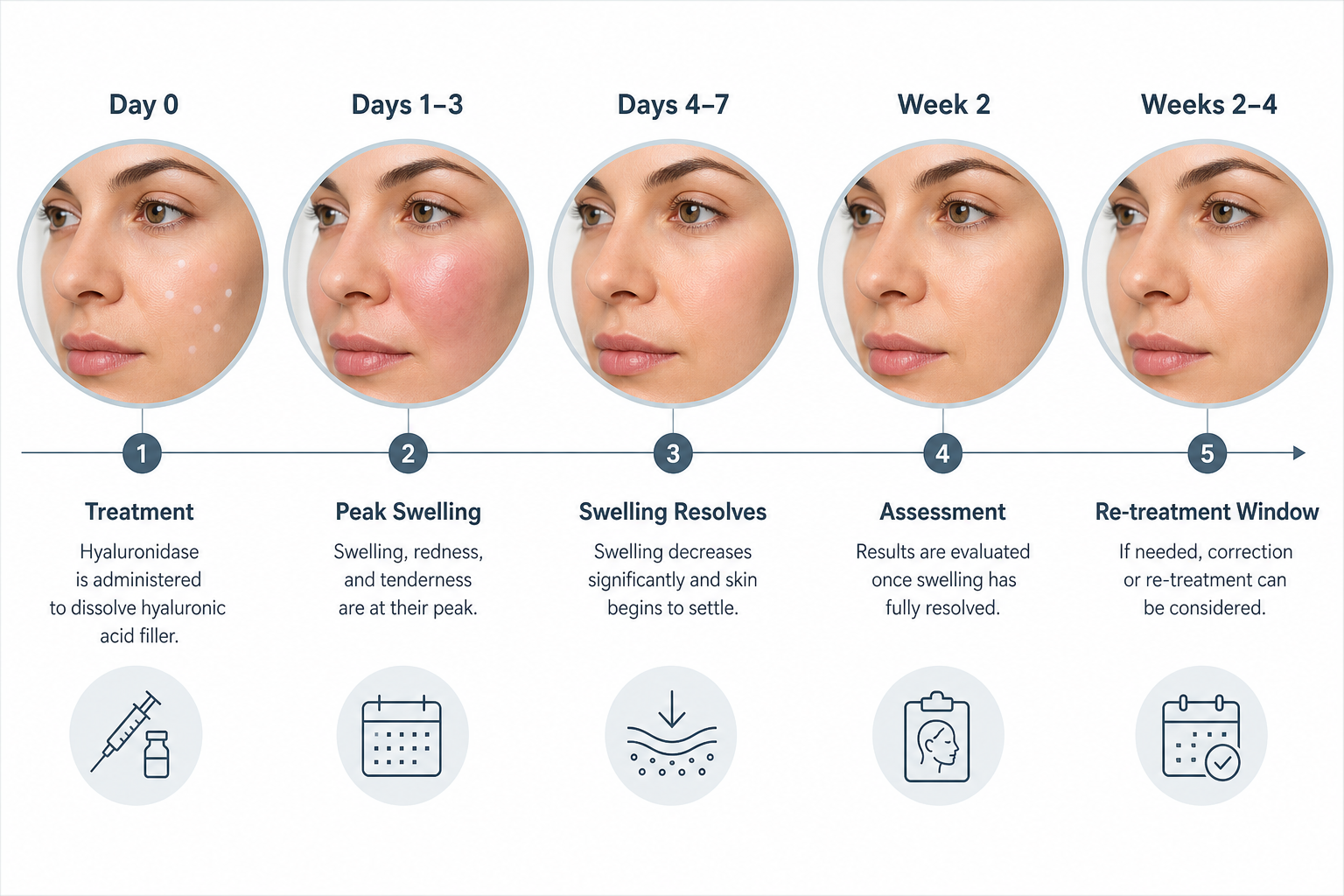
Understanding the post-dissolution timeline helps set realistic expectations and supports appropriate aftercare.
| Timeframe | What to Expect |
|---|---|
| Day 0 (treatment day) | Mild swelling and possible bruising at injection sites; lips may appear deflated or uneven as filler dissolves |
| Days 1–3 | Swelling typically peaks then begins to subside; the lip may look smaller than the natural baseline due to post-procedure inflammation |
| Days 4–7 | Swelling continues to resolve; the natural lip shape begins to emerge; bruising fades |
| Week 2 | Most swelling has resolved; the practitioner can assess whether dissolution is complete or a second session is needed |
| Weeks 2–4 | Healing window before re-treatment; the lip settles into its natural resting shape |
During the recovery period, avoiding vigorous exercise, heat exposure, and alcohol for the first 24 to 48 hours is generally recommended to minimise swelling and bruising. Gentle lip care — keeping the area clean and moisturised — is appropriate. Avoid pressing or massaging the lips unless specifically instructed by your practitioner, as this will not accelerate dissolution and may cause unnecessary discomfort.
Filler Type and Migration Risk: A Comparison
The type of filler used influences migration risk. The table below summarises key differences relevant to lip augmentation.
| Filler Category | Examples | Cohesivity | Migration Risk | Reversible? |
|---|---|---|---|---|
| Monophasic HA (softer) | Juvederm Ultra, Juvederm Volbella | Lower to moderate | Higher (more hydrophilic) | Yes — hyaluronidase |
| Biphasic HA (firmer) | Restylane Kysse, Restylane Lip | Moderate to higher | Lower (less water absorption) | Yes — hyaluronidase |
| Permanent / silicone filler | Silikon-1000, various permanent products | N/A | Can migrate; unpredictable | No — surgical removal only |
This comparison is a general guide. Individual product formulations vary, and the practitioner’s technique, injection depth, and volume placed are equally important variables. Patients who are unsure what type of filler they have received should ask their previous provider for documentation before seeking correction.
Non-HA Filler Migration: A More Complex Problem
Hyaluronic acid fillers are reversible, which makes correction manageable in most cases. Permanent fillers — including silicone-based products — cannot be dissolved with hyaluronidase. If a permanent filler has migrated, the correction options are significantly more limited and may involve surgical excision, which carries its own risks and does not always achieve a complete result. Patients who have received permanent or semi-permanent fillers from unregulated sources, or who are unsure of the product used, should seek assessment from a practitioner experienced in complex filler complications before pursuing any correction attempt.
How to Prevent Lip Filler Migration
Prevention is considerably easier than correction. The following factors meaningfully reduce migration risk:
-
- Gradual augmentation: Building volume incrementally across spaced appointments — rather than placing a large volume in a single session — allows the tissue to adapt and reduces pressure-driven displacement.
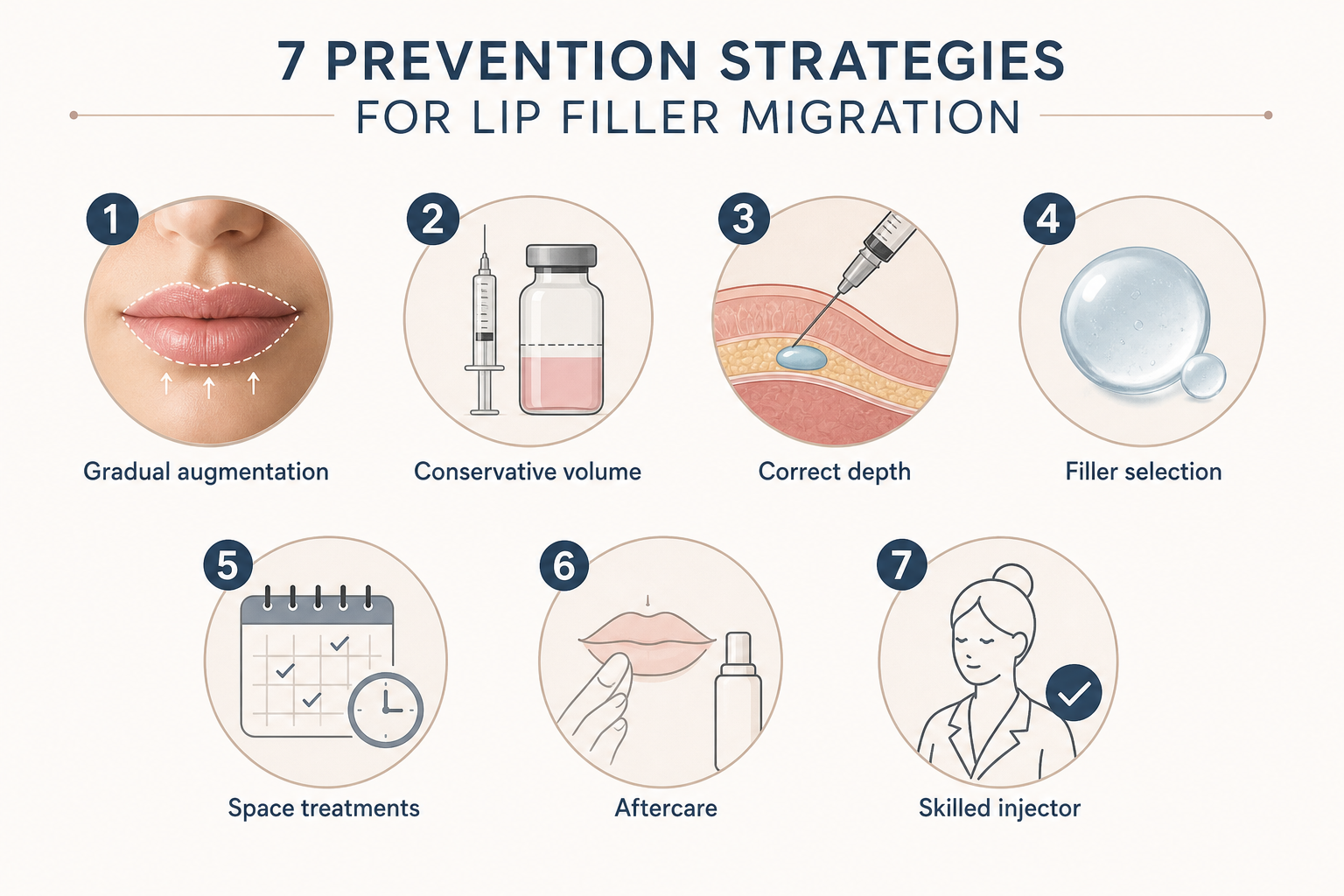
- Conservative volume per session: Starting with half a syringe or less and assessing the result before adding more is a widely recommended approach, particularly for patients with naturally thin lips.
- Correct injection depth: Placing filler within the appropriate tissue plane, rather than superficially, reduces the likelihood of product spreading into the perioral skin.
- Appropriate filler selection: Choosing a product with sufficient cohesivity for the lip area and the volume being placed reduces the risk of spreading.
- Spacing treatments: Allowing at least nine to twelve months between sessions, and ensuring existing filler is fully assessed before adding more, prevents cumulative overfilling.
- Aftercare compliance: Avoiding vigorous massage, extreme heat, and strenuous exercise in the days following treatment supports the filler settling in its intended position.
- Choosing a skilled injector: Practitioner experience and technique are among the most significant protective factors against migration.
Choosing the Right Practitioner for Correction
Selecting a qualified injector for an initial lip treatment is important; selecting the right practitioner for a correction case is arguably more so. Correction requires a thorough understanding of filler anatomy, the ability to assess how much product is present and where it has displaced, and experience with hyaluronidase dosing for different filler types and ages. When seeking correction, look for a practitioner who is medically qualified — such as a doctor, dentist, or nurse prescriber with aesthetic training — has specific experience managing filler complications, and is willing to take a conservative, staged approach rather than promising an immediate result in a single session. A practitioner who performs a thorough consultation, reviews your treatment history, and explains the realistic correction timeline is a more reliable choice than one who minimises the complexity of the situation.
It is also reasonable to ask how many hyaluronidase correction cases the practitioner has managed, whether they have access to emergency protocols for rare complications such as vascular occlusion, and what their approach is to re-treatment after dissolution. These questions help establish whether the practitioner has the depth of experience that a correction case warrants.
The Emotional Side of Filler Migration
Patients who notice migration often feel distressed, particularly if the change has affected their confidence or if they feel uncertain about how to raise the issue with a provider. It is worth acknowledging that these concerns are valid and that correction is achievable in the vast majority of hyaluronic acid filler cases. If you are uncomfortable returning to the original injector, seeking a second opinion from an independent qualified practitioner is entirely appropriate. A good practitioner will not make you feel embarrassed about seeking correction and will approach the consultation with the same care as any other aesthetic assessment.
Frequently Asked Questions
Does migrated lip filler go away on its own?
Hyaluronic acid filler does break down naturally over time, but this process can take twelve to eighteen months or longer for cross-linked products. Waiting for natural dissolution is not generally recommended because older, more fibrous filler is harder to dissolve with hyaluronidase, and the displaced product may cause progressive tissue changes. Early correction typically produces a cleaner result.
How many hyaluronidase sessions will I need?
This depends on the amount of filler present, how long it has been in place, and the degree of cross-linking. Many cases resolve in one or two sessions, but heavily stacked or older filler may require additional treatments. Your practitioner should assess the result at the two-week mark before deciding whether further dissolution is needed.
Can I get lip filler again after correction?
Yes, in most cases. The standard recommendation is to wait two to four weeks after hyaluronidase treatment before re-injecting, to allow swelling to resolve and the tissue to return to its natural baseline. Re-treatment should use conservative volume and a technique appropriate for your anatomy.
Is hyaluronidase safe?
Hyaluronidase has a well-established safety profile when administered by a qualified practitioner. The most common side effects are temporary swelling and bruising at the injection site. Allergic reactions are rare but possible; patients with bee sting allergies should discuss this with their practitioner before treatment. Over-dissolution — removing more filler than intended — is a risk with any enzymatic reversal, which is why a targeted, staged approach is preferable to aggressive single-session dissolution.
What is the difference between migration and normal swelling?
Normal post-treatment swelling peaks within 24 to 72 hours and resolves within two weeks. Migration produces changes — such as a blurred lip line, a filler shelf above the upper lip, or a filler mustache effect — that persist or become more apparent after swelling has settled. If you are concerned about the appearance of your lips beyond the two-week mark, a clinical assessment is the appropriate next step.
How much does correction typically cost?
The cost of hyaluronidase treatment varies by clinic, location, and the number of sessions required. Some clinics include correction within their aftercare policy if migration occurs following treatment performed there; others charge per session. It is worth discussing the likely number of sessions and the total cost estimate during your consultation, as correction of heavily stacked filler may require more than one appointment.
Making an Informed Decision About Lip Filler Migration Correction
Migrated lips are a correctable problem in the vast majority of cases involving hyaluronic acid filler. Enzymatic reversal with hyaluronidase is the established, evidence-supported approach, and a dissolve-and-restart strategy — using conservative volume and appropriate technique on re-treatment — offers the most predictable long-term outcome. The key variables are the type and age of the filler, the extent of displacement, and the experience of the practitioner performing the correction.
If you are concerned about lip filler migration, the most useful first step is a consultation with a medically qualified injector who has specific experience in filler correction. Avoid attempting home remedies, aggressive massage, or seeking additional filler to mask the problem, as these approaches are unlikely to help and may complicate correction. With the right assessment and a staged, patient approach, most people can achieve a natural-looking result and, if desired, a fresh start with lip augmentation performed safely and appropriately.