Forehead Botox Cost: What Affects the Price and What to Expect
Forehead Botox cost typically ranges from around £150 to £450 per session in the UK, or roughly $150 to $600 in the US, depending on how many units are used, who performs the treatment, and where the clinic is located. Because pricing models vary considerably between providers, understanding the factors that drive the final figure helps you compare quotes accurately and avoid decisions based on price alone.
Key Takeaways
- Forehead Botox is priced either per unit or per treatment area; per-unit pricing is generally more transparent for patients.
- The number of units needed depends on muscle strength, line depth, and whether the glabellar area is treated at the same time.
- Provider credentials, geographic location, and the neuromodulator brand used all meaningfully affect the cost per unit.
- Prices below a credible floor can indicate diluted product, under-dosing, or an unqualified injector — each carrying its own risks.
- Treating consistently every three to four months may reduce the units needed over time, lowering the long-term annual cost of forehead Botox.
How Much Does Forehead Botox Typically Cost?
The most commonly quoted range for forehead Botox in the United States is $10 to $20 per unit, with the national average sitting around $12 to $15 per unit at the time of writing. A standard forehead-only treatment using 10 to 20 units therefore costs approximately $120 to $400. When the glabellar lines — the vertical frown lines between the brows, sometimes called the “11s” — are treated in the same session, the total unit count rises to 20 to 40 units, bringing the typical session cost to $240 to $600 or more at mid-range pricing.
In the UK, most clinics charge between £10 and £18 per unit, or offer flat per-area fees ranging from £150 to £300 for the forehead alone. These figures shifted upward slightly following Allergan’s 2024 wholesale price adjustment, which added approximately $1 to $2 per unit to provider costs in the US and had a comparable effect in other markets. Many clinics absorbed part of this increase, but some passed it on to patients, which is one reason prices quoted today may be modestly higher than those seen in articles written before 2024.
Per-Unit vs. Per-Area Pricing: Which Is Better for You?
Clinics use two main pricing models. Per-unit pricing charges a fixed amount for each unit of botulinum toxin injected. Per-area pricing (sometimes called flat-rate pricing) charges a single fee regardless of how many units are used in a defined zone such as the forehead.
Per-unit pricing is generally more transparent because you pay for exactly what you receive. If your frontalis muscle is relatively small or your lines are mild, you may need fewer units and pay less. Per-area pricing can work in your favour if you need a higher unit count, but it can also mean a provider uses fewer units than optimal to protect their margin. Before booking, it is worth asking how many units are included in a flat-rate fee and what happens if more are needed — some clinics charge extra beyond a set threshold.
Package pricing, where you prepay for a block of units or a set number of sessions, is a third option offered by some clinics. This can reduce the effective cost per unit but requires commitment to a specific provider before you have experienced their results.
How Many Units of Botox Does the Forehead Need?
The frontalis muscle is the broad, flat muscle responsible for raising the eyebrows and creating horizontal forehead lines. The number of units required to relax it adequately depends on the muscle’s size, thickness, and strength — all of which vary considerably between individuals.
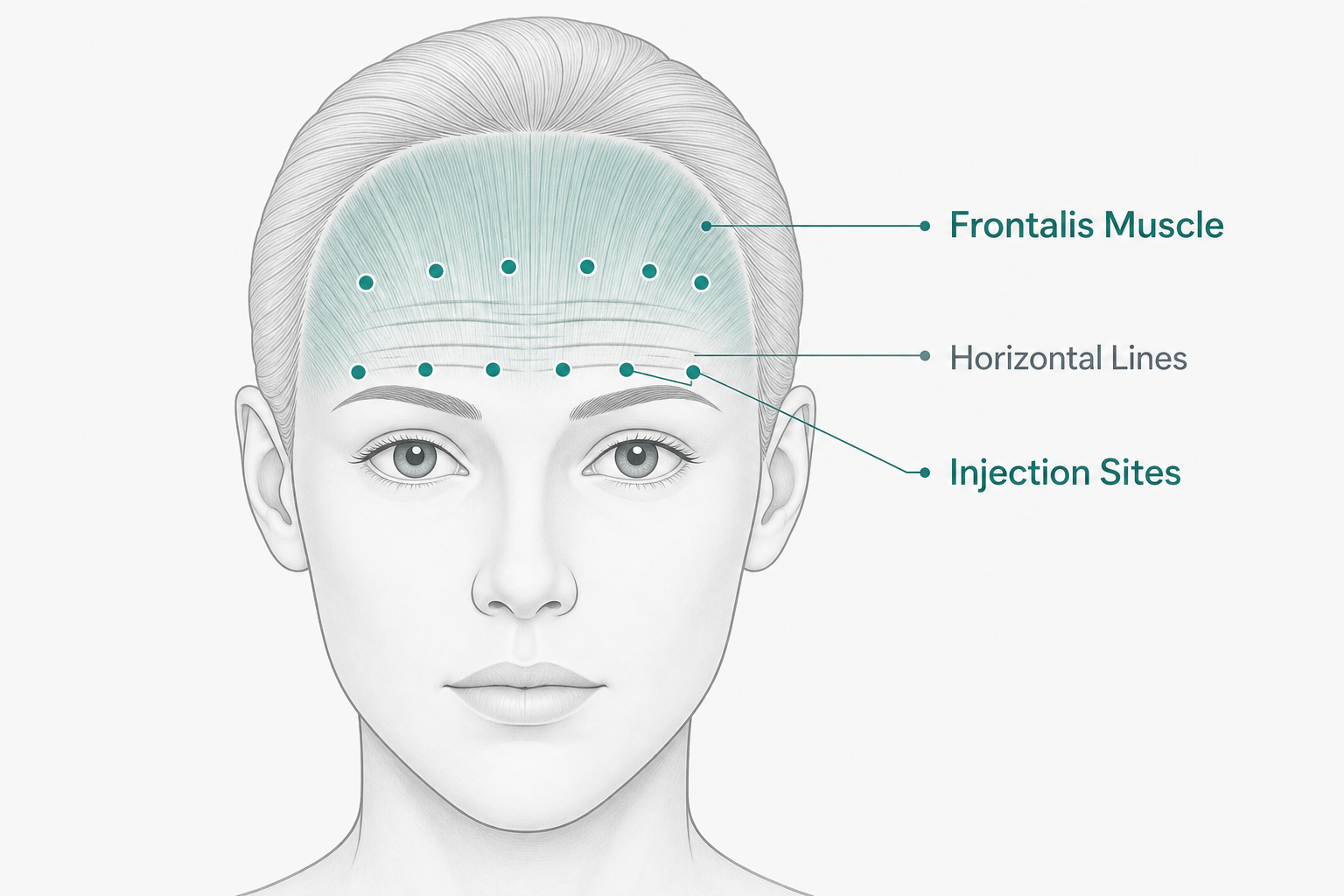
As a general guide, most adults need between 10 and 30 units for the forehead alone. Allergan’s prescribing information references a dosage of 20 units across five injection sites as a standard starting point for horizontal forehead lines, though clinical practice often involves adjusting this based on the individual. People with stronger or larger muscles — which is more common in men — typically need toward the higher end of the range or beyond it. Men often require 30 to 45 units for the forehead and glabella combined, which can bring the total cost to $330 to $675 or more at average per-unit rates.
Muscle strength and depth of lines are the two anatomical factors most directly linked to unit count. Deeper, well-established dynamic wrinkles generally require more product to achieve a smooth result than early or superficial lines. This is one reason baby Botox — a technique using lower doses to soften rather than fully relax expression — costs less per session. Preventative Botox in younger patients with mild lines may use as few as 6 to 12 units, reducing the session cost significantly.
Why the Forehead and Glabella Are Often Treated Together
A factor that surprises many first-time patients is that treating the forehead in isolation carries a meaningful risk of brow drop, also called brow ptosis. The frontalis muscle is the primary elevator of the eyebrow. If it is relaxed without also addressing the depressor muscles in the glabellar region, the net effect can be a heavy or lowered brow appearance — an outcome most patients want to avoid.
For this reason, experienced injectors often recommend treating the forehead and glabella together. This anatomical consideration directly affects cost: a combined treatment uses more units and therefore costs more than a forehead-only session. A full and natural-looking result for both areas typically requires 20 to 40 units in total, placing the realistic cost for most patients between $250 and $600 at mid-range per-unit pricing. Patients who receive a quote for forehead Botox alone at a very low price should ask whether the glabellar area will also be assessed, as omitting it may compromise both safety and aesthetic outcome.
Provider Type and Credentials
The qualifications and experience of the injector are among the most significant factors affecting both the cost per unit and the quality of the result. Broadly speaking, the following provider categories carry different typical price ranges in the US market:
| Provider Type | Typical Cost Per Unit (US) | Notes |
|---|---|---|
| Board-certified dermatologist | $15–$25 | Highest credential level; often most experienced with facial anatomy |
| Plastic surgeon | $14–$20 | Surgical background; strong anatomical knowledge |
| Nurse practitioner / PA (supervised) | $11–$18 | Varies widely by supervision quality and experience |
| Boutique medical spa | $12–$20 | Quality depends heavily on individual injector credentials |
| Med spa chain | $9–$14 | Lower overhead; consistency can vary between locations |
A board-certified injector with extensive experience in facial aesthetics commands a higher fee, but that fee reflects training, anatomical knowledge, and the ability to manage complications. The medspa vs. dermatologist cost difference is real, but so is the difference in the depth of clinical oversight. This does not mean every medspa delivers inferior results — many employ highly skilled practitioners — but the credential and supervision structure matters and is worth verifying before booking.
Geographic Location and Its Effect on Price
Geographic location is consistently one of the top two drivers of price variation in the Botox market. Clinic overhead, local demand, cost of living, and competitive density all influence what providers charge. In major metropolitan areas such as New York City, Los Angeles, and San Francisco, per-unit costs of $15 to $25 are common. In the Midwest, Southeast, and rural areas, the same treatment may cost $8 to $14 per unit. Texas cities typically fall in the $12 to $15 range.
This geographic variation means that a session costing $400 in Manhattan might cost $180 to $220 for a comparable treatment in a mid-sized city in the South. Patients who travel to a lower-cost area for treatment should factor in travel costs and the practical difficulty of returning for a touch-up treatment if the result needs adjustment.
Botox, Dysport, and Xeomin: Does the Brand Affect Cost?
Several botulinum toxin type A products are available for cosmetic use, and the brand used can affect both the price per unit and the total number of units required. The most important point for patients comparing quotes is that units are not interchangeable between brands.
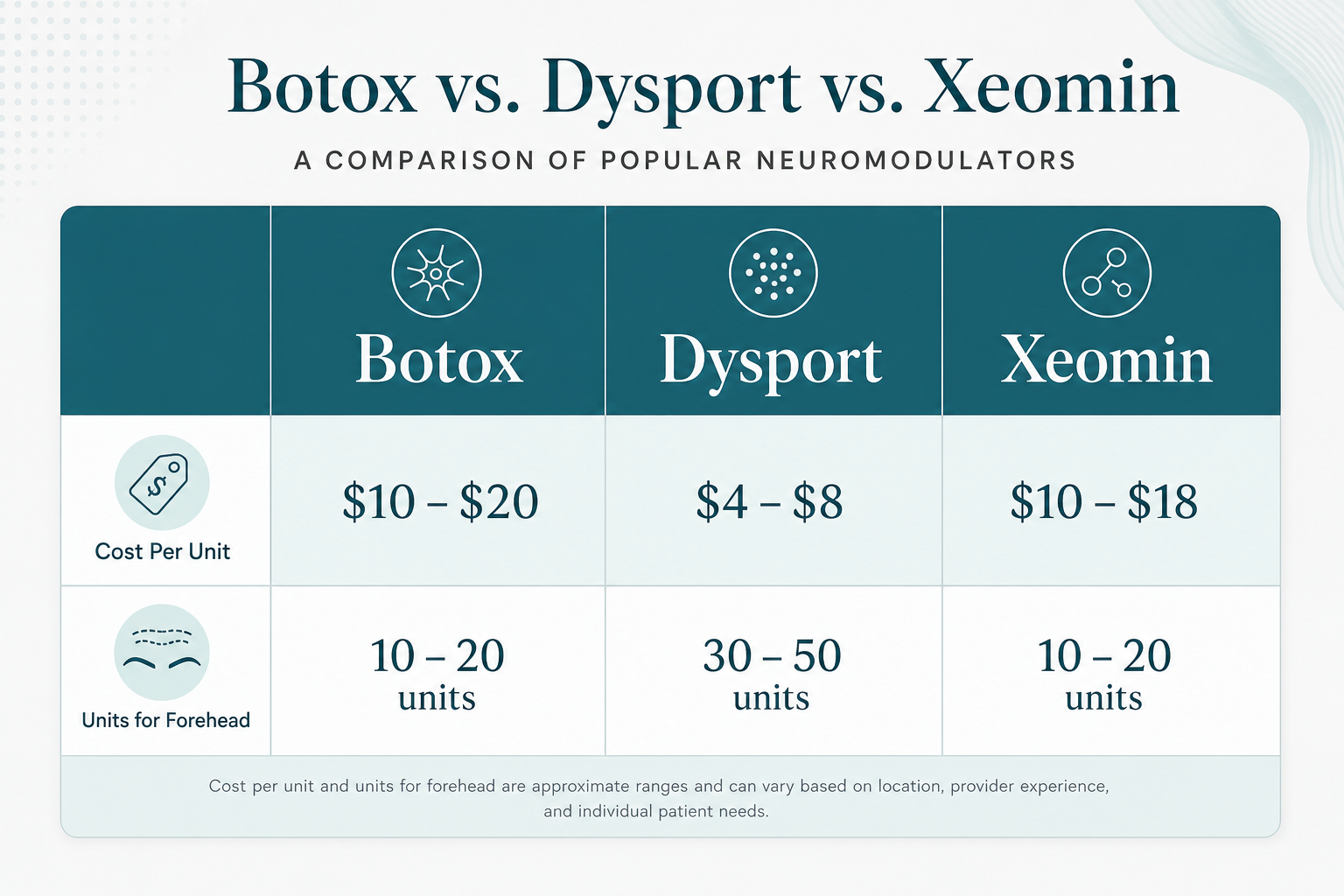
| Brand | Active Ingredient | Typical US Cost Per Unit | Approximate Units for Forehead |
|---|---|---|---|
| Botox (Allergan/AbbVie) | OnabotulinumtoxinA | $10–$20 | 10–30 |
| Dysport (Galderma) | AbobotulinumtoxinA | $4–$7 | 25–75 |
| Xeomin (Merz) | IncobotulinumtoxinA | $9–$18 | 10–30 |
| Jeuveau (Evolus) | PrabotulinumtoxinA | $9–$15 | 10–30 |
The Dysport unit conversion is a common source of confusion. Dysport is dosed at approximately 2.5 to 3 times the unit count of Botox to achieve a comparable effect. A clinic advertising Dysport at $5 per unit is not offering a cheaper treatment than one charging $15 per unit for Botox — the total product cost is roughly equivalent. Always compare total session cost, not cost per unit alone, when evaluating different brands.
Xeomin is sometimes described as a “naked” neuromodulator because it contains no accessory proteins, which some practitioners prefer for patients who may have developed resistance to other formulations. Xeomin’s wholesale cost is generally slightly lower than Botox, and some clinics pass this saving on. A patient treating the forehead, glabella, and crow’s feet might save $50 to $150 per session with Xeomin compared to Botox — modest per session, but meaningful over years of maintenance treatments.
The True Cost of Cheap Forehead Botox
Prices below approximately $8 to $9 per unit in the US market are a credible warning sign. The wholesale cost of authentic Botox to a licensed provider is roughly $6 per unit, leaving very little margin for clinic overhead, staff, and profit at prices below this threshold. Unusually low prices can indicate diluted product, expired stock, or an unlicensed injector — each carrying distinct risks.
Under-dosing is a subtler but equally important concern. A provider who uses fewer units than the treatment requires may produce results that last six weeks rather than three to four months. Over a year, this can mean five or six sessions instead of three or four, making the annual cost of forehead Botox higher than it would have been with a correctly dosed treatment from a more expensive provider. This is the false economy of cheap Botox: the lower session price does not necessarily translate to lower annual spending, and it may come with a higher risk of suboptimal results or complications that require correction.
Correction costs after a poor outcome — whether brow asymmetry, brow ptosis, or an unnatural frozen appearance — can exceed the original treatment cost. Choosing a qualified, experienced injector is a meaningful financial consideration, not just a safety one.
Annual Cost of Forehead Botox
Because botulinum toxin results typically last three to four months, most patients require three to four sessions per year to maintain their results. The annual cost of forehead Botox is therefore a more useful figure for long-term planning than the per-session cost alone.
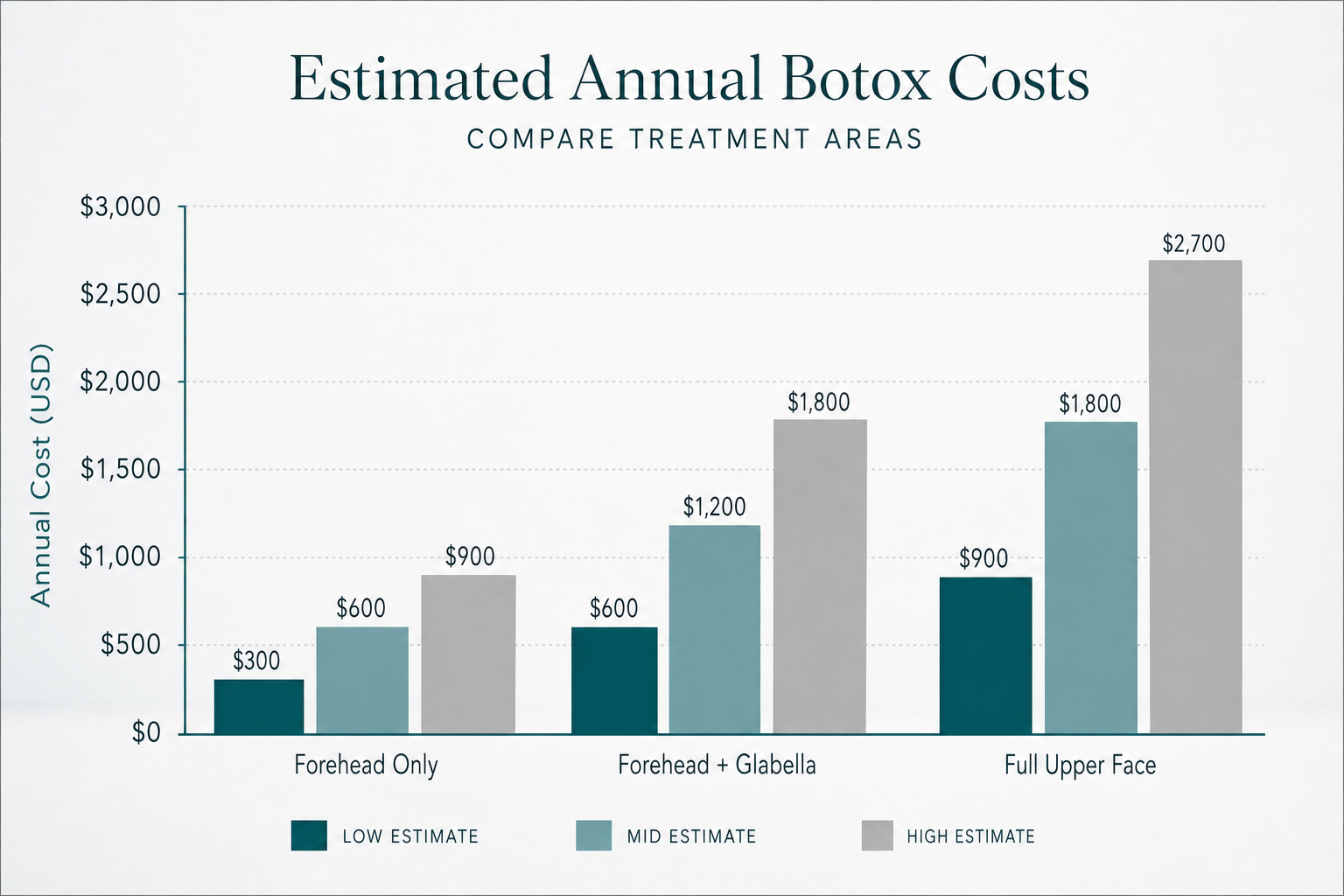
| Treatment Area | Typical Units Per Session | Sessions Per Year | Estimated Annual Cost (US) |
|---|---|---|---|
| Forehead only | 10–20 | 3–4 | $360–$1,200 |
| Forehead + glabella | 20–40 | 3–4 | $720–$2,400 |
| Full upper face (forehead, glabella, crow’s feet) | 30–60 | 3–4 | $1,080–$3,600 |
One underappreciated financial argument for consistent treatment is that regular sessions every three to four months may gradually reduce the units needed over time. Repeated relaxation of the frontalis muscle can lead to mild muscle atrophy, meaning some patients find they need slightly fewer units after one to two years of consistent treatment to achieve the same result. This is not guaranteed and varies between individuals, but it is a legitimate reason why long-term patients sometimes report lower per-session costs than they paid initially.
Hidden and Additional Costs to Be Aware Of
The quoted per-unit or per-area price is not always the total cost of a forehead Botox appointment. Several additional fees can apply:
- Consultation fee: Some clinics charge $50 to $150 for an initial consultation, which may or may not be credited toward treatment. Always ask in advance.
- Touch-up treatment: A follow-up appointment two weeks after the initial session to assess and refine the result is standard practice at many clinics. Some include this in the original fee; others charge separately.
- Gratuity: Tipping norms vary by country and clinic type. In the US, some patients tip injectors at medspas, though this is not universal or expected at physician-led practices.
- Combination treatment add-ons: If the consultation reveals that crow’s feet or other areas would benefit from treatment, the total cost will be higher than the forehead-only quote.
A brief note on insurance: cosmetic forehead Botox is not covered by health insurance in most countries. Botulinum toxin is sometimes covered for medical indications such as chronic migraine or hyperhidrosis, but cosmetic treatment of horizontal forehead lines falls outside standard insurance benefits. Patients should not expect reimbursement for aesthetic treatments.
How to Save Money on Forehead Botox Without Compromising Safety
Several legitimate strategies can reduce the cost of forehead Botox without requiring you to choose an unqualified provider or accept under-dosing:
- Allē loyalty program: Allergan’s Allē program awards points for Botox treatments that can be redeemed for $40 to $100 off future sessions. Patients who use Botox regularly can accumulate meaningful savings over time.
- ASPIRE Rewards and Xperience+: Galderma and Merz operate equivalent loyalty programs for Dysport and Xeomin respectively. Ask your clinic which programs they participate in.
- First-time patient offers: Many clinics offer 10 to 20% discounts or bonus units for new patients. These are worth asking about, but should not be the sole reason for choosing a provider.
- Seasonal promotions: Clinics frequently run promotions around Valentine’s Day, Mother’s Day, and other calendar events. Signing up to a clinic’s mailing list can provide advance notice.
- Clinic membership programmes: Some practices offer monthly membership fees that include discounted treatments. These work well for patients committed to regular maintenance.
- Botox banking: Prepaying for a block of units at a fixed price per unit can protect against future price increases and reduce the effective cost per session.
The most important principle when seeking savings is to prioritise the injector’s qualifications and the clinic’s product sourcing over the headline price. A modest saving per session is not worth the risk of a poor outcome or a safety complication.
Frequently Asked Questions
How many units of Botox does the forehead typically need?
Most adults need between 10 and 30 units for the forehead alone, with 20 units being a commonly cited starting point. Men and those with stronger frontalis muscles often need toward the higher end of this range. When the glabellar area is treated at the same time, the total rises to 20 to 40 units or more.
Is per-unit or per-area pricing better for patients?
Per-unit pricing is generally more transparent because you pay for exactly what is injected. Per-area pricing can be advantageous if you need a higher unit count, but it is worth confirming how many units are included in the flat fee and whether additional units are charged separately.
Why is treating the forehead and glabella together recommended?
The frontalis muscle raises the brow. Relaxing it without also addressing the glabellar depressor muscles can cause the brow to drop — a side effect called brow ptosis. Treating both areas together helps maintain a natural brow position and is standard practice for most patients.
Is Dysport cheaper than Botox for the forehead?
Not necessarily. Dysport is priced at a lower cost per unit, but approximately 2.5 to 3 times more Dysport units are needed to achieve the same effect as Botox. The total session cost is usually comparable. Always compare total treatment cost rather than cost per unit when evaluating different brands.
How long do forehead Botox results last?
Results typically last three to four months, after which the muscle activity gradually returns and lines begin to reappear. Some patients find results last slightly longer after several consistent treatment cycles, possibly due to mild muscle weakening over time.
What are the risks of choosing a very cheap provider?
Prices significantly below market rate can indicate diluted product, expired stock, or an injector without appropriate qualifications. Under-dosing is also common at very low price points, producing results that fade in six weeks rather than three to four months. Correction costs after a poor outcome can exceed the original treatment cost.
Does health insurance cover forehead Botox?
Cosmetic treatment of horizontal forehead lines is not covered by health insurance in most countries. Botulinum toxin may be covered for certain medical indications such as chronic migraine, but aesthetic use falls outside standard insurance benefits.
Making an Informed Decision About Forehead Botox Cost
Forehead Botox cost is shaped by a combination of factors — the number of units required, the pricing model used, the injector’s credentials and experience, the clinic’s geographic location, and the brand of neuromodulator chosen. No single factor determines value on its own. A higher per-unit price at a board-certified dermatologist’s practice may represent better value than a lower price at a clinic where the injector’s qualifications are unclear or the product sourcing is uncertain.
Before booking, it is worth asking any prospective provider how many units they plan to use, whether the glabellar area will be assessed alongside the forehead, what the total session cost will be including any consultation or touch-up fees, and which loyalty programmes the clinic participates in. A transparent provider will answer these questions clearly. If a quote seems unusually low, asking how it is possible at that price is a reasonable and sensible question.
For most patients, a realistic budget for a well-executed forehead and glabella treatment from a qualified injector is $250 to $500 per session, with an annual commitment of three to four sessions. Patients with mild lines or those opting for a preventative approach may spend less. Those with stronger muscles or deeper lines may spend more. A consultation with a qualified practitioner is the most reliable way to receive an accurate, personalised cost estimate based on your anatomy and goals.