
How to Get Rid of Thigh Fat: Treatments, Options and What to Expect
Thigh fat is one of the most common aesthetic concerns among both women and men, and it is also one of the most resistant to diet and exercise alone. Understanding why fat accumulates in the thighs, which approaches may help reduce it, and what realistic outcomes look like can help you make a more informed decision before seeking a professional consultation.
Key Takeaways
- Thigh fat is often hormonally influenced and can be difficult to reduce through lifestyle changes alone, particularly in the inner thigh and saddlebag areas.
- Non-surgical body contouring treatments such as cryolipolysis, radiofrequency, and injectable fat dissolvers may help reduce localised thigh fat, but results vary between individuals.
- No cosmetic treatment replaces a healthy lifestyle, and body contouring is not a treatment for obesity or general weight loss.
- Multiple sessions are typically required for non-surgical options, and results usually develop gradually over several weeks to months.
- A clinical assessment is essential to determine which approach, if any, is appropriate for your anatomy, goals, and health history.
Why Thigh Fat Is Difficult to Lose
Fat distribution across the body is largely determined by genetics, hormones, and sex. In women, oestrogen promotes fat storage in the thighs, hips, and buttocks — a pattern sometimes described as gynoid or pear-shaped fat distribution. This type of subcutaneous fat, which sits beneath the skin rather than around the organs, is metabolically less active and tends to be mobilised last during caloric deficit. This is why many people find that thigh fat persists even after significant overall weight loss.
In men, thigh fat accumulation is less common but does occur, particularly in the inner thigh region. Regardless of sex, localised fat deposits in the thighs are influenced by factors including age-related hormonal changes, reduced muscle mass, and reduced physical activity. Cellulite — the dimpled skin texture often visible on the outer and inner thighs — is a separate but related concern caused by fibrous connective tissue pulling the skin downward over fat lobules, and it requires different treatment considerations.
Spot reduction through exercise — the idea that targeting a specific muscle group burns fat in that area — is not supported by clinical evidence. Resistance training and cardiovascular exercise can reduce overall body fat and improve thigh muscle tone, but they cannot selectively eliminate fat from one region. This is the primary reason many people explore professional body contouring options for the thighs.
Lifestyle Approaches: What They Can and Cannot Do
Before considering any aesthetic treatment, it is worth understanding what lifestyle changes can realistically achieve. A sustained caloric deficit through a balanced diet and regular physical activity remains the most evidence-based approach to reducing overall body fat, including in the thighs. Resistance exercises targeting the quadriceps, hamstrings, and glutes — such as squats, lunges, and leg press — can improve muscle definition and overall leg shape, even if they do not selectively burn thigh fat.
Reducing dietary sodium and refined carbohydrates may help decrease water retention, which can temporarily reduce the appearance of puffiness in the thighs. Staying well hydrated and maintaining consistent sleep patterns also support healthy metabolic function. However, for individuals who have reached a stable weight and still have localised fat deposits that do not respond to these measures, professional body contouring treatments may be worth discussing with a qualified practitioner.
It is important to approach lifestyle changes as a foundation rather than a temporary phase. Non-surgical fat reduction treatments work best when a person is already close to their target weight and is committed to maintaining a stable weight afterward. Significant weight gain after treatment can diminish or reverse results.
Non-Surgical Body Contouring Options for the Thighs
Several non-surgical treatments are used in aesthetic clinics to reduce localised fat deposits in the thigh area. Each works through a different mechanism and carries its own profile of benefits, limitations, and potential side effects. None of these treatments are equivalent to surgical liposuction in terms of the volume of fat that can be removed in a single session.
Cryolipolysis (Fat Freezing)
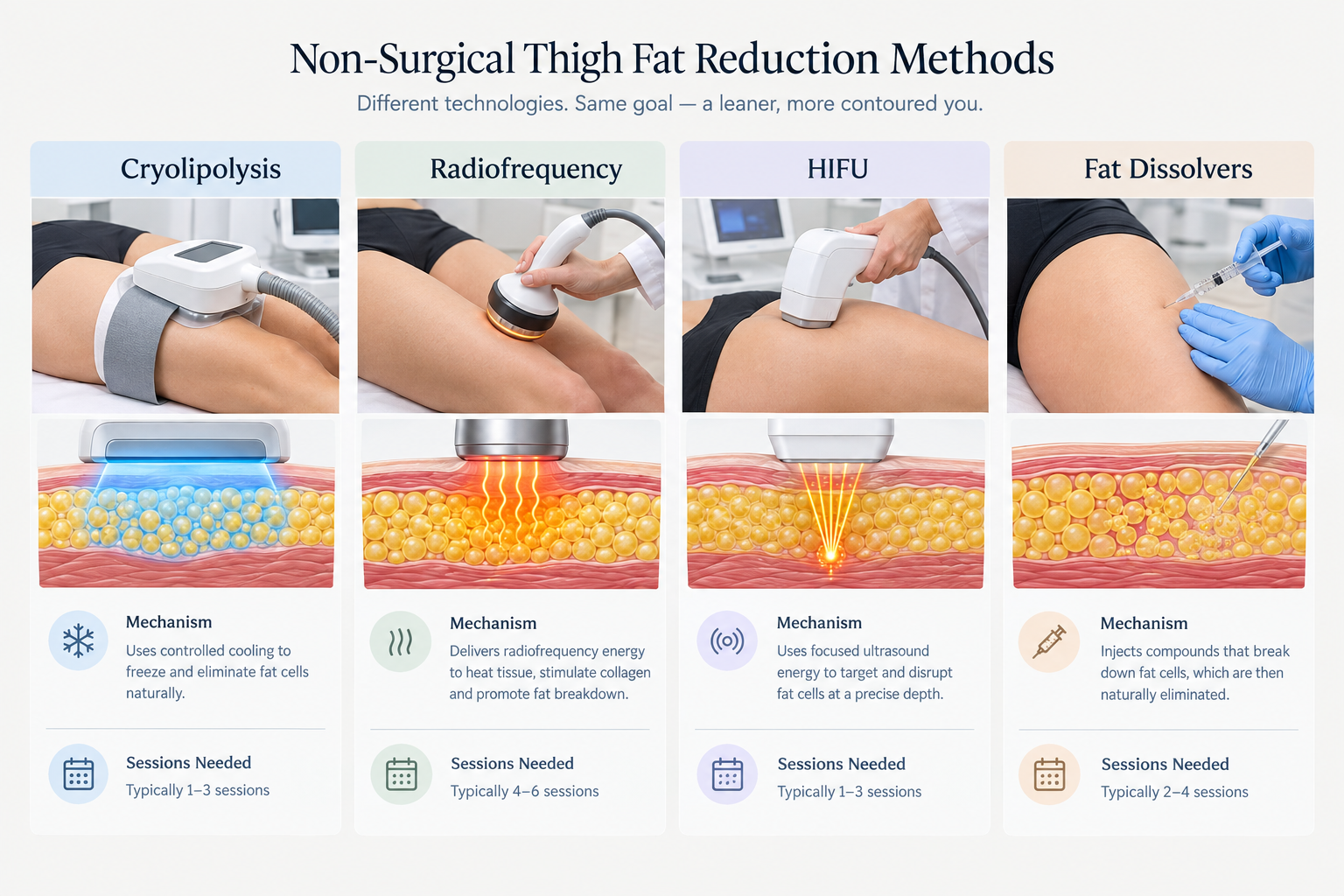
Cryolipolysis, commonly known as fat freezing, uses controlled cooling to target and destroy fat cells without damaging the overlying skin. The treatment works by exploiting the fact that fat cells are more sensitive to cold temperatures than surrounding tissue. When exposed to precise cooling, fat cells undergo a process called apoptosis — a form of programmed cell death — and are gradually cleared by the body’s lymphatic system over the following weeks and months.
Cryolipolysis is one of the more extensively studied non-surgical fat reduction methods and has regulatory clearance in several countries for specific treatment areas. The inner thigh and outer thigh (saddlebag area) are among the regions where applicators can be used, though the suitability of the area depends on the amount and pinchability of the fat tissue. Results typically become visible over eight to twelve weeks, with some patients seeing continued improvement for up to six months after treatment. Most people require more than one session to achieve their desired outcome, and individual responses vary considerably.
Common side effects include temporary redness, bruising, numbness, and swelling at the treatment site. A rare but recognised complication called paradoxical adipose hyperplasia — where the treated area paradoxically enlarges rather than reduces — has been reported, though it is uncommon. A thorough consultation is necessary to assess whether the thigh anatomy is suitable for cryolipolysis applicators.
Radiofrequency Fat Reduction and Skin Tightening
Radiofrequency (RF) energy heats the deeper layers of the skin and subcutaneous fat, which can promote fat cell disruption and stimulate collagen production. RF-based devices used for body contouring include both monopolar and bipolar systems, and some combine RF with other technologies such as vacuum suction or ultrasound. Treatments such as Thermage, Exilis, and Velashape use radiofrequency as part of their mechanism.
Radiofrequency treatments for the thighs may offer a dual benefit: modest fat reduction alongside skin tightening, which can be particularly relevant for individuals whose thigh skin has lost elasticity. However, the degree of fat reduction achievable with RF alone is generally more modest than with cryolipolysis or surgical options. Multiple sessions are typically required, and results are gradual. RF treatments are generally well tolerated, with temporary warmth, redness, and mild swelling being the most commonly reported effects.
High-Intensity Focused Ultrasound (HIFU) for Fat
High-intensity focused ultrasound can be directed at subcutaneous fat layers to generate heat and disrupt fat cells. Devices such as Liposonix use this approach specifically for fat reduction, as distinct from the HIFU devices used for skin lifting. HIFU fat reduction treatments for the thighs may be suitable for individuals with a defined layer of subcutaneous fat and can produce measurable circumference reduction, though results vary and multiple sessions may be needed. The treatment can cause discomfort during the procedure, and temporary bruising or soreness may follow.
Injectable Fat Dissolvers
Injectable fat-dissolving treatments use compounds that disrupt the fat cell membrane, causing the cell contents to be released and subsequently cleared by the body. Aqualyx is one of the more established injectable fat dissolvers used in aesthetic practice in the UK and Europe, containing a deoxycholic acid-based compound. Lemon Bottle is a newer injectable product that has gained popularity, though its independent clinical evidence base is less established than that of longer-standing products.
Injectable fat dissolvers for the thighs are typically used for smaller, more defined areas of localised fat such as the inner thigh. They are not suitable for large-volume fat reduction and are not a substitute for liposuction. Multiple treatment sessions are usually required, spaced several weeks apart. Side effects commonly include swelling, redness, bruising, and tenderness at the injection sites, which can be pronounced in the days following treatment. A qualified practitioner should assess whether the fat deposit is appropriate for this approach and whether the patient’s health history is compatible with the treatment.
Electromagnetic Muscle Stimulation
Devices such as Emsculpt and Emsculpt Neo use high-intensity focused electromagnetic (HIFEM) energy to induce supramaximal muscle contractions — contractions that are more intense than those achievable through voluntary exercise. Emsculpt Neo additionally combines HIFEM with radiofrequency energy, which may contribute to some fat reduction alongside muscle building.
For the thighs, electromagnetic muscle stimulation is primarily aimed at improving muscle tone and definition rather than achieving significant fat reduction. It may be a useful complementary option for individuals who want to improve the overall shape and firmness of the thighs alongside other fat reduction approaches. Results from clinical studies on these devices are generally positive for muscle mass improvement, though the degree of fat reduction in the thigh area specifically varies, and independent long-term evidence remains limited. Multiple sessions are required, and the treatment is not suitable for individuals with certain implanted metal devices or electronic implants.
Surgical Option: Liposuction
Surgical liposuction remains the most effective method for removing significant volumes of localised fat from the thighs. Inner thigh liposuction and outer thigh liposuction are among the most commonly performed liposuction procedures. The procedure involves the insertion of a thin cannula through small incisions to physically remove fat cells, and results are generally more immediate and more substantial than those achievable with non-surgical methods.
Liposuction carries the risks associated with any surgical procedure, including anaesthetic risks, infection, contour irregularities, scarring, and a recovery period that typically involves compression garments, swelling, and restricted activity for several weeks. It is not a weight loss procedure and is most appropriate for individuals who are at or near a stable healthy weight with localised fat deposits that have not responded to lifestyle measures. A consultation with a qualified plastic or cosmetic surgeon is necessary to assess suitability.
Treating Inner Thigh Fat vs Outer Thigh Fat
The inner thigh and outer thigh present different anatomical challenges and may respond differently to various treatments. Inner thigh fat is often softer and more pinchable, which can make it more accessible to injectable fat dissolvers and some cryolipolysis applicators. However, the inner thigh skin is also more prone to laxity, meaning that fat reduction in this area without attention to skin quality may result in looser-looking skin.
Outer thigh fat — sometimes called saddlebags — tends to be denser and more fibrous, particularly in women. Cryolipolysis and HIFU may be more applicable to this area, depending on the volume and consistency of the fat. Cellulite on the outer thighs involves the fibrous septae beneath the skin and is not effectively addressed by fat reduction treatments alone; specific cellulite treatments such as acoustic wave therapy or subcision may be more relevant for that concern.
A practitioner experienced in body contouring will assess the specific distribution and character of thigh fat before recommending a treatment approach, as a single method is rarely optimal for all areas simultaneously.
What to Expect: Treatment Experience and Recovery
The treatment experience varies considerably depending on the method chosen. Cryolipolysis sessions typically last between 35 and 60 minutes per applicator placement, during which patients may feel intense cold and pressure that usually subsides as the area becomes numb. After the session, the treated area is massaged to break up the crystallised fat cells, which can be uncomfortable. Temporary redness, swelling, bruising, and numbness are common in the days following treatment.
Injectable fat-dissolving treatments involve multiple small injections into the target area and can cause a burning or stinging sensation during administration. Significant swelling is expected in the days after treatment and may temporarily make the area appear larger before results become visible. Patients are usually advised to avoid strenuous exercise and heat exposure for a short period after injections.
Radiofrequency and HIFU treatments are generally performed without anaesthesia and involve a warming or heating sensation. Discomfort levels vary by device and individual sensitivity. Recovery is typically minimal, with most people able to return to normal activities the same day, though temporary redness or mild soreness may persist for a day or two.
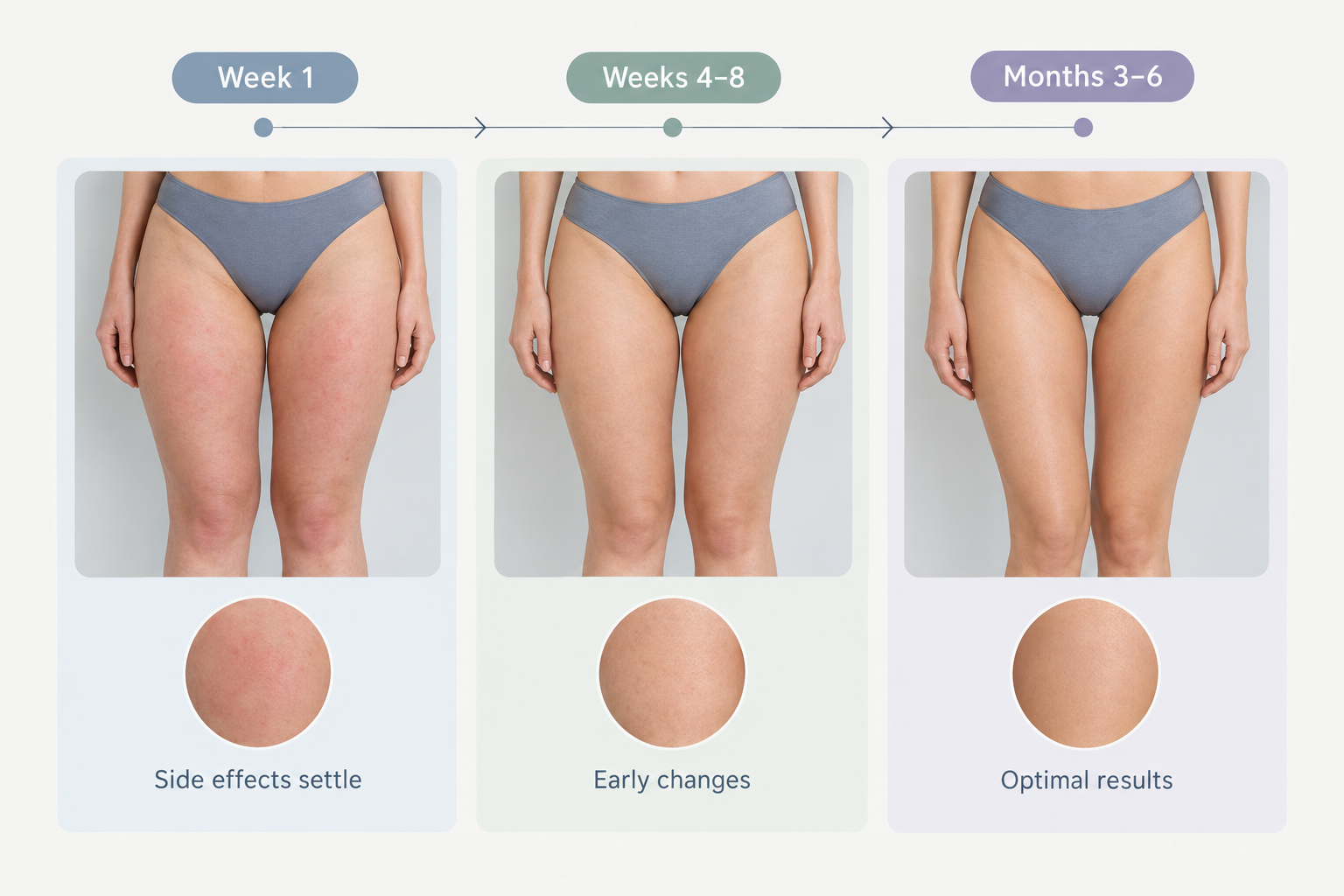
Results from non-surgical fat reduction treatments are not immediate. Most methods require the body to process and eliminate disrupted fat cells, a process that takes weeks to months. Visible changes typically begin to appear from four to eight weeks after treatment, with optimal results often seen at three to six months. Maintaining a stable weight is important for preserving results over time.
Who May Be Suitable for Thigh Fat Reduction Treatments
Non-surgical body contouring treatments for the thighs are generally most appropriate for individuals who are at or near a stable healthy weight, have localised areas of fat that have not responded to diet and exercise, and have realistic expectations about the degree of improvement achievable. These treatments are not designed for individuals seeking significant overall weight loss.
Factors that a practitioner will typically assess during a consultation include the volume and distribution of thigh fat, skin quality and elasticity, overall health and medical history, current medications, and individual aesthetic goals. Pregnancy and breastfeeding are contraindications for most aesthetic treatments. Certain medical conditions, implanted devices, or medications may also affect suitability for specific treatments.
Individuals with very limited subcutaneous fat in the thigh area, or those whose primary concern is skin laxity rather than fat volume, may be better served by skin tightening treatments or a combined approach rather than fat reduction alone.
Risks and Limitations to Consider
All body contouring treatments carry potential risks and limitations that should be discussed openly before proceeding. Non-surgical treatments generally carry lower risks than surgical liposuction, but they are not without side effects. Common risks across non-surgical methods include temporary bruising, swelling, redness, and discomfort. More significant but less common risks depend on the specific treatment and may include skin surface irregularities, prolonged numbness, or, in the case of cryolipolysis, paradoxical adipose hyperplasia.
A key limitation of all non-surgical fat reduction methods is that the degree of fat reduction achievable is modest compared to surgical liposuction. Results are gradual and may require multiple sessions, and individual responses vary considerably. Not everyone will achieve the same outcome, and some individuals may see minimal change despite completing a full course of treatment. Maintaining results requires a stable weight; significant weight gain after treatment can cause remaining fat cells to enlarge and diminish the aesthetic outcome.
The cost of multiple non-surgical sessions can accumulate, and it is worth considering the total investment relative to the likely degree of improvement when making a decision.
Frequently Asked Questions
Can you target thigh fat specifically with exercise?
Spot reduction — burning fat from a specific area through targeted exercise — is not supported by clinical evidence. Exercise improves overall body composition and can enhance muscle tone in the thighs, but it does not selectively remove fat from that region. A combination of cardiovascular exercise and resistance training is the most effective lifestyle approach for reducing overall body fat.
How many sessions of non-surgical fat reduction are typically needed for the thighs?
The number of sessions varies by treatment type and individual response. Cryolipolysis typically requires two to four sessions per area, spaced several weeks apart. Injectable fat dissolvers may require three to six sessions or more. Radiofrequency and HIFU treatments are often delivered in a course of four to eight sessions. A practitioner will advise on a realistic treatment plan after assessing your specific anatomy and goals.
Is fat freezing safe for the inner thigh?
Cryolipolysis can be used on the inner thigh when the anatomy is suitable — specifically, when there is sufficient pinchable fat to fit within the applicator. Not all inner thigh presentations are appropriate for this treatment. A clinical assessment is necessary to determine suitability, and the procedure should only be performed by a trained practitioner using a properly maintained device.
Will thigh fat come back after treatment?
Non-surgical fat reduction treatments destroy or disrupt fat cells, which are then cleared by the body and do not regenerate. However, remaining fat cells in the area can still enlarge if a person gains weight after treatment. Maintaining a stable weight through a balanced diet and regular activity is important for preserving results over the long term.
What is the difference between fat reduction and skin tightening for the thighs?
Fat reduction treatments aim to decrease the volume of subcutaneous fat in a specific area. Skin tightening treatments, such as radiofrequency or ultrasound-based devices, stimulate collagen production to improve skin firmness and elasticity. Some individuals benefit from a combined approach, particularly if skin laxity is a concern alongside excess fat. A practitioner can advise on which concern is the primary driver of the aesthetic issue and recommend accordingly.
Are fat-dissolving injections effective for thigh fat?
Injectable fat dissolvers such as Aqualyx may be effective for small, localised areas of thigh fat, particularly the inner thigh. They are not suitable for large-volume fat reduction and work best when the target area is well-defined. Results require multiple sessions and are gradual. The evidence base for established products is more robust than for newer injectable options, and treatment should only be carried out by a qualified practitioner.
Making an Informed Decision About Thigh Fat Reduction
Reducing thigh fat is achievable through a combination of lifestyle measures and, where appropriate, professional body contouring treatments — but it requires realistic expectations. No non-surgical treatment can replicate the results of surgical liposuction, and no treatment of any kind can guarantee a specific outcome for every individual. The most suitable approach depends on the volume and location of the fat, skin quality, overall health, and personal goals.
If you have reached a stable weight and have localised thigh fat that has not responded to diet and exercise, a consultation with a qualified aesthetic practitioner or cosmetic surgeon is a sensible next step. A thorough assessment will help identify which treatment or combination of treatments may be appropriate for your anatomy, what realistic results might look like, and what the full course of treatment would involve in terms of sessions, recovery, and cost. Approaching the decision with clear information and balanced expectations is the most reliable foundation for a satisfactory outcome.


