
Choosing the Best Lip Filler: Types, Results and What to Expect
Lip filler is one of the most requested aesthetic treatments, yet choosing the right type is rarely straightforward. The product used, the technique applied, and the anatomy of your lips all influence how natural the result looks, how long it lasts, and how comfortable the experience is. This guide explains the main categories of lip filler available, how they differ, what realistic outcomes look like, and what to consider before booking a consultation.
Key Takeaways
- Hyaluronic acid fillers are the most widely used lip filler type and are reversible with an enzyme called hyaluronidase, making them a practical first choice for most patients.
- Different hyaluronic acid products vary in thickness, elasticity, and how they integrate with tissue, which affects the final look and feel of the lips.
- Longer-lasting or permanent fillers exist but carry a different risk profile and are not reversible, which is an important consideration for any patient.
- Practitioner skill and product selection together determine the outcome; the same filler can produce very different results depending on technique.
- A thorough consultation, including a review of your medical history and lip anatomy, is essential before any lip filler treatment.
Why Lip Filler Type Matters
Not all lip fillers are the same product. The term “lip filler” describes a category of injectable treatments rather than a single substance, and the differences between products are clinically meaningful. A filler designed for deep structural support behaves differently from one formulated for superficial hydration. Using the wrong product for a given goal — or for a particular patient’s anatomy — can result in an unnatural appearance, uneven texture, or a higher risk of complications. Understanding the main types helps patients ask better questions during consultation and set realistic expectations before treatment.
Hyaluronic Acid Lip Fillers: The Most Common Choice
Hyaluronic acid (HA) fillers account for the large majority of lip filler treatments performed in aesthetic clinics. Hyaluronic acid is a naturally occurring substance found in skin and connective tissue, where it helps retain moisture and maintain volume. When used as a filler, it is produced synthetically through a fermentation process and cross-linked to create a gel that holds its shape after injection.
The key clinical advantage of hyaluronic acid lip fillers is reversibility. If a patient is unhappy with the result, or if a complication such as vascular occlusion occurs, the filler can be dissolved using an enzyme called hyaluronidase. This safety feature is one reason HA fillers are generally considered the most appropriate starting point for patients new to lip augmentation.
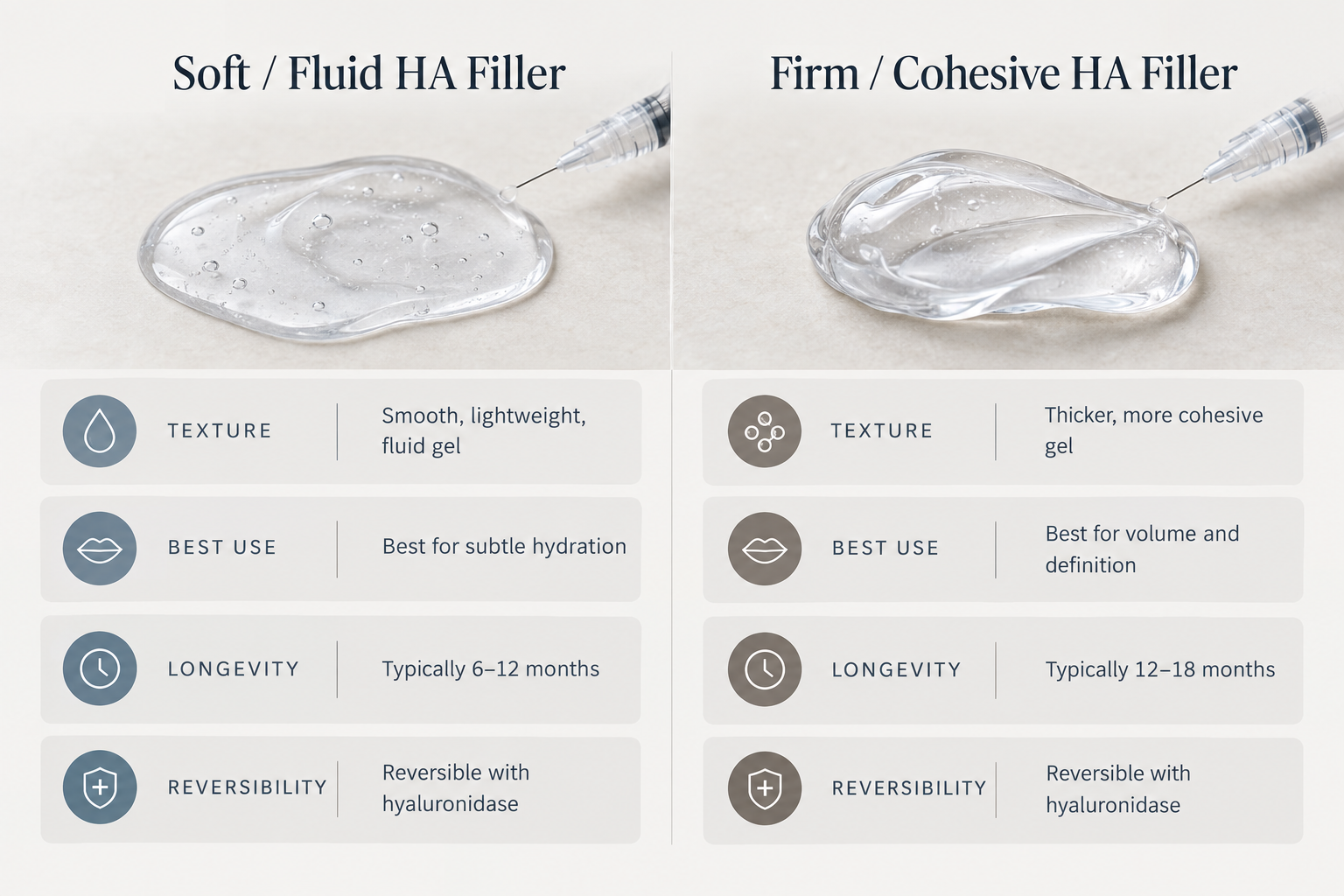
Within the HA category, products differ considerably in their physical properties. Manufacturers adjust the degree of cross-linking, the concentration of hyaluronic acid, and the particle size to create fillers with different levels of firmness, elasticity, and tissue integration. A softer, more fluid product tends to spread more evenly and may suit patients seeking subtle hydration or fine lip line definition. A firmer, more cohesive gel provides greater projection and structural support, which may be more appropriate for patients wanting significant volume increase or improved lip border definition.
Common HA Lip Filler Products
Several established brands produce hyaluronic acid fillers with formulations specifically intended for lip use. Products such as Juvederm Volbella, Juvederm Ultra, Restylane Kysse, and Belotero Soft are among those frequently used in clinical practice, though availability varies by country and regulatory approval status differs between markets. Each product has a distinct rheological profile — meaning the way it flows, deforms, and recovers under pressure — which influences how it behaves in the dynamic environment of the lips during movement, speaking, and eating. A qualified practitioner will select a product based on the patient’s anatomy, the desired outcome, and their own clinical experience with the material.
How Long Do Hyaluronic Acid Lip Fillers Last?
Hyaluronic acid lip fillers are temporary. The body gradually breaks down the cross-linked gel over time through natural enzymatic processes. In the lips specifically, longevity tends to be shorter than in less mobile areas of the face, because constant movement accelerates the breakdown of the filler material. Most patients find that HA lip fillers last somewhere between six and twelve months, though individual variation is significant. Factors that influence longevity include the specific product used, the volume injected, the patient’s metabolism, lifestyle factors such as sun exposure and smoking, and how frequently the area moves.
Patients who want to maintain their result will typically need repeat treatments. Some practitioners observe that after several consistent treatment cycles, patients may require slightly less product to achieve the same effect, though this is not guaranteed and depends on the individual.
Collagen Stimulating Fillers and the Lips
Collagen-stimulating injectables such as poly-L-lactic acid (PLLA) and calcium hydroxylapatite (CaHA) work differently from hyaluronic acid fillers. Rather than providing immediate volume through a gel, these substances stimulate the body’s own collagen production over several weeks or months. They are primarily used in other areas of the face, such as the cheeks and temples, where gradual volumisation and skin quality improvement are the goals.
These products are generally not recommended for use in the lips. The lips are a highly mobile, vascular area with a thin mucosal lining, and collagen stimulators carry a higher risk of nodule formation and irregular texture in this location. Most clinical guidance advises against their use in the lip body, and patients should be cautious of any practitioner who suggests them as a primary lip augmentation option.
Longer-Lasting and Permanent Lip Fillers
Some injectable products are designed to last significantly longer than hyaluronic acid fillers, and a small number are considered semi-permanent or permanent. These include certain formulations containing polymethylmethacrylate (PMMA) microspheres suspended in a collagen carrier, as well as silicone-based injectables. These products are not reversible once injected, which fundamentally changes the risk profile compared to HA fillers.
Complications from permanent fillers — including chronic inflammation, granuloma formation (small nodules of immune tissue that form around a foreign substance), migration, and asymmetry — can be extremely difficult to treat. Because the lips change with age, a result that looks appropriate at the time of treatment may appear disproportionate years later as surrounding facial structures change. For these reasons, most aesthetic medicine practitioners and professional bodies advise against the use of permanent fillers in the lips, particularly for patients who have not previously had lip augmentation with a reversible product.
Fat Transfer to the Lips
Autologous fat transfer — using the patient’s own fat harvested from another area of the body — is a surgical option for lip augmentation. Fat is removed by liposuction, processed, and then injected into the lips. Because the material is the patient’s own tissue, there is no risk of allergic reaction to a foreign substance. Results can be long-lasting, though a proportion of the transferred fat is typically reabsorbed by the body in the months following treatment, and the final volume may be difficult to predict precisely.
Fat transfer to the lips requires a surgical setting, carries the risks associated with both liposuction and injection, and involves a longer recovery period than injectable fillers. It is generally considered a more appropriate option for patients undergoing broader facial rejuvenation surgery rather than as a standalone lip treatment. Swelling can be significant and may take several weeks to fully resolve before the final result is visible.
What Realistic Lip Filler Results Look Like
Lip filler can increase lip volume, improve definition of the lip border (vermilion border), reduce the appearance of fine lines around the mouth, and improve overall lip symmetry. The degree of change depends on the starting anatomy, the product used, the volume injected, and the technique applied. A well-executed treatment with an appropriate product should produce lips that look natural in proportion to the rest of the face, with a soft texture that feels comfortable.
Immediately after treatment, the lips will appear more swollen than the final result. Swelling typically peaks within the first 24 to 48 hours and then gradually subsides over the following one to two weeks. Bruising is common and may take a similar amount of time to resolve. The final result is generally visible once swelling has fully settled, which can take up to two weeks in some patients. Photographs taken immediately after treatment are not an accurate representation of the outcome.
Overfilling — injecting more product than the anatomy can support naturally — is one of the most common causes of an unnatural appearance. The characteristic “duck lip” or excessively projected result is typically a consequence of too much volume rather than the filler type itself. A conservative approach, particularly for first-time patients, allows the practitioner and patient to assess the result before deciding whether additional volume is appropriate.
Risks and Side Effects of Lip Filler
All injectable treatments carry risks, and lip filler is no exception. Common side effects include swelling, bruising, tenderness, and redness at the injection sites. These are expected and typically resolve within one to two weeks without intervention.
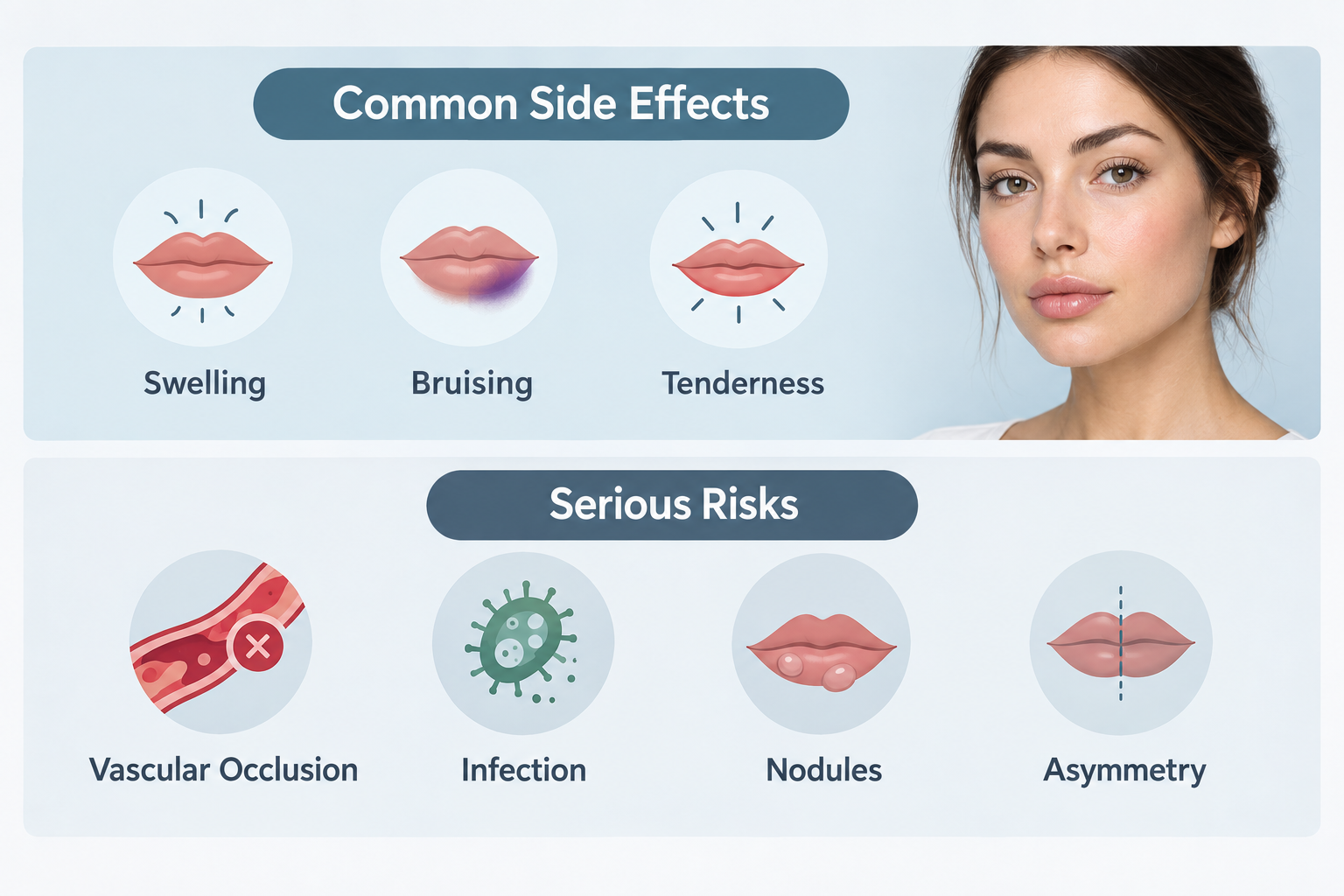
Less common but more serious risks include:
- Vascular occlusion: Filler injected into or near a blood vessel can block blood flow to surrounding tissue. In the lip area, this is a medical emergency requiring immediate treatment with hyaluronidase if an HA filler was used. Signs include severe pain, skin colour changes, or blanching around the injection site.
- Infection: Any injectable procedure carries a risk of introducing bacteria. Signs of infection include increasing redness, warmth, swelling, and discharge beyond the expected post-treatment period.
- Nodules and lumps: Small lumps can form if filler is placed superficially or if the product does not integrate evenly. Many resolve on their own; others may require massage, hyaluronidase, or other intervention.
- Asymmetry: Uneven placement or pre-existing asymmetry that was not fully accounted for during treatment can result in an uneven result.
- Cold sore reactivation: Patients with a history of cold sores (herpes simplex virus) may experience a reactivation triggered by the injection. Antiviral medication taken before treatment may reduce this risk; discuss this with your practitioner if relevant.
- Tyndall effect: Superficially placed HA filler can create a bluish discolouration visible through the skin. This is more likely with certain products and injection depths.
The risk of serious complications is reduced — though not eliminated — when treatment is performed by a qualified, experienced practitioner using appropriate products and sterile technique. Patients should ensure their practitioner is trained to recognise and manage complications, including vascular occlusion, and has access to hyaluronidase on site.
Who May Be Suitable for Lip Filler
Lip filler may be appropriate for adults who want to increase lip volume, improve lip symmetry, define the lip border, or address fine lines around the mouth. Suitability depends on individual anatomy, medical history, and realistic expectations. A thorough consultation is necessary before treatment.
Lip filler is generally not recommended for patients who are pregnant or breastfeeding, have an active infection or cold sore in or around the mouth, have certain autoimmune conditions, are taking blood-thinning medications (which may increase bruising risk), or have a known allergy to any component of the filler product. Patients with a history of severe allergic reactions or anaphylaxis should discuss this with their practitioner. Previous lip procedures, including permanent filler or surgical augmentation, should always be disclosed before treatment.
Alternatives to Lip Filler
For patients who want lip enhancement without injectable filler, several alternatives exist, though each has its own limitations.
- Lip flip with botulinum toxin: A small amount of botulinum toxin injected into the orbicularis oris muscle around the upper lip can cause the lip to roll slightly outward, creating the appearance of a fuller upper lip without adding volume. The effect is subtle, temporary (typically lasting two to three months), and does not increase actual lip size. It may suit patients who want a minor change or who are not ready for filler.
- Lip blushing (cosmetic tattooing): A semi-permanent pigment applied to the lips can enhance colour and create the appearance of a more defined border. It does not add volume and fades over time. Results vary depending on skin type and the pigments used.
- Surgical lip augmentation: Procedures such as a lip lift (which shortens the distance between the nose and upper lip) or implants offer longer-lasting results but involve surgical risks, recovery time, and are not reversible in the same way as HA filler.
- Skinboosters and hydrating injectables: Products designed to improve skin hydration and quality rather than add volume can improve the texture and appearance of the lip area without significant augmentation. These may suit patients whose primary concern is lip dryness or fine lines rather than volume.
Questions to Ask Before Your Lip Filler Appointment
A consultation is an opportunity to gather information as well as to be assessed. Useful questions to ask a practitioner include:
- Which specific product do you recommend for my goals, and why?
- How much volume do you suggest for a first treatment?
- What does your complication management protocol include, and do you have hyaluronidase available?
- What results are realistic given my lip anatomy?
- What should I avoid before and after treatment to reduce the risk of bruising or infection?
- How long should I expect swelling to last?
- What are the signs that I should contact you after treatment?
Frequently Asked Questions
Is there a “best” lip filler product?
No single product is universally best. The most appropriate lip filler depends on the patient’s anatomy, the desired outcome, and the practitioner’s clinical experience with the product. Hyaluronic acid fillers are the most widely used and are generally considered the safest starting point because they are reversible, but the specific formulation should be chosen based on individual assessment rather than brand name alone.
How much filler is typically used for lips?
The volume used varies considerably depending on the patient’s starting anatomy and goals. Many practitioners recommend beginning with a conservative amount — often 0.5 to 1 millilitre — particularly for first-time patients, and assessing the result before adding more. Larger volumes are not inherently better and increase the risk of an unnatural appearance.
Can lip filler be removed if I don’t like the result?
Hyaluronic acid lip filler can be dissolved using hyaluronidase, an enzyme that breaks down the filler. Dissolution is not always complete in a single session and may require more than one treatment. Permanent fillers cannot be removed in this way, which is one reason most practitioners advise against them for lip augmentation.
Does lip filler hurt?
Most lip filler products contain lidocaine, a local anaesthetic, which helps reduce discomfort during injection. Topical anaesthetic cream applied before treatment can further reduce sensitivity. The lips are a sensitive area, and some discomfort during injection is common, but most patients find the procedure tolerable. Significant pain during or after treatment should be reported to the practitioner promptly.
Will my lips look swollen straight after treatment?
Yes. Swelling immediately after lip filler is expected and is not an accurate reflection of the final result. Swelling typically peaks within the first 48 hours and gradually resolves over one to two weeks. Avoiding strenuous exercise, alcohol, and excessive heat in the first 24 to 48 hours may help reduce swelling.
Can I have lip filler if I have had cold sores before?
A history of cold sores does not automatically exclude a patient from lip filler, but it is important to disclose this to your practitioner. Injection can trigger a herpes simplex reactivation, and antiviral medication taken before treatment may reduce this risk. Treatment should not be performed if an active cold sore is present.
Choosing a Lip Filler That Suits Your Goals
The most important decision in lip filler treatment is not which brand to request by name, but whether the practitioner you choose has the clinical knowledge to select an appropriate product, apply it with a technique suited to your anatomy, and manage any complications that arise. Hyaluronic acid fillers remain the most evidence-supported and widely recommended option for most patients, primarily because of their reversibility and established safety record. Within that category, the specific product and the volume used should be determined through a proper consultation rather than a fixed protocol.
Patients who are considering lip filler for the first time are generally best served by a conservative approach — a modest volume with a soft, well-integrated product — that allows both patient and practitioner to assess the result before committing to more. Those with previous lip filler experience may have a clearer sense of what works for their anatomy and can have a more specific conversation about product choice and technique. In either case, realistic expectations, an honest consultation, and a practitioner who prioritises safety over volume are the foundations of a result that looks and feels right.


