
Laser Treatment for Rosacea: Calming Facial Redness Effectively
Rosacea is a chronic inflammatory skin condition that causes persistent facial redness, visible blood vessels, and in some cases, skin thickening or pustules. While it cannot be cured, its visible symptoms can often be managed effectively. Laser treatment for rosacea has become one of the most clinically supported options for reducing facial redness and broken capillaries, offering meaningful improvement for patients who have not found adequate relief from topical therapies alone. This article explains how laser and light-based treatments work for rosacea, what results are realistic, what the experience involves, and how to decide whether this approach may be worth discussing with a qualified practitioner.
Key Takeaways
- Laser and light-based treatments can significantly reduce facial redness, flushing, and visible blood vessels associated with rosacea, though results vary between individuals.
- Pulsed dye laser (PDL) and intense pulsed light (IPL) are among the most commonly used and well-studied options for vascular rosacea; no single device suits every patient.
- Multiple treatment sessions are typically required, and maintenance treatments may be needed over time as rosacea is a chronic condition.
- Side effects are usually temporary and mild, but risks including bruising, pigmentation changes, and rarely scarring should be discussed before treatment.
- Laser treatment addresses visible symptoms rather than the underlying cause of rosacea, so it is most effective when combined with appropriate skincare and trigger management.
Understanding Rosacea and Why Redness Persists
Rosacea affects an estimated 5–10% of the global population, most commonly presenting in fair-skinned adults between the ages of 30 and 60. The condition involves chronic inflammation and abnormal blood vessel behaviour in the skin, particularly across the central face — the cheeks, nose, chin, and forehead. In erythematotelangiectatic rosacea, the most common subtype, the skin flushes easily and small dilated blood vessels called telangiectasia become permanently visible near the surface. These vessels do not resolve on their own, and topical treatments such as brimonidine or azelaic acid can reduce redness temporarily but do not eliminate the underlying vessels.
The persistent redness of rosacea occurs because the superficial blood vessels in affected skin are chronically dilated and structurally abnormal. Over time, repeated flushing episodes can cause these vessels to remain permanently enlarged. This is precisely where laser and light-based treatments offer a meaningful advantage: they can selectively target and destroy these abnormal vessels without damaging the surrounding skin, reducing both the visible redness and the tendency to flush.
How Laser Treatment for Rosacea Works
Laser and light-based devices used for rosacea work through a principle called selective photothermolysis. This means the device emits light at a specific wavelength that is preferentially absorbed by oxyhemoglobin — the pigment that gives blood its red colour — inside the targeted blood vessels. The absorbed light energy converts to heat, which damages the vessel wall and causes it to collapse and be gradually reabsorbed by the body. Because the surrounding skin tissue absorbs far less of this specific wavelength, it is largely spared from thermal injury when the treatment is performed correctly.
The effectiveness of this mechanism depends on matching the device’s wavelength to the depth and diameter of the vessels being treated. Superficial fine telangiectasia respond differently from deeper, wider vessels, which is one reason why different devices may be recommended for different presentations of rosacea. Cooling systems built into modern laser handpieces help protect the outer skin surface during treatment, improving both safety and patient comfort.
Which Laser or Light Device Is Used for Rosacea?
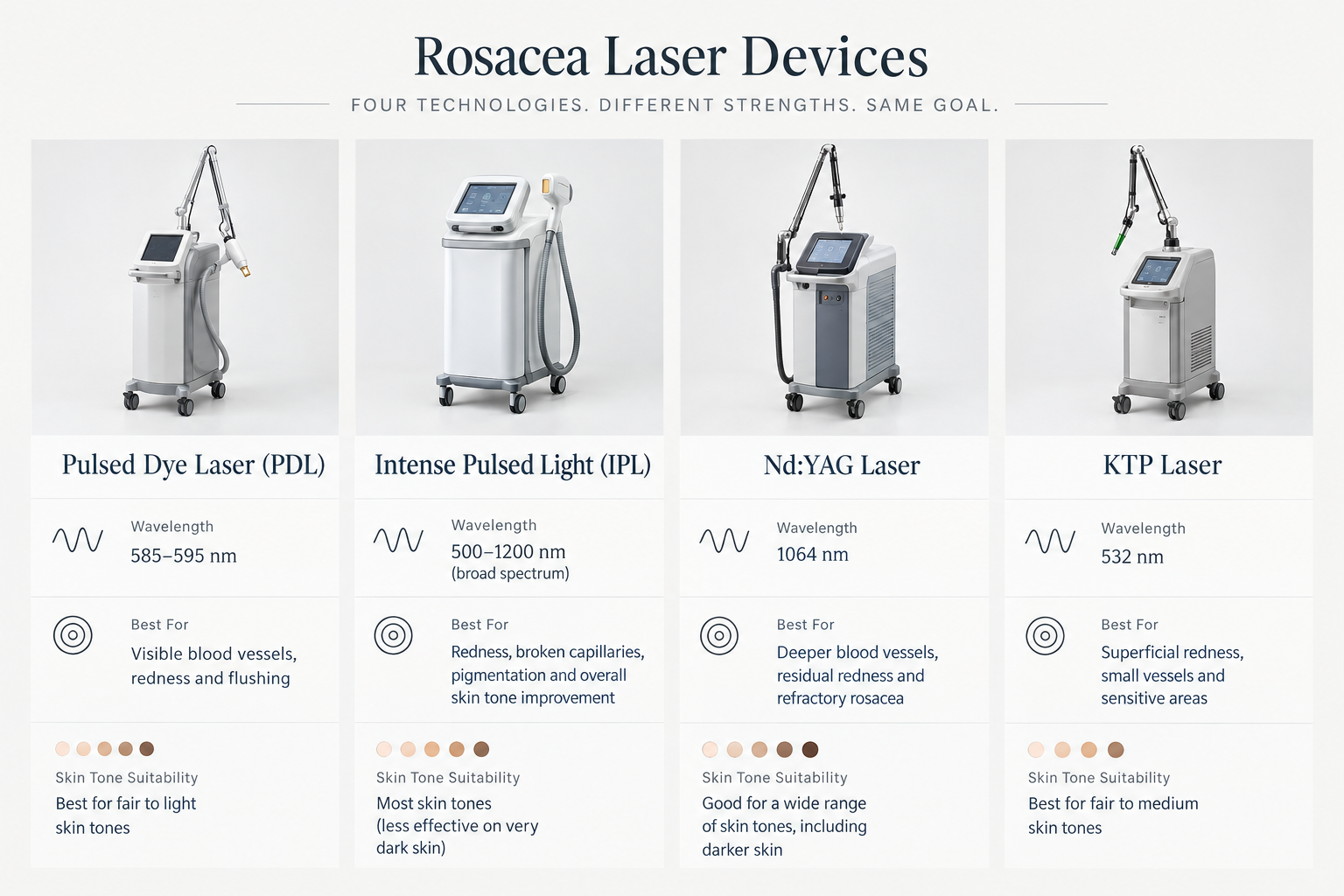
Several different devices are used clinically for rosacea-related redness and vascular changes. The most commonly discussed include pulsed dye laser, intense pulsed light, Nd:YAG laser, and KTP laser. Each has distinct characteristics that make it more or less suitable depending on the patient’s skin type, vessel depth, and specific rosacea subtype.
Pulsed Dye Laser (PDL)
Pulsed dye laser, which typically operates at a wavelength of 585 or 595 nanometres, is one of the most extensively studied laser treatments for vascular rosacea. PDL targets oxyhemoglobin with high specificity, making it particularly effective for superficial telangiectasia and diffuse facial redness. Clinical studies have demonstrated meaningful reductions in erythema and vessel visibility after a course of PDL treatments. A recognised limitation is that PDL can cause post-treatment purpura — a bruise-like discolouration — which may last one to two weeks, though newer settings and longer pulse durations have reduced this side effect in many cases.
Intense Pulsed Light (IPL)
Intense pulsed light is not technically a laser; it emits a broad spectrum of light wavelengths that are filtered to target specific chromophores including oxyhemoglobin. IPL is widely used for rosacea because it can address both redness and associated pigmentation concerns simultaneously, and it generally produces less post-treatment bruising than traditional PDL settings. IPL tends to be better suited to lighter skin tones and may be less effective for deeper or larger vessels. Multiple sessions — typically three to six — are usually recommended, spaced several weeks apart.
Nd:YAG Laser
The Nd:YAG laser operates at 1064 nanometres, a longer wavelength that penetrates more deeply into the skin. This makes it more suitable for treating larger or deeper blood vessels that do not respond adequately to PDL or IPL. Nd:YAG laser is also considered safer for patients with darker skin tones, where shorter-wavelength devices carry a higher risk of pigmentation changes. The trade-off is that Nd:YAG treatment can be more uncomfortable and may require more careful technique to avoid thermal injury to surrounding tissue.
KTP Laser
The KTP laser emits light at 532 nanometres and is effective for fine superficial telangiectasia and mild diffuse redness. It is sometimes used for patients with very superficial vessels where a shorter wavelength is advantageous. Like PDL, KTP laser is generally better suited to lighter skin types.
What Rosacea Symptoms Can Laser Treatment Address?
Laser and light-based treatments are most effective for the vascular features of rosacea. These include persistent facial redness (erythema), visible broken capillaries and telangiectasia, and flushing that has become semi-permanent. Patients with erythematotelangiectatic rosacea — characterised primarily by redness and visible vessels without significant papules or pustules — tend to be the most suitable candidates for laser-based approaches.
Laser treatment is generally less effective for the inflammatory papulopustular subtype of rosacea, where the primary concern is acne-like breakouts rather than vascular changes. In these cases, medical management with topical or oral treatments is usually the first-line approach, and laser may be considered as an adjunct once inflammation is controlled. Phymatous rosacea, which involves skin thickening particularly on the nose (rhinophyma), may benefit from ablative laser resurfacing rather than vascular laser treatment — a distinct approach that a dermatologist or specialist would assess separately.
What to Expect During a Laser Treatment Session
Before any laser treatment for rosacea, a thorough consultation should take place. A qualified practitioner will assess the rosacea subtype, skin tone, medical history, current medications, and previous treatments. Certain medications — including photosensitising drugs, isotretinoin, and blood thinners — may affect suitability or timing. Patients are typically advised to avoid sun exposure, tanning, and certain skincare actives in the weeks before treatment.
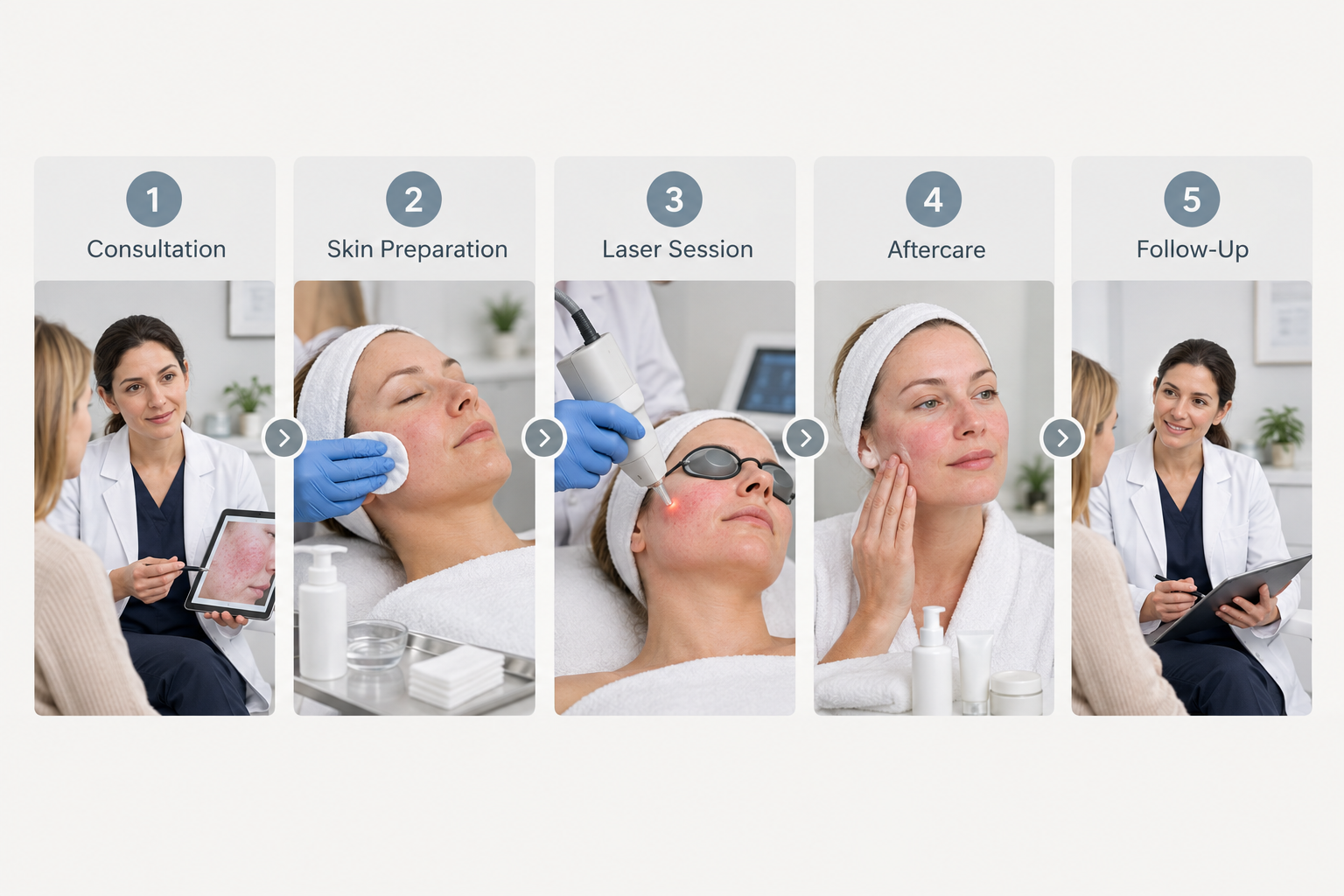
During the appointment itself, the treatment area is cleansed and protective eyewear is provided. A cooling gel may be applied to the skin, and the device handpiece is passed over the treatment area in a systematic pattern. Most patients describe the sensation as a series of brief snapping or stinging feelings, similar to a rubber band flicking against the skin. The level of discomfort varies depending on the device used, the settings, and individual pain tolerance. Sessions typically last between 20 and 45 minutes depending on the size of the area being treated.
Immediately after treatment, the skin usually appears red and may feel warm, similar to mild sunburn. Some swelling is common, particularly around the cheeks and nose. With PDL at higher settings, purpura may develop within hours and can take up to two weeks to resolve. With IPL and lower-fluence PDL settings, downtime is often shorter — many patients experience only mild redness for 24 to 48 hours.
Recovery, Downtime, and Aftercare
Recovery from laser treatment for rosacea is generally manageable, though it varies depending on the device and settings used. In the days following treatment, the skin may feel sensitive, appear flushed, or show mild swelling. Gentle skincare is important during this period: a mild fragrance-free cleanser, a simple moisturiser, and a broad-spectrum SPF 30 or higher sunscreen should be used consistently. Harsh exfoliants, retinoids, and alcohol-based products should be avoided until the skin has settled, typically for at least one week.
Sun protection is particularly important after laser treatment because the skin is temporarily more vulnerable to UV-induced pigmentation changes. Patients with rosacea are generally advised to maintain diligent sun protection as part of their long-term management regardless of whether they are undergoing laser treatment, as UV exposure is a recognised trigger for rosacea flares.
Most patients can return to normal daily activities within one to three days after IPL or low-fluence PDL, though they may prefer to avoid social commitments if visible redness or bruising is present. Higher-fluence PDL treatments may require a longer recovery period of up to two weeks if significant purpura develops.
How Many Sessions Are Needed and How Long Do Results Last?
The number of laser or IPL sessions required for rosacea varies depending on the severity of the condition, the device used, and the individual’s response to treatment. Most patients require between two and six sessions, spaced four to eight weeks apart, to achieve a meaningful reduction in redness and visible vessels. Some patients with mild rosacea may see satisfactory improvement after two or three sessions, while those with more extensive telangiectasia or diffuse erythema may need additional treatments.
Results from laser treatment for rosacea are not permanent. Because rosacea is a chronic condition, new vessels can develop over time and existing redness may gradually return, particularly if triggers such as sun exposure, heat, alcohol, or spicy foods are not managed. Many patients find that maintenance treatments once or twice a year help sustain their results. The interval between maintenance sessions varies considerably between individuals.
Visible improvement is often noticeable within two to four weeks after each session as the treated vessels are gradually reabsorbed. The full benefit of a treatment course may take several months to become apparent, particularly when multiple sessions are involved.
Risks and Side Effects of Laser Treatment for Rosacea
Laser treatment for rosacea is generally considered safe when performed by a trained and experienced practitioner using appropriate settings for the patient’s skin type. However, as with any energy-based treatment, risks and side effects exist and should be discussed openly before proceeding.
Common and usually temporary side effects include redness, swelling, warmth, and sensitivity in the treated area. Purpura — the bruise-like discolouration associated particularly with PDL — is expected at certain settings and resolves within one to two weeks. Crusting or mild blistering can occasionally occur if the skin is treated too aggressively or if aftercare instructions are not followed.
Less common but more significant risks include post-inflammatory hyperpigmentation (darkening of the skin), hypopigmentation (lightening of the skin), and in rare cases, scarring. The risk of pigmentation changes is higher in patients with darker skin tones, which is why device selection and settings must be carefully matched to the individual. Patients with a history of cold sores (herpes simplex) may experience a flare triggered by laser treatment and may be prescribed antiviral medication prophylactically.
Paradoxical worsening of rosacea symptoms has been reported in a small number of cases, though this is uncommon. Choosing a practitioner with specific experience in treating rosacea and vascular skin conditions reduces the likelihood of adverse outcomes.
Who May Be Suitable for Laser Treatment for Rosacea
Laser treatment for rosacea may be worth considering for adults who have persistent facial redness, visible telangiectasia, or flushing that has not responded adequately to topical or oral medical treatments. Patients with erythematotelangiectatic rosacea — the vascular subtype — tend to benefit most. Fair to medium skin tones (Fitzpatrick skin types I to III) are generally the most straightforward to treat with PDL and IPL, though Nd:YAG laser extends options to patients with darker skin tones.
Suitability depends on a full clinical assessment. Factors that may affect eligibility or require careful consideration include active skin infections, recent use of isotretinoin (typically a waiting period of six months to one year is recommended), pregnancy, photosensitising medications, a history of keloid scarring, and very recent sun exposure or tanning. A thorough consultation with a qualified practitioner is essential before proceeding.
Alternatives to Laser Treatment for Rosacea
Laser and light-based treatments are not the only options for managing rosacea-related redness, and they are not always the most appropriate first step. Understanding the alternatives helps patients make a more informed decision about their overall management plan.
Topical treatments such as brimonidine tartrate gel and oxymetazoline can temporarily constrict blood vessels and reduce redness, though their effects last only a few hours and do not address the underlying vessels. Azelaic acid and metronidazole have anti-inflammatory properties and are commonly used for papulopustular rosacea. Oral antibiotics such as low-dose doxycycline are used for their anti-inflammatory rather than antibiotic effect and can help control flares. Isotretinoin may be considered in severe or refractory cases under specialist supervision.
Trigger avoidance — identifying and minimising personal rosacea triggers such as UV exposure, heat, alcohol, spicy foods, and certain skincare ingredients — is a foundational part of rosacea management that complements any treatment approach. Broad-spectrum sun protection is universally recommended.
For patients who are not suitable for laser treatment or who prefer a non-laser approach, radiofrequency-based devices and certain topical prescription therapies may offer partial alternatives, though the evidence base for these in rosacea is generally less robust than for vascular laser treatments.
Frequently Asked Questions
Is laser treatment painful for rosacea?
Most patients describe the sensation as a series of brief stinging or snapping feelings during the procedure. Discomfort is generally tolerable and short-lived. Cooling systems built into modern devices help reduce the sensation, and topical anaesthetic cream can be applied beforehand if needed. The level of discomfort varies depending on the device, the settings, and individual sensitivity.
How soon will I see results after laser treatment for rosacea?
Initial improvement in redness and vessel visibility may become noticeable within two to four weeks after a session as treated vessels are gradually reabsorbed. The full benefit of a treatment course typically becomes apparent over several months. Results continue to develop between sessions, so patience is important when assessing the outcome.
Can laser treatment cure rosacea permanently?
Laser treatment cannot cure rosacea because the condition has an underlying chronic inflammatory component that persists regardless of treatment. It can significantly reduce visible symptoms such as redness and telangiectasia, but new vessels may develop over time and maintenance treatments are often needed. Managing known triggers remains an important part of long-term rosacea control.
Is IPL the same as laser treatment for rosacea?
Intense pulsed light (IPL) is not technically a laser. It uses a broad spectrum of filtered light rather than a single coherent wavelength. Both IPL and laser devices can be effective for rosacea-related redness, but they have different characteristics, and the most appropriate choice depends on the individual’s skin type, vessel characteristics, and treatment goals. A qualified practitioner can advise which option may be more suitable.
How many laser sessions will I need for rosacea?
Most patients require between two and six sessions to achieve meaningful improvement, though this varies depending on the severity of rosacea, the device used, and individual response. Maintenance sessions once or twice a year are often recommended to sustain results over time, as rosacea is a chronic condition.
Can laser treatment make rosacea worse?
In the short term, the skin will appear redder and more sensitive immediately after treatment, which is a normal response. Paradoxical worsening of rosacea beyond the expected recovery period is uncommon but has been reported. Choosing an experienced practitioner who uses appropriate settings for your skin type and rosacea subtype significantly reduces this risk.
Is laser treatment for rosacea suitable for darker skin tones?
Shorter-wavelength devices such as PDL and IPL carry a higher risk of pigmentation changes in patients with darker skin tones. Nd:YAG laser, which operates at a longer wavelength, is generally considered safer for Fitzpatrick skin types IV to VI. A thorough assessment by an experienced practitioner is essential to determine the safest and most effective approach for each individual.
Is Laser Treatment a Realistic Option for Your Rosacea?
For patients with persistent facial redness, visible telangiectasia, or flushing that has not responded adequately to topical or medical management, laser treatment for rosacea represents a clinically supported option with a meaningful evidence base. Pulsed dye laser and intense pulsed light are among the most studied approaches, and many patients experience significant reductions in redness and vessel visibility after a course of treatment. Results are not permanent, and rosacea management is best understood as an ongoing process rather than a one-time fix.
The decision to pursue laser treatment should be made in the context of a full clinical assessment. Skin type, rosacea subtype, medical history, and realistic expectations all influence whether this approach is appropriate and which device is most likely to be effective. A practitioner with specific experience in vascular skin conditions and rosacea management is best placed to advise on the most suitable treatment plan, including whether laser treatment should be combined with medical therapy, trigger management, and a rosacea-appropriate skincare routine. If you are considering this option, a consultation with a qualified dermatologist or aesthetic medicine practitioner is a sensible first step.


