
How Long Does a Lash Lift Take? What to Expect at Your Appointment
A lash lift typically takes between 45 minutes and 75 minutes from start to finish, though the exact duration depends on several factors including your natural lash length, the technique used, and how your lashes respond to the lifting solution. Understanding what happens during each stage of the appointment can help you plan your time and arrive with realistic expectations.
Key Takeaways
- Most lash lift appointments take between 45 and 75 minutes, with the chemical processing stages accounting for the majority of that time.
- Results typically last six to eight weeks, depending on your natural lash growth cycle and aftercare habits.
- There is no significant downtime, but lashes should be kept dry and free from makeup for the first 24 to 48 hours after treatment.
- A lash lift works on your natural lashes and does not require extensions, making it a lower-maintenance alternative for many people.
- Suitability depends on natural lash length and condition; very short or damaged lashes may not respond well to the treatment.
What Is a Lash Lift?
A lash lift is a semi-permanent treatment that uses a chemical solution to reshape the natural lashes from the root, creating the appearance of greater length, curl, and lift without the use of eyelash extensions. The treatment works by temporarily breaking and reforming the disulfide bonds within the lash hair structure, similar in principle to a hair perm, which allows the lashes to hold a new curved shape. A tinting step is often added during the same appointment to darken the lashes and enhance the overall effect. The result is a more open, wide-eyed appearance that can last for several weeks before the lashes gradually return to their natural position as part of the normal growth cycle.
How Long Does a Lash Lift Take? A Stage-by-Stage Breakdown
The total appointment time for a lash lift is usually between 45 and 75 minutes. This range exists because the treatment involves several distinct stages, each with its own processing time, and practitioners may adjust timing based on your lash type and the specific products being used. The breakdown below reflects a typical appointment sequence.
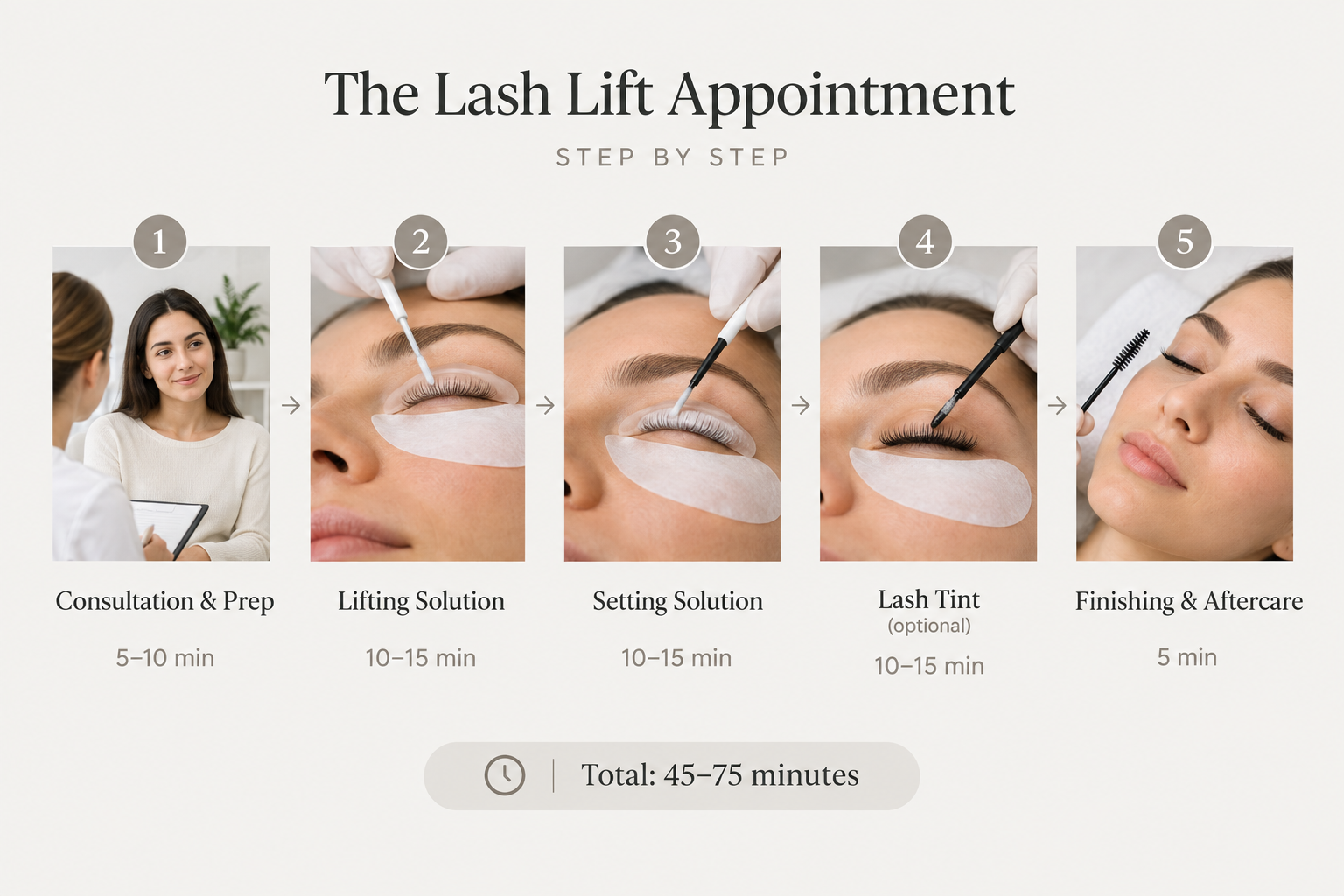
Consultation and Preparation (5–10 minutes)
Before the treatment begins, a qualified practitioner will assess your natural lashes, discuss your desired curl shape, and check for any contraindications such as eye infections, recent eye surgery, or known sensitivities to the chemicals used. Your eye area will be cleansed to remove any traces of makeup, oil, or skincare products, as residue can interfere with how the lifting solution adheres to the lashes. Silicone rods or shields of an appropriate size are then selected and applied to the eyelid to act as the mould around which the lashes will be shaped.
Lash Lifting Solution (10–15 minutes)
The lifting solution, sometimes called the perming lotion, is applied to the lashes once they have been carefully positioned over the silicone rod. This solution works by softening the internal structure of the lash hair so that it can take on the shape of the rod beneath it. Processing time varies depending on the product formulation and your lash thickness, but typically falls between 10 and 15 minutes. Finer or more delicate lashes generally require less processing time, while thicker or more resistant lashes may need slightly longer. Over-processing at this stage can cause lashes to become overly curled or brittle, so timing is an important part of the practitioner’s skill.
Setting Solution (10–15 minutes)
Once the lifting solution is removed, a setting or fixing solution is applied to the lashes while they remain on the rod. This solution works by re-forming the bonds within the lash structure in their new lifted position, locking the curl in place. This stage also typically takes between 10 and 15 minutes. Some practitioners use a nourishing or conditioning solution as a third step to help restore moisture to the lashes after the chemical processing, which adds a few additional minutes to the appointment.
Lash Tint (Optional, 10–15 minutes)
Many people choose to add a lash tint to their appointment, which is applied after the setting solution has been removed and the rods have been taken off. A semi-permanent tint, usually in a dark brown or black shade, is applied to the lashes and left to develop for approximately 10 to 15 minutes before being gently removed. Adding a tint to the appointment is one of the most common ways to enhance the overall result, as it makes the lashes appear darker and more defined without the need for mascara. If you choose to include a tint, factor in an additional 15 minutes or so to your total appointment time.
Final Nourishing Step and Aftercare Advice (5 minutes)
Many practitioners finish the treatment by applying a conditioning or keratin-based serum to the lashes to help counteract any dryness caused by the chemical solutions. The practitioner will then remove any remaining product, check the result, and provide aftercare instructions before you leave. This final stage is brief but important for both the quality of the result and the health of your lashes.
What Affects How Long a Lash Lift Takes?
While the 45-to-75-minute window covers most appointments, several individual factors can push the timing toward the shorter or longer end of that range.
- Natural lash length and thickness: Longer or thicker lashes may require more careful placement on the rod and slightly longer processing times to achieve an even curl.
- Lash condition: Previously chemically treated lashes, such as those that have had prior lifts or tints, may process more quickly and require careful monitoring to avoid over-processing.
- Chosen curl shape: A more dramatic curl may require a smaller rod and more precise application, which can add a few minutes to the preparation stage.
- Whether a tint is included: Adding a tint extends the appointment by approximately 10 to 15 minutes.
- Practitioner experience: An experienced practitioner who performs lash lifts regularly will generally work more efficiently than someone newer to the treatment, though thoroughness should never be sacrificed for speed.
- Product formulation: Different brands of lifting solution have different processing times, and practitioners adjust their timing accordingly.
How Long Do Lash Lift Results Last?
Lash lift results typically last between six and eight weeks, though some people find their results persist for up to ten weeks and others notice the curl beginning to relax after four to five weeks. The primary reason results are temporary is that lashes follow a natural growth cycle. As new lashes grow in from the root and older lashes shed, the lifted lashes gradually return to their natural position. The treatment does not permanently alter the lash structure, and each new lash that grows will be in its natural, unlifted state.
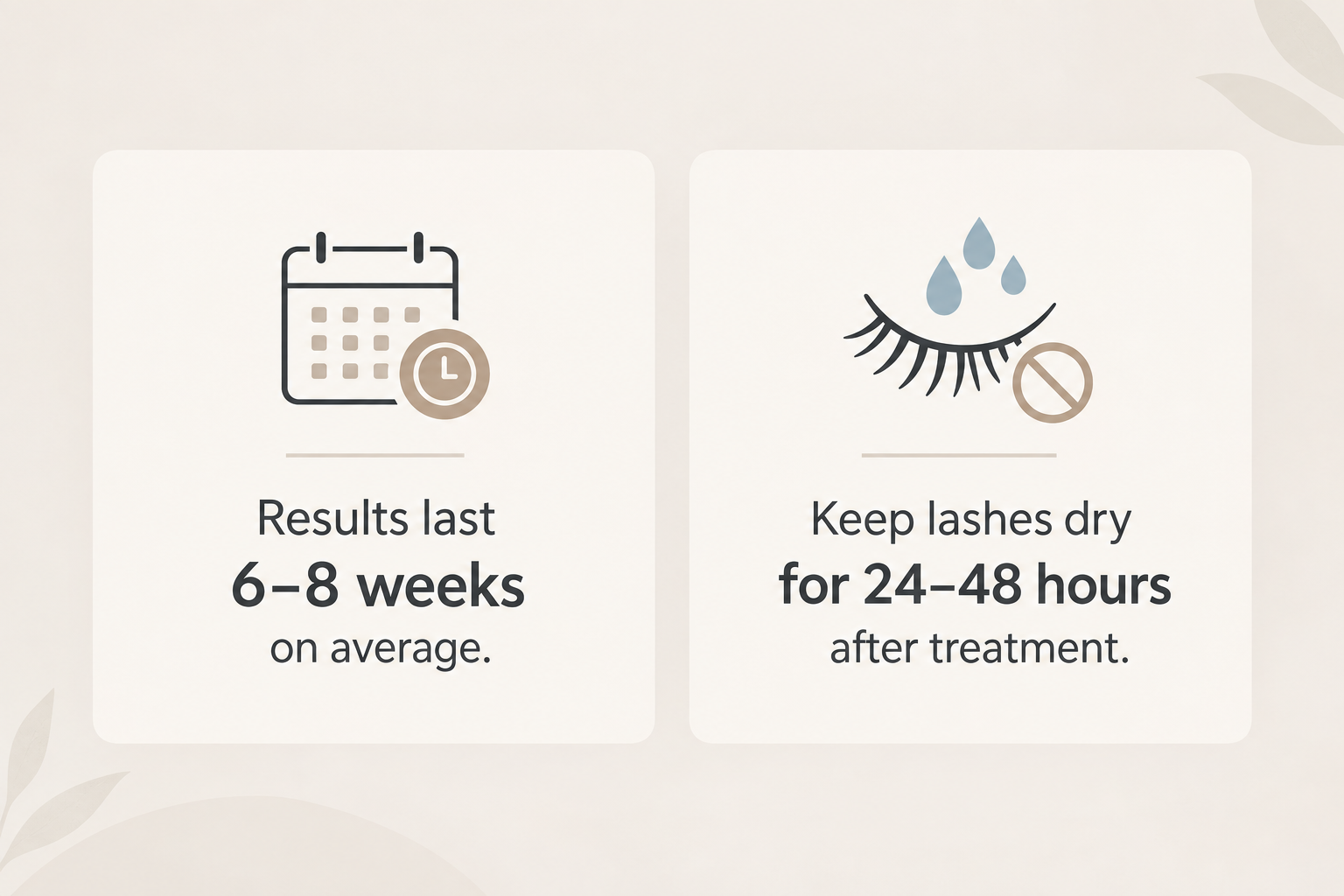
Several factors influence how long your results last in practice. Exposure to steam, heat, and moisture in the first 24 to 48 hours after treatment can interfere with the setting process and cause the curl to relax more quickly. Sleeping face-down, rubbing the eyes, and using oil-based eye products can also shorten the lifespan of the lift. Following the aftercare guidance provided by your practitioner gives the best chance of results lasting toward the longer end of the expected range. Most people choose to repeat the treatment every six to eight weeks to maintain the effect.
What to Expect Before and After Your Appointment
Before Your Appointment
Arriving with clean lashes free from mascara, eyelash serum, and eye makeup gives the lifting solution the best chance to work effectively. Many practitioners advise avoiding waterproof mascara for at least 24 hours before the appointment, as residue from waterproof formulas can be difficult to remove completely and may create a barrier between the solution and the lash. If you wear contact lenses, you will usually be asked to remove them before the treatment begins, as the eyes need to remain closed throughout the procedure and the solutions used should not come into contact with lenses.
During the Appointment
The lash lift procedure is generally well tolerated. You will lie with your eyes closed throughout, and most people find the experience relaxing. The silicone rods may feel slightly unusual on the eyelid, but they should not cause discomfort. The chemical solutions used have a mild smell, and some people notice a slight tingling sensation during processing, though this should not be painful. If you experience any stinging, burning, or significant discomfort at any point, you should let your practitioner know immediately so they can assess whether the solution needs to be removed.
After Your Appointment
Immediately after a lash lift, the lashes should appear visibly lifted and curled. Some people notice that the lashes look slightly more dramatic in the first day or two before settling into a more natural-looking curl as any residual tension from the rod relaxes. The most important aftercare instruction is to keep the lashes dry for the first 24 to 48 hours. This means avoiding swimming, saunas, steam rooms, and heavy exercise that causes sweating, as well as keeping the face dry when washing. Eye makeup, particularly mascara, should also be avoided during this initial period. After 48 hours, most normal activities and eye makeup use can resume.
Risks and Limitations to Be Aware Of
A lash lift is generally considered a low-risk treatment when performed by a trained and experienced practitioner using appropriate products. However, as with any cosmetic procedure involving chemical solutions applied near the eyes, there are potential risks and limitations that are worth understanding before booking an appointment.
- Chemical sensitivity or allergic reaction: The solutions used in a lash lift contain chemicals that can cause irritation or an allergic reaction in some individuals. A patch test performed 24 to 48 hours before the appointment can help identify sensitivity, though it does not eliminate all risk. Symptoms of a reaction may include redness, swelling, itching, or watering of the eyes.
- Over-processing: If the lifting solution is left on for too long, or if the lashes are in a fragile condition, the lashes may become overly curled, frizzy, or brittle. In more significant cases, lash breakage can occur. This risk is reduced by choosing a practitioner with appropriate training and experience.
- Eye irritation: If any solution enters the eye during the treatment, it can cause irritation. A skilled practitioner takes care to prevent this, but it is a known risk of any treatment performed in close proximity to the eye.
- Results may vary: Very short lashes may not lift as dramatically as longer lashes, and the degree of curl achieved depends partly on the natural lash characteristics. Results are not guaranteed to be identical from one appointment to the next.
- Temporary results: The lift will gradually relax as lashes grow and shed, meaning the treatment requires regular repetition to maintain the effect.
Who May Be Suitable for a Lash Lift?
A lash lift may be a suitable option for people who have natural lashes of at least a moderate length, typically around 4 to 5 millimetres or more, as very short lashes may not provide enough surface area to wrap around the silicone rod effectively. The treatment tends to work particularly well for people with naturally straight or downward-pointing lashes who want a more open, lifted appearance without the commitment of eyelash extensions. It can also suit those who find daily mascara application time-consuming or who want a lower-maintenance approach to eye definition.
People who may not be suitable for a lash lift include those with active eye infections, conjunctivitis, or inflammation around the eye area, as treatment should be postponed until the condition has resolved. Those with a known allergy to any of the ingredients in the lifting or setting solutions should not proceed. People who have recently had eye surgery, including laser eye surgery, should seek guidance from their surgeon before undergoing any treatment near the eye. Pregnancy is often cited as a reason for caution, and many practitioners prefer not to perform lash lifts during pregnancy due to the chemical nature of the solutions, though evidence on specific risks in this context is limited. A thorough consultation with a qualified practitioner is the appropriate way to assess individual suitability.
Alternatives to a Lash Lift
If a lash lift does not seem like the right option, or if you are curious about how it compares to other approaches to enhancing the appearance of the lashes, several alternatives are worth considering.
- Eyelash extensions: Individual synthetic, silk, or mink fibres are bonded to natural lashes to add length, volume, and curl. Extensions offer more dramatic and customisable results than a lash lift but require more frequent maintenance appointments, typically every two to three weeks, and carry their own set of risks including allergic reaction to the adhesive and potential damage to natural lashes if not applied or removed correctly.
- Lash tinting alone: For those who want darker, more defined lashes without altering the curl, a standalone lash tint is a quicker and simpler option that takes approximately 15 to 20 minutes and carries fewer risks than a full lift.
- Mascara and lash curlers: Daily use of a lash curler followed by mascara can achieve a similar lifted effect without any chemical treatment, though the result is temporary and requires daily effort.
- Lash growth serums: Some people use topical serums containing peptides or, in prescription formulations, prostaglandin analogues to encourage lash growth and thickness over time. Results from over-the-counter serums vary, and prescription options carry their own risk profile and require medical supervision.
- Lash lamination: This term is sometimes used interchangeably with lash lift, though in some contexts it refers to a slightly different technique that focuses on straightening and fanning the lashes rather than curling them upward. The appointment time and aftercare are broadly similar.
Frequently Asked Questions
Can I wear mascara after a lash lift?
Most practitioners advise waiting at least 24 to 48 hours before applying mascara after a lash lift, as the lashes need time to fully set in their new position. After this period, mascara can generally be used as normal. Water-based formulas are often recommended over waterproof versions, as waterproof mascara can be harder to remove and may require more rubbing, which can stress the lashes.
How soon can I have another lash lift?
Most practitioners recommend waiting at least six to eight weeks between lash lift appointments, which aligns with the natural lash growth cycle. Having the treatment more frequently than this increases the risk of over-processing and lash damage, as the lashes may not have had sufficient time to recover between chemical treatments.
Will a lash lift damage my natural lashes?
When performed correctly by a trained practitioner using appropriate products and timing, a lash lift should not cause significant damage to natural lashes. However, repeated treatments, over-processing, or using harsh products in the days following the treatment can weaken the lash structure over time. Using a nourishing lash serum or conditioning treatment between appointments may help maintain lash health.
Does a lash lift hurt?
A lash lift is not typically painful. Most people find the experience comfortable and some find it relaxing. A mild tingling sensation during the chemical processing stages is not unusual. If you experience any burning, stinging, or significant discomfort, you should inform your practitioner immediately.
Can I get a lash lift if I have sensitive eyes?
People with sensitive eyes or a history of reactions to cosmetic products near the eye area should discuss this with their practitioner before booking. A patch test is advisable, and the practitioner may recommend a specific product formulation that is less likely to cause irritation. In some cases, the treatment may not be appropriate.
How long after a lash lift can I shower?
Most practitioners advise avoiding water on the lashes for the first 24 to 48 hours after treatment. When showering during this period, it is generally recommended to keep the face away from the direct stream of water and to avoid steam. After 48 hours, normal showering and face washing can usually resume.
Is a lash lift suitable for very short lashes?
Very short lashes may not respond as well to a lash lift, as there may not be enough lash length to wrap around the silicone rod and achieve a visible curl. A practitioner can assess your lash length during a consultation and advise whether the treatment is likely to produce a worthwhile result for your particular lash type.
Is a Lash Lift Worth the Appointment Time?
For most people with natural lashes of a suitable length, a lash lift offers a practical and relatively low-maintenance way to enhance the appearance of the eyes for several weeks at a time. The appointment itself, typically lasting between 45 and 75 minutes, is straightforward and requires no significant recovery period. The 24-to-48-hour aftercare window is the main practical consideration in the days immediately following treatment.
The treatment is not without limitations. Results are temporary, individual responses vary, and the chemical nature of the solutions means that suitability should be assessed on an individual basis, particularly for those with sensitive eyes, a history of allergic reactions, or certain eye conditions. The quality of the result also depends significantly on the skill and experience of the practitioner, making the choice of clinic an important factor.
If you are considering a lash lift, a consultation with a qualified and experienced practitioner is the appropriate starting point. They can assess your natural lash length and condition, discuss the curl options available, explain the specific products they use, and advise whether the treatment is likely to achieve the result you are looking for. This conversation is also the right time to ask about patch testing, aftercare, and how frequently you might need to repeat the treatment to maintain the effect you want.


