
TRT Testosterone Types: Which Form Is Used for Testosterone Replacement Therapy?
Testosterone replacement therapy (TRT) is prescribed to men whose bodies produce insufficient testosterone, a condition known as hypogonadism. Several distinct forms of testosterone are used in clinical practice, and the type prescribed can influence how often you need treatment, how stable your hormone levels remain, and what side effects you may experience. Understanding the differences between these options can help you have a more informed conversation with your prescribing doctor before starting therapy.
Key Takeaways
- TRT uses bioidentical testosterone in several delivery forms, including injections, gels, patches, and pellets — each with different absorption profiles and dosing schedules.
- The most commonly prescribed forms are testosterone cypionate and testosterone enanthate, both administered by intramuscular or subcutaneous injection.
- No single testosterone formulation is universally superior; the best choice depends on your lifestyle, medical history, tolerance for injections, and how your body responds to treatment.
- All forms of TRT carry potential risks, including effects on fertility, red blood cell count, and cardiovascular health, and require ongoing medical monitoring.
- TRT is a medical treatment requiring a confirmed diagnosis of low testosterone and a prescription from a qualified healthcare provider.
What Is Testosterone Replacement Therapy?
Testosterone replacement therapy is a medically supervised treatment designed to restore testosterone levels in men diagnosed with hypogonadism — a condition where the testes produce inadequate amounts of testosterone. Symptoms associated with low testosterone may include persistent fatigue, reduced libido, erectile dysfunction, loss of muscle mass, increased body fat, low mood, and difficulty concentrating. TRT aims to bring testosterone levels back into a clinically normal physiological range, which may help alleviate some of these symptoms.
It is important to understand that TRT is not a performance-enhancing treatment for men with normal testosterone levels, nor is it a general anti-ageing therapy. A diagnosis of hypogonadism requires blood tests confirming consistently low testosterone levels alongside relevant clinical symptoms. Treatment decisions should always be made in partnership with a qualified endocrinologist, urologist, or GP with experience in hormone management.
The Main Types of Testosterone Used in TRT
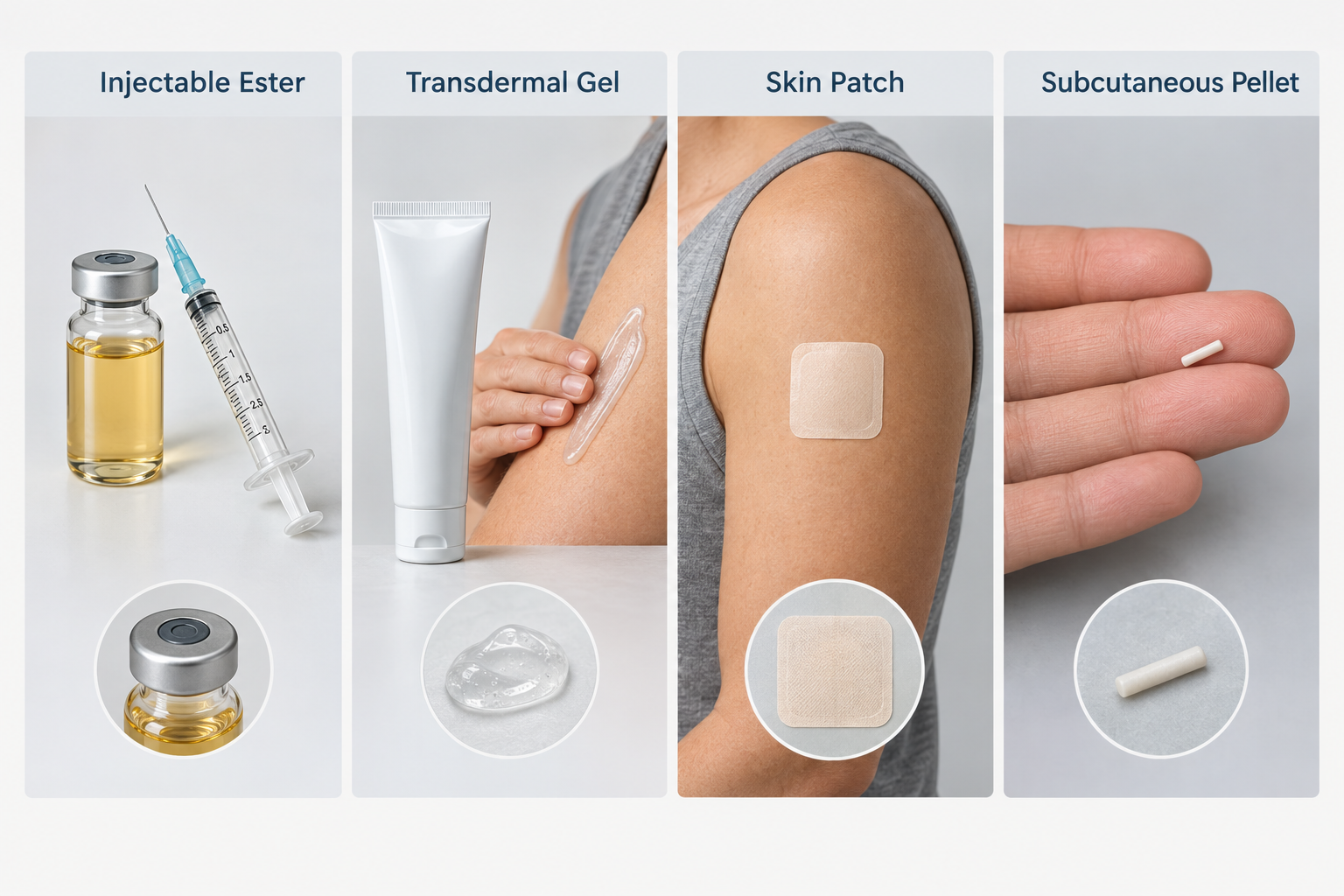
All testosterone formulations used in TRT contain bioidentical testosterone — the same hormone the body naturally produces. What differs between products is the delivery method, the chemical modification (known as an ester) attached to the testosterone molecule, and how quickly the hormone is released into the bloodstream. The main categories are injectable testosterone esters, transdermal gels and patches, subcutaneous pellets, and oral or buccal preparations.
Testosterone Cypionate
Testosterone cypionate is one of the most widely prescribed injectable testosterone formulations, particularly in the United States. It is a long-acting ester dissolved in oil and administered by intramuscular or subcutaneous injection, typically every one to two weeks, though some clinicians prefer more frequent smaller doses to maintain steadier blood levels. After injection, testosterone cypionate is gradually released from the injection site into the bloodstream, where enzymes cleave the ester to release active testosterone. Peak blood levels generally occur within two to four days of injection, followed by a gradual decline. Some patients notice fluctuations in energy, mood, or libido that correspond to these peaks and troughs, which is one reason some protocols use more frequent, smaller injections.
Testosterone Enanthate
Testosterone enanthate is another long-acting injectable ester and is among the most commonly used TRT formulations worldwide. Its pharmacokinetic profile is very similar to testosterone cypionate — it is oil-based, injected intramuscularly or subcutaneously, and typically administered every one to two weeks. The two esters are often considered clinically interchangeable, though individual responses can vary. Testosterone enanthate has a slightly shorter half-life than cypionate, meaning hormone levels may decline marginally faster between doses, though this difference is generally modest in clinical practice. Both enanthate and cypionate are cost-effective options and are widely available as generic formulations.
Testosterone Undecanoate (Injectable)
Injectable testosterone undecanoate is a very long-acting formulation that is administered by deep intramuscular injection, typically every ten to fourteen weeks after an initial loading phase. Because injections are required only a few times per year, this formulation may suit patients who find frequent injections inconvenient or difficult to manage. Testosterone undecanoate is dissolved in castor oil and releases testosterone slowly over an extended period, producing relatively stable blood levels compared to shorter-acting esters. One important safety consideration is that injectable testosterone undecanoate carries a risk of pulmonary oil microembolism — a rare but serious reaction that can occur immediately after injection — which is why the injection is typically administered in a clinical setting with a post-injection observation period.
Testosterone Propionate
Testosterone propionate is a short-acting injectable ester with a half-life of approximately two to three days, requiring injections every two to three days to maintain stable testosterone levels. Because of this frequent dosing requirement, testosterone propionate is less commonly used as a primary TRT formulation today, though it may be used in specific clinical situations or where rapid dose adjustments are needed. The more frequent injection schedule can be burdensome for many patients, and the shorter half-life means blood levels fluctuate more noticeably between doses.
Transdermal Testosterone Gels
Testosterone gels are applied daily to the skin — typically to the shoulders, upper arms, or abdomen — and absorbed transdermally into the bloodstream. Gels provide relatively stable daily testosterone levels because they are applied every day, avoiding the peaks and troughs associated with less frequent injections. This steady delivery profile is one reason some patients and clinicians prefer gels, particularly for those who are sensitive to hormonal fluctuations. A significant practical concern with testosterone gels is the risk of transference — the gel can be transferred to a partner, child, or other person through skin contact before it has fully dried and absorbed, which can cause unintended testosterone exposure. Patients using gels must allow the application site to dry completely and wash their hands thoroughly after application.
Testosterone Patches
Transdermal testosterone patches are applied to the skin once daily and deliver testosterone continuously through the skin over a 24-hour period. Like gels, patches provide relatively stable hormone levels. However, skin irritation and reactions at the application site are more commonly reported with patches than with gels, and some patients find them less comfortable or practical for daily use. Patches are typically applied to the back, abdomen, thigh, or upper arm, and the application site should be rotated to reduce local skin reactions.
Testosterone Pellets
Testosterone pellets are small, solid implants inserted subcutaneously — usually into the buttock or hip area — by a clinician during a minor in-office procedure. Each pellet releases testosterone slowly over approximately three to six months, after which the pellets are fully absorbed and a new insertion procedure is required. Pellets offer the advantage of very infrequent dosing and consistent hormone delivery without the need for daily application or regular self-injection. The main limitations include the need for a minor surgical procedure for each insertion, the inability to quickly adjust the dose once pellets are implanted, and a small risk of infection or pellet extrusion at the insertion site.
Oral and Buccal Testosterone
Oral testosterone formulations have historically been limited by poor bioavailability and concerns about liver toxicity with older preparations. Newer oral testosterone undecanoate formulations have improved this profile and are available in some countries, taken twice daily with food to enhance absorption through the lymphatic system rather than first-pass liver metabolism. Buccal testosterone is a small tablet applied to the gum above the incisor twice daily, where it dissolves and is absorbed through the oral mucosa. Both oral and buccal options avoid injections entirely, which may appeal to some patients, though they require strict adherence to dosing schedules and may cause local gum or mouth irritation in the case of buccal preparations.
Comparing TRT Testosterone Formulations
| Formulation | Delivery Method | Dosing Frequency | Hormone Stability | Key Considerations |
|---|---|---|---|---|
| Testosterone Cypionate | Injection (IM or SC) | Every 1–2 weeks (or more frequently) | Moderate — peaks and troughs possible | Widely available, cost-effective, self-injectable |
| Testosterone Enanthate | Injection (IM or SC) | Every 1–2 weeks | Moderate — similar to cypionate | Widely available, generic options, similar profile to cypionate |
| Testosterone Undecanoate (injectable) | Deep IM injection | Every 10–14 weeks | High — stable levels | Clinic administration required, pulmonary oil microembolism risk |
| Testosterone Propionate | Injection (IM or SC) | Every 2–3 days | Lower — frequent fluctuations | Less commonly used for TRT due to frequent dosing |
| Testosterone Gel | Transdermal (skin) | Daily | High — consistent daily levels | Transference risk, daily application required |
| Testosterone Patch | Transdermal (skin) | Daily | High — consistent daily levels | Skin irritation common, daily application required |
| Testosterone Pellets | Subcutaneous implant | Every 3–6 months | High — slow, steady release | Minor procedure required, dose not easily adjusted |
| Oral Testosterone Undecanoate | Oral tablet | Twice daily with food | Moderate | Requires strict adherence, availability varies by country |
| Buccal Testosterone | Gum tablet | Twice daily | Moderate | Gum irritation possible, no injections required |
Risks and Side Effects of TRT
All forms of testosterone replacement therapy carry potential risks and side effects, and these should be discussed thoroughly with a prescribing clinician before starting treatment. The risks are broadly similar across formulations, though the delivery method can influence the likelihood of certain local reactions.
Common side effects associated with TRT include acne, oily skin, increased red blood cell production (erythrocytosis), fluid retention, and breast tissue sensitivity or enlargement (gynaecomastia). Erythrocytosis — an elevated red blood cell count — is a clinically important consideration because it can increase blood viscosity and the risk of clotting events; haematocrit levels are typically monitored regularly during TRT. Testosterone therapy also suppresses the body’s natural production of luteinising hormone (LH) and follicle-stimulating hormone (FSH), which can significantly reduce sperm production and fertility. Men who wish to preserve fertility should discuss this with their doctor before starting TRT, as alternative approaches such as human chorionic gonadotropin (hCG) therapy may be considered.
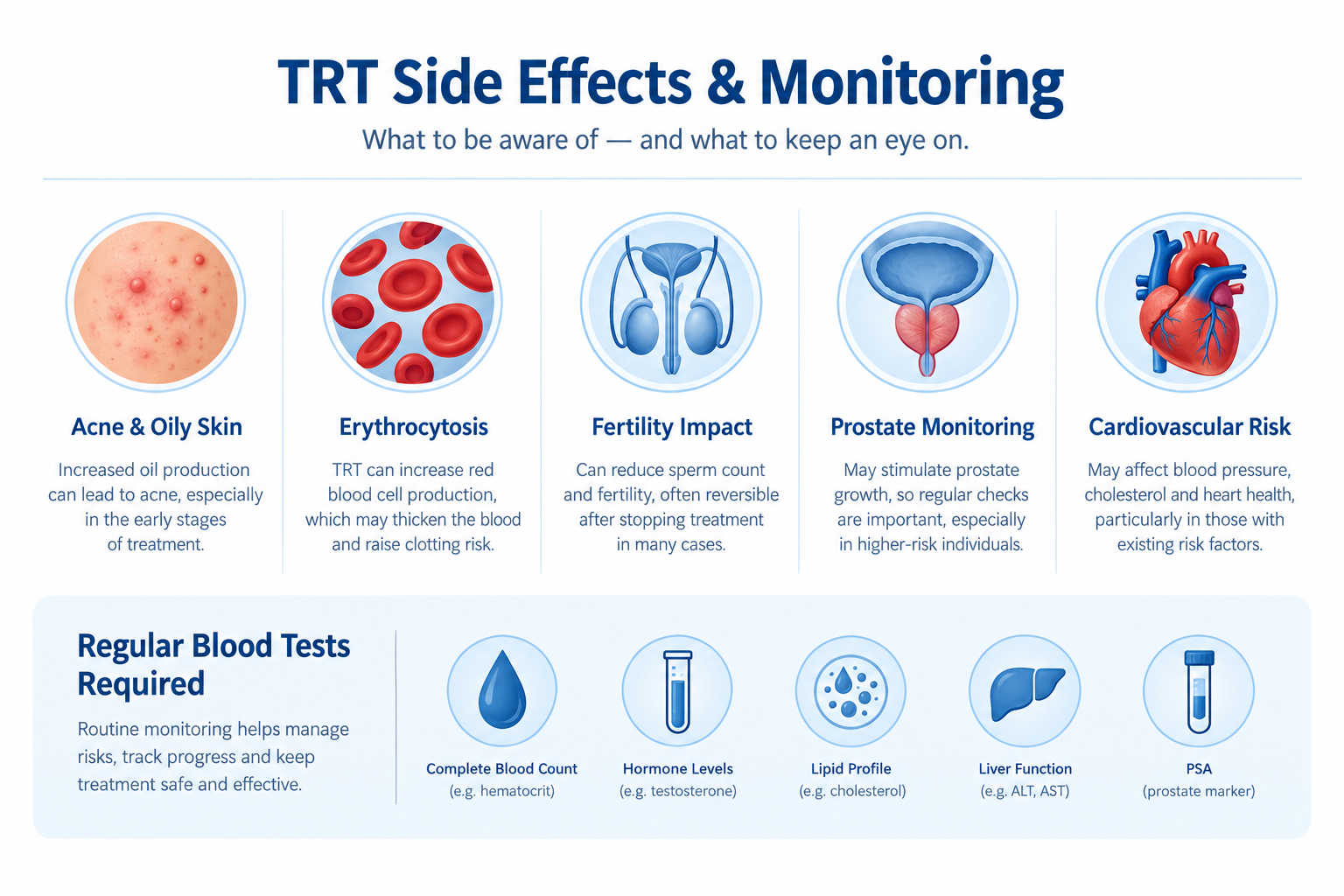
The relationship between TRT and cardiovascular health has been an area of ongoing research and clinical debate. Some studies have raised concerns about potential cardiovascular risks, while others have suggested that restoring testosterone to normal physiological levels in genuinely hypogonadal men may be neutral or potentially beneficial for certain cardiovascular risk factors. The evidence in this area continues to evolve, and individual cardiovascular risk assessment is an important part of TRT evaluation. TRT is generally not recommended for men with a recent history of heart attack or stroke without specialist guidance.
Other considerations include potential worsening of sleep apnoea, prostate health monitoring (TRT is contraindicated in men with known or suspected prostate cancer), and mood changes. Injection-specific side effects include pain, bruising, or infection at the injection site. Gel-specific risks include the transference concern described earlier. Pellet insertion carries a small risk of infection or extrusion.
Who May Be Suitable for TRT
TRT may be appropriate for adult men who have a confirmed diagnosis of hypogonadism based on at least two morning blood testosterone measurements showing levels below the clinically accepted normal range, combined with relevant symptoms. The underlying cause of low testosterone — whether primary (testicular) or secondary (pituitary or hypothalamic) — may influence treatment decisions. A thorough medical evaluation including assessment of cardiovascular health, prostate health, haematocrit, and fertility intentions is typically conducted before TRT is initiated.
Men who may not be suitable for TRT, or who require careful specialist assessment before starting, include those with known or suspected prostate cancer, breast cancer, untreated severe sleep apnoea, uncontrolled heart failure, a recent cardiovascular event, or a desire to maintain fertility in the near term. Age alone is not a contraindication, but the risk-benefit balance should be carefully considered in older men with multiple comorbidities.
Monitoring During TRT
Ongoing medical monitoring is an essential component of safe TRT. Regular blood tests are used to assess testosterone levels, haematocrit, haemoglobin, prostate-specific antigen (PSA), liver function, and lipid profiles. The frequency of monitoring typically decreases once stable levels are achieved, but it should never be discontinued entirely. Dose adjustments may be needed based on blood results, symptom response, and tolerability. Patients should maintain open communication with their prescribing clinician and report any new or worsening symptoms promptly.
Alternatives to TRT
For men with secondary hypogonadism — where the problem originates in the pituitary gland or hypothalamus rather than the testes — medications such as clomiphene citrate or human chorionic gonadotropin (hCG) may stimulate the body’s own testosterone production rather than replacing it externally. These approaches may be particularly relevant for younger men or those wishing to preserve fertility. Lifestyle modifications including weight management, improved sleep, reduced alcohol consumption, and regular resistance exercise can also support healthy testosterone levels in men with borderline or lifestyle-related low testosterone, though these measures are unlikely to fully correct clinically significant hypogonadism on their own.
It is worth noting that symptoms such as fatigue, low mood, and reduced libido can have multiple causes beyond low testosterone, including thyroid disorders, depression, sleep disorders, and other hormonal imbalances. A comprehensive medical evaluation is important to ensure that TRT is addressing the correct underlying issue.
Frequently Asked Questions
What is the most commonly prescribed testosterone for TRT?
Testosterone cypionate and testosterone enanthate are among the most frequently prescribed forms of TRT, particularly in injectable form. Both are long-acting esters with similar clinical profiles and are widely available as cost-effective generic formulations. The most appropriate choice depends on individual factors discussed with a prescribing clinician.
Is one form of TRT testosterone better than another?
No single formulation is universally superior. The best option depends on your lifestyle, preference for injection versus daily application, how your body responds to treatment, and practical factors such as availability and cost. Some patients prefer the convenience of long-acting injections or pellets, while others prefer the stable daily levels provided by gels or patches.
Can TRT affect fertility?
Yes. All forms of exogenous testosterone suppress the body’s natural production of the hormones needed for sperm production, which can significantly reduce fertility during treatment. Men who wish to father children should discuss fertility preservation options with their doctor before starting TRT. Stopping TRT may allow sperm production to recover over time, though this is not guaranteed.
How long does it take for TRT to work?
The timeline for noticing improvements varies depending on the symptom and the individual. Some men report improvements in energy and mood within a few weeks, while changes in body composition, libido, and sexual function may take several months to become apparent. Blood testosterone levels typically reach a stable range within a few weeks of starting treatment, depending on the formulation used.
Do I need to stay on TRT permanently?
TRT is often a long-term treatment, particularly for men with primary hypogonadism where the testes cannot produce adequate testosterone independently. For men with secondary hypogonadism, alternative treatments may allow the body to resume its own production. The decision to continue, adjust, or stop TRT should always be made in consultation with a qualified clinician based on ongoing monitoring and individual circumstances.
Is TRT the same as anabolic steroid use?
TRT uses the same hormone — testosterone — that is also misused in supraphysiological doses for performance enhancement. However, TRT is a medically supervised treatment that aims to restore testosterone to a normal physiological range in men with a confirmed deficiency. Anabolic steroid misuse typically involves doses far exceeding physiological levels and is associated with significantly greater health risks. The two should not be conflated.
Choosing the Right TRT Formulation: What to Discuss With Your Doctor
The decision about which testosterone formulation to use for TRT is not one-size-fits-all. Testosterone cypionate and enanthate remain the most widely used options due to their established safety profiles, flexibility in dosing frequency, and cost-effectiveness, but they require a willingness to self-inject or attend regular clinic appointments. Testosterone gels and patches offer needle-free daily dosing with stable hormone levels, though they demand consistent daily adherence and careful attention to transference risk. Long-acting injectable testosterone undecanoate and subcutaneous pellets reduce the frequency of administration significantly but involve either clinic-based injections or minor surgical procedures.
Before starting TRT, it is worth discussing your daily routine, comfort with injections, household circumstances (particularly if there are children or a partner who could be exposed to transdermal preparations), fertility intentions, and any relevant medical history with your prescribing clinician. Monitoring requirements, cost, and local availability of specific formulations should also factor into the decision. TRT can be an effective and well-tolerated treatment for men with confirmed hypogonadism, but it requires a committed approach to ongoing medical supervision to be used safely and appropriately.


