
BBL Laser Treatment for Body Contouring: How Light Therapy Works
BBL laser treatment — short for BroadBand Light — is a light-based therapy increasingly discussed in the context of body contouring and skin improvement. While it is not a fat-reduction procedure in the traditional sense, BBL technology is used to address a range of skin concerns across the body, including texture irregularities, pigmentation, redness, and early signs of skin laxity. Understanding what BBL can and cannot do for body contour is important before deciding whether it belongs in your treatment plan.
Key Takeaways
- BBL (BroadBand Light) is an intense pulsed light technology that targets skin concerns such as pigmentation, redness, and texture — it does not directly reduce fat deposits.
- When used on body areas, BBL may improve the appearance of skin quality, which can contribute to a smoother, more refined contour over a course of treatments.
- Results vary depending on skin type, treatment area, and the specific concern being addressed; multiple sessions are typically required.
- BBL is generally well tolerated with minimal downtime, though side effects such as temporary redness, swelling, and pigment changes are possible.
- A thorough clinical assessment is essential to determine whether BBL is appropriate for your skin type, goals, and medical history.
What Is BBL Laser Treatment?
BBL stands for BroadBand Light, a technology developed by Sciton that delivers high-intensity pulses of light across a broad spectrum of wavelengths. Despite the common use of the term “BBL laser,” the device is technically an intense pulsed light (IPL) system rather than a true laser. The distinction matters clinically: a laser emits a single, coherent wavelength of light, whereas BBL emits a range of wavelengths that can be filtered and adjusted to target different chromophores — the light-absorbing molecules in skin tissue such as melanin (responsible for pigmentation) and oxyhaemoglobin (responsible for redness in blood vessels).
The Sciton BBL platform has evolved over several generations, with the HERO (High Energy Rapid Output) variant offering faster delivery and higher fluence settings. These advances have expanded the range of treatable concerns and body areas, making BBL a versatile option in aesthetic medicine. However, versatility does not mean universal suitability, and the technology has specific strengths and limitations that any prospective patient should understand clearly.
How Does BBL Work on the Skin?
BBL delivers controlled pulses of broad-spectrum light through a handheld device applied directly to the skin surface. Filters are selected to narrow the wavelength range and direct energy toward a specific target. When melanin absorbs the light energy, it heats and fragments, allowing the body to clear excess pigment over the following days to weeks. When oxyhaemoglobin in superficial blood vessels absorbs the energy, the vessel wall is damaged and gradually reabsorbed, reducing visible redness and vascular irregularities.
Beyond these targeted effects, BBL light energy also reaches the dermis — the deeper layer of skin — where it stimulates fibroblast activity. Fibroblasts are the cells responsible for producing collagen and elastin, the structural proteins that give skin its firmness and elasticity. This collagen-stimulating effect is one reason BBL is discussed in the context of skin quality improvement and mild skin tightening, though the degree of tightening achievable with light-based therapy alone is modest compared with dedicated radiofrequency or ultrasound devices.
Research published in peer-reviewed dermatology journals has suggested that regular BBL treatments may influence gene expression in skin cells in ways that resemble younger skin biology. This area of investigation, sometimes referred to as “Forever Young BBL” in marketing contexts, remains an active area of study, and while early findings are interesting, the evidence base is still developing and should not be interpreted as a guarantee of anti-ageing outcomes.
BBL for Body Contouring: What Does It Actually Address?
The phrase “light therapy for body contour” can mean different things depending on the clinical context. It is important to be precise: BBL treatment does not destroy or reduce fat cells, and it is not a body contouring device in the same category as cryolipolysis (CoolSculpting), high-intensity focused ultrasound (HIFU), or radiofrequency-based fat reduction. Patients seeking to reduce localised fat deposits will not achieve that outcome with BBL alone.
What BBL can address on the body is the quality and appearance of the skin overlying areas of concern. Common body applications include:
- Pigmentation and sun damage: Age spots, sun spots, and uneven skin tone on the chest, shoulders, arms, hands, and legs may respond well to BBL treatment.
- Vascular irregularities: Superficial broken capillaries, redness, and mild rosacea-like changes on the body can be targeted with appropriate wavelength filters.
- Skin texture and early laxity: The collagen-stimulating effect of BBL may contribute to modest improvements in skin texture and firmness over a course of treatments, which can refine the overall appearance of treated areas.
- Stretch marks and scarring: Some practitioners use BBL as part of a combination approach for stretch marks and superficial scarring, though results in these areas are variable and evidence is more limited.
- Hair removal: BBL is also used for long-term hair reduction on body areas, which is a distinct application from skin quality improvement.
When practitioners discuss BBL in the context of body contouring, they are typically referring to improving the skin surface quality in areas where body shape has already been addressed through other means, or where skin appearance — rather than underlying fat — is the primary concern. Realistic goal-setting before treatment is essential.
Treatment Areas on the Body
BBL is suitable for use across a wide range of body areas, though the face remains the most commonly treated site. On the body, treatment is frequently applied to the chest and décolletage, the backs of the hands, the forearms and upper arms, the shoulders, the upper back, and the legs. These areas are often subject to cumulative sun exposure and may develop pigmentation, vascular changes, and textural irregularities over time.
Treating larger body surface areas requires more time per session and may involve higher overall energy delivery compared with facial treatments. Practitioners adjust settings including wavelength filters, pulse duration, and fluence (energy per unit area) based on the specific concern, skin type, and anatomical location. Darker skin tones require particular care, as higher melanin levels increase the risk of unwanted pigment changes; a thorough skin assessment using a recognised classification system such as the Fitzpatrick scale is standard practice before treatment.
What Happens During a BBL Treatment Session?
A typical BBL session begins with a consultation or pre-treatment review to confirm suitability, review any changes in medications or health, and discuss the treatment plan. The skin is cleansed and, where appropriate, a topical cooling gel may be applied. Protective eyewear is provided to both the patient and the practitioner, as the light pulses are intense enough to cause eye injury without adequate shielding.
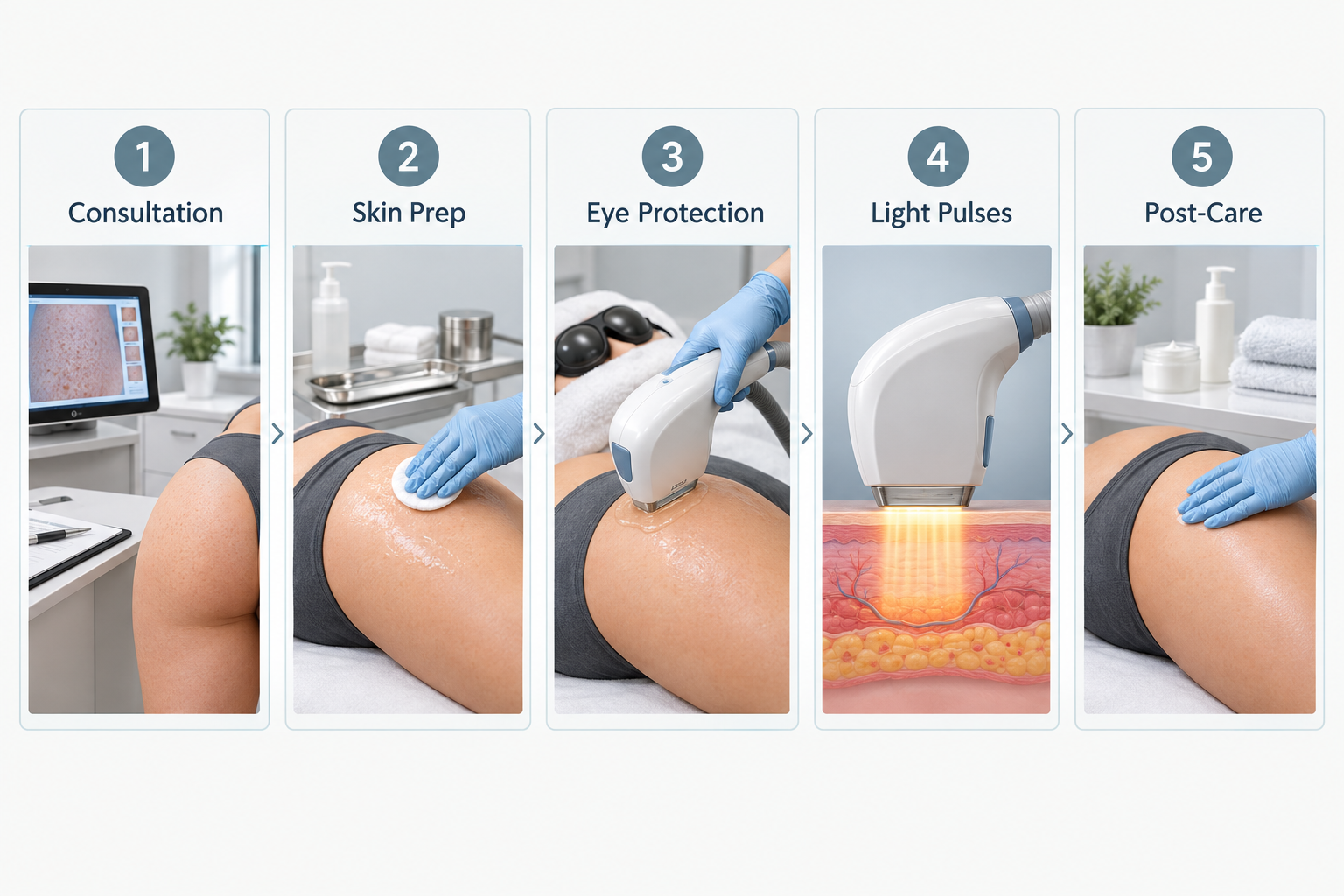
The BBL handpiece is placed against the skin and delivers a series of light pulses across the treatment area. Each pulse produces a brief sensation often described as a warm snap or mild elastic-band flick. Most patients find BBL on body areas tolerable without anaesthetic, though individual sensitivity varies. The device incorporates a cooling mechanism to protect the skin surface and improve comfort during delivery.
Session duration depends on the size of the area being treated. A small area such as the hands may take fifteen to twenty minutes, while a larger area such as the full chest and shoulders may take forty-five minutes or longer. After treatment, the skin is typically cooled and a soothing product applied. Patients can usually return to normal activities the same day, making BBL a practical option for those with limited availability for recovery time.
Expected Results and Timeline
Results from BBL treatment on the body develop gradually rather than appearing immediately after a single session. In the days following treatment for pigmentation, treated spots may temporarily darken before they flake away — a normal part of the clearance process that patients should be prepared for. Vascular changes may appear to flush or redden briefly before fading. Skin quality improvements related to collagen stimulation typically become more noticeable over several weeks as the remodelling process progresses.
Most practitioners recommend a course of treatments rather than a single session for meaningful and lasting improvement. For body pigmentation and sun damage, a series of two to four sessions spaced four to six weeks apart is a common starting point, though the appropriate number depends on the severity of the concern and the individual response. Maintenance treatments, typically once or twice a year, are often recommended to sustain results, particularly for areas with ongoing sun exposure.
It is important to set realistic expectations. BBL can produce meaningful improvements in skin tone, clarity, and texture, but it will not replicate the results of surgical procedures or more aggressive resurfacing treatments. Patients with moderate to severe skin laxity, deep pigmentation, or significant textural concerns may require combination approaches or alternative treatments to achieve their goals.
Risks and Side Effects
BBL is generally considered a low-downtime treatment with a well-established safety profile when performed by a trained and experienced practitioner on appropriate skin types. However, side effects and risks exist and should be discussed openly before proceeding.
Common and expected side effects include temporary redness and mild swelling in the treated area, which typically resolve within a few hours to a day. Treated pigmented lesions often darken before clearing, which can be alarming if patients are not forewarned. Mild sensitivity and a warm sensation in the skin may persist for several hours after treatment.
Less common but clinically significant risks include:
- Post-inflammatory hyperpigmentation (PIH): Darkening of the skin in the treated area, more likely in patients with darker skin tones or those who have had recent sun exposure. This is usually temporary but can take weeks to months to resolve.
- Hypopigmentation: Lightening of the skin, which may be more persistent and is a particular concern in darker skin types.
- Blistering or crusting: Rare but possible if settings are too aggressive for the individual’s skin, or if the skin is more reactive than anticipated.
- Paradoxical darkening of certain pigmented lesions: Some pigmented lesions, particularly certain types of melasma, may worsen with light-based treatments. Accurate diagnosis before treatment is important.
- Scarring: Extremely rare with appropriate technique and settings, but a risk with any energy-based treatment.
Patients should avoid significant sun exposure before and after BBL treatment and use broad-spectrum sun protection consistently. Tanned skin significantly increases the risk of adverse pigment changes and may be a reason to postpone treatment.
Who May Be Suitable for BBL Treatment
BBL may be a reasonable option for individuals who:
- Have lighter skin tones (Fitzpatrick types I–III) with pigmentation, sun damage, or vascular irregularities on body areas;
- Are seeking improvement in skin quality and texture rather than fat reduction;
- Have realistic expectations about the degree of improvement achievable with light-based therapy;
- Are not pregnant or breastfeeding;
- Are not currently taking photosensitising medications such as certain antibiotics, retinoids, or other agents that increase light sensitivity;
- Have not had significant recent sun exposure or active tan in the treatment area;
- Do not have active skin infections, open wounds, or inflammatory skin conditions in the treatment area.
Individuals with darker skin tones (Fitzpatrick types IV–VI) may still be candidates for BBL in some circumstances, but require careful assessment, conservative settings, and an experienced practitioner to minimise the risk of pigment complications. A patch test may be recommended before full treatment in higher-risk cases.
Who May Not Be Suitable
BBL is not appropriate for everyone. Contraindications and cautions include active photosensitivity disorders, a history of keloid scarring, certain autoimmune conditions affecting the skin, use of isotretinoin within a specified period prior to treatment, and a history of seizures triggered by light. Patients with a personal or family history of melanoma or other skin cancers should have any suspicious lesions assessed by a dermatologist before undergoing light-based treatment. Implanted electronic devices such as pacemakers in or near the treatment area may also be a contraindication depending on the device and location.
A thorough medical history review and skin assessment by a qualified practitioner is the appropriate way to determine individual suitability. Self-assessment based on general information is not a substitute for a clinical evaluation.
BBL Compared with Other Body Contouring and Skin Treatments
Understanding where BBL sits relative to other available treatments helps clarify whether it is the right choice for a given concern. The table below compares BBL with several commonly considered alternatives for body skin and contouring concerns.
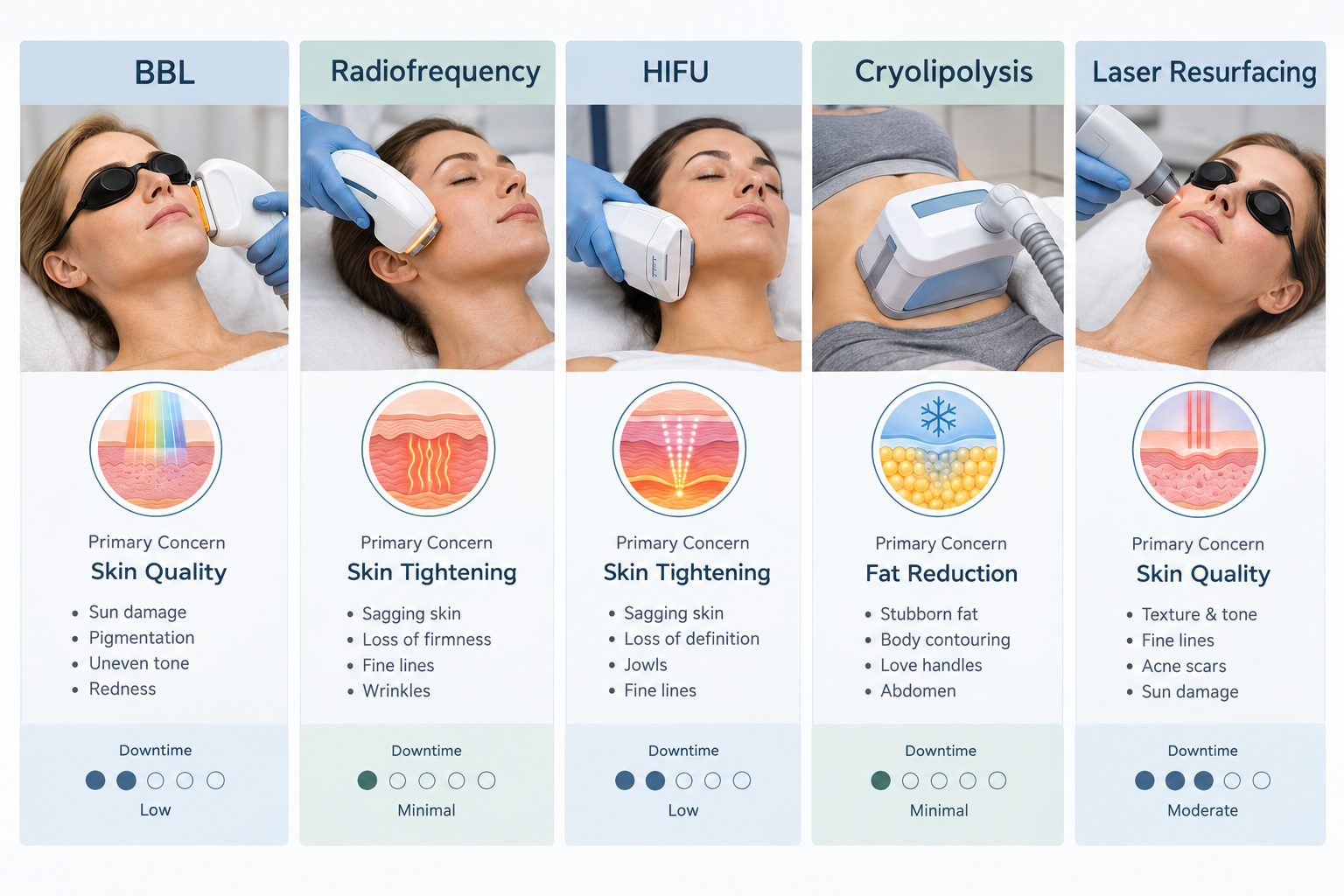
| Treatment | Primary Mechanism | Main Body Concern Addressed | Fat Reduction | Skin Quality Improvement | Typical Downtime | Sessions Often Needed |
|---|---|---|---|---|---|---|
| BBL (BroadBand Light) | Intense pulsed light targeting melanin and haemoglobin; collagen stimulation | Pigmentation, vascular changes, texture, mild laxity | No | Yes | Minimal (hours to 1 day) | 2–4+ per course |
| Radiofrequency (RF) skin tightening | Thermal energy stimulating collagen and elastin remodelling | Skin laxity, texture | Some devices combine RF with fat reduction | Yes | Minimal to mild | 3–6 per course |
| HIFU (High-Intensity Focused Ultrasound) | Focused ultrasound energy at specific tissue depths | Skin laxity, mild lifting | No (skin-focused) | Yes | Minimal | 1–2 per year |
| Cryolipolysis (e.g. CoolSculpting) | Controlled cooling to induce fat cell apoptosis | Localised fat reduction | Yes | Limited | Mild (days) | 1–3 per area |
| Emsculpt / Emsculpt Neo | High-intensity electromagnetic energy for muscle stimulation; Neo adds RF | Muscle definition, fat reduction (Neo) | Neo: modest fat reduction | Limited | None | 4 per course |
| Laser resurfacing (ablative/fractional) | Controlled laser injury stimulating skin renewal | Texture, scarring, pigmentation, laxity | No | Yes (more aggressive) | Moderate to significant | 1–3 per course |
This comparison illustrates that BBL occupies a specific niche: it is well suited to improving skin quality and addressing surface-level pigmentation and vascular concerns, but it is not a fat-reduction or significant skin-tightening tool. Patients with multiple concerns may benefit from a combination approach, which a qualified practitioner can help design based on individual goals and suitability.
Combining BBL with Other Treatments
In clinical practice, BBL is frequently used as part of a combination treatment strategy rather than as a standalone solution for body contouring goals. Combining BBL with radiofrequency skin tightening, for example, may address both surface pigmentation and deeper collagen remodelling in the same treatment plan, potentially producing more comprehensive skin quality improvements than either treatment alone. Similarly, BBL may be used alongside body contouring procedures such as cryolipolysis to improve the skin appearance of an area where fat reduction has been achieved.
Combination approaches require careful planning to avoid overlapping risks and to allow adequate recovery between sessions. The sequencing, interval, and suitability of combination treatments should be determined by a practitioner with experience in multiple modalities, not based on general guidance alone. Not every combination is appropriate for every patient, and more treatment is not always better.
Frequently Asked Questions
Is BBL the same as a laser?
BBL (BroadBand Light) is technically an intense pulsed light (IPL) device rather than a true laser. Lasers emit a single coherent wavelength, while BBL emits a broad spectrum of light that is filtered to target specific skin concerns. The term “BBL laser” is widely used colloquially but is not technically precise. Both technologies can be effective for skin concerns, but they work differently and have different profiles of suitable applications.
How many BBL sessions will I need for body skin concerns?
The number of sessions depends on the specific concern, its severity, and how your skin responds. For body pigmentation and sun damage, two to four sessions spaced four to six weeks apart is a common starting framework. Maintenance sessions are typically recommended once or twice a year. Your practitioner will advise on the appropriate plan after assessing your skin.
Will BBL tighten loose skin on the body?
BBL may contribute to modest improvements in skin firmness through collagen stimulation, but it is not a primary skin-tightening treatment. Patients with significant skin laxity are unlikely to achieve meaningful tightening from BBL alone. Dedicated radiofrequency or ultrasound-based devices are generally more appropriate for skin tightening as a primary goal.
Is BBL treatment painful?
Most patients describe BBL as producing a brief warm snapping sensation with each pulse. Discomfort is generally mild and well tolerated without anaesthetic. The device’s built-in cooling system helps manage heat at the skin surface. Sensitivity varies between individuals and treatment areas.
Can BBL be used on darker skin tones?
BBL can be used on some patients with darker skin tones, but requires careful assessment, conservative settings, and an experienced practitioner. The risk of post-inflammatory hyperpigmentation and hypopigmentation is higher in darker skin types. A patch test and thorough consultation are particularly important in these cases.
How long do BBL results last on the body?
Results from BBL treatment for pigmentation and vascular concerns can last for a year or more with appropriate sun protection and maintenance treatments. Ongoing sun exposure without adequate protection can cause new pigmentation to develop, reducing the longevity of results. Skin quality improvements related to collagen stimulation may be maintained with periodic treatments.
Can BBL reduce fat or change body shape?
No. BBL does not reduce fat deposits or alter body shape in the way that fat-reduction treatments such as cryolipolysis or high-intensity focused ultrasound do. BBL addresses skin surface concerns including pigmentation, vascular irregularities, and texture. Patients seeking fat reduction or significant body reshaping should discuss dedicated body contouring options with their practitioner.
Is BBL Light Therapy the Right Choice for Your Body Skin Goals?
BBL laser treatment offers a well-established, low-downtime option for improving skin quality on body areas affected by pigmentation, sun damage, vascular irregularities, and textural concerns. When used appropriately and with realistic expectations, it can produce meaningful improvements in skin clarity and tone over a course of sessions. The collagen-stimulating effects may contribute modestly to skin firmness, adding a degree of refinement to the overall appearance of treated areas.
However, BBL is not a body contouring treatment in the sense of reducing fat or producing significant structural changes to body shape. Patients whose primary concern is localised fat, significant skin laxity, or muscle definition will need to explore other options — and a combination approach may be the most effective strategy for those with multiple goals.
Suitability depends on skin type, medical history, current medications, and the specific concern being addressed. A consultation with a qualified aesthetic practitioner who can assess your skin, discuss your goals honestly, and recommend an evidence-informed treatment plan is the appropriate starting point. BBL may be one useful tool within that plan — but understanding its role clearly will help you make a well-informed decision.


