
Natural Mole Removal: Why Home Remedies Don’t Work and What Actually Does
Searches for how to remove moles naturally in one day reflect a genuine desire for a quick, painless, and affordable solution. The reality, however, is that no home remedy, natural ingredient, or over-the-counter product can safely remove a mole in a single day — or at all. Understanding why these methods fail, and why attempting them carries real medical risk, is essential before making any decision about mole removal.
Key Takeaways
- No natural or home remedy has been shown to safely and effectively remove moles. Claims to the contrary are not supported by clinical evidence.
- Attempting to remove a mole at home can cause scarring, infection, and — critically — may delay the diagnosis of a potentially cancerous lesion.
- Moles should be assessed by a qualified clinician before any removal is considered, regardless of the method.
- Safe, clinically proven removal options exist and are performed by trained practitioners using appropriate techniques.
- Not every mole needs to be removed. A professional assessment helps determine whether removal is appropriate and which method may be suitable.
What Is a Mole and Why Does It Matter?
A mole, known medically as a melanocytic naevus, is a benign growth formed by clusters of pigment-producing cells called melanocytes. Most people have between 10 and 40 moles, and the majority are entirely harmless. Moles can be flat or raised, smooth or textured, and range in colour from light tan to dark brown or black. They may be present from birth or develop during childhood and early adulthood, with sun exposure and genetics both playing a role in their formation.
The reason moles matter medically is that, in a small number of cases, a mole can undergo changes that indicate the development of melanoma — a form of skin cancer that, when caught early, is highly treatable but can become life-threatening if left undetected. This is why any decision to remove a mole, or to attempt to alter its appearance, carries implications beyond cosmetics. A mole that is removed without professional assessment cannot be sent for histological examination, meaning any early warning signs would be missed entirely.
Common Natural Mole Removal Claims and Why They Fail
A wide range of substances are promoted online as natural mole removers. These include apple cider vinegar, garlic, castor oil mixed with baking soda, iodine, tea tree oil, hydrogen peroxide, banana peel, and various herbal pastes. None of these have been demonstrated in peer-reviewed clinical research to remove moles safely or effectively. Understanding why they fail requires a basic understanding of mole structure.
Melanocytic naevi extend into the dermis — the deeper layer of skin beneath the surface epidermis. Surface-applied substances, regardless of their acidity, enzymatic activity, or antimicrobial properties, cannot selectively target and eliminate melanocyte clusters at this depth without causing broader tissue damage. What these substances can do is irritate or chemically burn the surrounding skin, creating the superficial appearance of change while leaving the underlying mole cells intact. Any apparent fading is typically temporary inflammation or surface damage, not genuine mole removal.
Apple Cider Vinegar
Apple cider vinegar is one of the most frequently cited natural mole removal remedies. Its acetic acid content gives it mild corrosive properties, which proponents suggest can break down mole tissue. In practice, applying an acidic substance repeatedly to skin causes a chemical burn. This may produce scabbing and temporary discolouration, but it does not remove the melanocyte clusters that form the mole. The result is often an irritated, scarred area of skin with the mole still present beneath the surface damage. There is no published clinical evidence supporting apple cider vinegar as an effective or safe mole removal method.
Garlic and Herbal Pastes
Garlic contains allicin, a compound with antimicrobial and mild caustic properties. Like apple cider vinegar, applying garlic directly to skin can cause contact dermatitis, blistering, and chemical burns. Herbal pastes and poultices promoted for mole removal work through similar mechanisms — surface irritation rather than targeted cellular removal. These approaches carry a meaningful risk of permanent scarring and do not address the deeper dermal component of a mole.
Castor Oil and Baking Soda
This combination is widely promoted as a gentle, gradual mole-fading remedy. Castor oil is an emollient with no known mechanism for affecting melanocyte activity. Baking soda is a mild abrasive and alkaline substance. Neither ingredient, alone or combined, has any demonstrated ability to reduce or remove a mole. Repeated application may cause mild skin irritation in sensitive individuals but is unlikely to produce visible change to the mole itself.
Over-the-Counter Mole Removal Products
Various creams, serums, and pen-style devices are marketed for at-home mole removal. Many of these products contain caustic or acidic ingredients similar to those described above, or use low-level electrical current. Regulatory bodies in multiple countries have issued warnings about these products. They are not approved for mole removal, their safety and efficacy have not been established through clinical trials, and their use carries risks of scarring, infection, and — again — the critical problem of bypassing professional assessment of the lesion.
The Real Risks of Attempting Home Mole Removal
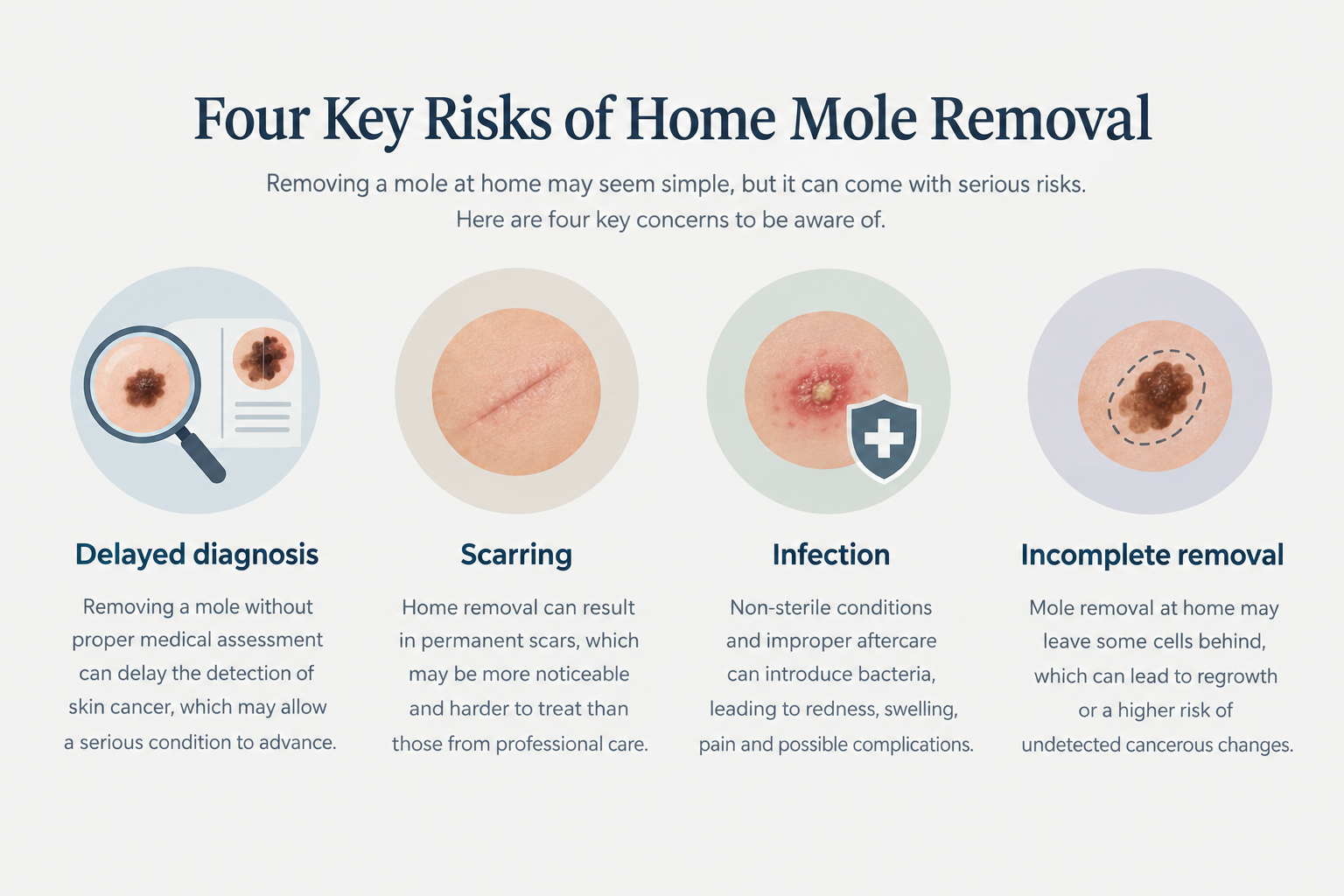
The risks associated with attempting to remove a mole at home extend well beyond the cosmetic. Understanding these risks is important for anyone considering a DIY approach.
Delayed Diagnosis of Skin Cancer
This is the most serious risk. Melanoma and other forms of skin cancer can develop within or adjacent to existing moles. A mole that is changing in size, shape, colour, or texture — or one that bleeds, itches, or develops an irregular border — may warrant urgent dermatological assessment. Attempting to remove such a mole at home, or simply monitoring it without professional evaluation, can delay a diagnosis that could be life-saving. Even a mole that appears entirely normal to the untrained eye may show features of concern under dermoscopy, a specialist examination technique that is not available outside a clinical setting.
Scarring
Chemical burns, repeated abrasion, and tissue damage from caustic substances frequently result in permanent scarring. Ironically, many people seek mole removal for cosmetic reasons, yet home removal attempts often produce a scar that is more visible and more difficult to treat than the original mole.
Infection
Breaking the skin’s surface — whether through chemical irritation, cutting, or abrasion — creates an entry point for bacteria. Skin infections following home mole removal attempts can range from localised cellulitis to more serious complications, particularly in individuals with compromised immune systems or diabetes.
Incomplete Removal and Recurrence
Even if a home method appears to remove the visible surface of a mole, the deeper melanocyte clusters are likely to remain. This can result in the mole returning, sometimes with an altered appearance that makes subsequent professional assessment more difficult. A mole that has been partially treated and then recurs may be harder to evaluate accurately.
How Moles Are Assessed Professionally
Before any mole removal is considered, a qualified clinician — typically a dermatologist, plastic surgeon, or trained aesthetic practitioner — will assess the lesion. This assessment usually involves a visual examination and dermoscopy, which uses a handheld device with magnification and polarised light to examine the mole’s internal structure. Dermoscopy allows trained clinicians to identify features that may indicate malignancy, such as irregular pigment networks, atypical vascular patterns, or asymmetric structures that are invisible to the naked eye.
In some cases, a clinician may recommend a biopsy — removing a small sample of tissue for laboratory analysis — before deciding on a removal approach. This step is particularly important for moles that show any features of concern. The ABCDE criteria (Asymmetry, Border irregularity, Colour variation, Diameter greater than 6mm, and Evolution or change over time) are a widely used patient-facing guide for identifying moles that warrant professional review, though clinical assessment goes considerably beyond these criteria.
Clinically Recognised Mole Removal Methods
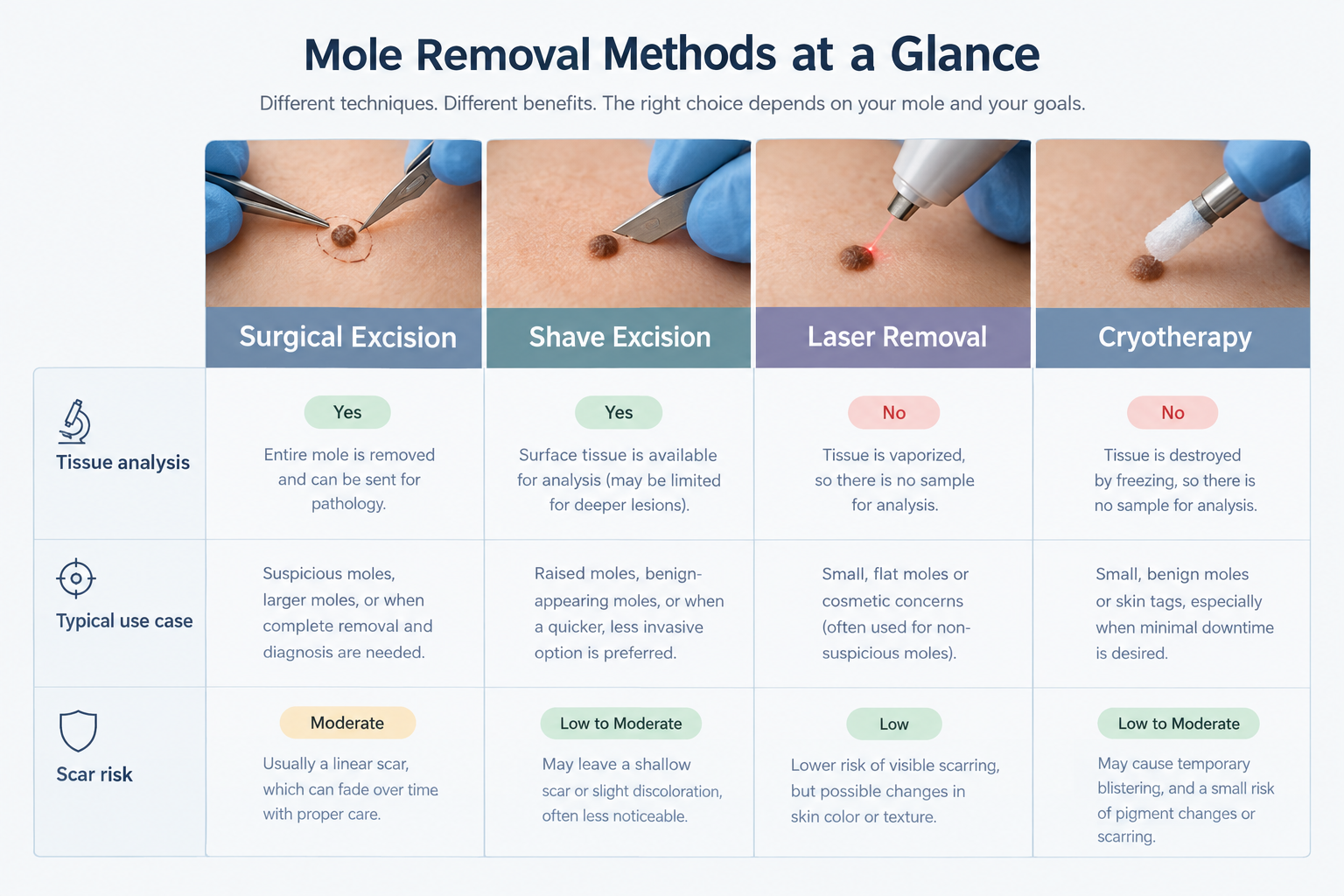
When professional assessment confirms that a mole is benign and removal is appropriate — whether for cosmetic reasons or because the mole is in a location prone to irritation — several clinically recognised methods may be considered. The most suitable approach depends on the mole’s size, depth, location, and the patient’s skin type and medical history.
Surgical Excision
Surgical excision involves removing the mole and a small margin of surrounding tissue using a scalpel, followed by closure with sutures. This method allows the removed tissue to be sent for histological examination, which is an important safety advantage. Surgical excision is typically performed under local anaesthetic and is suitable for most mole types, including raised and deeper lesions. A small linear scar is expected, though skilled technique and appropriate wound care can minimise its visibility.
Shave Excision
Shave excision uses a surgical blade to remove a raised mole flush with the surrounding skin surface, without sutures. This technique is generally used for benign, raised lesions and leaves a flat, circular mark that typically fades over time. The removed tissue can still be sent for analysis. Shave excision is not appropriate for all mole types and is not suitable where there is any clinical concern about the lesion.
Laser Mole Removal
Laser treatment uses targeted light energy to break down pigment within the mole. It is generally considered suitable only for small, flat, benign moles and is not appropriate for raised, deeply pigmented, or clinically uncertain lesions. A significant limitation of laser mole removal is that no tissue is collected for histological examination, meaning it should only be used after thorough professional assessment has confirmed the mole is benign. Multiple sessions may be required, and results can vary depending on mole depth and skin type.
Cryotherapy
Cryotherapy uses liquid nitrogen to freeze and destroy tissue. It is more commonly used for other skin lesions such as warts and seborrhoeic keratoses than for true melanocytic naevi. Like laser treatment, cryotherapy does not allow tissue to be collected for analysis and is therefore only appropriate for confirmed benign lesions. It may cause temporary blistering, pigmentation changes, and, in some cases, scarring.
Who May Be Suitable for Mole Removal?
Mole removal may be appropriate for individuals whose moles have been assessed and confirmed as benign, and who have a clear reason for removal — such as cosmetic concern, repeated irritation from clothing or jewellery, or discomfort. Removal is not appropriate for moles that show any features of concern until a full clinical assessment, and where indicated a biopsy, has been completed.
Certain factors may affect suitability for specific removal methods, including skin type, tendency to form keloid scars, current medications such as anticoagulants, pregnancy, active skin infections in the treatment area, and previous treatments to the same site. A thorough consultation with a qualified practitioner is necessary to determine which approach, if any, is appropriate for an individual patient.
Moles That Should Be Assessed Urgently
Certain changes in a mole warrant prompt professional assessment rather than any form of home treatment. These include a mole that has grown noticeably in a short period, developed an irregular or poorly defined border, changed colour or become multi-toned, started to bleed without injury, become itchy or painful, or developed a raised area within a previously flat lesion. These features do not automatically indicate cancer, but they do require evaluation by a qualified clinician. Attempting to remove or alter such a mole at home before assessment is strongly inadvisable.
Frequently Asked Questions
Can apple cider vinegar really remove a mole?
No. Apple cider vinegar can cause a chemical burn on the skin surface, which may produce temporary scabbing or discolouration, but it does not remove the melanocyte clusters that form a mole. The mole typically remains beneath any surface damage, and the process carries a real risk of permanent scarring and infection.
Is it safe to cut off a mole at home?
Cutting or shaving a mole at home is not safe. It carries significant risks of infection, uncontrolled bleeding, and scarring. More importantly, it removes the possibility of having the tissue examined in a laboratory, which is the only way to rule out malignancy. Home cutting of moles is strongly discouraged by dermatological and medical organisations.
How long does professional mole removal take?
Most professional mole removal procedures are completed within a single appointment, typically lasting between 15 and 45 minutes depending on the method and the size of the lesion. Local anaesthetic is used for surgical procedures, so discomfort during the procedure itself is usually minimal. Healing time varies by method, ranging from a few days for minor procedures to several weeks for surgical excision.
Will mole removal leave a scar?
All mole removal methods carry some risk of scarring. Surgical excision typically leaves a small linear scar, while shave excision leaves a flat circular mark. Laser and cryotherapy may cause temporary pigmentation changes. The visibility of any resulting mark depends on the mole’s size and location, the removal technique, the individual’s skin type, and how well aftercare instructions are followed. A skilled practitioner will discuss realistic expectations before treatment.
Does the NHS or insurance cover mole removal?
In the United Kingdom, mole removal on the NHS is generally available only when there is a clinical concern about the lesion, such as suspected malignancy. Cosmetic removal of benign moles is typically not funded through public healthcare and would need to be arranged privately. Insurance coverage varies by provider and policy. It is advisable to check directly with your insurer and discuss the clinical rationale with your practitioner.
How do I know if my mole needs to be removed?
The decision to remove a mole should be made in consultation with a qualified clinician after a proper assessment. A mole does not need to be removed simply because it exists. Reasons a clinician might recommend removal include clinical concern about the lesion’s appearance, a history of change, or patient-reported symptoms such as bleeding or persistent irritation. Cosmetic removal of a confirmed benign mole is a personal decision that can be discussed with a practitioner.
What to Do Instead of Trying Natural Mole Removal
If a mole is causing concern — whether cosmetic or medical — the appropriate first step is a professional assessment, not a home remedy. A consultation with a dermatologist, GP, or qualified aesthetic practitioner who offers mole assessment services allows the lesion to be evaluated properly using dermoscopy and clinical expertise. If removal is appropriate and desired, the practitioner can explain which method may be most suitable, what the procedure involves, what results are realistic, and what aftercare is required.
For individuals concerned about the appearance of multiple moles or skin lesions, a full skin check — sometimes called a mole mapping or total body skin examination — provides a comprehensive baseline assessment and allows any changes to be monitored over time. This approach is particularly relevant for people with a personal or family history of melanoma, a large number of moles, or significant sun exposure history.
Attempting to remove a mole naturally at home does not save time, money, or discomfort in any meaningful sense. It introduces risks that a brief professional consultation would avoid entirely, and it bypasses the safety step that matters most: knowing whether the mole is benign before doing anything to it.


