
Tear Trough Fillers: Hyaluronic Acid for Under-Eye Hollows
Tear trough fillers use hyaluronic acid to address the hollow groove that forms beneath the eyes, between the lower eyelid and the upper cheek. This area is one of the most technically demanding sites for injectable treatment, and understanding what the procedure can and cannot achieve is essential before deciding whether to pursue it. This article explains how tear trough filler works, who may benefit, what the treatment experience involves, realistic outcomes, meaningful risks, and the alternatives worth knowing about.
Key Takeaways
- Tear trough fillers use hyaluronic acid gel to restore volume in the hollow beneath the eye, which can reduce the appearance of shadowing and a tired look.
- Not every under-eye concern responds to filler; pigmentation, prominent blood vessels, and excess skin require different approaches.
- The tear trough is a high-risk injection zone — practitioner experience, product selection, and patient anatomy all significantly affect safety and outcome.
- Results typically last between nine and eighteen months, though this varies depending on the product used, the volume placed, and individual metabolism.
- Hyaluronic acid fillers can be dissolved with hyaluronidase if a result is unsatisfactory or a complication arises, which is an important safety consideration.
What Is the Tear Trough and Why Does It Hollow?
The tear trough is the concave groove that runs from the inner corner of the eye diagonally toward the cheek. It is formed by the attachment of the orbicularis retaining ligament — a fibrous band that anchors the skin to the underlying bone — and is present to some degree in most people. In youth, surrounding fat compartments and soft tissue provide enough volume to keep this groove shallow and relatively inconspicuous. Over time, several changes make the tear trough more visible.
Volume loss in the periorbital fat pads and the mid-face causes the skin to descend and the groove to deepen. Bone resorption around the orbital rim reduces the structural support beneath the eye. Skin thinning, which is particularly pronounced in the lower eyelid where the dermis is already very thin, allows underlying structures to show through more easily. Genetics also play a role; some people develop a prominent tear trough in their twenties or even earlier, independent of significant ageing changes.
The result is a shadowed, hollowed appearance that can make a person look fatigued, older, or unwell even when well-rested. Because the shadow is caused by a structural depression rather than pigment alone, topical skincare products rarely correct it meaningfully.
How Hyaluronic Acid Filler Works in the Tear Trough
Hyaluronic acid is a naturally occurring polysaccharide found in connective tissue, skin, and the fluid surrounding joints. In aesthetic medicine, hyaluronic acid is cross-linked into a gel of varying firmness and is injected to restore or add volume in specific anatomical locations. When placed carefully in or around the tear trough, the gel physically lifts the overlying skin, reduces the depth of the groove, and softens the shadow that creates the hollowed appearance.
Not all hyaluronic acid fillers are equivalent for this purpose. The tear trough requires a product with relatively low viscosity and high cohesivity — meaning it integrates smoothly into tissue without creating visible lumps or a bluish discolouration beneath the thin eyelid skin. This discolouration, known as the Tyndall effect, occurs when a filler with inappropriate optical properties is placed too superficially. Practitioners experienced in periorbital treatment typically select softer, more hydrophilic formulations specifically suited to this delicate area.
Injection technique also varies. Some practitioners use a fine needle, while others prefer a blunt-tipped cannula, which may reduce bruising and the risk of inadvertent vascular injury. The choice depends on the practitioner’s training, the patient’s anatomy, and the specific product being used. Placement depth — whether the filler is deposited above or below the muscle, or directly on the periosteum — affects both the aesthetic result and the risk profile.
Who May Be Suitable for Tear Trough Filler
Tear trough filler tends to produce the most satisfying outcomes in patients whose primary concern is genuine volume loss or hollowness in the under-eye groove. A clinical assessment is necessary to determine whether filler is appropriate, because the under-eye area can look tired or aged for several different reasons, and filler addresses only some of them.
Patients who may be considered suitable include those with a clearly defined tear trough hollow, good skin quality in the lower eyelid, adequate cheek volume to support the result, and realistic expectations about the degree of improvement possible. Younger patients with a genetically prominent tear trough and minimal skin laxity often respond particularly well.
Patients who may be less suitable, or for whom filler carries a higher risk of a suboptimal result, include those with:
- Significant lower eyelid skin laxity or excess skin, which filler cannot correct and may worsen in appearance
- Prominent lower eyelid fat pads or festoons, where adding volume beneath the eye may accentuate puffiness
- Very thin, translucent lower eyelid skin, which increases the risk of visible filler or the Tyndall effect
- Dark circles caused primarily by pigmentation or visible blood vessels rather than hollowness
- A history of significant lower eyelid surgery, which may alter anatomy and drainage
- Active skin infection, inflammation, or cold sore in or near the treatment area
- Certain bleeding disorders or use of anticoagulant medications, which increase bruising risk
- Pregnancy or breastfeeding, during which elective injectable treatments are generally avoided
- Known allergy to hyaluronic acid or lidocaine, which is often included in filler formulations
A thorough consultation with a qualified and experienced practitioner is essential before proceeding. The tear trough is not a suitable area for inexperienced injectors, and patient selection is a critical part of achieving a safe and satisfactory outcome.
The Treatment Experience
A tear trough filler appointment typically begins with a detailed consultation if one has not already taken place. The practitioner will assess the anatomy of the lower eyelid and mid-face, discuss the patient’s concerns and goals, review medical history, and explain the procedure, expected results, and risks. Photographs are usually taken for reference.
Before injection, the skin is cleaned and a topical anaesthetic cream may be applied to reduce discomfort, though many hyaluronic acid fillers contain lidocaine within the gel itself, which provides additional comfort during injection. The procedure is generally well tolerated, though the under-eye area can be sensitive and some patients experience mild stinging or pressure during injection.
The amount of filler used is typically small — often less than one millilitre across both sides — because the tear trough is a confined space and overfilling is a common cause of unsatisfactory results. A conservative approach, with the option to add more at a review appointment, is generally preferable to placing too much product in a single session.
The appointment itself usually takes between thirty and sixty minutes, including preparation and assessment. Patients can generally return to normal activities the same day, though some restrictions apply during the immediate recovery period.
Recovery, Downtime, and Aftercare
Swelling and bruising are the most common immediate effects of tear trough filler and are expected to some degree in most patients. The lower eyelid has a rich blood supply and very thin skin, which makes bruising more likely here than in many other injection sites. Swelling may also be more pronounced than in other areas and can temporarily make the result appear uneven or overfilled in the first few days.
Most patients find that initial swelling settles within three to five days, though some residual puffiness may persist for up to two weeks. Bruising, if it occurs, typically resolves within one to two weeks and can be covered with makeup once any puncture sites have closed, usually within twenty-four hours.
Standard aftercare advice following tear trough filler generally includes:
- Avoiding rubbing or applying pressure to the treated area for at least twenty-four to forty-eight hours
- Keeping the head elevated when sleeping in the first night or two to help reduce swelling
- Avoiding strenuous exercise, alcohol, and excessive heat such as saunas or steam rooms for twenty-four to forty-eight hours
- Avoiding makeup directly on injection sites for the first twenty-four hours
- Attending a review appointment, typically two to four weeks after treatment, to assess the settled result
Because swelling can temporarily distort the appearance of the result, it is important not to judge the final outcome until the treated area has fully settled. A review appointment allows the practitioner to assess whether any refinement is needed.
Results: What to Realistically Expect
When tear trough filler is well-placed in a suitable patient, the result can be a meaningful reduction in the depth of the under-eye groove, a softening of the shadow that creates a tired appearance, and a smoother transition between the lower eyelid and the cheek. The improvement is typically subtle rather than dramatic — the goal is a refreshed, rested appearance rather than a visible change in facial structure.
Results are not guaranteed to be symmetrical, and some degree of natural asymmetry is present in most faces before treatment. Practitioners aim to improve balance, but perfect symmetry is rarely achievable. Individual response to hyaluronic acid filler also varies; some patients retain the product for longer than others depending on their metabolism, lifestyle, and the specific formulation used.
Tear trough filler does not address dark circles caused by pigmentation, which require different treatments such as topical agents, chemical peels, or laser therapy. It also does not tighten loose skin, reduce prominent fat pads, or correct vascular discolouration. Patients with these concerns may find that filler alone does not fully address their goals, and a combination approach or an alternative treatment may be more appropriate.
How Long Do Tear Trough Fillers Last?
Hyaluronic acid filler in the tear trough typically lasts between nine and eighteen months, though results outside this range are possible. Several factors influence longevity. The specific product used matters — softer, more hydrophilic formulations may be metabolised more quickly than firmer gels, though firmer products are generally not appropriate for this area. The volume placed, the depth of injection, and the patient’s individual rate of hyaluronic acid metabolism all contribute to how long the result is maintained.
Some patients report that results in the tear trough last longer than in other areas such as the lips, possibly because the periorbital region has less dynamic movement. Others find the opposite. Maintaining results requires repeat treatment, typically once or twice a year depending on how the individual responds.
It is worth noting that repeated filler treatments in the same area over many years can occasionally lead to product accumulation, particularly if small amounts are added at each session without fully dissolving previous material. This is one reason why periodic review and, where appropriate, dissolution of accumulated filler before retreatment may be recommended by experienced practitioners.
Risks and Side Effects
The tear trough is considered one of the higher-risk areas for dermal filler injection, and patients should be fully informed of the potential complications before consenting to treatment. Common and expected side effects include bruising, swelling, tenderness, and temporary asymmetry, all of which typically resolve within one to two weeks.
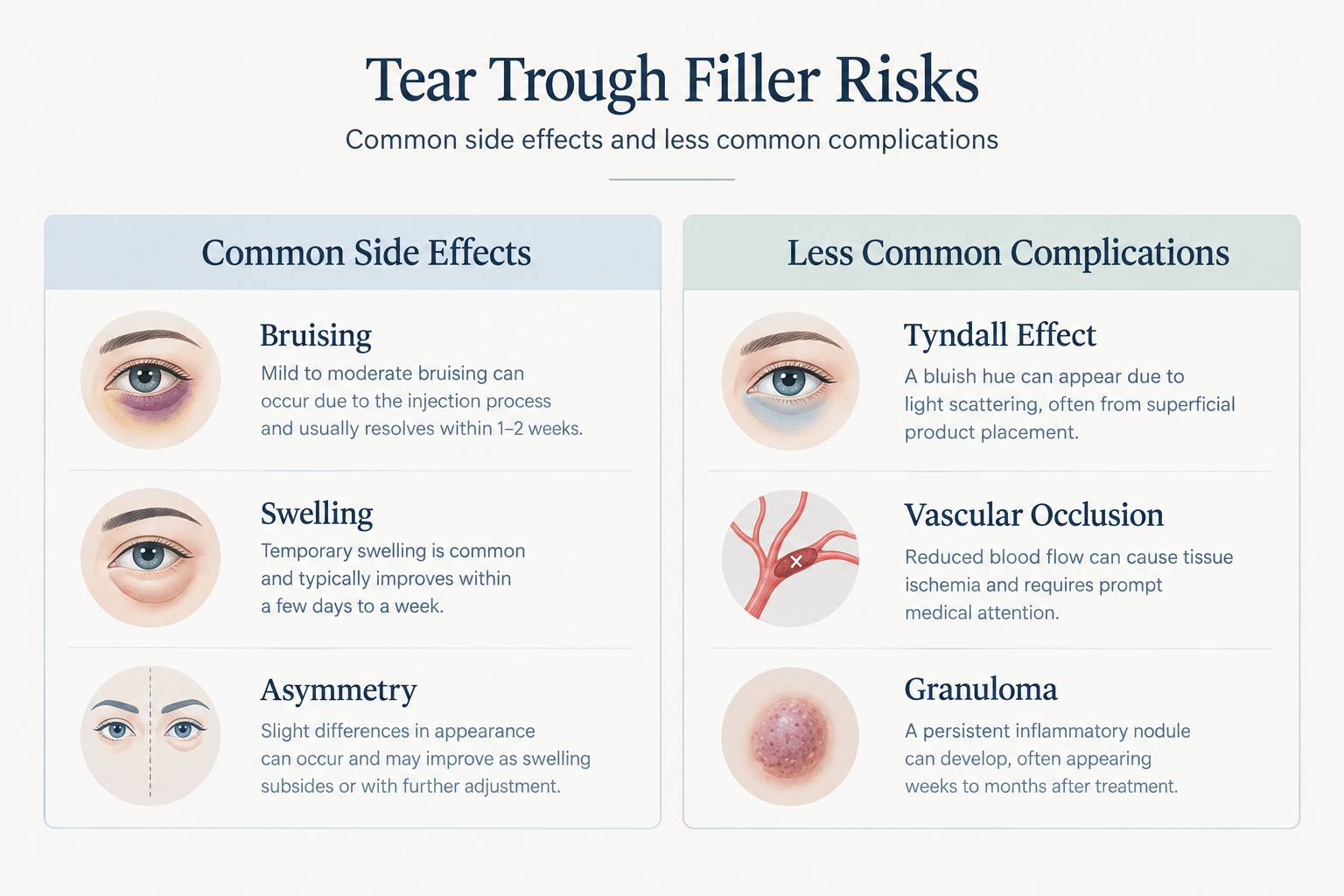
More significant complications, though less common, include:
- Tyndall effect: A bluish discolouration visible through the thin eyelid skin, caused by superficially placed filler with inappropriate optical properties. This can persist until the filler is dissolved.
- Visible lumps or irregularities: Filler that migrates, is placed unevenly, or swells asymmetrically may create visible or palpable lumps beneath the skin.
- Prolonged or worsening swelling: Some patients experience oedema that persists beyond the expected recovery period, particularly those prone to fluid retention or with compromised lymphatic drainage.
- Vascular occlusion: Inadvertent injection into or compression of a blood vessel can restrict blood flow to surrounding tissue. In the periorbital region, this carries a risk of skin necrosis or, in rare cases, vision changes if the ophthalmic circulation is affected. This is a rare but serious complication that requires immediate medical attention.
- Infection: As with any injectable procedure, there is a small risk of infection at the injection site.
- Granuloma formation: An inflammatory reaction to the filler material, which can occur months or years after treatment and may require medical management.
The reversibility of hyaluronic acid filler with hyaluronidase — an enzyme that breaks down hyaluronic acid — is an important safety feature. If a complication such as vascular occlusion occurs, or if the result is unsatisfactory, hyaluronidase can be used to dissolve the filler. This is one reason why hyaluronic acid is generally preferred over permanent or semi-permanent fillers in the tear trough.
Choosing a practitioner with specific training and experience in periorbital anatomy, who has access to hyaluronidase and knows how to use it promptly in an emergency, significantly reduces the risk of serious complications.
Alternatives to Tear Trough Filler
Tear trough filler is not the only option for under-eye hollowness, and for some patients it may not be the most appropriate first choice. Understanding the alternatives helps in making an informed decision.
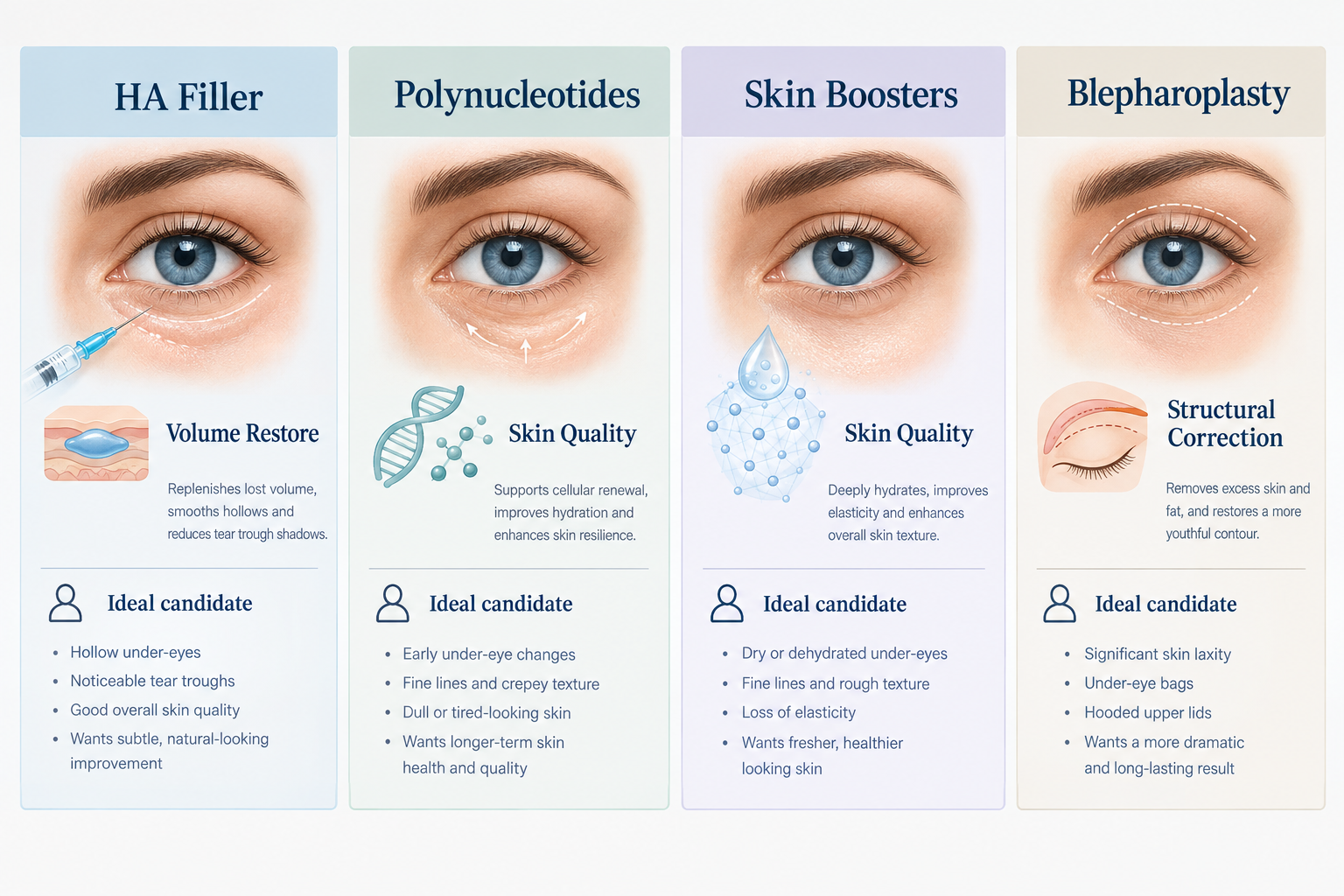
Polynucleotides (PDRN or PN injections) are an emerging treatment that uses purified DNA fragments to stimulate tissue regeneration, improve skin hydration, and support collagen production in the periorbital area. Polynucleotide injections do not add volume in the same way as hyaluronic acid filler, but they may improve skin quality, reduce fine lines, and address mild hollowness in patients with early-stage concerns. Evidence for polynucleotides in the under-eye area is still developing, and they are often used alongside filler rather than as a direct replacement.
Profhilo and skin booster injections use highly fluid hyaluronic acid formulations to improve skin hydration and quality rather than to add structural volume. These may be appropriate for patients whose primary concern is skin texture or crepiness rather than a deep hollow.
Surgical lower blepharoplasty addresses excess skin, prominent fat pads, and significant laxity in the lower eyelid — concerns that filler cannot correct. For patients with these features, surgery may produce a more appropriate and longer-lasting result than injectable treatment.
Laser resurfacing and radiofrequency treatments can improve skin quality, reduce pigmentation, and stimulate collagen in the periorbital area, though they do not restore volume.
Topical treatments including retinoids, vitamin C, and targeted eye creams may improve skin quality and reduce the appearance of fine lines over time, but are unlikely to correct a structural hollow.
The most appropriate approach depends on the specific cause of the under-eye concern, the patient’s anatomy, their medical history, and their goals. A thorough assessment by a qualified practitioner is the most reliable way to identify which option, or combination of options, is likely to be most effective.
Frequently Asked Questions
Can tear trough filler fix dark circles?
Tear trough filler can reduce the shadow caused by a hollow groove beneath the eye, which may improve the appearance of darkness in that area. However, dark circles caused by pigmentation, visible blood vessels, or thin skin with underlying muscle showing through are not corrected by filler. A clinical assessment is needed to identify the cause before recommending treatment.
Is tear trough filler painful?
Most patients describe the procedure as mildly uncomfortable rather than painful. Topical anaesthetic cream is often applied beforehand, and most hyaluronic acid fillers used in this area contain lidocaine, which reduces discomfort during injection. Individual pain tolerance varies, and the under-eye area can be more sensitive than other injection sites.
How soon will I see results?
Some improvement is usually visible immediately after treatment, but initial swelling can temporarily distort the result. The settled outcome is generally visible two to four weeks after the procedure, once swelling has fully resolved. A review appointment at this stage allows the practitioner to assess whether any refinement is needed.
What happens if I don’t like the result?
Hyaluronic acid filler can be dissolved using hyaluronidase, an enzyme that breaks down the gel. This is one of the key advantages of hyaluronic acid over non-reversible fillers. Dissolution is not always immediate and may require more than one treatment, but it provides an important option if the result is unsatisfactory or a complication arises.
How much filler is typically used in the tear trough?
The volume used is usually small — often between 0.5 and 1 millilitre across both sides combined — because the tear trough is a confined space and overfilling is a common cause of poor outcomes. A conservative approach with a review appointment is generally preferable to placing too much product in a single session.
Can tear trough filler make puffiness worse?
In patients with prominent lower eyelid fat pads or a tendency to retain fluid, adding volume beneath the eye can accentuate puffiness rather than improve it. This is one reason why careful patient selection and a thorough pre-treatment assessment are essential. Patients with significant lower eyelid fat prolapse may be better served by surgical options.
Is there an age limit for tear trough filler?
There is no fixed upper age limit, but the suitability of filler changes with age. In older patients with significant skin laxity, thin skin, or prominent fat pads, filler may be less appropriate and surgical assessment may be more relevant. Younger patients with a genetically prominent tear trough and good skin quality often respond particularly well to filler treatment.
Is Tear Trough Filler the Right Choice for Your Under-Eye Concerns?
Tear trough filler with hyaluronic acid can be an effective treatment for the right patient — specifically, someone with genuine volume loss or hollowness in the under-eye groove, good lower eyelid skin quality, and realistic expectations about the degree of improvement achievable. When performed by an experienced practitioner using an appropriate product and technique, the treatment can meaningfully reduce the shadowed, fatigued appearance that a prominent tear trough creates.
The limitations are equally important to understand. Tear trough filler does not correct pigmentation-based dark circles, excess skin, prominent fat pads, or vascular discolouration. The tear trough is a technically demanding injection site with a meaningful risk profile, and the outcome depends heavily on practitioner skill, product selection, and patient anatomy. The reversibility of hyaluronic acid filler is a genuine safety advantage, but it does not eliminate the importance of choosing a qualified and experienced injector from the outset.
If you are considering tear trough filler, a thorough consultation with a practitioner who has specific experience in periorbital treatment is the most important first step. A good consultation will assess whether your concern is likely to respond to filler, identify any factors that might increase your risk, and help you understand what a realistic result looks like for your individual anatomy. That assessment is the foundation of a safe and satisfying outcome.


