
Temple Filler Volume: What to Expect, How It Works, and Who It Suits
The temples are one of the first areas of the face to lose volume with age, yet they are often overlooked in favour of more commonly discussed concerns such as nasolabial folds or lip thinning. When the temples hollow, the upper face can appear gaunt, the brow may descend, and the overall facial shape shifts from a youthful oval or heart towards a more rectangular or skeletal appearance. Temple filler treatment uses injectable dermal filler to restore volume to this area, addressing structural changes that other treatments cannot easily reach. This article explains how temple filler works, what realistic results look like, how long volume may last, and what risks and alternatives are worth understanding before a consultation.
Key Takeaways
- Temple hollowing is a normal part of facial ageing caused by fat loss, bone resorption, and muscle thinning in the temporal region.
- Dermal fillers — most commonly hyaluronic acid or calcium hydroxylapatite — can restore volume to the temples and improve upper facial contour.
- Results typically last between 12 and 24 months depending on the filler used, the volume placed, and individual metabolism.
- The temporal region contains important vascular and neural structures, making practitioner experience and anatomical knowledge essential for safe treatment.
- Temple filler is not suitable for everyone; a thorough consultation and medical history review are necessary before proceeding.
Why the Temples Lose Volume
Temporal volume loss is driven by several overlapping processes that occur gradually from the mid-thirties onwards. The temporal fat pad — a layer of subcutaneous fat that sits beneath the skin of the temple — diminishes over time, reducing the soft-tissue support that gives the upper face its rounded, full appearance. Alongside fat loss, the temporal bone itself undergoes resorption, meaning the bony scaffold that supports the overlying soft tissue becomes less prominent. The temporalis muscle, which runs through the temple and is responsible for jaw movement, can also thin with age, particularly in people who have lost significant body weight or who have a naturally lean facial structure.
The combined effect of these changes is a concave or hollowed appearance in the area between the outer brow and the hairline. In some individuals, temporal hollowing also contributes to brow descent, because the lateral brow loses its underlying support. This can make the eyes appear heavier or more tired than they actually are. Understanding these mechanisms matters because it helps explain why temple filler is not simply a cosmetic addition — it is addressing a genuine structural deficit that develops as part of the normal ageing process.
What Is Temple Filler?
Temple filler refers to the injection of a dermal filler product into the temporal region to restore lost volume and improve upper facial contour. The treatment is performed by a qualified medical practitioner — typically a doctor, dentist, or nurse prescriber with specialist training in facial aesthetics — using a fine needle or blunt-tipped cannula to place filler at the appropriate depth within the tissue.
Several types of dermal filler may be used in the temples, and the choice depends on the practitioner’s assessment, the degree of volume loss, and the patient’s anatomy. Hyaluronic acid fillers are the most widely used option. Hyaluronic acid is a naturally occurring substance found in connective tissue, and when formulated as a gel filler it can be injected to add volume, with the added benefit that it can be dissolved using an enzyme called hyaluronidase if a complication arises or the result is unsatisfactory. Calcium hydroxylapatite, a mineral-based filler with a thicker consistency, is also used in the temples and may provide longer-lasting results, though it cannot be dissolved in the same way as hyaluronic acid. Poly-L-lactic acid, a collagen-stimulating injectable, is occasionally used in this area to gradually rebuild volume over a series of sessions, though it requires a different treatment approach and timeline.
The specific product chosen, the volume used, and the injection technique are all decisions that should be made by the treating practitioner based on individual assessment. Patients should not arrive at a consultation with a fixed expectation of a particular product or volume, as these decisions require clinical judgement.
How Temple Filler Restores Facial Volume
When dermal filler is placed in the temporal region, it physically replaces the volume that has been lost from the fat pad, muscle, and bone. Depending on the filler type and the depth of placement, the product may be injected into the subcutaneous layer, the supraperiosteal plane (directly above the bone), or the deep temporal fascia. Placement depth is an important technical consideration because the temporal region contains the superficial temporal artery and vein, branches of the facial nerve, and the zygomaticotemporal nerve. Injecting at the correct anatomical plane reduces the risk of inadvertent vascular or neural injury.
The immediate effect of temple filler is a visible increase in volume that softens the concave appearance of the hollow temple. Over the following days, the filler integrates with the surrounding tissue and any initial swelling settles, revealing the final result more clearly. Hyaluronic acid fillers also attract water molecules, which can contribute to a subtle additional volumising effect in the weeks after treatment. The overall outcome is a smoother, more convex temple contour that restores the upper facial frame and can improve the appearance of the lateral brow position.
What Results May Look Like
Realistic expectations are important when considering any aesthetic treatment. Temple filler can meaningfully improve the appearance of hollowed temples and restore a more balanced upper facial shape, but it does not reverse all signs of ageing in the area, nor does it replicate the exact tissue composition of a younger face.
Patients who are likely to notice the most visible improvement are those with moderate to significant temporal hollowing, a lean facial structure, or volume loss following weight reduction. In these individuals, even a modest amount of filler — often between 0.5 ml and 2 ml per side, though the appropriate volume varies considerably between patients — can produce a noticeable change in facial shape. The brow may appear slightly lifted as the lateral support is restored, and the overall face can look less gaunt or tired.
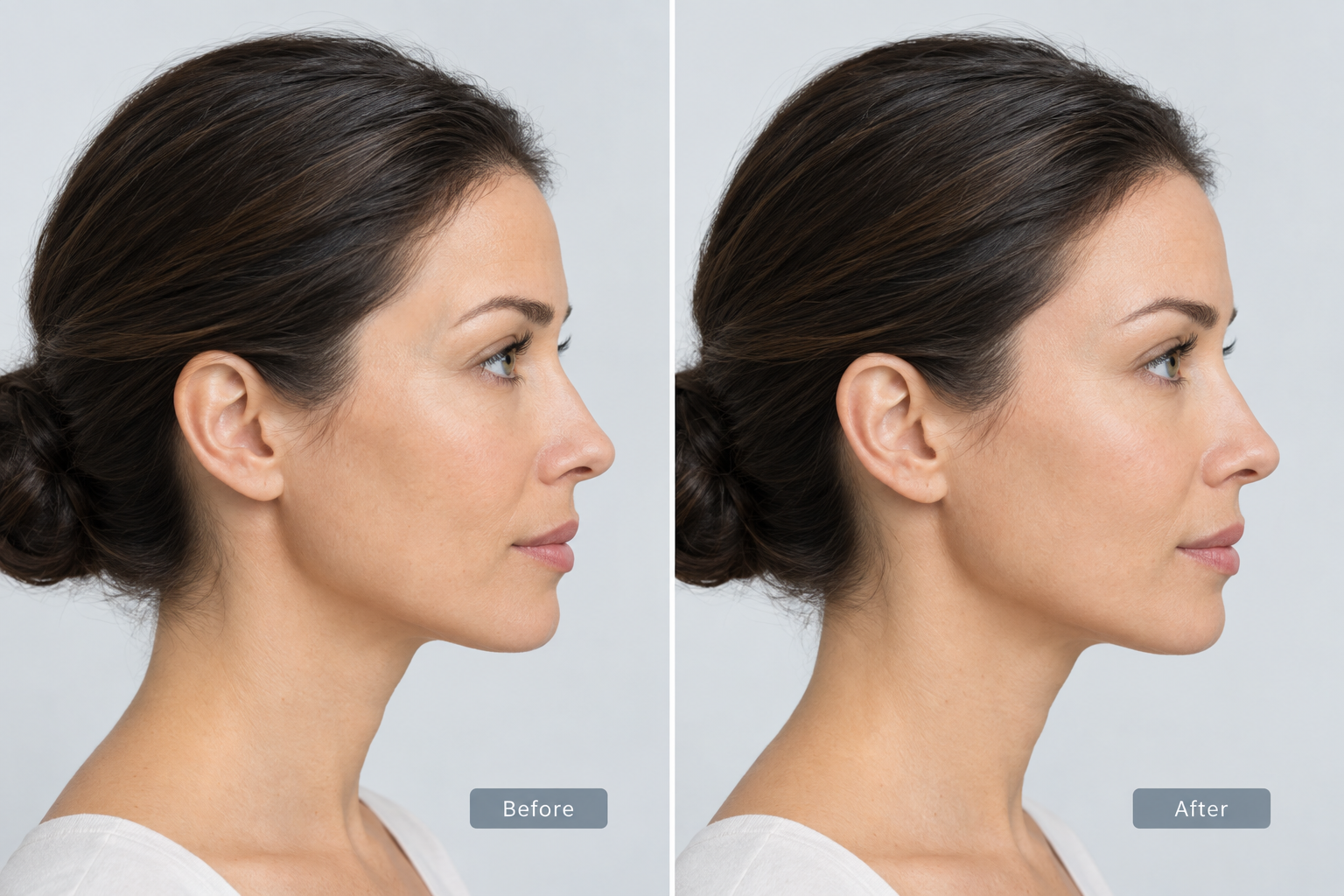
In patients with mild hollowing, the improvement may be more subtle and primarily appreciated in photographs or by those who know the patient well. Temple filler is not a treatment for skin laxity, deep wrinkles, or significant brow ptosis (drooping), and patients with these concerns may benefit from a broader treatment plan that addresses multiple aspects of facial ageing. Results should be assessed at a follow-up appointment, typically two to four weeks after treatment, once swelling has fully resolved.
How Long Temple Filler Lasts
The longevity of temple filler depends on the type of product used, the volume placed, the depth of injection, and individual factors such as metabolism, lifestyle, and the degree of muscle activity in the area. Hyaluronic acid fillers in the temples typically last between 12 and 18 months, though some patients report results persisting for up to two years. Calcium hydroxylapatite may last longer, with some estimates suggesting 18 to 24 months or beyond, partly because it also stimulates some degree of collagen production in the surrounding tissue.
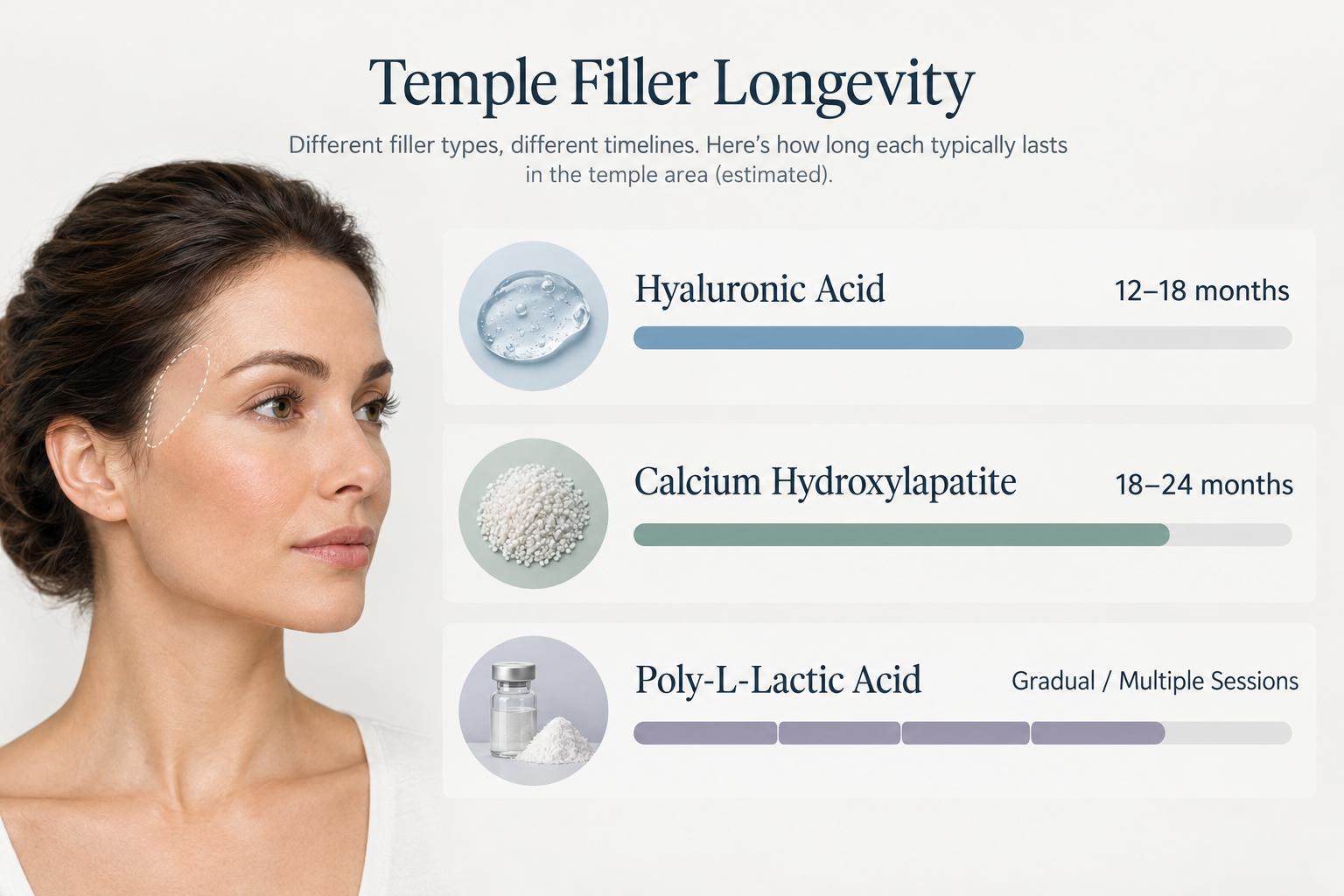
The temporal region is generally considered a relatively low-movement area compared to zones such as the lips or nasolabial folds, which means filler placed here may be broken down more slowly. However, individuals with a higher metabolic rate, those who exercise intensively, or those who have experienced significant weight fluctuation may find that results do not last as long as average estimates suggest. Maintenance treatments are typically needed to sustain the result over time, and the interval between sessions can often be extended as the practitioner builds on previous volume rather than starting from zero.
The Treatment Experience
A temple filler appointment typically begins with a consultation or a review of the treatment plan agreed at a previous consultation. The practitioner will assess the degree of temporal hollowing, discuss the patient’s goals, review the medical history, and explain the procedure, risks, and aftercare. Photographs are usually taken before treatment for comparison purposes.
The skin over the temple is cleaned and a topical anaesthetic cream may be applied to reduce discomfort, though many practitioners find that the filler itself — which often contains lidocaine, a local anaesthetic — provides sufficient comfort during injection. The injection itself takes only a few minutes per side. Some practitioners use a fine needle for precise placement, while others prefer a blunt-tipped cannula, which may reduce the risk of bruising and vascular injury by navigating around rather than through blood vessels. The choice of technique depends on the practitioner’s training and the individual anatomy.
Patients may feel mild pressure or a brief stinging sensation during injection. Significant pain is not expected and should be communicated to the practitioner immediately. After the filler is placed, the practitioner will gently massage the area to ensure even distribution and assess the result. The appointment typically takes between 30 and 60 minutes in total, including consultation time.
Recovery and Downtime
Temple filler treatment involves minimal downtime for most patients. The most common immediate effects are mild swelling, redness at the injection site, and occasional bruising. Swelling in the temporal region tends to be less pronounced than in areas such as the lips, and most patients find it resolves within three to five days. Bruising, if it occurs, may take up to ten days to fully fade and can be covered with makeup once the injection sites have closed, usually within a few hours.
Patients are generally advised to avoid strenuous exercise, alcohol, and excessive heat — including saunas and hot baths — for 24 to 48 hours after treatment, as these can increase swelling and bruising. Sleeping with the head slightly elevated on the first night may also help to minimise swelling. Most patients return to normal activities the same day or the following day. A follow-up appointment two to four weeks after treatment allows the practitioner to assess the settled result and determine whether any additional volume is needed.
Risks and Side Effects
Temple filler carries risks that patients should understand before consenting to treatment. Common and generally temporary side effects include swelling, bruising, redness, tenderness, and mild asymmetry in the days immediately following injection. These typically resolve without intervention.
More serious risks are less common but clinically significant. The temporal region is supplied by the superficial temporal artery, and inadvertent injection into or compression of a blood vessel can, in rare cases, cause vascular occlusion — a blockage that restricts blood flow to surrounding tissue. If not recognised and treated promptly, vascular occlusion can lead to tissue damage or, in very rare cases, more serious complications including visual disturbance if the ophthalmic circulation is affected. This is why temple filler should only be performed by a practitioner with thorough knowledge of facial vascular anatomy and access to hyaluronidase for emergency dissolution of hyaluronic acid filler.
Other potential risks include infection, nodule formation, filler migration, and delayed inflammatory reactions. Granuloma formation — a chronic inflammatory response to the filler material — is uncommon but can occur with any injectable filler and may require treatment with corticosteroids or, in the case of hyaluronic acid, dissolution with hyaluronidase. Patients should be given clear aftercare instructions and a contact number to reach their practitioner if they experience unexpected symptoms such as increasing pain, skin colour changes, or visual disturbance after treatment.
Who May Be Suitable for Temple Filler
Temple filler may be appropriate for adults who have developed noticeable temporal hollowing as a result of ageing, weight loss, or a naturally lean facial structure, and who wish to restore a more balanced upper facial appearance. Suitable candidates are generally in good general health, have realistic expectations about what the treatment can achieve, and understand the risks involved.
Patients who have previously had temple filler and are seeking a maintenance or top-up treatment are also commonly seen in aesthetic practice. In these cases, the practitioner will assess how much of the previous filler remains and whether additional volume is needed to maintain the result.
Who May Not Be Suitable
Temple filler is not appropriate for everyone. Patients who are pregnant or breastfeeding are generally advised to postpone elective injectable treatments. Those with active skin infections, inflammatory skin conditions, or autoimmune disorders affecting the skin in the treatment area may not be suitable candidates. A history of severe allergic reactions, particularly to filler components such as hyaluronic acid or lidocaine, is a contraindication that must be discussed at consultation.
Patients taking blood-thinning medications — including warfarin, aspirin, or certain supplements such as high-dose fish oil and vitamin E — may have an increased risk of bruising and should discuss this with their practitioner before treatment. Those with a history of cold sores may be advised to take antiviral medication prophylactically, as injection trauma can occasionally trigger a recurrence. Patients with unrealistic expectations or body dysmorphic disorder should not proceed with treatment, and a responsible practitioner will decline to treat in these circumstances.
Alternatives to Temple Filler
For patients who are not suitable for or do not wish to have injectable filler, several alternatives may be worth discussing with a practitioner. Surgical temporal augmentation using implants or fat transfer (autologous fat grafting) can provide longer-lasting volume restoration, though these procedures carry greater risks, require recovery time, and are typically performed under sedation or general anaesthesia. Fat transfer involves harvesting fat from another area of the body, processing it, and injecting it into the temples; results can be variable as not all transferred fat survives long-term.
Collagen-stimulating injectables such as poly-L-lactic acid or hyperdilute calcium hydroxylapatite are sometimes used in the temporal region to gradually improve tissue quality and volume over a series of treatments, rather than providing immediate volumisation. These approaches may suit patients who prefer a more gradual change or who are not ideal candidates for standard filler volumes.
Non-injectable options such as radiofrequency skin tightening or high-intensity focused ultrasound (HIFU) can improve skin laxity in the temporal region but do not address volume loss directly. These treatments may be useful as part of a broader facial rejuvenation plan but are unlikely to produce the same degree of structural improvement as volume replacement with filler.
Frequently Asked Questions
Is temple filler painful?
Most patients describe the sensation as mild pressure or a brief sting during injection. Topical anaesthetic cream can be applied beforehand, and many filler products contain lidocaine to improve comfort during the procedure. Significant pain is not expected and should be reported to the practitioner immediately.
How much filler is typically needed for the temples?
The volume required varies considerably between individuals depending on the degree of hollowing, facial anatomy, and the desired outcome. A practitioner will assess this at consultation and may recommend starting conservatively and adding more at a follow-up if needed. Attempting to specify a volume before clinical assessment is not clinically appropriate.
Can temple filler lift the brow?
Restoring volume to the lateral temple can provide some support to the outer brow and may improve the appearance of mild lateral brow descent. However, temple filler is not a substitute for treatments specifically designed to lift the brow, such as botulinum toxin or surgical brow lifting, and the degree of improvement varies between patients.
What happens when temple filler wears off?
As the filler gradually breaks down, the temples will return towards their pre-treatment appearance. The process is gradual rather than sudden, and most patients choose to have a maintenance treatment before the filler has fully dissipated. There is no evidence that the temples appear worse after filler has worn off than they did before treatment.
Can temple filler be dissolved if I am unhappy with the result?
Hyaluronic acid temple filler can be dissolved using hyaluronidase, an enzyme that breaks down hyaluronic acid. This is one of the reasons hyaluronic acid is often preferred for this area, particularly for first-time patients. Calcium hydroxylapatite and poly-L-lactic acid fillers cannot be dissolved in the same way and require a different management approach if complications arise.
How do I choose a practitioner for temple filler?
Temple filler should be performed by a qualified medical professional with specific training in facial anatomy and injectable treatments. The temporal region contains important vascular structures, and the risk of serious complications is meaningfully reduced when treatment is carried out by an experienced practitioner who understands the anatomy and knows how to manage adverse events. Checking qualifications, asking about experience with temple treatments specifically, and ensuring the practitioner has access to hyaluronidase are all reasonable steps before proceeding.
Is Temple Filler the Right Approach for Your Facial Concerns?
Temple filler is a well-established injectable treatment that can meaningfully restore volume to a part of the face that significantly influences overall facial balance and the perception of age. For patients with noticeable temporal hollowing — whether from ageing, weight loss, or natural anatomy — the treatment can improve upper facial contour, soften a gaunt appearance, and in some cases provide subtle support to the lateral brow. Results are temporary, typically lasting between one and two years depending on the product used and individual factors, and maintenance treatments are needed to sustain the outcome over time.
The decision to proceed with temple filler should be made after a thorough consultation with a qualified and experienced practitioner who can assess your anatomy, discuss realistic outcomes, and explain the specific risks relevant to your situation. The temporal region requires careful technique and anatomical knowledge, and the choice of practitioner matters as much as the choice of treatment. If you are considering temple volume restoration, a consultation with a medical professional specialising in facial aesthetics is the appropriate starting point for understanding whether this treatment may be right for you.


