
Asymmetrical Face: Causes, Treatments, and What to Realistically Expect
Almost every face is asymmetrical to some degree. Minor differences between the left and right sides are a normal feature of human anatomy, and most people are unaware of them until they study a photograph closely. For some individuals, however, facial asymmetry is more pronounced, affecting the jawline, cheeks, eyes, lips, or nose in ways that feel noticeable or that cause self-consciousness. Understanding what drives these differences, which treatment options exist, and what results are realistically achievable is an important first step before considering any intervention.
Key Takeaways
- A degree of facial asymmetry is entirely normal and present in virtually all faces; only more pronounced differences typically warrant clinical assessment.
- Causes range from natural developmental variation and genetics to habitual posture, dental issues, volume loss with ageing, and previous injury or surgery.
- Non-surgical options such as dermal fillers and botulinum toxin can address certain types of asymmetry with minimal downtime, though results are temporary and depend heavily on the underlying cause.
- Surgical correction may be appropriate for structural asymmetry involving bone, cartilage, or significant soft-tissue differences, but carries greater risk and recovery time.
- A thorough clinical assessment by a qualified practitioner is essential before choosing any approach, as the most suitable treatment depends on the specific cause and anatomy involved.
What Causes an Asymmetrical Face?
Facial asymmetry can arise from a wide range of causes, and identifying the underlying reason is critical to selecting an appropriate treatment. In many cases, more than one contributing factor is present simultaneously.

Natural Developmental Variation
During foetal development and childhood growth, the two sides of the face develop independently and rarely mirror each other perfectly. Subtle differences in bone structure, soft tissue distribution, and muscle attachment are common and considered a normal biological variation rather than a medical concern. Research consistently shows that a small degree of left-right asymmetry is present in the vast majority of adult faces.
Genetics and Inherited Bone Structure
Inherited skeletal structure plays a significant role in facial symmetry. Conditions such as hemifacial microsomia, where one side of the face is underdeveloped, represent a more pronounced genetic influence. More commonly, inherited jaw shape, cheekbone prominence, and orbital position contribute to the subtle asymmetries most people experience.
Habitual Posture and Muscle Use
Repetitive behaviours such as sleeping consistently on one side, chewing predominantly on one side of the mouth, or habitually resting the face on one hand can gradually influence soft tissue distribution and even bone remodelling over time. Asymmetric muscle activity, including differences in how strongly the masseter muscles on each side contract, can contribute to visible jaw asymmetry.
Dental and Jaw Alignment Issues
Malocclusion, missing teeth, or temporomandibular joint (TMJ) dysfunction can alter the way the jaw sits and moves, producing visible asymmetry in the lower face. Dental problems that shift the midline or affect bite height may cause the chin or lower jaw to appear off-centre.
Volume Loss and Ageing
As the face ages, fat compartments in the cheeks, temples, and under-eye area lose volume at different rates on each side. Bone resorption and changes in skin laxity also progress unevenly, meaning that asymmetry which was barely noticeable in youth can become more apparent with age. This type of asymmetry is primarily a soft-tissue and volume concern rather than a structural skeletal issue.
Injury, Surgery, or Medical Conditions
Trauma to the face, previous surgical procedures, Bell’s palsy, stroke, or other neurological conditions affecting facial nerve function can all produce or worsen asymmetry. In these cases, the cause is clearly identifiable and treatment planning must account for the underlying medical history.
Assessing Facial Asymmetry: What a Practitioner Evaluates
A qualified aesthetic practitioner or surgeon will assess facial asymmetry by examining the face at rest and in motion, considering the relationship between bony landmarks, soft tissue volume, skin quality, and muscle activity. Standardised facial photography from multiple angles is commonly used to document and analyse differences between the two sides. In some cases, dental assessment or imaging may be recommended to evaluate underlying skeletal or jaw contributions.
Practitioners often consider the face in thirds: the upper third (forehead and brow), the middle third (nose, cheeks, and under-eye area), and the lower third (lips, chin, and jaw). Asymmetry may be confined to one zone or may span multiple areas, and the treatment approach will differ accordingly. Understanding whether the asymmetry is primarily skeletal, muscular, or related to soft tissue volume is essential before any treatment is planned.
Non-Surgical Treatments for Facial Asymmetry
Non-surgical approaches are often the first option considered for mild to moderate facial asymmetry, particularly when the cause relates to volume differences or muscle imbalance rather than underlying bone structure. These treatments are generally reversible or temporary, which can be an advantage for patients who want to assess results before committing to anything more permanent.
Dermal Fillers
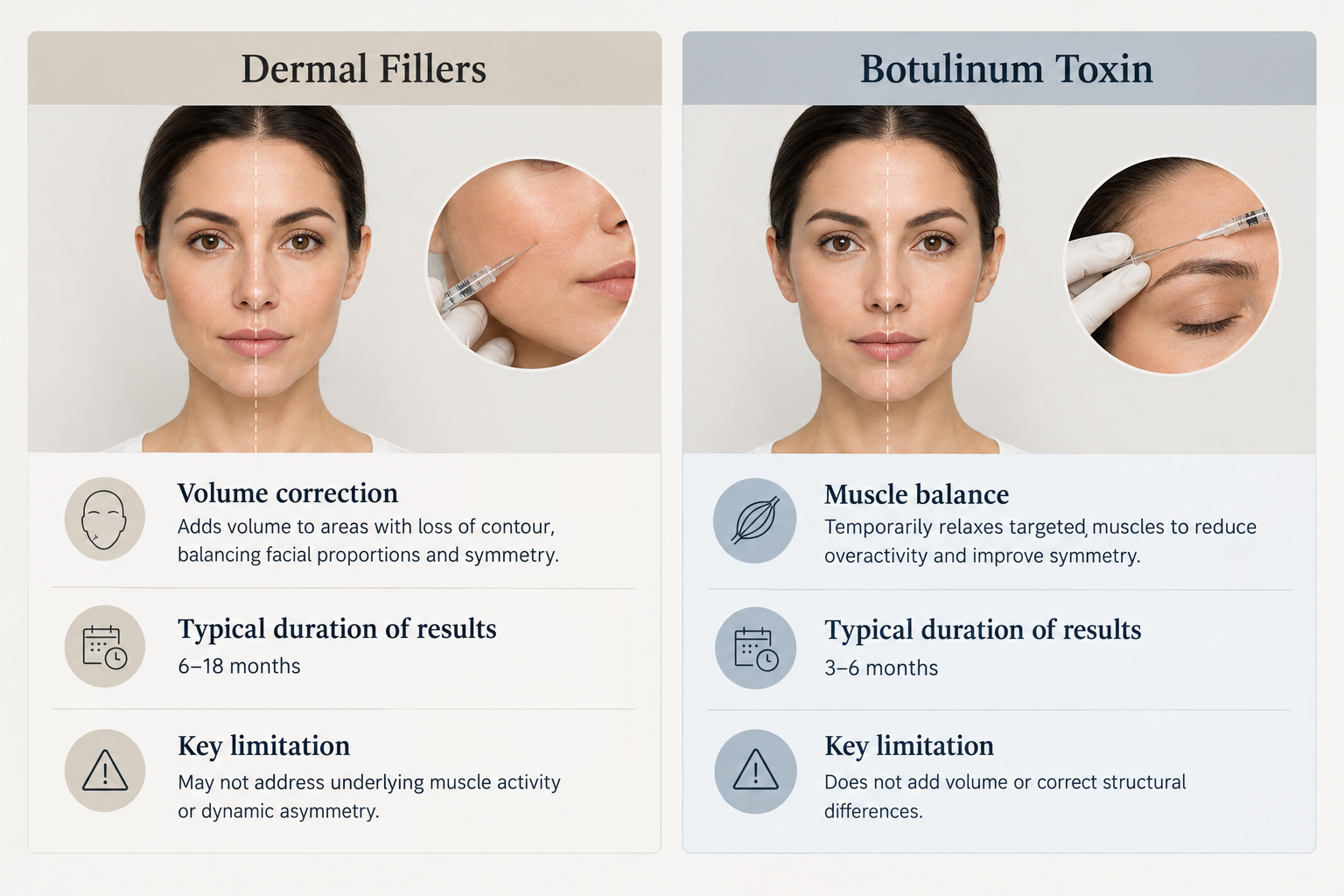
Hyaluronic acid dermal fillers are among the most commonly used non-surgical tools for addressing facial asymmetry caused by uneven volume distribution. By adding volume selectively to a flatter cheek, a less defined jawline on one side, or an asymmetric lip, a skilled injector can create a more balanced appearance. Results are typically visible immediately and may last between six and eighteen months depending on the product used, the area treated, and individual metabolism.
Dermal filler treatment for asymmetry requires precise anatomical knowledge and careful assessment. Overcorrection is a genuine risk, and the goal is balance rather than perfection. Hyaluronic acid fillers have the advantage of being dissolvable with hyaluronidase if the result is unsatisfactory or if a complication occurs, which provides a degree of reversibility not available with permanent fillers. Risks include bruising, swelling, asymmetric placement, and in rare cases vascular complications, which is why treatment should only be performed by a trained and experienced practitioner.
Botulinum Toxin Injections
Botulinum toxin (commonly known by brand names such as Botox, Dysport, or Azzalure) can be used to address asymmetry caused by uneven muscle activity. A common example is asymmetric brow position, where one eyebrow sits noticeably higher or lower than the other due to differences in frontalis or corrugator muscle activity. Carefully placed botulinum toxin injections can relax the more dominant muscle on one side, allowing the brow on the opposite side to lift slightly, reducing the visible difference.
Botulinum toxin is also used to address asymmetric lip movement, uneven jaw muscle bulk (masseter asymmetry), and differences in how the corners of the mouth move. Results typically become apparent within two to fourteen days and generally last three to six months, after which repeat treatment is needed to maintain the effect. Because the treatment is temporary, it allows for gradual adjustment over successive appointments, which is particularly useful when treating subtle asymmetry where small changes make a meaningful difference.
Lip Fillers and Lip Asymmetry
Lip asymmetry is one of the more common concerns patients raise in aesthetic consultations. The upper lip border, cupid’s bow, and lip volume can all differ between the left and right sides. Hyaluronic acid lip filler placed with precision can improve the appearance of uneven lip borders or volume differences. As with all filler treatments, the risk of worsening asymmetry exists if placement is not carefully planned, and a conservative approach with gradual correction over more than one appointment is often advisable.
Polynucleotides and Skin Quality
Where asymmetry is partly related to differences in skin quality, texture, or fine lines between the two sides, skin-quality treatments such as polynucleotide injections or biostimulators may support overall facial balance by improving tissue hydration and collagen production. These treatments do not directly correct structural or volume asymmetry but may complement other approaches as part of a broader treatment plan.
Surgical Options for Facial Asymmetry
When facial asymmetry is primarily structural, involving differences in bone, cartilage, or significant soft-tissue excess or deficit, surgical correction may be the most appropriate option. Non-surgical treatments cannot reposition bone or correct significant skeletal discrepancies, and attempting to mask a structural problem with filler alone can sometimes produce an unnatural result.
Orthognathic Surgery
Orthognathic surgery, performed by a maxillofacial or oral surgeon, repositions the upper jaw (maxilla), lower jaw (mandible), or both to correct skeletal asymmetry. This type of surgery is typically planned in collaboration with an orthodontist and may require preparatory dental treatment. Recovery involves several weeks of restricted diet and activity, and results are generally long-lasting once healing is complete.
Rhinoplasty
An asymmetric nose, whether due to a deviated septum, uneven nasal tip, or differences in nostril size and shape, can be addressed through rhinoplasty. Both open and closed techniques are available, and the approach depends on the specific structural concern. Rhinoplasty carries the risks associated with any surgical procedure, including anaesthesia, infection, scarring, and the possibility of requiring revision surgery.
Fat Grafting
Autologous fat transfer, where fat is harvested from one area of the body and injected into a deficient area of the face, can address volume asymmetry with results that may be longer-lasting than hyaluronic acid fillers. However, fat grafting involves a surgical procedure with associated recovery time, and the survival rate of transferred fat cells varies between individuals, meaning the final result may take several months to fully assess.
Blepharoplasty and Brow Lifting
Asymmetry in the upper face involving uneven eyelid position or brow height may be addressed through blepharoplasty (eyelid surgery) or a brow lift procedure. These are surgical interventions with meaningful recovery periods and should be considered only after non-surgical options have been evaluated and found insufficient for the degree of asymmetry present.
Risks and Limitations of Asymmetry Treatments
Every treatment for facial asymmetry carries potential risks, and it is important to approach the decision with realistic expectations. Non-surgical treatments such as dermal fillers and botulinum toxin carry risks including bruising, swelling, infection, allergic reaction, and in rare cases more serious complications such as vascular occlusion with filler. Surgical procedures carry additional risks including anaesthesia complications, scarring, nerve damage, and the need for revision.
A significant limitation of all treatments is that perfect symmetry is not a realistic or necessarily desirable goal. The human face is not designed to be perfectly symmetrical, and attempting to achieve complete balance can sometimes produce an unnatural appearance. The aim of treatment is generally to reduce the degree of asymmetry to a level that feels comfortable and natural for the individual patient, not to create a mathematically identical left and right side.
Results from non-surgical treatments are temporary and require ongoing maintenance. Patients should factor in the cumulative cost and time commitment of repeat appointments when deciding whether a non-surgical approach is appropriate for their situation. Surgical results are generally more durable but involve greater upfront risk and recovery.
Who May Be Suitable for Asymmetry Treatment?
Suitability for any treatment depends on the specific cause and degree of asymmetry, the patient’s overall health, their treatment goals, and their willingness to accept the associated risks and limitations. Patients who are likely to benefit most from non-surgical approaches are those whose asymmetry is primarily related to soft tissue volume differences or muscle imbalance, and who have realistic expectations about the degree of improvement achievable without surgery.
Patients with significant skeletal asymmetry, those who have previously had multiple filler treatments without satisfactory results, or those whose asymmetry is related to an underlying medical condition should be assessed by a practitioner with appropriate surgical expertise before any further non-surgical treatment is considered. Pregnancy, breastfeeding, active skin infection in the treatment area, certain autoimmune conditions, and some medications may affect suitability for specific treatments and should be discussed openly during consultation.
What to Expect During and After Treatment
For non-surgical treatments, the appointment typically begins with a detailed consultation and facial assessment, followed by photography and treatment planning. Topical anaesthetic cream is commonly applied before filler or botulinum toxin injections to improve comfort. The injection procedure itself usually takes between fifteen and forty-five minutes depending on the areas being treated. Mild swelling, redness, and bruising are common in the days following treatment and generally resolve within one to two weeks.
Results from botulinum toxin for asymmetry may take up to two weeks to fully develop, and a follow-up appointment is often recommended to assess the outcome and make any minor adjustments. Filler results are visible more immediately, though initial swelling can make it difficult to judge the final outcome until it has fully settled, typically within two to four weeks. Patients are generally advised to avoid strenuous exercise, alcohol, and excessive heat in the first twenty-four to forty-eight hours after injectable treatments.
Surgical recovery timelines vary considerably depending on the procedure. Orthognathic surgery may require several weeks before returning to normal activities, while less invasive procedures such as fat grafting may involve a shorter recovery period. A full assessment of expected downtime should be part of the pre-operative consultation for any surgical approach.
Frequently Asked Questions
Is it normal to have an asymmetrical face?
Yes. A degree of facial asymmetry is present in virtually all human faces and is considered a normal anatomical feature. Most people only become aware of it when examining photographs, particularly those taken at close range or from certain angles. Only more pronounced asymmetry that causes functional problems or significant self-consciousness typically warrants clinical assessment.
Can facial asymmetry worsen with age?
Asymmetry can become more noticeable with age as volume loss, bone resorption, and changes in skin laxity progress at different rates on each side of the face. Habitual sleeping positions and patterns of muscle use over decades can also contribute to gradual changes in facial balance.
Can dermal fillers fix facial asymmetry permanently?
Dermal fillers provide temporary results, typically lasting between six and eighteen months depending on the product and area treated. They are not a permanent solution and require repeat treatment to maintain the effect. For longer-lasting correction of volume asymmetry, surgical options such as fat grafting may be worth discussing with a qualified surgeon.
Will treating facial asymmetry look natural?
When performed by an experienced practitioner with a conservative approach, treatment for facial asymmetry can produce natural-looking results. The goal is to reduce the degree of difference between the two sides rather than to achieve mathematical perfection. Overcorrection or poorly planned treatment can produce an unnatural appearance, which is why practitioner selection and thorough pre-treatment assessment are important.
How do I know whether I need non-surgical or surgical treatment?
The most appropriate approach depends on the underlying cause of the asymmetry. Volume differences and muscle imbalance often respond well to non-surgical treatments. Structural skeletal differences generally require surgical assessment. A consultation with a practitioner who has experience in both non-surgical and surgical facial aesthetics is the most reliable way to determine which approach is appropriate for your specific anatomy and goals.
Can lifestyle changes reduce facial asymmetry?
Addressing habits such as consistently sleeping on one side, chewing predominantly on one side, or resting the face on one hand may help prevent asymmetry from worsening over time, though they are unlikely to reverse established differences. Dental treatment for malocclusion or TMJ dysfunction may improve jaw-related asymmetry in some cases.
Are there risks specific to treating asymmetry with fillers compared to other filler treatments?
The risks of filler treatment for asymmetry are broadly similar to those of filler treatment for other concerns, including bruising, swelling, infection, and rare vascular complications. One additional consideration is the risk of overcorrection or asymmetric placement, which can temporarily worsen the appearance. Choosing a practitioner with specific experience in facial balancing and asymmetry correction reduces this risk.
Deciding Whether Treatment for Facial Asymmetry Is Right for You
Facial asymmetry is a broad concern that encompasses a wide spectrum of causes and degrees of severity, and there is no single treatment that is appropriate for every patient. For many people, understanding that a degree of asymmetry is entirely normal and does not require intervention is itself a valuable outcome of a clinical consultation. For those who do wish to explore treatment, the most important step is a thorough assessment by a qualified practitioner who can identify the specific contributing factors and recommend an approach that is proportionate, safe, and realistic.
Non-surgical options such as dermal fillers and botulinum toxin offer meaningful improvement for soft tissue and muscle-related asymmetry with relatively low downtime and the advantage of reversibility or gradual adjustment. Surgical options may be more appropriate where structural differences are the primary concern, but involve greater commitment in terms of recovery, cost, and risk. In either case, the goal should be a natural improvement in facial balance rather than the pursuit of perfect symmetry, which is neither achievable nor necessarily desirable. If you are considering treatment, a consultation with a practitioner experienced in facial aesthetics and asymmetry assessment is the most reliable starting point.


