
Fat Dissolving Injections: How the Lipolysis Mechanism Works
Fat dissolving injections are a non-surgical approach to reducing localised fat deposits in specific areas of the body. Understanding how these injections actually work at a cellular level can help you form realistic expectations, ask better questions during a consultation, and make a more informed decision about whether this type of treatment may be appropriate for your goals.
Key Takeaways
- Fat dissolving injections use compounds that disrupt the membrane of fat cells, triggering a process called lipolysis that leads to the gradual breakdown and removal of fat from treated areas.
- These treatments are intended for localised fat reduction, not general weight loss, and work best on small, stubborn pockets of fat that are resistant to diet and exercise.
- Multiple treatment sessions are typically required, and results develop gradually over several weeks as the body processes and eliminates the disrupted fat cells.
- Common side effects include swelling, bruising, and tenderness at the injection site; serious complications are less common but possible, and suitability depends on individual health factors.
- A thorough consultation with a qualified practitioner is essential to assess whether fat dissolving injections are appropriate for your specific concerns and anatomy.
What Are Fat Dissolving Injections?
Fat dissolving injections are a category of injectable treatments designed to reduce small, defined areas of unwanted fat beneath the skin. They are not a treatment for obesity or a substitute for weight management, and they are not intended to produce significant overall body weight reduction. Instead, they target localised subcutaneous fat — the layer of fat that sits just beneath the skin — in areas where diet and exercise have not produced the desired change in contour.
The most widely used active ingredients in fat dissolving injections are deoxycholic acid and phosphatidylcholine, sometimes used in combination. Deoxycholic acid is a bile acid that occurs naturally in the human body, where it plays a role in the digestion and absorption of dietary fat. When injected into subcutaneous fat tissue, it acts as a cytolytic agent — meaning it disrupts and destroys the cell membrane of fat cells, known as adipocytes. Phosphatidylcholine, a phospholipid derived from soybean lecithin, is often used alongside deoxycholic acid and is thought to assist in emulsifying and mobilising fat for removal by the body’s lymphatic and metabolic systems.
Several branded formulations are available, including Aqualyx and Lemon Bottle, each with slightly different compositions and concentrations. Regulatory approval status and licensed indications vary by country, so it is important to discuss the specific product being used during your consultation.
The Lipolysis Mechanism: How Fat Dissolving Injections Work
The term lipolysis refers broadly to the breakdown of lipids — fats — within the body. In the context of fat dissolving injections, the mechanism is more accurately described as adipocyte lysis, meaning the physical destruction of fat cells rather than the metabolic release of fatty acids that occurs during natural lipolysis triggered by exercise or caloric deficit. Understanding this distinction matters because it explains both the potential benefits and the limitations of injectable fat reduction.
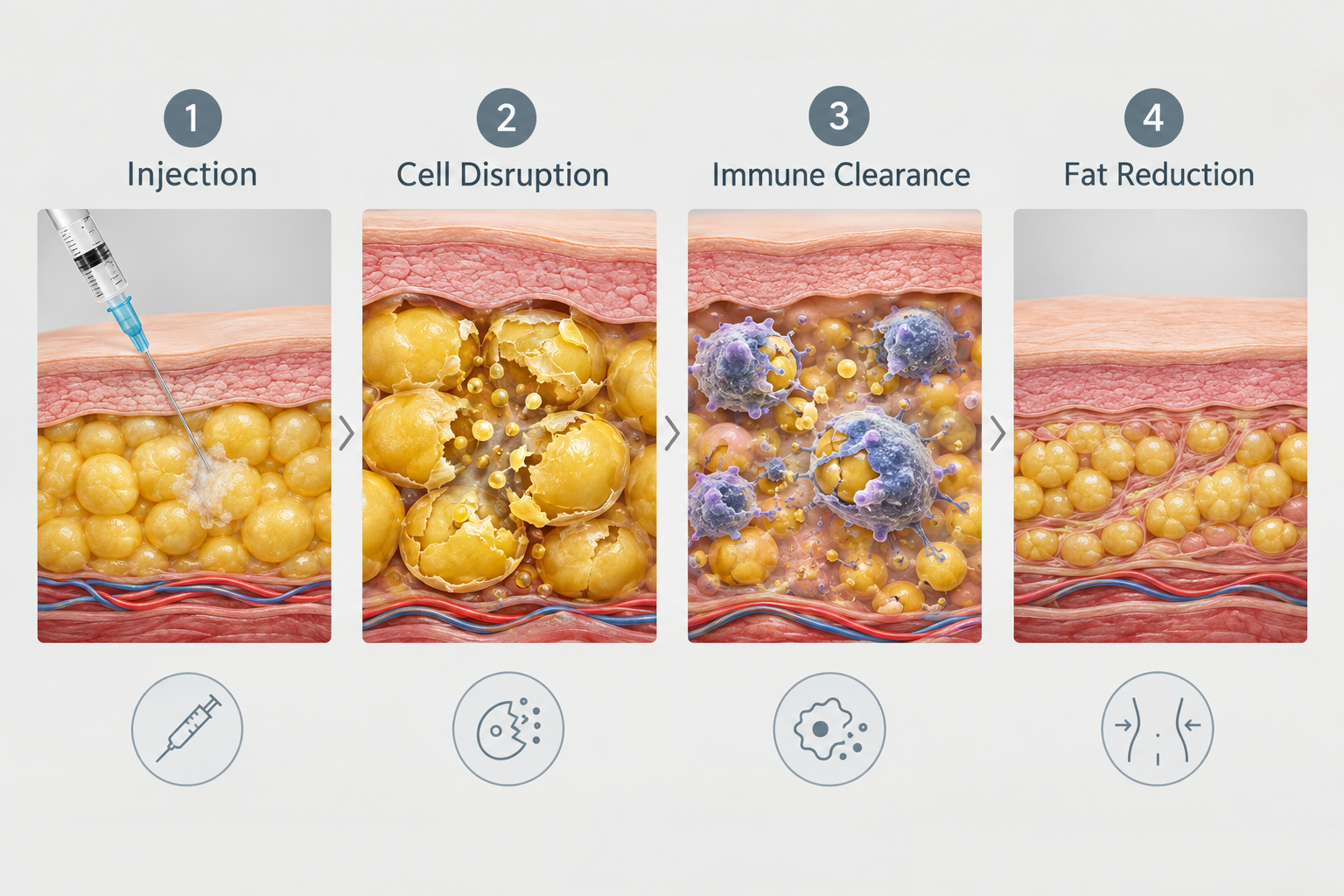
Adipocyte Membrane Disruption
When deoxycholic acid is injected into subcutaneous fat tissue, it integrates into the phospholipid bilayer of the adipocyte cell membrane. This integration destabilises the membrane structure, causing it to rupture. Once the membrane is disrupted, the contents of the fat cell — primarily stored triglycerides — are released into the surrounding interstitial space. The fat cell itself is permanently destroyed and cannot regenerate or refill with fat.
This permanent destruction of adipocytes is one of the key characteristics that distinguishes injectable fat reduction from treatments that temporarily shrink fat cells, such as cryolipolysis (CoolSculpting), which causes fat cell death through controlled cooling rather than chemical disruption. Both approaches ultimately lead to a reduction in the number of fat cells in the treated area, but the mechanisms and treatment experiences differ considerably.
Inflammatory Response and Clearance
The rupture of fat cells triggers a localised inflammatory response. The body recognises the released cellular contents and the disrupted tissue as material requiring clearance, and it initiates an immune response involving macrophages — specialised cells that engulf and digest cellular debris and lipid material. This inflammatory phase is responsible for the swelling, warmth, and tenderness that are commonly experienced in the days following treatment.
Over the following weeks, the lymphatic system and the body’s metabolic processes gradually transport and process the released lipids and cellular debris. The liver plays a role in metabolising the fatty acids that enter systemic circulation. This clearance process is not instantaneous, which is why visible results from fat dissolving injections typically develop over four to eight weeks rather than appearing immediately after treatment.
Fibroblast Activation and Tissue Remodelling
Beyond fat cell destruction, the inflammatory response triggered by fat dissolving injections may also stimulate fibroblast activity in the treated area. Fibroblasts are cells responsible for producing collagen and other structural proteins in connective tissue. Some practitioners and product manufacturers suggest that this secondary effect may contribute to a degree of skin tightening in the treated area, though the clinical evidence for significant skin tightening from injectable lipolysis alone remains limited and variable. Patients with significant skin laxity in the treatment area may not achieve satisfactory skin tightening from fat dissolving injections alone and may require additional treatments to address this concern.
Common Treatment Areas
Fat dissolving injections are most commonly used on small, defined areas where localised fat deposits are present. The most frequently treated areas include the submental region — commonly referred to as a double chin — as well as the jowls, upper arms, inner thighs, abdomen, flanks, bra line, and knees. Some practitioners also use these injections for smaller areas such as the axillary fat pads near the armpits or localised fat deposits around the face.
The submental area has the most established evidence base for injectable deoxycholic acid treatment. A synthetic form of deoxycholic acid under the brand name Kybella is approved by the US Food and Drug Administration specifically for submental fat reduction in adults, providing a regulatory reference point for this indication. Other treatment areas are commonly addressed in clinical practice but may have a less extensive body of published clinical evidence supporting their use.
It is important to note that fat dissolving injections are not appropriate for treating large volumes of fat or for achieving significant body contouring across broad areas. They are best considered as a refinement tool for specific, localised concerns rather than a primary body contouring solution.
What to Expect During and After Treatment
The Appointment
A fat dissolving injection appointment typically begins with a clinical assessment of the treatment area, including evaluation of the fat deposit, overlying skin quality, and surrounding anatomy. The practitioner will mark the injection points and may apply a topical anaesthetic cream to reduce discomfort, though this varies by practitioner and treatment area. The injections themselves are administered using a fine needle at multiple points across the treatment area, with the number of injection points depending on the size and shape of the area being treated.
The procedure itself is generally completed within 20 to 45 minutes depending on the number of areas being treated. Most patients describe the injections as producing a stinging or burning sensation during administration, which typically subsides within a few minutes. Some formulations contain lidocaine, a local anaesthetic, to help manage discomfort during the procedure.
Immediate Aftercare and Recovery
Swelling is the most predictable and often the most pronounced immediate side effect of fat dissolving injections. In the submental area in particular, swelling can be quite significant in the first 24 to 72 hours and may persist at a lesser degree for one to two weeks. Bruising, redness, tenderness, and a sensation of firmness or nodularity in the treated tissue are also common in the days following treatment. These effects are a direct consequence of the inflammatory response described above and are generally expected rather than indicative of a complication.
Most patients are able to return to normal daily activities relatively quickly, though visible swelling may make some people prefer to schedule treatment around social commitments. Strenuous exercise and alcohol consumption are typically advised against for 24 to 48 hours post-treatment. Applying a cold compress and keeping the head elevated can help manage swelling in the submental area.
When Results Appear and How Long They May Last
Because the body requires time to clear the disrupted fat cells and cellular debris, visible changes in contour typically begin to emerge four to six weeks after treatment and may continue to develop for up to eight to twelve weeks. The timeline varies between individuals depending on factors such as metabolism, lymphatic function, and the volume of fat being treated.
Since fat dissolving injections permanently destroy the treated adipocytes, the fat cells that are eliminated do not return. However, remaining fat cells in the area — and fat cells in untreated areas — can still expand if a person gains weight. This means that while the structural reduction in fat cell number in the treated area is lasting, the overall result can be affected by significant weight changes after treatment. Maintaining a stable body weight helps preserve the outcome.
How Many Sessions Are Typically Needed
Most patients require more than one treatment session to achieve their desired result. The number of sessions depends on the size of the fat deposit, the specific product used, the treatment area, and the individual’s response to treatment. For submental fat, clinical studies have used between two and six treatment sessions spaced approximately four to six weeks apart. For other body areas, the number of sessions may vary.
A qualified practitioner should provide a realistic assessment of the likely number of sessions required during the initial consultation, based on a physical evaluation of the treatment area. It is reasonable to ask for this estimate before committing to treatment, along with an understanding of the total cost involved across the full course.
Risks and Side Effects
Fat dissolving injections carry a range of potential side effects and risks that should be understood before treatment. Common side effects — those that occur frequently and are generally expected — include swelling, bruising, redness, tenderness, numbness, and a firm or lumpy texture in the treated area in the days to weeks following injection. These typically resolve without intervention as the inflammatory response subsides.
Less common but more significant risks include nerve injury, which in the submental area could affect the marginal mandibular nerve and cause temporary or, in rare cases, prolonged weakness of the lower lip. Skin ulceration or necrosis can occur if the product is inadvertently injected into the skin rather than the subcutaneous fat layer, or if it spreads to unintended tissue. Alopecia — hair loss — has been reported in areas where injections were administered close to hair-bearing skin. Dysphagia, or difficulty swallowing, has been reported following submental treatments.
The risk of serious complications is generally considered low when treatment is performed by an appropriately trained and experienced practitioner using a correctly formulated product. However, the risk is not zero, and the importance of practitioner selection and a thorough pre-treatment assessment cannot be overstated. Injecting into the wrong tissue plane, using an incorrectly diluted product, or treating an unsuitable candidate increases the risk of adverse outcomes.
Who May Be Suitable — and Who May Not
Fat dissolving injections may be suitable for adults who have localised, pinchable subcutaneous fat deposits that have not responded adequately to diet and exercise, who have realistic expectations about the degree of improvement achievable, and who are in generally good health. Candidates should have adequate skin elasticity in the treatment area, as significant skin laxity may not be improved — and could potentially be worsened — by fat reduction alone.
Fat dissolving injections are generally not suitable for individuals who are pregnant or breastfeeding, those with active infection or inflammation in the proposed treatment area, people with certain bleeding disorders or who are taking anticoagulant medications, and those with a known allergy to any component of the formulation. Individuals with significant skin laxity, very little subcutaneous fat in the target area, or unrealistic expectations about the degree of change achievable may not be good candidates. People with a history of difficulty swallowing or certain neurological conditions affecting the neck and throat may not be suitable for submental treatment specifically.
A comprehensive medical history and physical assessment by a qualified practitioner is essential to determine individual suitability. Self-assessment based on online information alone is not sufficient to establish whether this treatment is appropriate for a specific person.
Alternatives to Fat Dissolving Injections
Several alternative approaches exist for localised fat reduction, and the most appropriate option depends on the treatment area, the volume of fat, skin quality, individual health factors, and personal preferences regarding downtime and treatment experience.
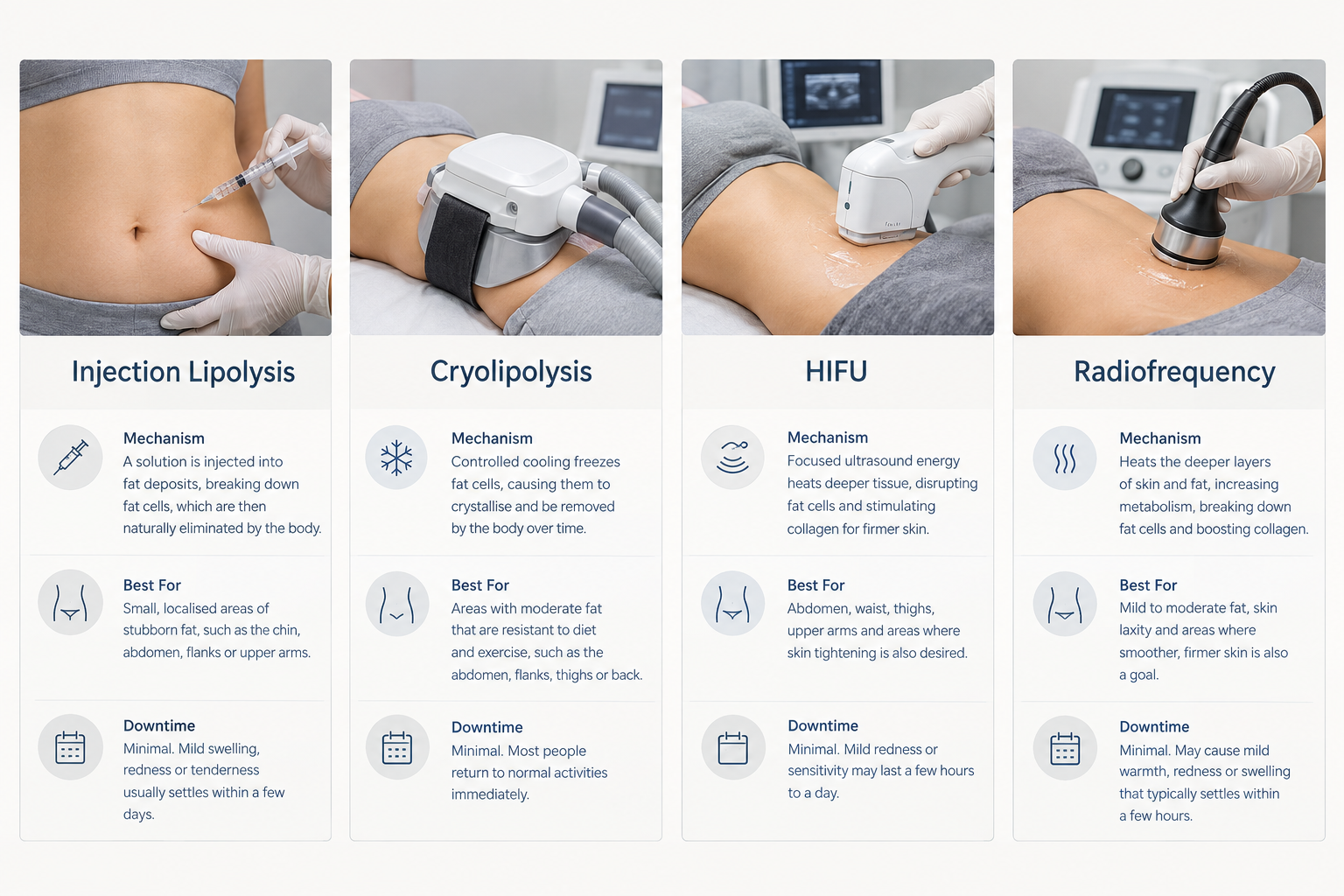
Cryolipolysis, commonly known by the brand name CoolSculpting, uses controlled cooling to induce fat cell death through a process called apoptosis. It is a non-injectable option that may suit patients who prefer to avoid needles, though it also requires multiple sessions and produces gradual results. High-intensity focused ultrasound (HIFU) and radiofrequency-based treatments can address both fat and skin laxity in some cases, though their fat reduction efficacy varies. Ultrasonic cavitation uses low-frequency ultrasound waves to disrupt fat cells and is available as a non-invasive option, though the evidence base for its effectiveness is less robust than for some other modalities.
For larger volumes of fat or more significant body contouring goals, surgical options such as liposuction remain the most established and predictable approach. Liposuction allows for greater volumes of fat to be removed in a single procedure and provides the surgeon with direct control over the contour result, though it carries the risks associated with surgery and anaesthesia and involves a longer recovery period. The choice between non-surgical and surgical fat reduction should be made in consultation with a qualified practitioner who can assess the specific concern and recommend the most appropriate approach.
Frequently Asked Questions
Do fat dissolving injections permanently remove fat cells?
The fat cells destroyed by fat dissolving injections do not regenerate. However, remaining fat cells in the treated area and elsewhere in the body can still enlarge with weight gain. Maintaining a stable body weight after treatment helps preserve the result.
How is injectable fat reduction different from weight loss?
Fat dissolving injections reduce the number of fat cells in a specific localised area. They do not cause overall body weight loss and are not a treatment for obesity. The total amount of fat removed is relatively small, and the change on the scales is typically minimal. The intended benefit is an improvement in the shape or contour of a specific area rather than a reduction in body weight.
Is the swelling after treatment normal?
Yes. Swelling is a direct and expected consequence of the inflammatory response triggered by the injections. It can be pronounced, particularly in the submental area, and may last one to two weeks. Significant or worsening swelling beyond this period, or swelling accompanied by fever or increasing pain, should be assessed by the treating practitioner promptly.
Can fat dissolving injections tighten loose skin?
Some degree of skin tightening may occur as a secondary effect of the inflammatory and remodelling process, but the evidence for clinically meaningful skin tightening from injectable lipolysis alone is limited. Patients with significant skin laxity may need additional treatments to address this concern, and this should be discussed during the consultation.
How do I choose between Aqualyx and Lemon Bottle?
Aqualyx and Lemon Bottle are two different branded formulations used for injectable fat reduction, with different compositions and concentrations. The choice between them should be guided by your practitioner’s clinical assessment of your specific treatment area and goals, their experience with each product, and the available evidence for the intended indication. Neither product should be assumed to be universally superior; individual response and practitioner expertise are important factors.
How many sessions will I need before seeing results?
Most patients require between two and six sessions depending on the treatment area and the volume of fat being addressed. Results develop gradually over four to eight weeks after each session. A realistic treatment plan with an estimated number of sessions should be discussed and agreed upon during the initial consultation.
Is Fat Dissolving the Right Approach for You?
Fat dissolving injections can offer a meaningful improvement in the contour of specific localised fat deposits for appropriately selected patients. The mechanism — permanent destruction of adipocytes followed by gradual clearance through the body’s inflammatory and lymphatic systems — is well understood, and the treatment has an established evidence base particularly for submental fat reduction. For patients with small, stubborn pockets of subcutaneous fat, realistic expectations, and good skin elasticity in the treatment area, injectable lipolysis may be a reasonable option to explore.
However, fat dissolving injections are not suitable for everyone, are not a weight loss solution, and carry real risks that require careful consideration. The quality of the outcome depends significantly on practitioner skill, appropriate patient selection, correct product use, and the individual’s biological response to treatment. Multiple sessions are typically needed, and results take weeks to become apparent.
If you are considering fat dissolving injections, a thorough in-person consultation with a qualified and experienced practitioner is the essential first step. This allows for a proper assessment of the treatment area, a discussion of realistic outcomes, an honest review of the risks, and an exploration of whether alternative approaches might better suit your specific goals and anatomy.


