
Chin Filler for Profile Balance: What to Expect, Who It Suits, and How It Works
Chin filler is a non-surgical injectable treatment that uses hyaluronic acid gel to reshape or project the chin, with the goal of improving the proportional balance of the face — particularly when viewed from the side. For patients who feel their chin is recessed, asymmetrical, or lacks definition, dermal filler placed in the chin area may offer a meaningful change without surgery. This article explains how chin filler works, what it can and cannot achieve, who may be a suitable candidate, what the treatment involves, and what risks and alternatives are worth understanding before booking a consultation.
Key Takeaways
- Chin filler uses hyaluronic acid dermal filler to add projection, definition, or symmetry to the chin, improving the overall balance of the facial profile.
- Results are temporary, typically lasting between 12 and 24 months depending on the product used, the volume placed, and individual metabolism.
- The treatment carries real risks, including bruising, swelling, asymmetry, and rare but serious vascular complications; practitioner skill and anatomy knowledge are critical.
- Chin filler is not a substitute for surgical chin augmentation (genioplasty or chin implant) in patients requiring significant structural change.
- A thorough facial assessment by a qualified practitioner is essential to determine whether chin filler is appropriate and how it fits within the overall facial aesthetic.
What Is Chin Filler and How Does It Work?
Chin filler refers to the injection of a dermal filler product — most commonly a hyaluronic acid (HA) filler — into the soft tissue of the chin to alter its shape, size, or position in a controlled and reversible way. Hyaluronic acid is a naturally occurring substance found in the skin and connective tissue; when formulated as a gel and injected, it adds volume and structure to the treated area. Different HA filler products vary in their cross-linking density, viscosity, and lifting capacity, and a practitioner will select a product appropriate for the chin based on the degree of projection or definition required.
The chin sits at the base of the lower face and plays a significant role in how the face appears in profile. When the chin is underprojected — meaning it sits further back than the ideal relationship with the nose and lips — the nose can appear larger, the neck-jaw angle can look less defined, and the lower face may appear disproportionately short or soft. By placing filler strategically in the chin, a practitioner can increase anterior projection (forward extension), improve vertical height, refine the chin point, or address mild asymmetry. The result, when well-executed, is a more balanced facial profile rather than a dramatically altered appearance.
Some practitioners also use small amounts of filler along the jawline in combination with chin filler to enhance the overall lower face contour, though the chin and jawline are distinct treatment areas with different anatomical considerations.
Facial Profile Balance: Why the Chin Matters
Facial balance is assessed using several reference frameworks that practitioners use during consultation. One commonly referenced approach is the evaluation of facial thirds — dividing the face horizontally into upper, middle, and lower segments — and assessing whether these proportions appear harmonious. The lower face, which includes the chin, is particularly important in profile view.
A useful clinical reference for profile assessment is Ricketts’ E-line (the esthetic line), an imaginary line drawn from the tip of the nose to the tip of the chin. In a balanced profile, the lips sit slightly behind this line. When the chin is recessed, this relationship is disrupted: the nose appears more prominent, the lips may seem to protrude, and the overall profile can look unbalanced even when each individual feature is unremarkable in isolation. Chin filler can shift the chin point forward to bring the profile closer to a more harmonious relationship between these landmarks.
It is important to understand that facial balance is subjective and culturally influenced. There is no single universally correct chin position, and a good practitioner will discuss the patient’s own aesthetic goals rather than imposing a textbook ideal. The aim of chin filler for profile balance is to address a specific concern the patient has identified, not to conform to a rigid standard.
Who May Be a Suitable Candidate for Chin Filler?
Chin filler may be worth discussing with a qualified practitioner if you have a chin that appears recessed or underprojected in profile, a chin that lacks definition or appears rounded, mild chin asymmetry that affects the overall appearance of the lower face, or a desire to improve the balance between the chin, lips, and nose without surgery. Patients who are generally in good health, have realistic expectations about what a non-surgical treatment can achieve, and understand that results are temporary are typically better candidates than those seeking a permanent or dramatic structural change.
Chin filler tends to work well for patients with mild to moderate chin retrusion — where the chin is slightly behind its ideal position but the underlying bone structure is not severely deficient. In cases of significant skeletal underdevelopment, the volume of filler required to achieve a meaningful result may be impractical, and surgical options such as a chin implant or orthognathic surgery may be more appropriate.
Suitability also depends on individual anatomy. The chin area contains important blood vessels, and the depth and distribution of these vessels varies between individuals. A practitioner with detailed knowledge of facial anatomy will assess the risks specific to each patient before proceeding.
Who May Not Be Suitable
Chin filler may not be appropriate for patients who are pregnant or breastfeeding, have an active skin infection or inflammation in the treatment area, have a known allergy to hyaluronic acid or any filler component, are taking certain blood-thinning medications that significantly increase bleeding risk, or have previously had permanent filler placed in the chin area. Patients with certain autoimmune conditions or those who are immunocompromised should discuss their medical history carefully with a practitioner before proceeding. Individuals with very thin skin or significant soft tissue laxity in the lower face may also find that chin filler produces less predictable results.
What Happens During a Chin Filler Appointment?
A chin filler appointment typically begins with a consultation or a review of the consultation that took place previously. The practitioner will assess the face from multiple angles — front, three-quarter, and profile — and discuss the patient’s specific concerns and goals. Photographs are often taken for reference. The practitioner will explain the planned approach, the product to be used, the expected outcome, and the relevant risks.
Before injection, the skin is cleaned and a topical anaesthetic cream may be applied to reduce discomfort, though many HA filler products used in the chin contain lidocaine (a local anaesthetic) within the gel itself, which helps manage pain during the procedure. The practitioner will inject the filler using a fine needle or a blunt-tipped cannula, depending on their technique and the specific anatomy involved. Cannulas are sometimes preferred in the chin area because they may reduce the risk of inadvertent vascular injury, though both techniques are used by experienced practitioners.
The amount of filler used varies depending on the degree of change required, but chin treatments typically involve a relatively modest volume — often between 0.5 ml and 2 ml — placed precisely to achieve the desired projection or definition. The appointment itself usually takes between 30 and 60 minutes including preparation and aftercare discussion. Patients can generally return to normal activities the same day, though strenuous exercise and significant pressure on the treated area are usually avoided for 24 to 48 hours.
Results: What Chin Filler Can and Cannot Achieve
Chin filler can produce a visible improvement in chin projection, definition, and lower face balance when the treatment is well-matched to the patient’s anatomy and goals. Changes are often noticeable immediately after treatment, though initial swelling means the final result is better assessed after one to two weeks once the filler has settled and any swelling has resolved. In profile, a well-placed chin filler treatment may make the nose appear proportionally smaller, improve the definition of the jawline, and create a more balanced relationship between the lower face and the rest of the facial features.
Chin filler cannot replicate the structural change achievable with a surgical chin implant or genioplasty. It cannot correct significant skeletal discrepancies, alter the position of the teeth or jaw, or produce permanent results. The degree of projection achievable with filler is limited by the volume that can safely and aesthetically be placed in the soft tissue, and results will diminish as the filler is gradually broken down by the body over time. Patients should also be aware that repeated filler treatments over many years can occasionally lead to changes in tissue texture or filler migration, though these outcomes are uncommon when treatment is performed conservatively and by an experienced practitioner.
How Long Does Chin Filler Last?
The longevity of chin filler depends on several factors, including the specific product used, the volume injected, the patient’s individual metabolism, and the degree of movement in the area. The chin is a relatively low-movement area compared to the lips, which means filler placed here tends to last longer than in more dynamic regions. Most patients find that chin filler results last between 12 and 24 months, with some products and techniques producing results at the longer end of this range.
Over time, hyaluronic acid filler is gradually broken down by the body’s natural enzymatic processes. As the filler diminishes, the chin will return toward its original appearance. Maintenance treatments can be used to sustain the result, though the timing and volume required will vary between individuals. One advantage of hyaluronic acid filler is that it can be partially or fully dissolved using an enzyme called hyaluronidase if the result is unsatisfactory or if a complication arises, which provides a degree of reversibility not available with permanent implants.
Risks and Side Effects of Chin Filler
Chin filler carries real risks that patients should understand before proceeding. Common and expected side effects include temporary swelling, bruising, redness, and tenderness at the injection site. These typically resolve within a few days to two weeks. Mild asymmetry immediately after treatment is also common due to uneven swelling and usually improves as the filler settles.
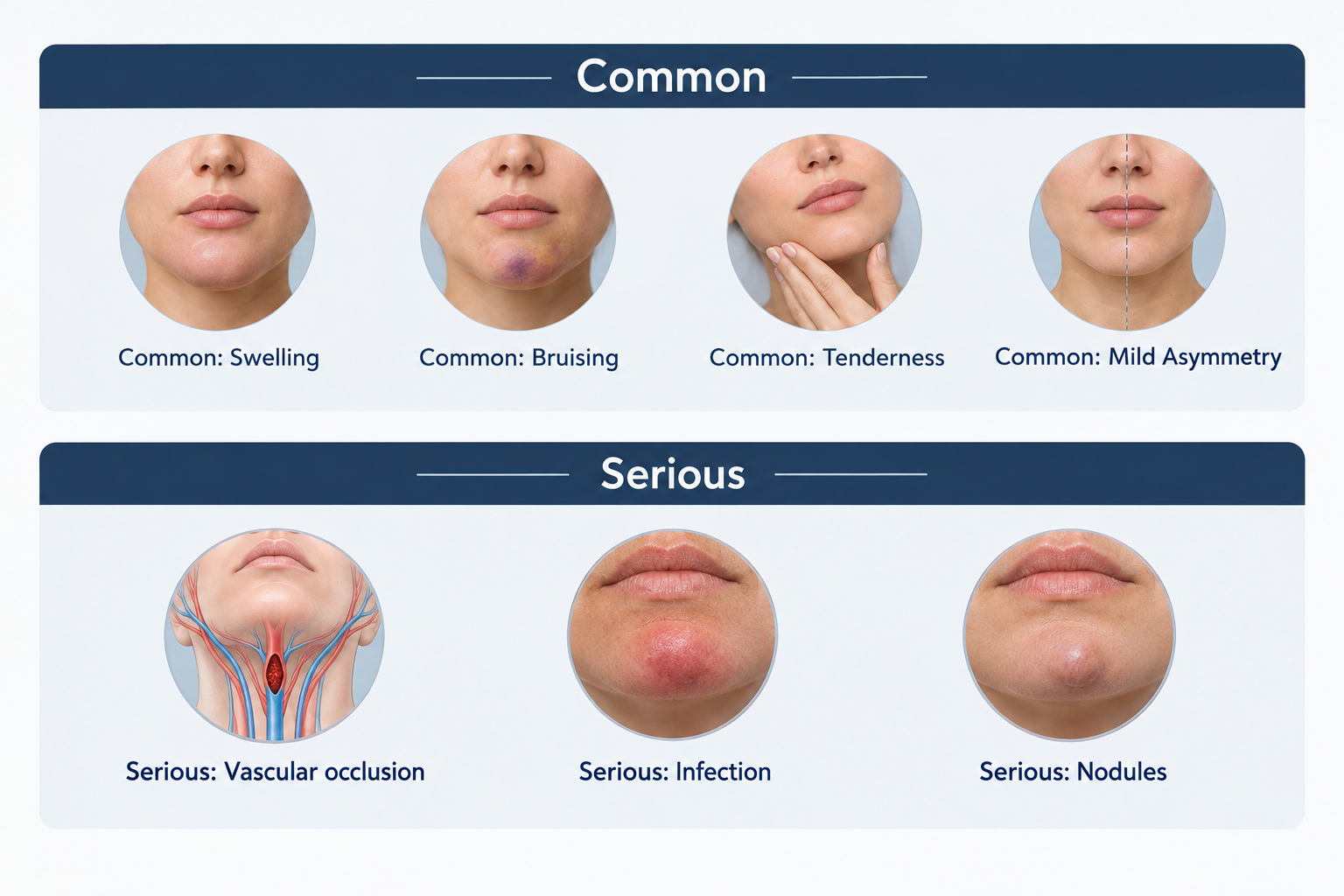
Less common but more significant risks include persistent asymmetry requiring correction, nodule formation (small lumps under the skin), infection, and delayed inflammatory reactions. These outcomes are uncommon but do occur and may require treatment with hyaluronidase, antibiotics, or other interventions.
The most serious risk associated with any facial filler treatment is vascular occlusion — a situation in which filler is inadvertently injected into or compresses a blood vessel, potentially restricting blood flow to the surrounding tissue. In the chin and lower face, this can affect branches of the facial artery or other vessels. Vascular occlusion can, in rare cases, lead to tissue necrosis (skin death) or, extremely rarely, vision changes if filler travels retrogradely toward the eye. These complications are rare but are not theoretical; they have been documented in the medical literature. The risk is significantly reduced when treatment is performed by a practitioner with thorough knowledge of facial vascular anatomy, who uses appropriate technique, and who has access to hyaluronidase for emergency reversal.
Choosing a qualified, experienced practitioner — ideally a doctor, dentist, or nurse prescriber with specific training in facial anatomy and filler complications — is one of the most important factors in minimising risk.
Chin Filler vs. Surgical Chin Augmentation
For patients considering a more permanent or structurally significant change to the chin, surgical options exist and are worth understanding as part of an informed decision. A chin implant (alloplastic augmentation) involves placing a solid silicone implant over the chin bone through a small incision, producing a permanent increase in projection. Genioplasty is a more involved surgical procedure in which the chin bone itself is repositioned, allowing changes in projection, height, and symmetry that cannot be achieved with soft tissue treatments alone.
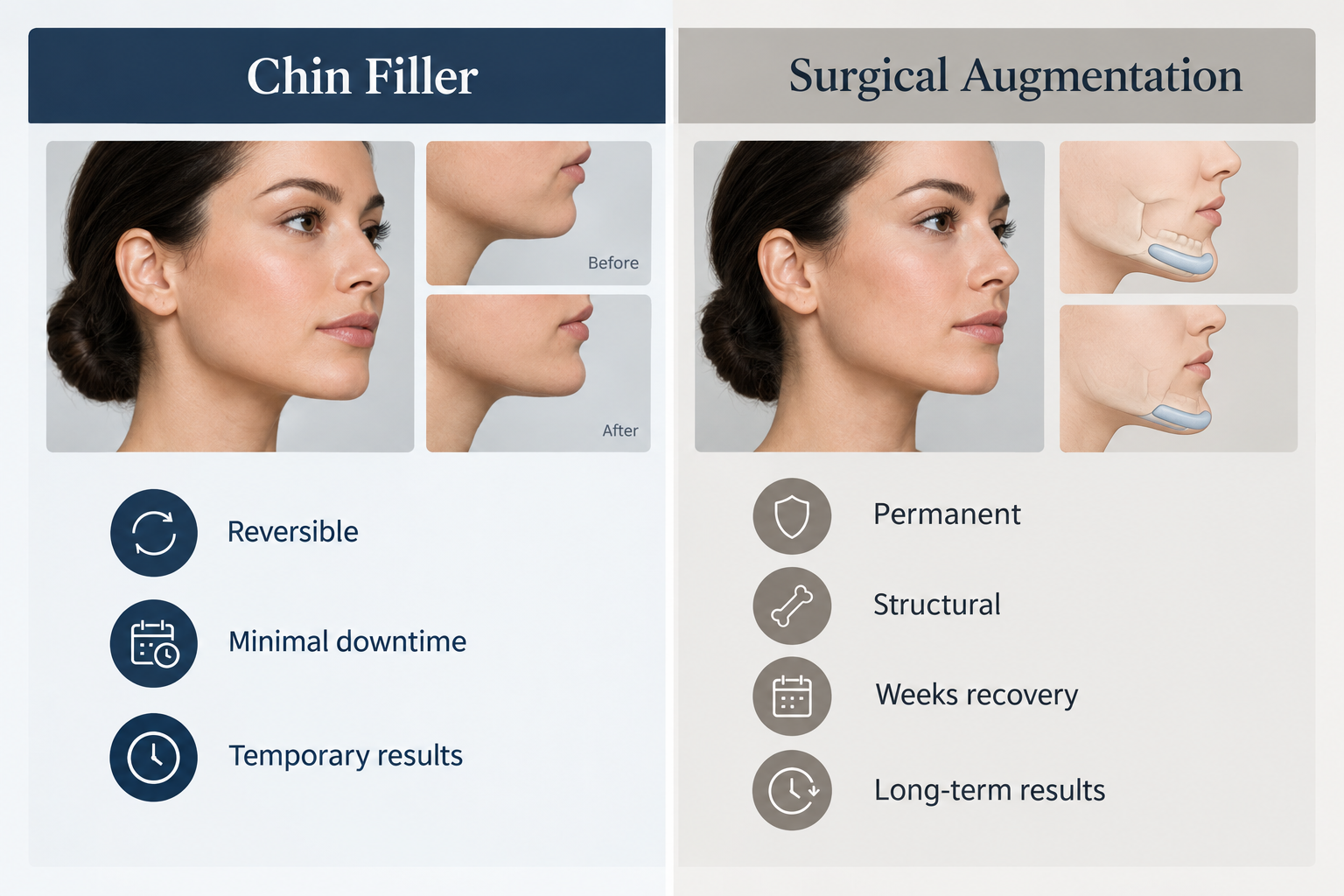
Surgical chin augmentation produces permanent results and can achieve a greater degree of structural change than filler. However, it carries the risks associated with surgery and general or local anaesthesia, requires a recovery period of several weeks, and involves a financial commitment that is typically higher than non-surgical treatment. Chin filler, by contrast, is reversible, requires minimal downtime, and allows the patient to assess the aesthetic change before committing to anything permanent. Some patients use chin filler as a way of previewing the effect of a more projected chin before deciding whether to pursue surgery.
The right approach depends on the degree of change desired, the patient’s anatomy, their tolerance for surgical risk and recovery, and their long-term goals. A practitioner who offers both surgical and non-surgical options — or who works alongside surgical colleagues — is well-placed to provide balanced guidance.
Combining Chin Filler with Other Treatments
Chin filler is frequently considered alongside other facial aesthetic treatments as part of a broader approach to facial balance. Common combinations include jawline filler to enhance lower face definition, lip filler to address the relationship between the lips and chin, and botulinum toxin injections to the mentalis muscle (the muscle at the base of the chin) to reduce chin dimpling or puckering that can affect the appearance of the chin surface. Rhinoplasty — surgical or non-surgical — is sometimes considered alongside chin assessment, since the nose and chin are closely related in profile balance.
When multiple treatments are planned, a staged approach is often sensible, allowing each treatment to settle before the next is assessed. A practitioner who takes a whole-face view rather than treating each area in isolation is better positioned to achieve a harmonious result. Patients should be cautious of any approach that recommends multiple simultaneous treatments without a clear rationale for each.
Questions to Ask Before Your Chin Filler Consultation
- What qualifications and training does the practitioner have in facial anatomy and filler injection?
- Which filler product will be used, and why is it appropriate for the chin area?
- How much filler is being recommended, and what result is realistically expected?
- What are the specific risks for my anatomy, and how would a complication be managed?
- Does the practitioner have access to hyaluronidase on-site for emergency reversal?
- What is the practitioner’s approach if I am unhappy with the result?
- Are there alternative treatments — surgical or non-surgical — that might better suit my goals?
Frequently Asked Questions
Does chin filler hurt?
Most patients find chin filler tolerable. Topical anaesthetic cream is often applied before treatment, and many filler products contain lidocaine, which reduces discomfort during injection. Some patients experience a mild pressure or stinging sensation, but significant pain is uncommon. Discomfort after the procedure is usually mild and short-lived.
Can chin filler make my nose look smaller?
Chin filler does not change the nose itself, but by improving chin projection and lower face balance, it can alter the visual relationship between the chin and nose in profile. Many patients find that a more projected chin makes the nose appear proportionally less prominent. This is a perceptual effect rather than a physical change to nasal size or shape.
How soon will I see results from chin filler?
An initial change in chin shape is usually visible immediately after treatment. However, swelling in the first few days can make the result appear larger or less defined than the final outcome. Most practitioners advise waiting one to two weeks for swelling to resolve before assessing the result fully.
Can chin filler be dissolved if I don’t like the result?
Yes. Hyaluronic acid chin filler can be dissolved using an enzyme called hyaluronidase, which breaks down the filler relatively quickly. This is one of the key advantages of HA filler over permanent implants. Dissolution is not always complete in a single session and may require a follow-up appointment, but it provides meaningful reversibility.
Is chin filler safe for everyone?
Chin filler is not appropriate for everyone. Contraindications include pregnancy, breastfeeding, active infection in the treatment area, known allergy to filler components, and certain medical conditions. Individual anatomy also affects risk. A thorough medical history and facial assessment by a qualified practitioner is necessary to determine suitability.
How much does chin filler cost?
Pricing varies significantly depending on the practitioner’s qualifications, the clinic’s location, the product used, and the volume required. Patients should be cautious of unusually low prices, as these may reflect less experienced practitioners or lower-quality products. The cost of managing a complication can far exceed the cost of the original treatment, making practitioner quality a more important consideration than price alone.
Is Chin Filler the Right Choice for Your Profile Concerns?
Chin filler can be a genuinely useful non-surgical option for patients with mild to moderate chin retrusion or lack of definition who want to improve the balance of their facial profile without committing to surgery. When performed by a qualified practitioner with strong anatomical knowledge and appropriate technique, the treatment can produce a meaningful and natural-looking improvement in profile balance, with results that typically last one to two years and can be reversed if needed.
The treatment is not suitable for everyone, and it is not a replacement for surgical intervention in patients who require significant structural change. The risks — while manageable in experienced hands — are real and include rare but serious vascular complications that require prompt recognition and treatment. Selecting a practitioner based on qualifications, training, and clinical experience rather than price or convenience is one of the most important decisions a patient can make.
If you are considering chin filler for profile balance, a thorough consultation with a qualified aesthetic practitioner is the appropriate starting point. A good consultation will involve a careful assessment of your facial proportions, an honest discussion of what filler can and cannot achieve for your specific anatomy, and a clear explanation of the risks and alternatives — including whether a surgical approach might better serve your long-term goals.


