
Baby Botox: What It Is, How It Works, and What to Expect
Baby Botox refers to a technique that uses smaller doses of botulinum toxin than a conventional treatment, with the aim of softening facial lines while preserving a fuller range of natural expression. The approach has grown in popularity among people who want subtle, preventative, or refreshed results rather than a noticeably frozen appearance. This article explains how the technique works, who it may suit, what realistic outcomes look like, and what limitations and risks you should understand before booking a consultation.
Key Takeaways
- Baby Botox uses reduced doses of botulinum toxin to create a more natural-looking result with greater movement preserved compared to standard dosing.
- It may suit first-time patients, those with mild lines, or anyone who prefers a subtle aesthetic outcome, but it is not appropriate for everyone.
- Results typically last a shorter time than standard botulinum toxin treatment, often requiring more frequent maintenance appointments.
- The technique still carries the same category of risks as conventional botulinum toxin injections and requires a qualified, experienced practitioner.
- A thorough consultation is essential to assess whether reduced dosing will achieve your specific goals or whether an alternative approach may be more appropriate.
What Is Baby Botox?
Baby Botox is not a separate product or a different formulation of botulinum toxin. The term describes an injection technique in which a practitioner administers lower-than-standard doses of botulinum toxin across treatment areas, often using more injection points spread over a wider surface. The goal is a softening effect rather than full muscle relaxation, allowing the face to retain more natural movement and expression after treatment.
The botulinum toxin used is the same prescription medicine used in conventional aesthetic treatment, whether that is onabotulinumtoxinA (commonly known by the brand name Botox), abobotulinumtoxinA (Azzalure or Dysport), or another licensed preparation. The distinction lies entirely in how much is injected and how the doses are distributed, not in the substance itself. Because the active ingredient is identical, the safety profile, contraindications, and regulatory requirements are the same as for any botulinum toxin procedure.
The phrase “baby” is a colloquial marketing term rather than a clinical classification. You may also encounter it described as micro-Botox, micro-tox, or a natural Botox technique, all of which generally refer to the same principle of reduced dosing for a more understated outcome.
How Does the Technique Work?
Botulinum toxin works by temporarily blocking the nerve signals that cause specific facial muscles to contract. When a muscle cannot contract fully, the overlying skin is less likely to crease, which reduces the appearance of dynamic wrinkles — lines that form during facial movement such as frowning, squinting, or raising the eyebrows.
In a standard botulinum toxin treatment, the dose is calibrated to achieve significant or near-complete relaxation of the target muscle. In a baby Botox approach, the practitioner uses a lower total dose, which produces partial rather than complete muscle relaxation. The muscle retains more of its ability to move, so expressions such as raising the eyebrows or smiling appear less restricted. The trade-off is that the softening effect on lines may be less pronounced, and the duration of the result is generally shorter because a smaller amount of toxin is metabolised more quickly.
Some practitioners also use a micro-droplet or intradermal injection technique alongside reduced dosing, placing very small amounts of botulinum toxin just beneath the skin surface rather than deeper into the muscle belly. This approach is sometimes used to address skin texture, pore appearance, or fine surface lines rather than deeper dynamic wrinkles, and is a distinct variation within the broader baby Botox concept. The evidence base for intradermal micro-dosing techniques is still developing, and outcomes can vary considerably depending on practitioner skill and individual anatomy.
Common Treatment Areas
Baby Botox is most commonly applied to the same areas treated with standard botulinum toxin, but the reduced dosing makes it particularly relevant for regions where preserving movement is a priority or where only mild softening is needed.
- Forehead lines: Horizontal lines that appear when the eyebrows are raised. Reduced dosing here can soften lines while allowing the brow to move more freely, which many patients prefer.
- Glabellar lines (frown lines): The vertical lines between the eyebrows that form during concentration or frowning. This is one of the most commonly treated areas with botulinum toxin generally, and lower doses can reduce their depth without eliminating all movement.
- Crow’s feet: The fine lines at the outer corners of the eyes that appear when smiling or squinting. A lighter touch here can soften lines while keeping a natural smile appearance.
- Brow area: Small doses can be used to subtly lift or shape the brow position without creating an overly arched or frozen look.
- Lip lines and perioral area: Very small doses around the mouth may soften fine vertical lip lines, though this area requires particular precision and carries a higher risk of affecting lip function.
- Neck bands (platysmal bands): Reduced doses can be used to soften the vertical cords of the platysma muscle in the neck, sometimes called a Nefertiti lift when combined with jawline treatment.
Not every area is equally suited to a reduced-dose approach. In areas where the concern is a deeper, established static line — one visible at rest rather than only during movement — lower doses of botulinum toxin may produce limited improvement, and a practitioner may recommend a different treatment or a standard dose instead.
Who May Be Suitable for Baby Botox?
Baby Botox may be worth discussing with a qualified practitioner if you fall into one or more of the following categories, though individual suitability always requires a clinical assessment.
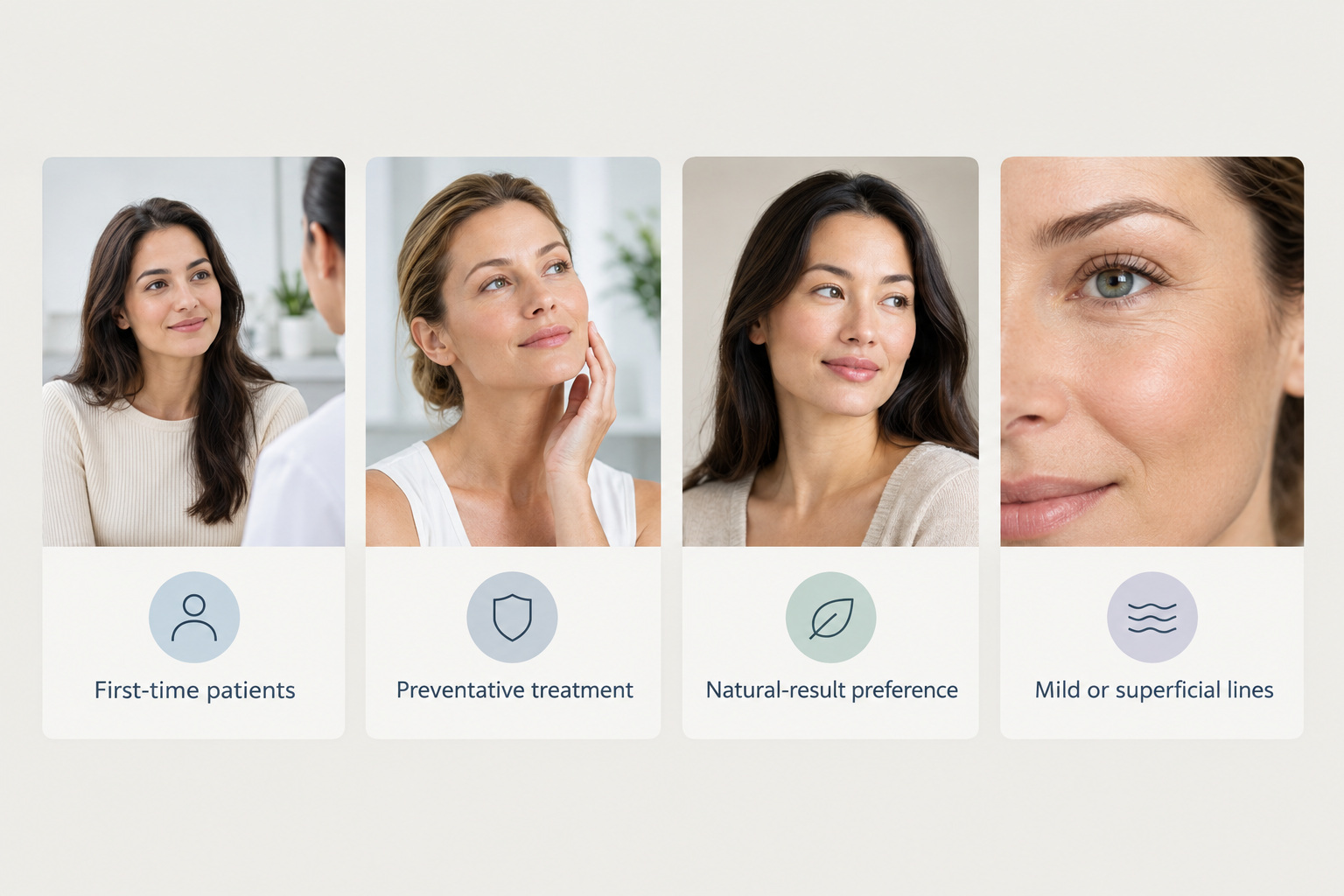
- First-time patients: People who are new to botulinum toxin treatment and want to understand how their face responds before committing to a fuller dose. Starting conservatively allows both patient and practitioner to assess individual muscle response and adjust future treatments accordingly.
- Preventative treatment: Younger adults who have noticed early dynamic lines and want to slow their progression before they become established at rest. The evidence that preventative botulinum toxin treatment delays long-term wrinkle formation is still developing, and this remains an area of ongoing discussion in aesthetic medicine.
- Patients who prefer natural-looking results: Those who have had standard treatment in the past and found the result too restrictive, or who simply prefer to retain more facial movement and expression.
- People with mild or superficial lines: Patients whose lines are fine and primarily dynamic may achieve satisfactory softening with lower doses, making a heavier treatment unnecessary.
- Patients with smaller facial muscles: Individual anatomy varies considerably. Some people have naturally less prominent or smaller facial muscles that respond well to lower doses, while others may need a standard dose to achieve any meaningful effect.
Baby Botox is unlikely to be the most appropriate choice if you have deep, established static lines that are visible at rest, significant volume loss, or skin laxity. In these situations, botulinum toxin at any dose addresses only one component of the concern, and a practitioner may suggest combining it with dermal fillers, skin-quality treatments, or other approaches.
Who May Not Be Suitable?
The contraindications for baby Botox are the same as for any botulinum toxin treatment, because the active ingredient is identical. A practitioner will typically advise against treatment if you:
- are pregnant or breastfeeding;
- have a known allergy to botulinum toxin or any component of the formulation;
- have a neuromuscular condition such as myasthenia gravis or Lambert-Eaton syndrome;
- are taking certain medications that may interact with botulinum toxin, including some antibiotics and muscle relaxants;
- have an active skin infection or inflammation in the planned treatment area;
- have had recent surgery or procedures in the area that may affect safe injection.
You should always disclose your full medical history, current medications, and any previous aesthetic treatments at your consultation. This information is essential for safe treatment planning, even when the doses involved are lower than standard.
What Happens During a Baby Botox Appointment?
A baby Botox appointment follows a similar structure to a standard botulinum toxin consultation and treatment session. The practitioner will begin by reviewing your medical history, discussing your aesthetic goals, and assessing your facial anatomy and muscle activity. This assessment is particularly important with a reduced-dose approach because the practitioner needs to judge how much relaxation is likely to be achieved with lower doses given your individual muscle strength and the depth of your lines.
The injection process itself is brief, typically taking between ten and twenty minutes depending on the number of areas treated. A fine needle is used to deliver small amounts of botulinum toxin into or near the target muscles. Most patients describe the sensation as a mild sting or pinch. Topical anaesthetic cream is not always necessary but can be applied beforehand if you are particularly sensitive.
After the injections, you will usually be advised to remain upright for a few hours, avoid rubbing or massaging the treated areas, and refrain from strenuous exercise for the remainder of the day. These instructions are standard for botulinum toxin treatment regardless of the dose used. You should receive clear aftercare guidance from your practitioner before leaving the appointment.
When Do Results Appear and How Long Do They Last?
The onset of botulinum toxin effects is not immediate. Most patients begin to notice some softening of movement within two to four days of treatment, with the full effect typically visible at around ten to fourteen days. This timeline is broadly similar to standard botulinum toxin treatment, as the mechanism of action — blocking neuromuscular transmission — operates on the same biological pathway regardless of dose.
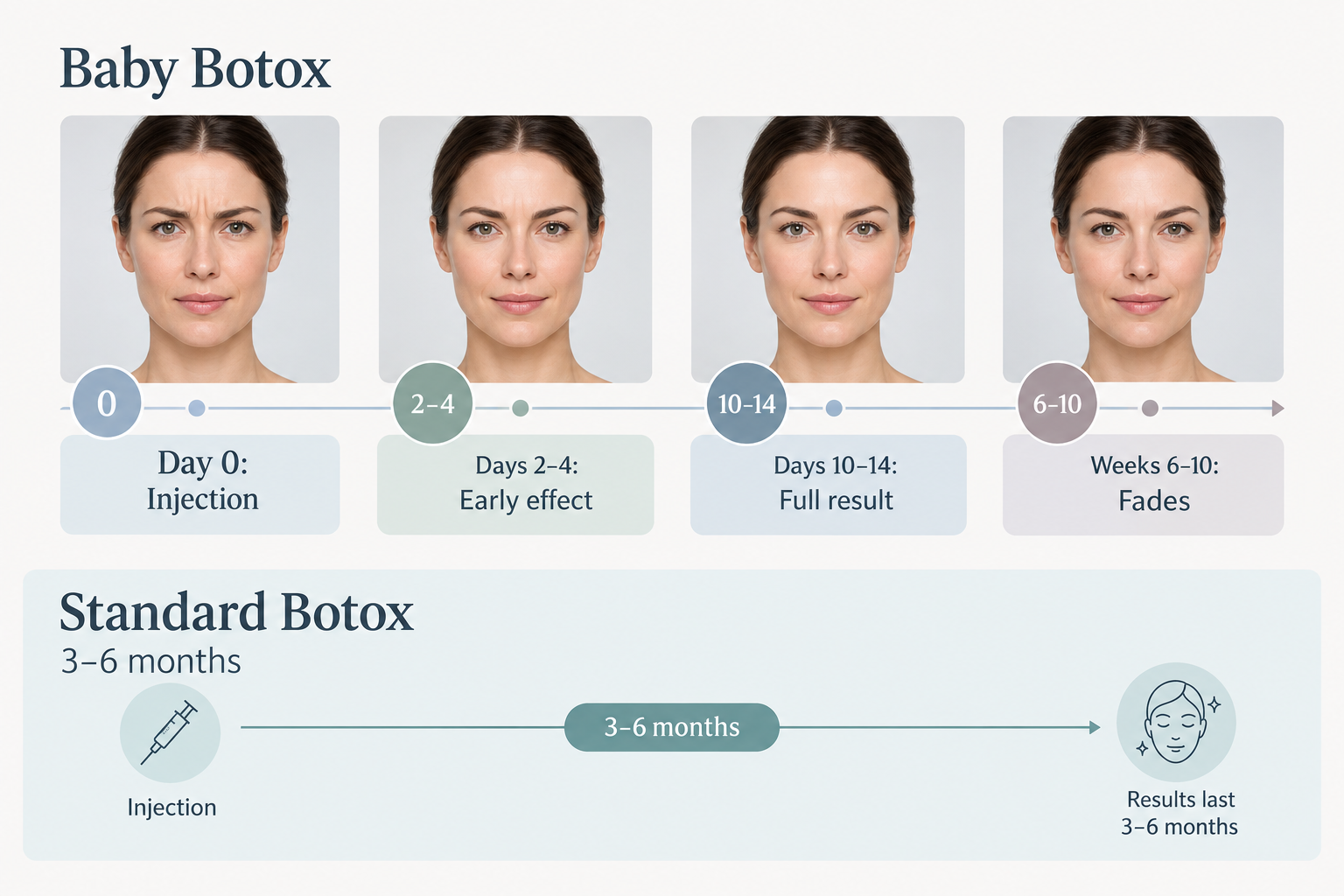
Duration is where baby Botox differs most meaningfully from standard treatment. Because a smaller amount of botulinum toxin is used, the effect tends to wear off more quickly. Standard botulinum toxin treatment typically lasts between three and six months depending on the individual, the area treated, and the dose used. With a reduced-dose approach, results may last closer to six to ten weeks in some patients, though this varies considerably. Patients who choose baby Botox for its natural appearance should be aware that more frequent maintenance appointments may be needed to sustain the result, which has implications for both time and cost.
Individual response to botulinum toxin varies significantly. Factors including muscle mass, metabolism, physical activity level, and previous treatment history can all influence how long the effect lasts. A practitioner experienced in reduced-dose techniques will be able to give you a more personalised estimate based on your anatomy and treatment history.
Realistic Benefits of the Baby Botox Approach
When performed by a skilled and experienced practitioner on a well-selected patient, a reduced-dose botulinum toxin approach may offer several meaningful advantages over standard dosing.
- More natural-looking movement: The most commonly cited benefit is that the face retains more expressive range, which many patients find preferable both aesthetically and socially.
- Gradual introduction to treatment: Starting with lower doses allows a patient and practitioner to assess individual response before committing to a fuller treatment, reducing the risk of an outcome the patient finds too restrictive.
- Potentially lower risk of certain side effects: Some complications of botulinum toxin treatment, such as brow heaviness or an overly elevated brow, may be less likely with conservative dosing, though they remain possible.
- Suitable for subtle refinement: For patients with mild lines or those seeking a refreshed rather than dramatically altered appearance, lower doses may achieve the desired outcome without over-treating.
Limitations and Honest Considerations
Baby Botox is not a universally superior approach, and it is important to understand its limitations before deciding whether it is right for you.
- Reduced efficacy for deeper lines: Lower doses may not produce meaningful improvement in established static lines or in patients with strong facial muscles. In these cases, a standard dose or a combination approach may be more appropriate.
- Shorter duration: The need for more frequent appointments is a practical and financial consideration that should be factored into your decision.
- Variable results: Because individual muscle response varies, the outcome of a reduced-dose treatment is less predictable than a standard dose. Some patients may find the result insufficient, while others respond well.
- Not a substitute for other treatments: Baby Botox addresses dynamic muscle activity. It does not replace volume, improve skin texture, or address pigmentation. Patients with multiple concerns may need a broader treatment plan.
- Practitioner skill is critical: Achieving a natural result with lower doses requires precise technique and a thorough understanding of facial anatomy. The outcome is highly dependent on the practitioner’s experience and judgement.
Risks and Side Effects
Because baby Botox uses the same botulinum toxin preparation as standard treatment, the potential risks and side effects are the same category, even if the lower dose may reduce the likelihood or severity of some of them.
Common side effects include temporary redness, swelling, or bruising at the injection sites. These typically resolve within a few days. Headache is occasionally reported in the days following treatment. These effects are generally mild and self-limiting.
Less common but more significant risks include eyelid drooping (ptosis), brow heaviness, or asymmetry. These occur when botulinum toxin diffuses beyond the intended target muscle or when dosing is not well-matched to the individual’s anatomy. Although lower doses may reduce diffusion risk, they do not eliminate it entirely. Eyelid ptosis, for example, can still occur with small doses if the injection is placed close to the levator palpebrae muscle.
Serious adverse events from aesthetic botulinum toxin treatment are rare when the procedure is performed by a qualified practitioner using a licensed product. However, botulinum toxin should always be treated as a prescription medicine with a meaningful risk profile, not as a routine cosmetic product. If you experience difficulty swallowing, breathing problems, or generalised muscle weakness after any botulinum toxin treatment, seek medical attention promptly.
Choosing a practitioner who is appropriately qualified, works in a regulated clinical environment, and uses a licensed botulinum toxin product is the most important safety step you can take.
Baby Botox vs Standard Botulinum Toxin Treatment
The decision between a reduced-dose and a standard-dose approach is not simply a matter of preference. It depends on your anatomy, the severity of your concerns, your aesthetic goals, and your practitioner’s clinical assessment. The table below summarises the key practical differences to help you understand the trade-offs before your consultation.
| Characteristic | Baby Botox | Standard Botulinum Toxin |
|---|---|---|
| Dose | Reduced, lower than standard | Standard therapeutic dose |
| Muscle relaxation | Partial | More complete |
| Expression preserved | More movement retained | More restricted movement |
| Typical onset | 2–14 days | 2–14 days |
| Typical duration | Approximately 6–10 weeks (varies) | Approximately 3–6 months (varies) |
| Maintenance frequency | More frequent appointments likely | Less frequent appointments |
| Best suited for | Mild lines, first-time patients, natural result preference | Moderate to deep dynamic lines, established treatment patients |
| Efficacy for deep lines | Limited | More effective |
| Risk profile | Same category as standard; some risks may be less likely | Same category; some risks may be more pronounced at higher doses |
| Product used | Same licensed botulinum toxin | Same licensed botulinum toxin |
Alternatives to Baby Botox
If you are considering baby Botox but are uncertain whether it is the right approach, it is worth understanding the alternatives that a practitioner might discuss with you.
Standard botulinum toxin treatment remains the most established option for dynamic facial lines. If your concern is moderate to deep lines or if you have not responded adequately to lower doses in the past, a standard dose may be more appropriate. A skilled practitioner can still achieve a natural-looking result with standard dosing through careful technique and conservative placement.
Dermal fillers address volume loss, static lines, and structural changes that botulinum toxin cannot correct. Hyaluronic acid fillers are the most commonly used type and are reversible with hyaluronidase. Fillers and botulinum toxin are often used together in a combined approach when a patient has both dynamic lines and volume-related concerns.
Skin-quality treatments such as medical-grade chemical peels, microneedling, radiofrequency treatments, or laser resurfacing may improve fine surface lines, skin texture, and overall skin quality. These approaches work through different mechanisms and may complement or, in some cases, partially substitute for botulinum toxin depending on the nature of the concern.
Polynucleotides and biostimulators are injectable treatments that aim to improve skin quality, hydration, and collagen production over time. They do not relax muscles but may improve the appearance of fine lines by improving the skin itself. Evidence for these treatments is still developing.
Topical skincare including prescription retinoids, antioxidants, and broad-spectrum sun protection plays a meaningful role in managing fine lines and slowing their progression. While topical products cannot replicate the effect of botulinum toxin on dynamic lines, they are an important part of any long-term skin health strategy.
Questions to Ask at Your Consultation
A consultation with a qualified practitioner is the appropriate setting to determine whether baby Botox is suitable for your specific concerns. The following questions may help you make the most of that appointment.
- Based on my anatomy and the lines I want to address, is a reduced-dose approach likely to achieve a meaningful result?
- Which botulinum toxin product will be used, and is it a licensed preparation?
- How frequently would I need to return for maintenance if I choose a lower-dose approach?
- Are there any areas where you would recommend a standard dose rather than a reduced dose?
- What are the most likely side effects for my specific treatment plan?
- Are there any other treatments that might better address my concerns, either alone or in combination?
- What qualifications and experience do you have in botulinum toxin treatment?
Frequently Asked Questions
Is baby Botox a different product from regular Botox?
No. Baby Botox uses the same licensed botulinum toxin preparation as standard treatment. The difference is in the dose and technique, not the product itself. The same safety considerations and contraindications apply.
Will baby Botox completely prevent wrinkles from forming?
Botulinum toxin treatment, including reduced-dose approaches, can reduce the appearance of dynamic lines and may slow the progression of lines that form through repeated muscle movement. However, it does not prevent all wrinkle formation, and its preventative effect over the long term is still an area of ongoing research rather than established certainty.
Can I go back to a standard dose if baby Botox is not enough?
Yes. If a reduced-dose treatment does not achieve the result you were hoping for, your practitioner can reassess and adjust the dose at a follow-up appointment or at your next treatment session. This is one reason why starting conservatively can be a sensible approach for first-time patients.
How soon after treatment can I return to normal activities?
Most people return to their usual daily activities immediately after a botulinum toxin appointment. Strenuous exercise, alcohol, and significant heat exposure are typically advised against for the remainder of the treatment day. There is no significant downtime associated with the injections themselves, though bruising or swelling at injection sites may occasionally be visible for a few days.
Is baby Botox suitable for men?
Botulinum toxin treatment is used in both men and women. Men typically have stronger and larger facial muscles, which means that lower doses may be less likely to produce a meaningful result in male patients. A practitioner will assess this individually and may recommend a standard or higher dose to achieve the desired effect.
How do I know if my practitioner is qualified to perform this treatment?
Botulinum toxin is a prescription medicine in many countries, meaning it should only be prescribed and administered by appropriately qualified healthcare professionals. You should verify your practitioner’s qualifications, check that they work in a regulated clinical environment, and confirm that they use licensed products. Avoid treatments offered in non-clinical settings or without a prior consultation and medical assessment.
Is Baby Botox the Right Approach for Your Goals?
Baby Botox can be a genuinely useful technique for the right patient in the right clinical context. If you have mild dynamic lines, are new to botulinum toxin treatment, or strongly prefer to retain natural facial movement, a reduced-dose approach may be worth discussing with a qualified practitioner. The results, when well-matched to the patient’s anatomy and goals, can look refreshed and natural without the more restricted appearance that some people associate with conventional treatment.
However, baby Botox is not a universally superior option. It is less effective for deeper or established lines, tends to require more frequent maintenance, and carries the same category of risks as standard botulinum toxin treatment. The outcome depends heavily on practitioner skill, individual anatomy, and whether the technique is genuinely appropriate for your specific concerns rather than simply chosen because the name sounds less clinical.
The most reliable way to determine whether this approach is right for you is a thorough consultation with an experienced, qualified practitioner who can assess your facial anatomy, understand your goals, and recommend a treatment plan — whether that involves reduced dosing, standard dosing, a combination approach, or an alternative treatment entirely. Informed decision-making, grounded in realistic expectations, is the foundation of a satisfying outcome.


