
Lip Filler Guide: What to Expect, How It Works, and Whether It’s Right for You
Lip filler is one of the most commonly requested aesthetic treatments, yet it’s also one of the most misunderstood. Whether you’re considering it for the first time or looking to understand your options more clearly, this guide explains how lip filler works, what the treatment involves, what realistic results look like, and what risks and limitations you should weigh before booking a consultation.
Key Takeaways
- Most lip fillers use hyaluronic acid, a substance naturally found in the body, which can be dissolved if needed.
- Results typically last between six and twelve months, depending on the product used, the volume injected, and individual metabolism.
- Common side effects include swelling, bruising, and tenderness; serious complications are rare but possible and require prompt medical attention.
- Lip filler is not suitable for everyone — a thorough consultation with a qualified practitioner is essential before treatment.
- Natural-looking results depend heavily on practitioner skill, product choice, and realistic goal-setting before treatment.
What Is Lip Filler?
Lip filler refers to injectable treatments used to add volume, improve shape, define the lip border, or enhance symmetry in the lips. The vast majority of lip fillers used in clinical practice today are based on hyaluronic acid (HA), a naturally occurring polysaccharide found in connective tissue and skin. Hyaluronic acid attracts and retains water, which gives it volumising properties when injected into soft tissue.
Because hyaluronic acid is biocompatible — meaning it is well tolerated by the body — HA-based lip fillers have become the dominant choice for lip augmentation. They are also reversible: an enzyme called hyaluronidase can be injected to dissolve the filler if results are unsatisfactory or if a complication arises. This reversibility is a meaningful safety advantage compared with older, permanent filler materials.
Lip fillers are distinct from anti-wrinkle injections (botulinum toxin), which relax muscles rather than add volume. Some practitioners use a small amount of botulinum toxin around the lip area — for example, to soften a gummy smile or reduce fine lines above the upper lip — but this is a separate treatment with a different mechanism and outcome.
How Does Lip Filler Work?
Hyaluronic acid lip fillers are injected directly into the lip tissue using a fine needle or, in some cases, a blunt-tipped cannula. The practitioner places the product in specific anatomical layers — typically within the body of the lip, along the vermilion border (the defined edge of the lip), or in the Cupid’s bow area — depending on the patient’s goals and anatomy.
Once injected, the hyaluronic acid integrates with the surrounding tissue and draws in water molecules, creating a soft, hydrated volume. Different HA filler formulations vary in their cross-linking density, which affects how firm or soft the result feels, how long the product lasts, and how it behaves in the lip. Softer, more flexible formulations are generally preferred for lips because they move naturally with facial expression and feel less rigid.
The choice of product and injection technique significantly influences the outcome. A practitioner experienced in lip anatomy will consider factors such as the natural lip-to-face ratio, the patient’s existing lip shape, skin quality, and the degree of enhancement requested. Technique matters as much as the product itself.
What Can Lip Filler Achieve?
Lip filler can address a range of aesthetic concerns, though it is important to have realistic expectations about what is achievable in a single session and over time.
- Volume enhancement: Adding fullness to lips that have naturally thin proportions or have lost volume with age.
- Definition and border enhancement: Sharpening the vermilion border and Cupid’s bow for a more defined lip outline.
- Symmetry improvement: Reducing visible asymmetry between the upper and lower lip, or between the left and right sides.
- Hydration and texture: Some patients notice improved lip texture and hydration following treatment, though this is a secondary effect rather than the primary purpose.
- Perioral lines: Filler placed carefully around the lip border may soften fine vertical lines above the upper lip, though this area requires particular precision.
- Projection: Enhancing the forward projection of the lips, particularly the central portion, for a fuller appearance from the side profile.
Lip filler cannot change the fundamental structure of the mouth, alter the position of the teeth, or correct concerns that are related to bone or muscle anatomy. For some patients, concerns about lip appearance may be better addressed through other means, which a qualified practitioner can discuss during consultation.
What Happens During a Lip Filler Appointment?
A lip filler appointment typically begins with a consultation, either at the same visit or at a separate pre-treatment appointment. During this stage, the practitioner assesses your lip anatomy, discusses your goals, reviews your medical history, and explains what is realistically achievable. This is also the appropriate time to ask questions about the product being used, the practitioner’s experience, and what to expect during recovery.
Before the injections begin, a topical anaesthetic cream is usually applied to the lips and surrounding area. This is left in place for around fifteen to twenty minutes to reduce discomfort. Many HA lip filler products also contain lidocaine — a local anaesthetic — within the formulation itself, which further reduces discomfort during injection.
The injection process itself typically takes between fifteen and thirty minutes, depending on the complexity of the treatment. Most patients describe the sensation as a mild stinging or pressure rather than sharp pain, though individual pain tolerance varies. Some areas of the lip, particularly the vermilion border, may be more sensitive than others.
Immediately after treatment, the lips will appear swollen and may look more dramatic than the final result. This initial swelling is normal and expected. The practitioner may gently massage the area to distribute the product evenly. You will usually be able to see a more accurate representation of the result once the swelling has settled, which typically takes between three and seven days, though some residual swelling can persist for up to two weeks.
Recovery and Downtime After Lip Filler
Lip filler has minimal downtime compared with surgical lip augmentation, but the recovery period does involve some temporary side effects that patients should plan for.
Swelling is the most common and expected effect. It is usually most pronounced in the first twenty-four to forty-eight hours and gradually subsides over the following days. Applying a cold compress gently to the area can help reduce swelling, though direct ice should not be placed on the skin.
Bruising occurs in a proportion of patients and can range from minor discolouration to more visible bruising around the injection sites. Bruising typically resolves within five to ten days. Avoiding blood-thinning medications and supplements — such as aspirin, ibuprofen, fish oil, and vitamin E — in the days before treatment (where medically appropriate and with your doctor’s agreement) may help reduce bruising risk, though it cannot be eliminated entirely.
Tenderness and sensitivity around the lips are common for the first few days. Most patients find these manageable without prescription pain relief.
During the initial recovery period, practitioners generally advise avoiding strenuous exercise, excessive heat (such as saunas or steam rooms), alcohol, and significant pressure on the lips for at least twenty-four to forty-eight hours. Wearing lipstick or applying pressure to the area immediately after treatment is usually discouraged until initial swelling has settled.
How Long Does Lip Filler Last?
Hyaluronic acid lip filler is not permanent. The body gradually breaks down the hyaluronic acid over time through natural enzymatic processes. Most patients find that lip filler results last between six and twelve months, though this varies considerably between individuals.
Several factors influence how long lip filler lasts:
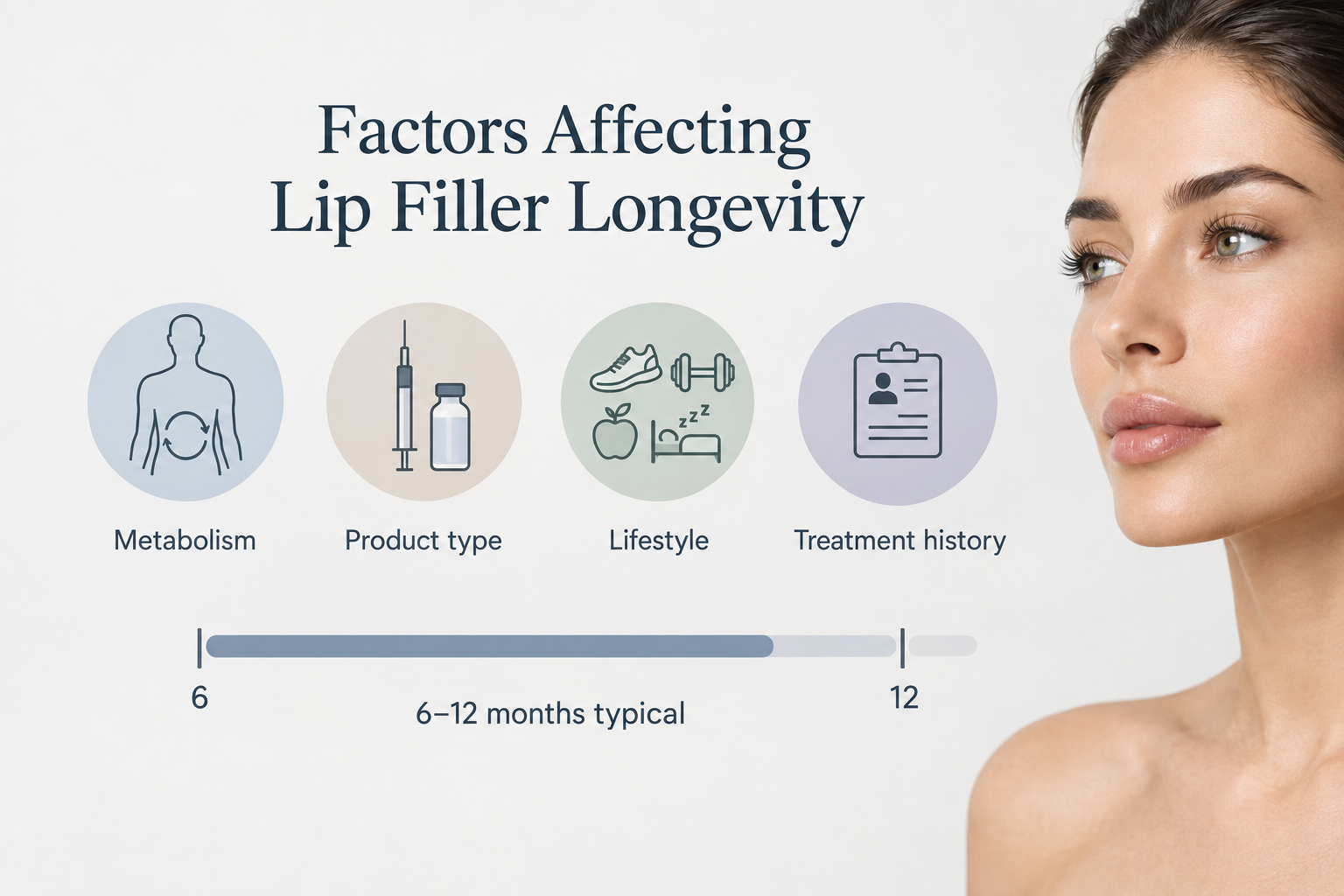
- Metabolism: Individuals with faster metabolic rates tend to break down filler more quickly.
- Product formulation: Denser, more highly cross-linked HA products generally last longer than softer formulations, though softer products are often preferred in the lips for a more natural feel.
- Volume injected: Larger volumes may last slightly longer in some cases, though this is not a reliable predictor.
- Lifestyle factors: High levels of physical activity, sun exposure, and smoking may accelerate filler breakdown.
- Treatment history: Some patients who have had repeated treatments over time report that results appear to last longer, though this is not universally observed and the mechanism is not fully established.
Maintenance treatments are typically needed every six to twelve months to sustain results. It is worth factoring this ongoing commitment — and its associated cost — into your decision-making before starting treatment.
Risks and Side Effects of Lip Filler
Lip filler is generally considered a low-risk procedure when performed by a qualified and experienced practitioner using appropriate products and technique. However, no injectable treatment is without risk, and patients should be fully informed before proceeding.
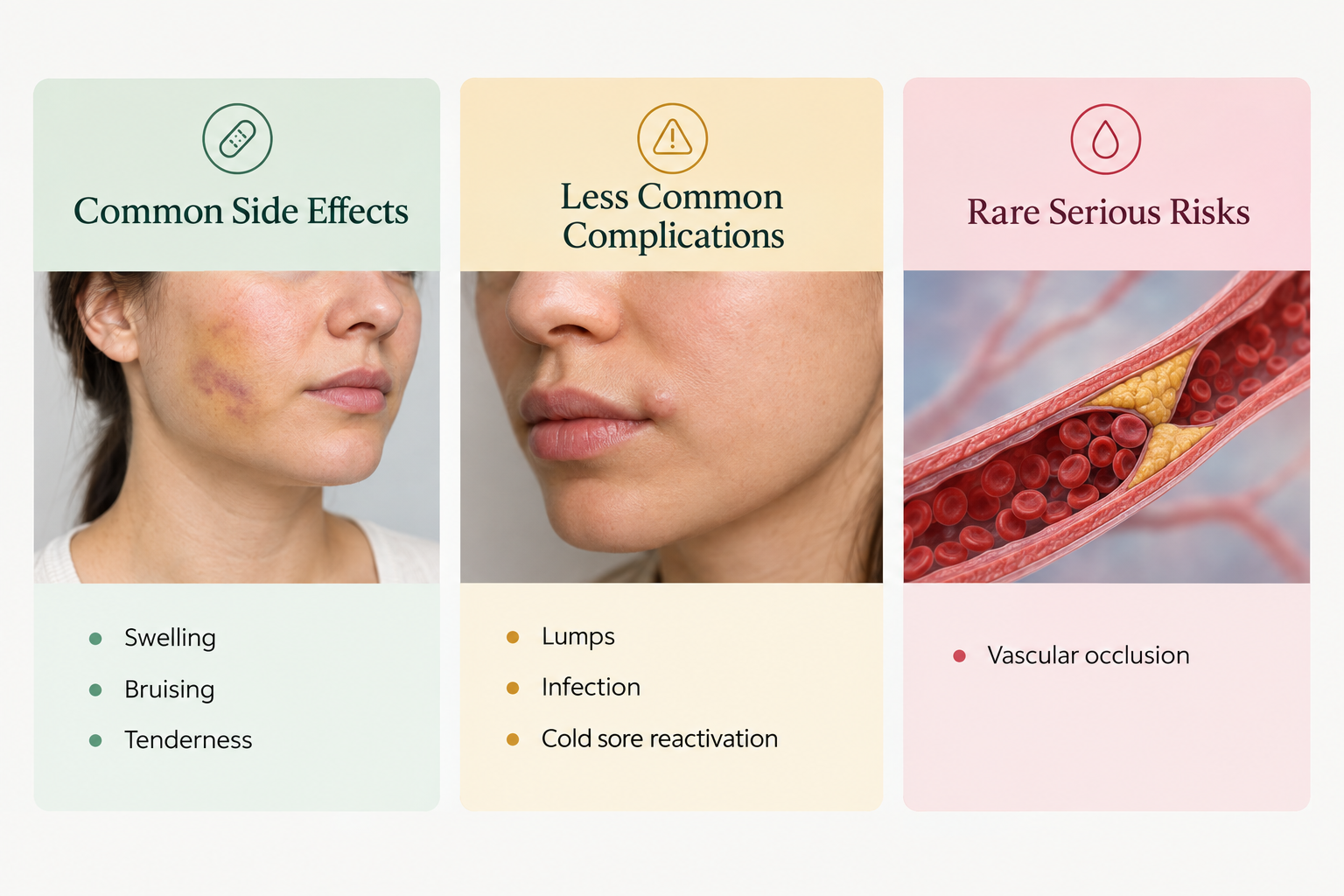
Common Side Effects
- Swelling and puffiness (expected and temporary)
- Bruising at injection sites
- Tenderness and sensitivity
- Redness around the injection points
- Asymmetry in the immediate post-treatment period (often resolves as swelling settles)
Less Common but Possible Complications
- Lumps or irregularities: Small lumps can sometimes be felt or seen after treatment. Many resolve on their own; others may require massage or, in some cases, dissolution with hyaluronidase.
- Infection: Any injectable procedure carries a small risk of infection. Signs include increasing redness, warmth, pain, or discharge and should be assessed by a medical professional promptly.
- Cold sore reactivation: Patients with a history of cold sores (herpes simplex virus) may experience a reactivation triggered by the trauma of injection. Antiviral prophylaxis may be recommended before treatment for those with a relevant history.
- Tyndall effect: A bluish discolouration that can occur if filler is placed too superficially in the skin. This is more commonly associated with under-eye filler but can occasionally occur near the lip border.
- Allergic or hypersensitivity reaction: Rare with HA fillers, but possible. Delayed inflammatory reactions have been reported in some patients.
Serious but Rare Complications
The most serious complication associated with any dermal filler injection is vascular occlusion — where filler is inadvertently injected into or compresses a blood vessel, potentially restricting blood flow to surrounding tissue. In the lip and perioral area, this can affect the labial arteries. Vascular occlusion requires immediate recognition and treatment, typically with hyaluronidase. Symptoms may include blanching (whitening) of the skin, severe pain, or skin colour changes. This is why treatment should only be performed by practitioners with appropriate training, knowledge of facial anatomy, and access to hyaluronidase for emergency use.
Patients should be given clear aftercare instructions and know how to contact their practitioner if they experience any concerning symptoms after treatment.
Who May Be Suitable for Lip Filler?
Lip filler may be appropriate for adults who have realistic expectations, are in good general health, and have specific aesthetic goals that hyaluronic acid filler can reasonably address. Suitable candidates are typically those who want to enhance lip volume, improve definition, or address age-related volume loss in the lip area.
A thorough consultation is necessary to assess individual suitability. Factors that a practitioner will consider include:
- Medical history, including any history of autoimmune conditions, bleeding disorders, or previous filler treatments
- Current medications, particularly blood thinners or immunosuppressants
- History of cold sores or other oral infections
- Allergies, including any known sensitivity to hyaluronic acid or lidocaine
- Skin condition in and around the treatment area
- Pregnancy or breastfeeding (lip filler is generally not recommended during these periods)
- Realistic expectations and understanding of the procedure’s limitations
Who May Not Be Suitable
Lip filler is not appropriate for everyone. Treatment is generally not recommended for individuals who are pregnant or breastfeeding, those with active infection or inflammation in or around the lips, or those with certain autoimmune conditions that may affect healing or increase complication risk. Patients with a history of severe allergic reactions or anaphylaxis should discuss this carefully with their practitioner. Those taking medications that significantly affect blood clotting may face a higher bruising risk, and the timing of treatment may need to be considered in discussion with their prescribing doctor.
Patients who have unrealistic expectations — for example, expecting a dramatic transformation from a conservative treatment, or expecting results to look identical to a specific celebrity or social media image — may not be well served by lip filler. A good practitioner will discuss goals honestly and decline to proceed if the requested outcome is not safely achievable or is not in the patient’s best interest.
Alternatives to Lip Filler
Lip filler is not the only option for patients interested in improving the appearance of their lips. Depending on the specific concern, the following alternatives may be worth discussing with a qualified practitioner:
- Lip flip with botulinum toxin: A small amount of botulinum toxin injected into the orbicularis oris muscle above the upper lip can cause the lip to roll slightly outward, creating the appearance of a fuller upper lip without adding volume. This is a subtle effect and is not equivalent to filler in terms of volume enhancement, but may suit patients who want a minimal change.
- Skin boosters: Injectable hydrating treatments, such as those based on highly diluted hyaluronic acid or polynucleotides, can improve lip texture and hydration without significantly adding volume. These may be suitable for patients primarily concerned with lip quality rather than size.
- Surgical lip augmentation: Procedures such as a lip lift (which shortens the distance between the nose and upper lip) or fat transfer offer more permanent results but involve surgical risk, recovery time, and greater cost. These are typically considered when non-surgical options have not achieved the desired outcome or when a more lasting change is sought.
- Makeup and cosmetic techniques: For patients who are uncertain about injectable treatment, cosmetic techniques using lip liner, lipstick, and gloss can create the appearance of fuller, more defined lips without any medical intervention.
Choosing a Practitioner for Lip Filler
The practitioner performing lip filler has a significant influence on both the safety and the aesthetic outcome of the treatment. Lip anatomy is complex, and the perioral area contains important vascular structures. Treatment should be performed by a qualified medical professional — such as a doctor, dentist, or nurse prescriber — with specific training in facial anatomy and injectable treatments.
When researching practitioners, it is reasonable to ask about their qualifications, their training in facial aesthetics, how long they have been performing lip filler treatments, what products they use, and what their protocol is in the event of a complication. A practitioner who is willing to answer these questions clearly and who does not pressure you into treatment is a positive sign.
Be cautious of unusually low prices, treatments offered in non-clinical settings, or practitioners who are unwilling to discuss risks or show evidence of their training. The reversibility of hyaluronic acid filler is a meaningful safety feature, but it does not eliminate the importance of choosing a skilled and appropriately trained injector.
Frequently Asked Questions
How much lip filler will I need?
The amount of filler used varies depending on your starting point and your goals. Many practitioners begin with 0.5 to 1 ml for a first treatment, particularly for patients new to lip filler. Starting conservatively allows you to assess the result before deciding whether additional volume is appropriate. Your practitioner will recommend an amount based on your anatomy and the outcome you are hoping to achieve.
Will lip filler look natural?
Natural-looking results are achievable with lip filler, but they depend on the volume used, the product selected, the injection technique, and the patient’s existing anatomy. Overfilled or poorly placed filler can produce an unnatural appearance. Communicating clearly with your practitioner about wanting a subtle or natural result — and choosing a practitioner with a portfolio of work that reflects that aesthetic — is important.
Does lip filler hurt?
Most patients find lip filler tolerable rather than painful. Topical anaesthetic cream is applied before treatment, and many filler products contain lidocaine. Individual pain tolerance varies, and some areas of the lip may be more sensitive than others. The procedure is brief, which also helps most patients manage any discomfort.
Can lip filler be dissolved?
Yes. Hyaluronic acid lip filler can be dissolved using an enzyme called hyaluronidase, which breaks down the hyaluronic acid. Dissolution may be recommended if there is a complication such as vascular occlusion, if the patient is unhappy with the result, or if there is significant asymmetry or lumpiness that does not resolve on its own. Dissolution is generally effective, though multiple treatments may occasionally be needed.
How soon can I wear makeup after lip filler?
Most practitioners advise waiting at least twenty-four hours before applying lipstick or other products directly to the lips, to reduce the risk of introducing bacteria to the injection sites while they are healing. Your practitioner will give you specific aftercare guidance based on your treatment.
What happens if I stop having lip filler?
If you stop having lip filler treatments, the hyaluronic acid will gradually break down and your lips will return to their natural appearance over time. Lip filler does not cause permanent stretching or sagging of the lips when used in appropriate volumes, though very large volumes maintained over many years may have a different effect on tissue. This is worth discussing with your practitioner if you are considering long-term treatment.
Is there a best age to start lip filler?
There is no universally agreed optimal age to begin lip filler. Treatment is generally only appropriate for adults, and many practitioners prefer to treat patients whose facial development is complete. The decision should be based on individual goals, anatomy, and a thorough consultation rather than age alone.
Is Lip Filler the Right Choice for You?
Lip filler can be a well-tolerated and effective option for adults who want to enhance lip volume, improve definition, or address age-related changes in the lip area. When performed by a qualified practitioner using an appropriate hyaluronic acid product and sound technique, results can look natural and proportionate to the face. The reversibility of HA filler adds a meaningful layer of safety that distinguishes it from older or permanent alternatives.
At the same time, lip filler is not without limitations. Results are temporary and require ongoing maintenance. Side effects such as swelling and bruising are common in the short term, and while serious complications are rare, they are possible and require prompt attention. The outcome depends significantly on practitioner skill, product selection, and the patient’s own anatomy and healing response.
The most important step before any lip filler treatment is a thorough, honest consultation with a qualified medical professional who can assess your suitability, discuss realistic outcomes, and answer your questions without pressure. If you are considering lip filler, use that consultation to ask about the practitioner’s experience, the specific product they plan to use, what the recovery involves, and what happens if you are not satisfied with the result. A practitioner who takes time to address these questions is one who takes your safety and satisfaction seriously.


