
Polynucleotides Before and After: What Results Can You Realistically Expect?
Polynucleotide (PDRN) treatments have attracted significant interest as a skin-regenerating injectable, with many patients curious about what genuine before and after results look like and how long improvements may last. Unlike treatments that add volume or relax muscles, polynucleotides work by stimulating the skin’s own repair processes — which means results develop gradually and vary considerably between individuals. This article explains what changes are realistic to expect, when they may appear, how many sessions are typically involved, and what limitations patients should understand before committing to treatment.
Key Takeaways
- Polynucleotide injections stimulate collagen production and tissue regeneration rather than filling or freezing, so visible improvements typically emerge over several weeks rather than immediately.
- Most patients require a course of two to four sessions to see meaningful results, with maintenance treatments often recommended every six to twelve months.
- Commonly reported improvements include better skin hydration, reduced fine lines, improved skin texture and tone, and a more rested appearance around the eyes — though individual outcomes vary.
- Polynucleotides are not a replacement for treatments targeting volume loss, deep folds, or significant skin laxity; a qualified practitioner can advise on whether they are appropriate for your specific concerns.
- Temporary redness, swelling, and bruising are common after treatment; serious adverse events are uncommon but possible, and a thorough consultation is essential before proceeding.
What Are Polynucleotides and How Do They Work?
Polynucleotides are long-chain DNA fragments derived from purified salmon or trout sperm DNA, processed to remove proteins that could trigger an immune response. The active component, polydeoxyribonucleotide (PDRN), has been studied in wound healing and tissue repair contexts for several decades. When injected into the skin, polynucleotides are thought to act through two main mechanisms: stimulating fibroblast activity to encourage collagen and elastin synthesis, and promoting angiogenesis — the formation of new small blood vessels — which improves local tissue nutrition and oxygenation.
Unlike hyaluronic acid dermal fillers, polynucleotides do not add physical volume to the treated area. Instead, they are classified as biostimulators — substances that encourage the skin to regenerate from within. This distinction is important when setting expectations: the changes that polynucleotide treatment produces are biological and cumulative, not mechanical and immediate. Patients who understand this mechanism tend to have more realistic expectations about their before and after experience.
Common Treatment Areas and Skin Concerns
Polynucleotide injections are used across a range of facial and body areas, though the evidence base is stronger for some indications than others. The most frequently treated areas include the under-eye region (periorbital area), the face more broadly, the neck, décolletage, and hands. Some practitioners also use polynucleotides for scalp treatments targeting hair thinning, though this application has a more limited evidence base.
The skin concerns most commonly addressed with polynucleotide treatment include fine lines and superficial wrinkles, skin dullness and uneven tone, dehydration and loss of skin elasticity, and the crepey or thin skin texture that often develops with age. Under-eye concerns are among the most popular indications, but it is important to understand that the under-eye area can look tired or dark for several different reasons — including pigmentation, visible blood vessels, hollowness from volume loss, or skin laxity — and polynucleotides are more likely to help with skin quality and hydration than with structural hollowness or deep pigmentation.
Polynucleotides Before and After: What Changes Are Realistic?
Realistic before and after outcomes from polynucleotide treatment depend heavily on the patient’s age, baseline skin condition, the area treated, the number of sessions completed, and the specific product used. With those variables in mind, the improvements most consistently reported in clinical literature and patient experience include improved skin hydration and plumpness, a reduction in fine surface lines, more even skin tone, and a general improvement in skin quality often described as a healthier or more refreshed appearance.
Significant structural changes — such as lifting sagging skin, eliminating deep nasolabial folds, or correcting pronounced hollowing under the eyes — are generally not achievable with polynucleotides alone. Patients with these concerns may benefit more from hyaluronic acid fillers, collagen-stimulating treatments such as Sculptra, or energy-based devices, either instead of or alongside polynucleotide therapy. A practitioner who assesses your skin in person can advise on whether polynucleotides are likely to address your specific concerns or whether a combination approach would be more appropriate.
In terms of skin texture and tone, some patients notice a visible improvement in the smoothness and luminosity of their skin after a course of treatment. Fine lines around the eyes, lips, and forehead may appear softened. The skin may feel more hydrated and resilient. These are the changes most reliably associated with polynucleotide treatment in published studies, though the degree of improvement varies between individuals and is not guaranteed.
Treatment Timeline: When Do Results Appear?
Understanding the polynucleotide treatment timeline is essential for managing expectations. Unlike botulinum toxin, which typically produces visible results within a few days, or hyaluronic acid filler, which creates an immediate volumising effect, polynucleotide results develop gradually as the skin’s biological repair processes are activated.
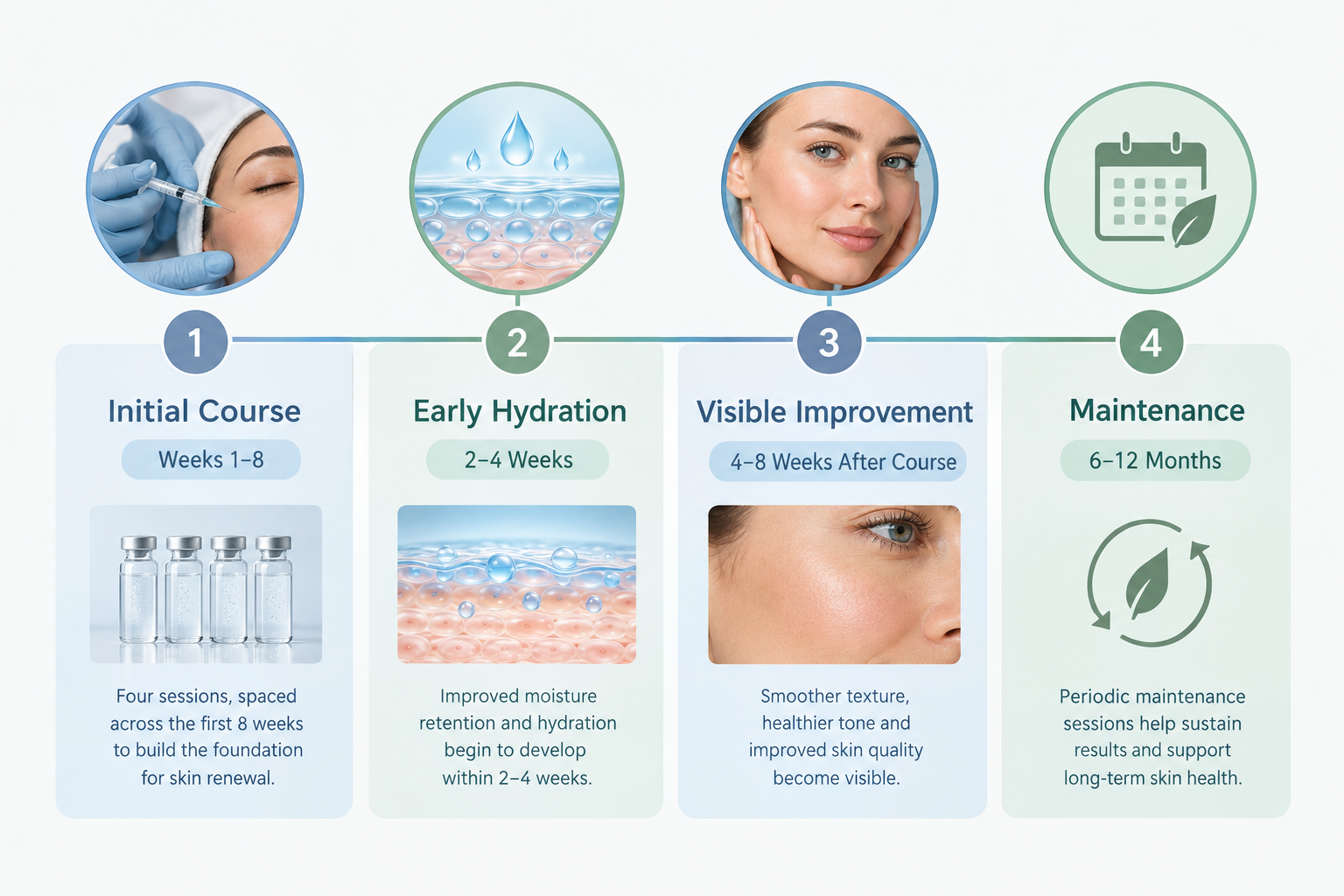
Most patients do not notice significant visible changes after a single session. Early improvements in skin hydration may be perceptible within two to four weeks of the first treatment, but the more meaningful changes in skin texture, fine lines, and overall quality typically become apparent after a course of sessions — usually two to four treatments spaced two to four weeks apart. The full effect of a treatment course is often most visible approximately four to eight weeks after the final session in the course, as collagen remodelling continues after the injections themselves.
This gradual timeline can be frustrating for patients accustomed to more immediate results from other aesthetic treatments. It is worth noting that the progressive nature of the improvement is a direct consequence of the biological mechanism — the skin is being encouraged to regenerate, not temporarily altered by an external substance. Practitioners often recommend taking standardised photographs before treatment and at intervals afterwards to track changes that may be subtle enough to miss without comparison.
Typical Treatment Schedule
- Initial course: Usually two to four sessions, spaced two to four weeks apart.
- Early changes: Improved hydration and skin feel may be noticeable within two to four weeks of starting treatment.
- Visible skin quality improvements: Typically more apparent four to eight weeks after completing the initial course.
- Maintenance: Many practitioners recommend follow-up sessions every six to twelve months to sustain results, though individual needs vary.
How Long Do Polynucleotide Results Last?
The longevity of polynucleotide results is not fixed and depends on several factors including the patient’s age, skin condition, lifestyle, and whether maintenance treatments are undertaken. In general, the improvements achieved through a course of polynucleotide injections are not permanent. The skin continues to age, and the collagen stimulated by treatment will gradually break down over time.
Many patients find that results from an initial course are maintained for approximately six to twelve months before a noticeable decline in skin quality occurs. This is why most practitioners recommend periodic maintenance sessions — typically one to two treatments per year — to sustain the improvements achieved. Some patients choose to integrate polynucleotide treatment into a broader skin health routine alongside topical skincare, sun protection, and other aesthetic treatments.
It is also worth noting that polynucleotide treatment may have a cumulative benefit over multiple courses: patients who undergo repeated treatment cycles over time may find that their skin quality improves progressively, though this is based largely on clinical observation and patient-reported outcomes rather than long-term controlled trials.
What Happens During a Polynucleotide Treatment Appointment?
A polynucleotide treatment session typically begins with a consultation or review, during which the practitioner assesses the treatment area, discusses the patient’s goals, and confirms suitability. The skin is cleaned and, depending on the practitioner’s approach and the patient’s preference, a topical anaesthetic cream may be applied to reduce discomfort during injection.
The polynucleotide solution is injected into the skin using a fine needle or cannula, with the technique varying depending on the area being treated and the product being used. Sessions typically last between 20 and 45 minutes. Most patients describe the injections as mildly uncomfortable rather than painful, though the under-eye area and lips can be more sensitive. Immediately after treatment, the skin may appear slightly red, swollen, or show small injection marks, which generally resolve within a few hours to a few days.
Recovery and Downtime After Polynucleotide Injections
Polynucleotide injections are generally considered a low-downtime procedure, though this does not mean there are no visible after-effects. The most common immediate reactions include redness, mild swelling, and small raised bumps at injection sites, which typically settle within 24 to 48 hours. Bruising is possible, particularly in delicate areas such as under the eyes, and may take up to one to two weeks to fully resolve.
Most patients are able to return to normal daily activities on the same day or the following day, though many choose to schedule treatment when they have a few days before a significant social event. Practitioners typically advise avoiding strenuous exercise, alcohol, and excessive heat — such as saunas or hot baths — for 24 to 48 hours after treatment. Sun protection is particularly important in the days following treatment, as the skin may be temporarily more sensitive.
Makeup can usually be applied after 24 hours, though this varies by practitioner guidance and individual healing. Patients should follow the specific aftercare instructions provided by their treating practitioner rather than relying on general advice.
Risks and Side Effects
Polynucleotide injections carry a risk profile broadly similar to other injectable skin treatments. The most common side effects — redness, swelling, bruising, and tenderness at injection sites — are temporary and expected. Less commonly, patients may experience prolonged swelling, small nodules under the skin, or uneven results.
Serious adverse events are uncommon but not impossible. As with any injectable treatment, there is a risk of infection if sterile technique is not maintained. Vascular complications — where an injection inadvertently affects a blood vessel — are a risk with any facial injectable, though the risk profile differs from that of thicker dermal fillers. Allergic reactions to the polynucleotide product are theoretically possible; patients with a known fish allergy should discuss this with their practitioner before treatment, as most commercial polynucleotide products are derived from fish DNA.
The risk of adverse events is significantly influenced by practitioner training, technique, and the clinical environment. Treatment should be performed by a qualified medical professional with appropriate training in injectable aesthetics, in a setting where complications can be recognised and managed.
Who May Be Suitable for Polynucleotide Treatment?
Polynucleotide treatment may be worth discussing with a qualified practitioner if you are experiencing early to moderate signs of skin ageing — such as fine lines, reduced skin elasticity, dullness, or dehydration — and are looking for a gradual, biologically driven improvement in skin quality rather than an immediate or dramatic change. The treatment is often considered suitable for patients in their late twenties onwards, though there is no strict age threshold.
Patients with realistic expectations, an understanding of the gradual timeline, and a willingness to commit to a course of sessions are generally better candidates than those seeking a single-session transformation. Polynucleotides may also be used alongside other treatments — such as botulinum toxin, dermal fillers, or energy-based skin treatments — as part of a broader aesthetic plan, though the sequencing and combination should be guided by a practitioner.
Who May Not Be Suitable
Polynucleotide treatment is not appropriate for everyone. Patients who are pregnant or breastfeeding are generally advised to avoid injectable aesthetic treatments. Those with a known allergy to fish or fish-derived products should exercise particular caution and discuss this with their practitioner before proceeding, given the origin of most polynucleotide products.
Active skin infections, inflammatory skin conditions, or autoimmune conditions affecting the skin in the treatment area may be contraindications, depending on the specific circumstances. Patients taking blood-thinning medications may have an increased risk of bruising. A thorough medical history and consultation with a qualified practitioner is essential to determine individual suitability — this article cannot substitute for a clinical assessment.
Alternatives to Polynucleotide Treatment
For patients considering polynucleotide treatment, it is useful to understand how it compares to other options for improving skin quality and addressing early signs of ageing.
Profhilo is another injectable bioremodelling treatment that uses high-concentration hyaluronic acid to hydrate and stimulate collagen production. It tends to produce faster visible hydration results than polynucleotides and may be more suitable for patients primarily concerned with skin laxity and hydration rather than fine lines and texture.
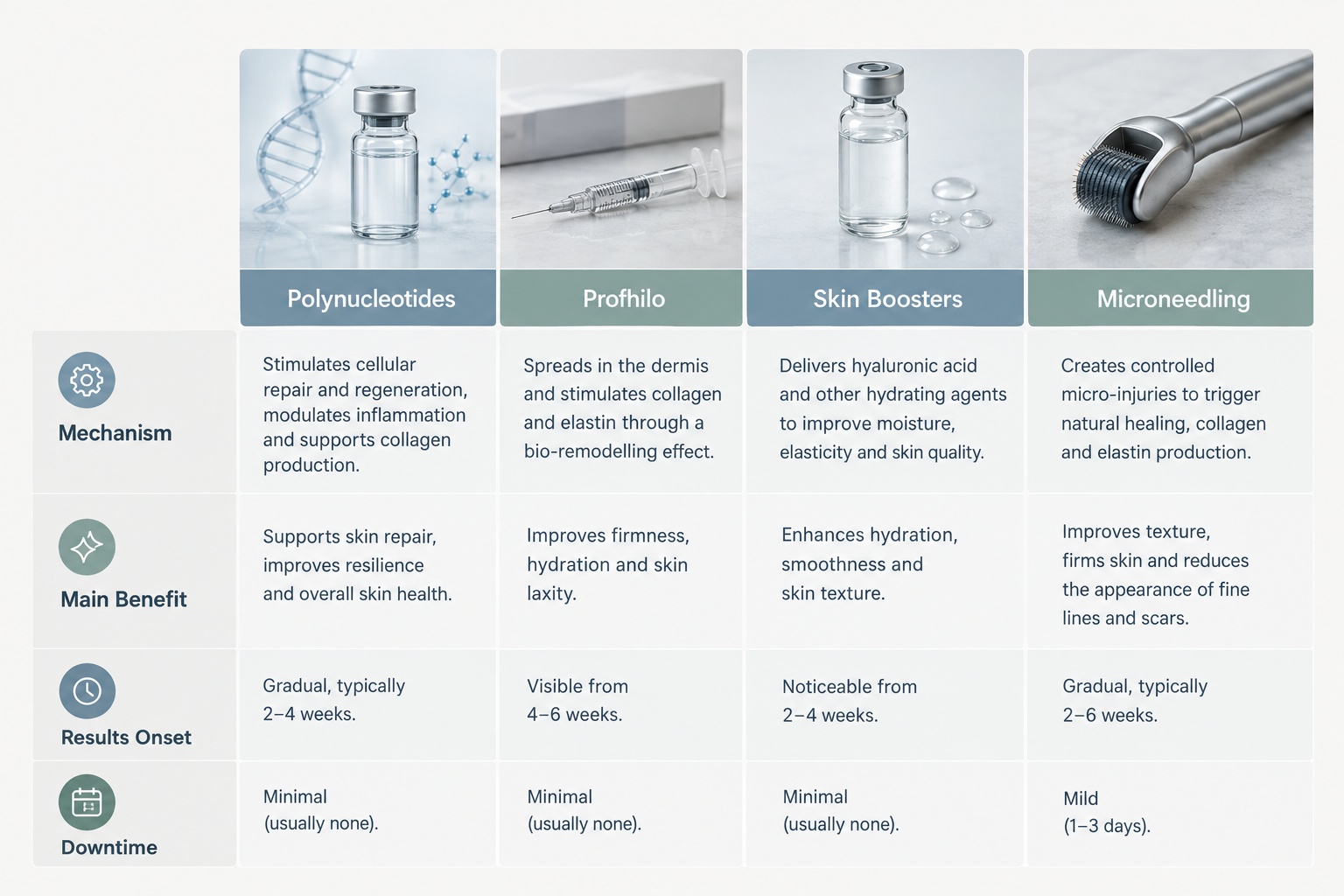
Skin boosters such as Restylane Skinboosters or Juvederm Volite use dilute hyaluronic acid injected superficially to improve skin hydration and quality. These may produce more immediate hydration effects but work through a different mechanism to polynucleotides.
Microneedling — with or without radiofrequency — stimulates collagen production through controlled skin injury and may be an alternative or complementary option for improving skin texture and fine lines, with a different risk and recovery profile.
Chemical peels and laser resurfacing can address skin texture, tone, and superficial lines through controlled exfoliation or thermal stimulation, and may be more effective than polynucleotides for certain pigmentation concerns or more pronounced textural irregularities.
The most appropriate treatment depends on the individual patient’s concerns, skin type, medical history, and goals. A practitioner experienced in multiple modalities is best placed to recommend a suitable approach.
Frequently Asked Questions
How many polynucleotide sessions will I need before I see results?
Most patients require a course of two to four sessions before meaningful results become visible. Early improvements in skin hydration may be noticeable after the first or second session, but the more significant changes in skin texture and fine lines typically develop over the weeks following a full course. Individual response varies, and a practitioner can give a more personalised estimate after assessing your skin.
Can polynucleotides remove dark circles under the eyes?
Polynucleotide treatment may improve the appearance of the under-eye area by enhancing skin quality, hydration, and thickness — which can make the skin look less tired and reduce the visibility of fine lines. However, dark circles have multiple causes, including pigmentation, visible blood vessels, and hollowness from volume loss. Polynucleotides are unlikely to fully correct dark circles caused primarily by pigmentation or structural hollowing, and a practitioner should assess the underlying cause before recommending treatment.
Are polynucleotide results permanent?
No. The improvements achieved with polynucleotide treatment are not permanent. Results typically last approximately six to twelve months before a gradual decline in skin quality occurs, as the skin continues to age and the stimulated collagen breaks down over time. Maintenance sessions are usually recommended to sustain results.
Is polynucleotide treatment painful?
Most patients describe the injections as mildly uncomfortable rather than significantly painful. The level of discomfort depends on the area being treated, the patient’s individual sensitivity, and whether topical anaesthetic is used. The under-eye area tends to be more sensitive than other facial areas. Practitioners can apply numbing cream before treatment to reduce discomfort.
Can polynucleotides be combined with other treatments?
Yes, polynucleotide treatment is often used alongside other aesthetic treatments such as botulinum toxin, dermal fillers, or energy-based skin treatments. The combination and sequencing of treatments should be planned by a qualified practitioner based on your individual goals and skin condition. Not all combinations are appropriate for every patient.
How soon after treatment can I wear makeup?
Most practitioners advise waiting at least 24 hours before applying makeup to the treated area, to reduce the risk of introducing bacteria to the injection sites while the skin is healing. Your practitioner will provide specific aftercare guidance based on the product used and the area treated.
Is there a risk of allergic reaction to polynucleotides?
Allergic reactions to polynucleotide products are uncommon but theoretically possible. Because most commercial polynucleotide products are derived from salmon or trout DNA, patients with a known fish allergy should discuss this with their practitioner before treatment. A thorough allergy history should be taken as part of the pre-treatment consultation.
Making an Informed Decision About Polynucleotide Treatment
Polynucleotide treatment can offer a meaningful improvement in skin quality, hydration, and the appearance of fine lines for suitable patients — but it is not a universal solution, and realistic expectations are essential. The before and after changes most reliably associated with polynucleotide injections are gradual, biological, and cumulative: patients who commit to a full course of treatment and appropriate maintenance are more likely to see and sustain meaningful results than those expecting a single-session transformation.
The treatment is best suited to patients with early to moderate skin quality concerns who are looking for a regenerative approach rather than an immediate volumising or line-relaxing effect. For more pronounced concerns — such as significant volume loss, deep wrinkles, or marked skin laxity — polynucleotides may be more effective as part of a combination treatment plan than as a standalone solution.
If you are considering polynucleotide treatment, a consultation with a qualified and experienced aesthetic practitioner is the most important first step. A thorough assessment of your skin, medical history, and goals will help determine whether polynucleotides are appropriate for you, what results are realistic to expect, and whether alternative or complementary treatments might better address your concerns.


