
Lip Flip Before and After: What Results Can You Realistically Expect?
The lip flip is one of the more subtle injectable treatments available, yet it consistently attracts patients who want a more defined upper lip without the volume of traditional lip filler. Understanding what actually changes before and after a lip flip — and what does not — is essential for setting realistic expectations before booking a consultation.
Key Takeaways
- A lip flip uses small amounts of botulinum toxin injected into the muscle around the upper lip to allow the lip to roll slightly outward, creating the appearance of a fuller upper lip without adding volume.
- Results typically become visible within five to ten days and may last approximately six to eight weeks, though individual response varies.
- The change is subtle — a lip flip reshapes the upper lip border rather than dramatically increasing lip size, making it better suited to patients who want definition rather than significant volume.
- Temporary side effects such as difficulty with certain mouth movements are possible and should be discussed with a qualified practitioner before treatment.
- A lip flip is not a replacement for lip filler; the two treatments address different concerns and can sometimes be used together depending on individual anatomy and goals.
What Is a Lip Flip?
A lip flip is a cosmetic injectable treatment that uses botulinum toxin — the same active ingredient found in brands such as Botox, Dysport, and Azzalure — to relax the orbicularis oris muscle that encircles the mouth. When a small amount of botulinum toxin is placed along the upper lip border, the muscle’s pull on the lip edge is temporarily reduced. This allows the upper lip to roll slightly outward and upward, revealing more of the pink lip tissue (the vermilion) and creating the visual impression of a more prominent upper lip.
Unlike lip filler, which physically adds hyaluronic acid to increase lip volume, a lip flip does not change the actual size of the lip. The effect is a positional change rather than a volumetric one. This distinction matters significantly when comparing lip flip before and after results with those seen after lip filler treatment, because the degree of visible change is quite different between the two approaches.
How the Lip Flip Works: The Mechanism Behind the Results
The orbicularis oris is a circular muscle that controls lip movement, including pursing, sealing, and shaping the lips during speech and expression. In its resting state, this muscle exerts a degree of inward tension on the upper lip, which can cause the lip to curl slightly inward — a feature that becomes more pronounced in some individuals when they smile, as the upper lip can thin and roll under. Botulinum toxin temporarily inhibits the nerve signals that cause the muscle to contract, reducing this inward tension without eliminating normal lip function entirely.
The result is that the upper lip rests in a slightly more everted (outward-facing) position. From the front, this can make the upper lip appear fuller and more defined, particularly along the cupid’s bow. In profile, the upper lip may appear to project slightly more than before treatment. These changes are most noticeable in patients whose upper lip naturally rolls inward or appears thin at rest, and less dramatic in those who already have a well-defined upper lip border.
Lip Flip Before and After: What Actually Changes
When reviewing lip flip before and after outcomes, the most consistent change is an improvement in upper lip definition rather than a significant increase in lip size. Patients typically notice that the upper lip appears slightly more visible, the cupid’s bow looks more defined, and the lip border appears more distinct. In some cases, a small amount of additional pink lip tissue becomes visible that was previously hidden by the inward curl of the lip.
The change is intentionally subtle. A well-performed lip flip should not look dramatically different in a photograph taken from a neutral distance — the improvement is often more apparent in close-up images or in profile. Patients who expect a transformation comparable to lip filler are likely to be disappointed, and this is one of the most important points a practitioner should clarify during consultation.
For patients who experience upper lip thinning when they smile — sometimes called a gummy smile component or a lip that disappears on smiling — a lip flip may produce a more noticeable before and after difference in dynamic expressions than at rest. The lip may retain more visible fullness during a smile, which some patients find to be the most meaningful improvement.
What Does Not Change After a Lip Flip
A lip flip does not add volume to the lips. If a patient’s primary concern is that their lips look thin or small in overall size, a lip flip alone is unlikely to produce a satisfying result. The treatment does not alter the lower lip, does not change lip symmetry caused by structural differences in anatomy, and does not address fine lines around the mouth (perioral lines) in the same way that targeted botulinum toxin treatment for those lines would. It also does not lift the corners of the mouth or address a downturned lip appearance, which may require different injection techniques or additional treatments.
The Treatment Experience: Before, During, and After the Appointment
Before a lip flip appointment, a qualified practitioner will assess the patient’s lip anatomy, discuss their goals, and review relevant medical history. Patients are typically asked about previous injectable treatments, any history of cold sores (as trauma to the area can trigger an outbreak), current medications, and whether they are pregnant or breastfeeding — both of which are contraindications to botulinum toxin treatment.
The procedure itself is brief, usually taking under fifteen minutes. A small number of injections are placed along the upper lip border, typically into the central portion of the orbicularis oris muscle. Some practitioners use a topical numbing cream beforehand, though many patients find the discomfort manageable without it given the small needle size and limited number of injection points. There is usually minimal visible evidence of treatment immediately afterward — some patients experience minor redness or small injection marks that resolve within a few hours.
After the appointment, patients are generally advised to avoid rubbing or applying pressure to the treated area, to remain upright for a short period, and to avoid strenuous exercise for the remainder of the day. These are standard post-botulinum toxin precautions rather than lip-flip-specific requirements, and individual practitioners may provide slightly different aftercare guidance.
When Do Lip Flip Results Appear?
Botulinum toxin does not produce immediate results. After a lip flip, most patients begin to notice a change within three to five days as the muscle-relaxing effect starts to take hold. The full result is generally visible by ten to fourteen days post-treatment. Some practitioners schedule a review appointment at two weeks to assess the outcome and determine whether any refinement is appropriate.
The gradual onset means that patients should not judge the result in the first few days. It is also worth noting that the two sides of the lip may appear to respond at slightly different rates during the first week, which can cause temporary asymmetry that usually resolves as the full effect develops. If asymmetry persists beyond two weeks, this should be discussed with the treating practitioner.
How Long Do Lip Flip Results Last?
Lip flip results are temporary. The botulinum toxin effect gradually wears off as the treated muscle recovers normal nerve signalling, and most patients find that the visible result lasts approximately six to eight weeks. This is notably shorter than the typical duration seen with botulinum toxin in areas such as the forehead or glabella, which often lasts three to four months. The shorter duration in the lip area is thought to relate to the high level of muscle activity in this region — the orbicularis oris is in near-constant use during speaking, eating, and facial expression, which may accelerate the breakdown of the toxin’s effect.
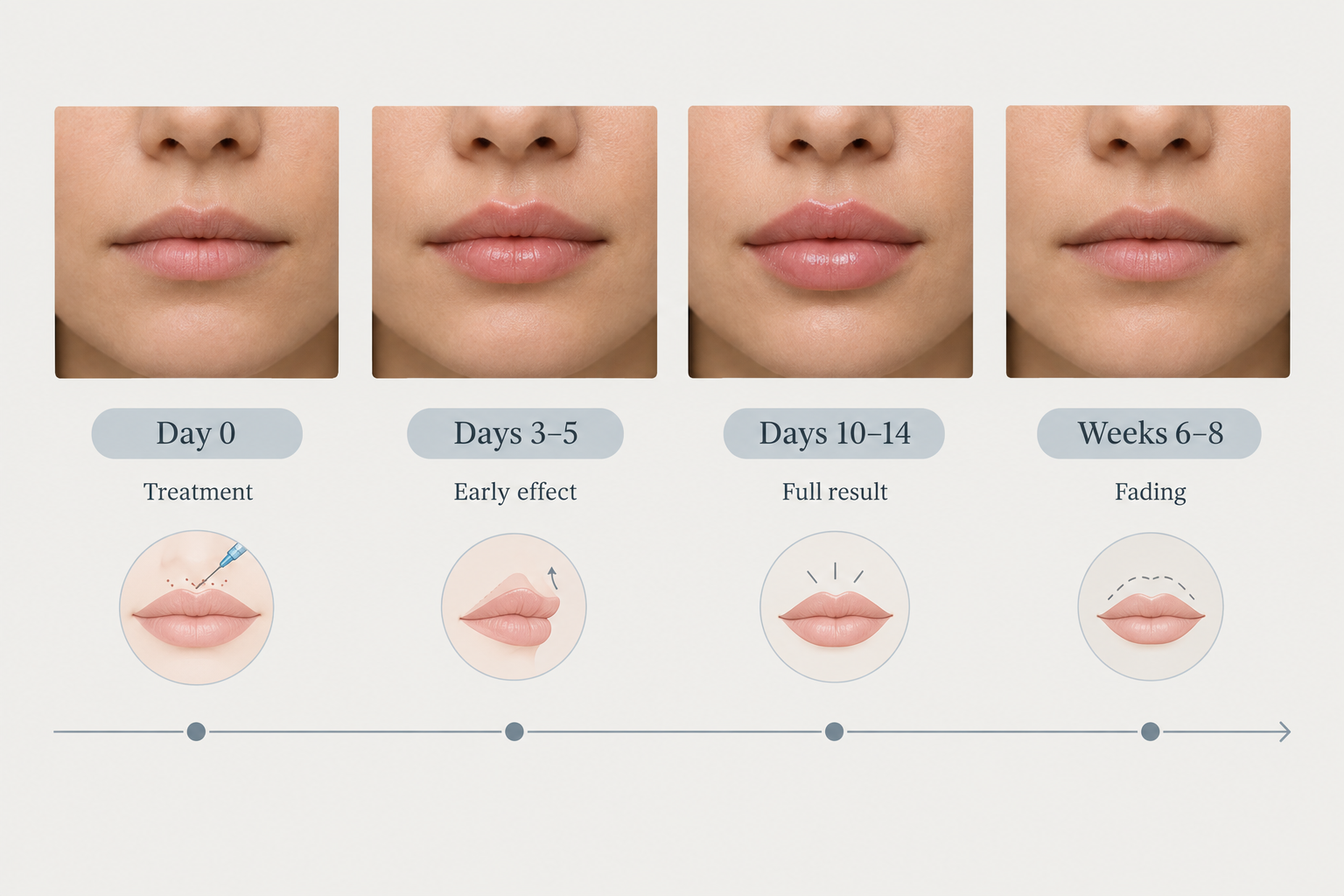
Individual variation is significant. Some patients report results lasting closer to ten to twelve weeks, while others notice the effect fading after four to five weeks. Factors that may influence duration include the specific botulinum toxin product used, the amount administered, individual metabolism, and the degree of muscle activity in the area. Patients considering a lip flip should factor in this relatively short duration when weighing the treatment against alternatives.
Lip Flip vs Lip Filler: Understanding the Difference in Results
Comparing lip flip before and after results with lip filler before and after results highlights a fundamental difference in what each treatment achieves. Lip filler — typically a hyaluronic acid-based dermal filler — physically adds volume to the lips, increasing their size and projection. The change is usually more immediately visible and more dramatic than a lip flip, and results typically last six to twelve months or longer depending on the product used and individual factors.
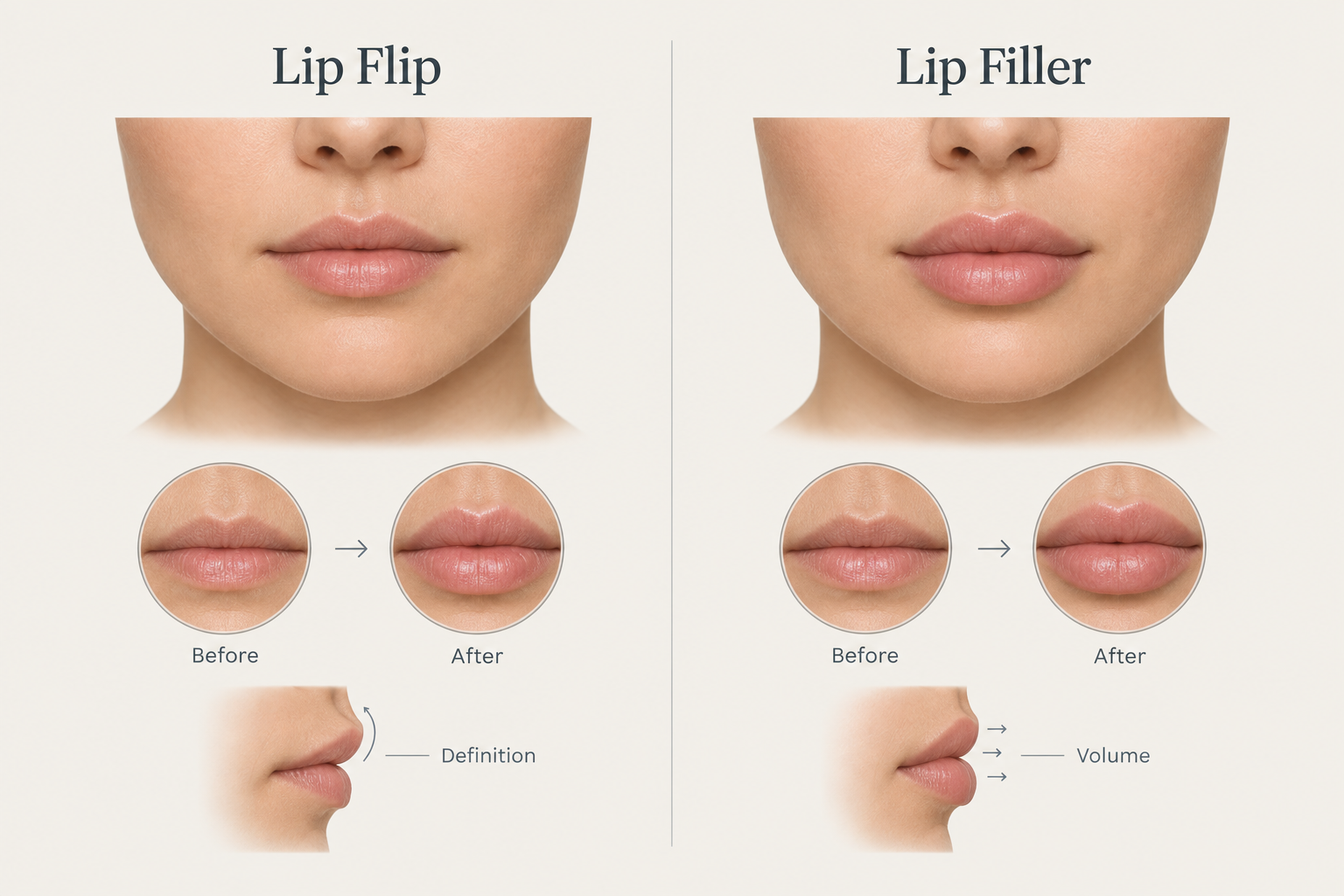
A lip flip, by contrast, produces a more refined change: improved definition and a subtle increase in visible lip surface without added volume. For patients who want a natural-looking enhancement or who are concerned that lip filler may look overdone for their face, a lip flip may be a more appropriate starting point. For patients who want a meaningful increase in lip size, lip filler is likely to be more effective.
Some practitioners offer a combination approach, using a small amount of lip filler for volume alongside a lip flip to improve upper lip definition and reduce the tendency of the lip to roll inward. Whether this combination is appropriate depends on individual anatomy and goals, and should be assessed during a thorough consultation.
Risks, Side Effects, and Limitations
A lip flip carries a specific set of potential side effects that patients should understand before proceeding. Because the orbicularis oris muscle is involved in many fine motor functions of the mouth, temporary changes to these functions are possible after treatment.
- Difficulty with certain mouth movements: Some patients find it temporarily harder to whistle, play wind instruments, drink through a straw, or pronounce certain sounds clearly. These effects are temporary and resolve as the botulinum toxin wears off, but they can be inconvenient and are worth considering for patients whose work or lifestyle depends on precise lip control.
- Asymmetry: Temporary asymmetry during the onset phase is common. Persistent asymmetry beyond two weeks should be reviewed by the treating practitioner.
- Overcorrection: If too much botulinum toxin is used, the lip may appear overly everted or the upper lip may lose its natural shape. This is why conservative dosing and practitioner experience are important.
- Bruising and swelling: Minor bruising or swelling at injection sites is possible and usually resolves within a few days.
- Cold sore reactivation: Patients with a history of herpes simplex virus (cold sores) may experience reactivation following any injectable treatment in the lip area. Prophylactic antiviral medication may be recommended in some cases.
- Unsatisfactory result: Because the change is subtle, some patients feel the result does not meet their expectations. Unlike hyaluronic acid filler, botulinum toxin cannot be dissolved — patients must wait for the effect to wear off naturally if they are unhappy with the outcome.
Serious complications from lip flip treatment are rare when the procedure is performed by a qualified and experienced practitioner using appropriate technique and dosing. However, as with any injectable treatment, the importance of choosing a suitably trained professional cannot be overstated.
Who May Be Suitable for a Lip Flip?
A lip flip may be worth discussing with a practitioner for patients who:
- have an upper lip that appears thin or rolls inward at rest or when smiling;
- want a subtle improvement in upper lip definition without added volume;
- are new to lip treatments and want to try a less permanent option before committing to filler;
- experience upper lip thinning when smiling and want to maintain more visible lip fullness during expression;
- have a mild gummy smile component that may benefit from relaxation of the upper lip muscle (though more significant gummy smile concerns may require a different approach);
- are in good general health with no relevant contraindications to botulinum toxin.
Who May Not Be Suitable
A lip flip is unlikely to be appropriate for patients who:
- are pregnant or breastfeeding;
- have a known allergy or sensitivity to botulinum toxin or any of its components;
- have a neuromuscular condition such as myasthenia gravis or Lambert-Eaton syndrome;
- are taking certain medications that may interact with botulinum toxin, including some antibiotics and muscle relaxants — a full medication review is essential;
- have an active infection or skin condition in the treatment area;
- rely on precise lip muscle control for professional or personal reasons and cannot accommodate even temporary changes to lip function;
- want a significant increase in lip volume — in this case, lip filler is likely a more appropriate option.
Alternatives to a Lip Flip
Patients who are considering a lip flip but are uncertain whether it matches their goals may benefit from understanding the available alternatives.
Lip filler using hyaluronic acid is the most common alternative and is better suited to patients who want increased lip volume. Results last longer than a lip flip and the change is more visible, though the treatment carries its own set of risks including bruising, swelling, asymmetry, and in rare cases vascular complications. Hyaluronic acid filler can be dissolved with hyaluronidase if needed, which provides a degree of reversibility that botulinum toxin does not.
Combination treatment — using both a lip flip and a small amount of lip filler — may suit patients who want both improved definition and modest volume. This approach requires careful assessment to avoid an unnatural appearance.
Perioral botulinum toxin for fine lines around the mouth is a related but distinct treatment that targets vertical lip lines (sometimes called smoker’s lines or lipstick lines) rather than the lip shape itself. Some patients confuse this with a lip flip, but the injection technique and intended outcome differ.
Surgical lip lift is a permanent surgical option that shortens the distance between the nose and the upper lip, increasing the visible height of the upper lip. This is a more significant intervention with a longer recovery period and is generally considered when non-surgical options have not achieved the desired result or when a permanent change is preferred.
Frequently Asked Questions
Does a lip flip hurt?
Most patients describe the discomfort as mild. The injections are made with a fine needle and the number of injection points is small. Topical numbing cream can be applied beforehand if preferred. The lip area is more sensitive than some other injection sites, but the brief duration of the procedure means most patients find it manageable.
Can I see results immediately after a lip flip?
No. Botulinum toxin takes time to take effect. Most patients begin to notice a change between three and five days after treatment, with the full result visible at around ten to fourteen days. Judging the outcome before this point is not reliable.
Will a lip flip make my lips look bigger?
A lip flip does not add volume to the lips. It changes the position of the upper lip so that more of the lip surface is visible, which can create the impression of a slightly fuller upper lip. If a meaningful increase in lip size is the goal, lip filler is likely to be more appropriate.
How often would I need to repeat a lip flip?
Because results typically last six to eight weeks, patients who want to maintain the effect would need to repeat the treatment more frequently than with most other botulinum toxin treatments. This is worth factoring into both the time and cost commitment before proceeding.
Can a lip flip go wrong?
As with any injectable treatment, outcomes are not guaranteed and side effects are possible. The most common concerns are temporary functional changes to lip movement, asymmetry, and results that do not meet expectations. Choosing a qualified and experienced practitioner significantly reduces the risk of a poor outcome, though it does not eliminate it entirely.
Is a lip flip suitable if I already have lip filler?
This depends on individual anatomy, the amount of existing filler, and the specific goals. Some patients with existing lip filler find that a lip flip improves upper lip definition further. A practitioner who can assess the current result in person is best placed to advise whether adding a lip flip is appropriate.
What is the difference between a lip flip and a gummy smile treatment?
Both treatments use botulinum toxin in the upper lip area, but they target different concerns. A gummy smile treatment aims to reduce the amount of gum visible when smiling by limiting how far the upper lip elevates. A lip flip focuses on the orbicularis oris to allow the upper lip to roll outward. There is some overlap in the anatomy involved, and a practitioner may address both concerns in some patients, but they are not the same treatment.
Is a Lip Flip the Right Choice for Your Goals?
A lip flip is a well-defined treatment with a specific and limited scope: it can improve upper lip definition and reduce the tendency of the lip to roll inward, producing a subtle enhancement that suits patients who want a natural-looking result. The before and after difference is real but modest, and patients who approach the treatment with accurate expectations are generally more satisfied than those who expect a dramatic transformation.
The short duration of results — typically six to eight weeks — is a meaningful practical consideration, particularly when compared with lip filler, which lasts considerably longer. The temporary functional side effects, while usually mild and self-resolving, are also worth discussing honestly before treatment, especially for patients whose daily activities involve precise lip control.
For patients who want increased lip volume, a more visible change, or longer-lasting results, lip filler or a combination approach may be more appropriate. For patients who want subtle refinement, improved upper lip definition, or a low-commitment introduction to lip enhancement, a lip flip may be a reasonable option to explore with a qualified practitioner.
A thorough in-person consultation with a suitably trained professional is the most reliable way to determine whether a lip flip is appropriate for your anatomy, concerns, and goals. A practitioner who takes time to understand what you are hoping to achieve — and who is honest about what the treatment can and cannot deliver — is the most important factor in a satisfying outcome.


