
Lip Flip: Who Is It Suitable For and What Should You Expect?
A lip flip is a minimally invasive cosmetic treatment that uses small amounts of botulinum toxin to subtly reshape the upper lip, making it appear slightly fuller and more defined without adding volume through filler. It has become increasingly popular among people who want a natural-looking enhancement rather than a noticeably augmented result, but it is not the right choice for everyone. Understanding what a lip flip actually does, how it differs from lip filler, and whether your anatomy and goals make you a suitable candidate is essential before booking a consultation.
Key Takeaways
- A lip flip uses botulinum toxin injected into the orbicularis oris muscle to relax the upper lip and allow it to roll slightly outward, creating the appearance of a fuller lip without adding volume.
- It is best suited to people with a thin or inward-rolling upper lip, a gummy smile, or those who want a subtle, natural-looking result rather than visible augmentation.
- Results are temporary, typically lasting six to eight weeks, which is shorter than most lip filler treatments.
- Lip flip treatment is not appropriate for everyone; anatomy, medical history, and realistic expectations all influence suitability.
- A qualified practitioner assessment is necessary to determine whether a lip flip, lip filler, or a combination approach is most appropriate for your individual goals.
What Is a Lip Flip?
A lip flip is a botulinum toxin treatment applied to the upper lip area, specifically targeting the orbicularis oris muscle — the circular muscle that surrounds the mouth and controls lip movement. When small, precise amounts of botulinum toxin are injected into this muscle, it partially relaxes, allowing the upper lip to roll slightly outward and upward. The result is that more of the pink lip tissue becomes visible, giving the impression of a fuller, more defined upper lip without physically adding volume beneath the skin.
The term “lip flip” refers to this outward rolling or flipping motion of the lip. It is not a filler procedure and does not involve injecting hyaluronic acid or any volumising substance. The change is subtle by design. Most people who choose a lip flip are not looking for a dramatic transformation; they want their upper lip to look slightly more prominent, particularly when smiling or at rest, without the puffiness or projection that can accompany larger volumes of lip filler.
Botulinum toxin products used in aesthetic medicine — including those commonly known by brand names such as Botox, Dysport, and Azzalure — work by temporarily blocking the nerve signals that cause muscle contraction. In the context of a lip flip, this targeted muscle relaxation changes the resting position and movement of the upper lip rather than altering its physical structure. The effect is functional as well as cosmetic: the lip sits differently because the muscle behaves differently, not because tissue has been added or removed.
How Does a Lip Flip Differ from Lip Filler?
Lip filler and a lip flip are frequently discussed together, but they work through entirely different mechanisms and produce different outcomes. Understanding this distinction is important when deciding which treatment, if either, may be appropriate for your goals.
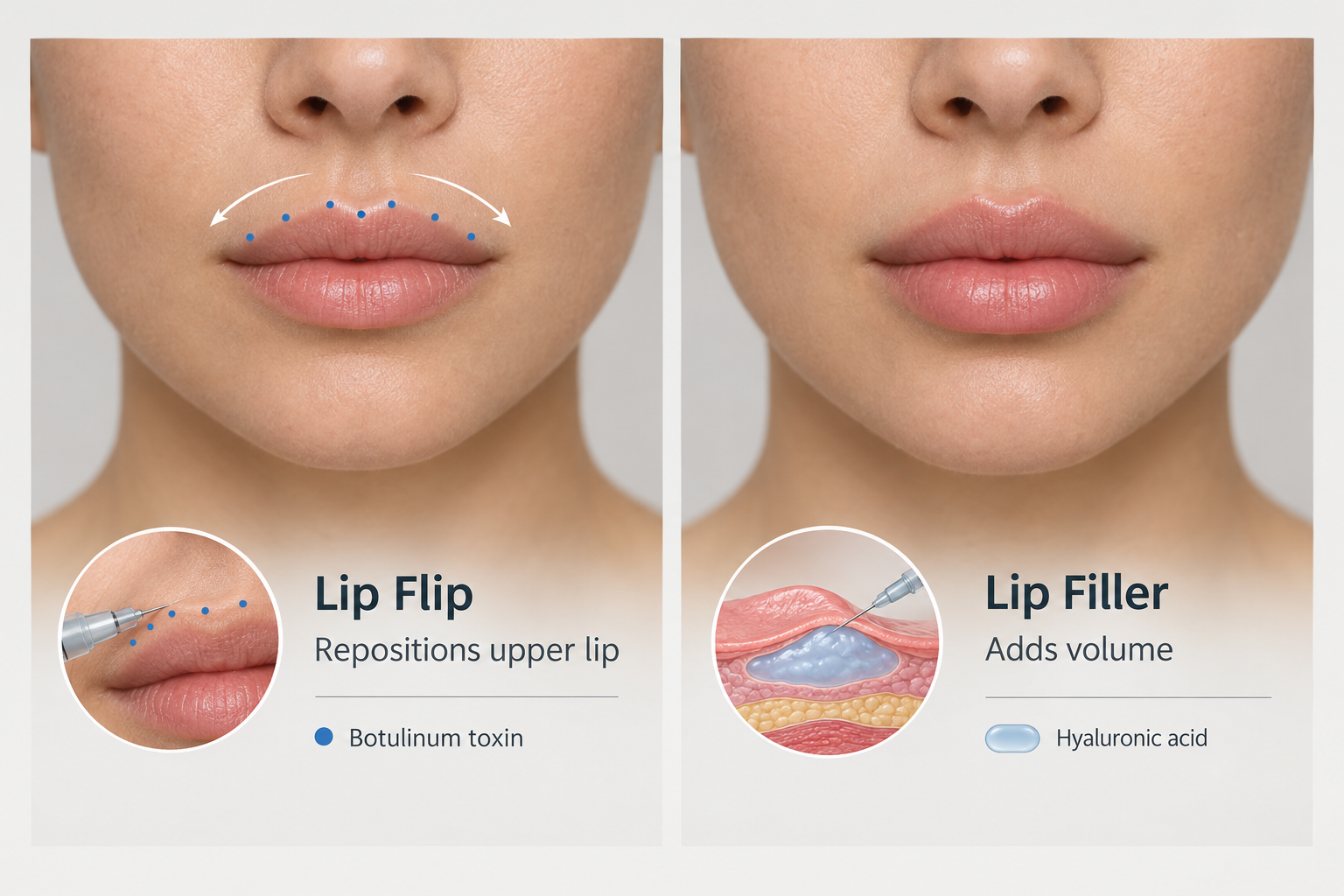
Lip filler typically uses hyaluronic acid — a substance that occurs naturally in the body — injected directly into the lip tissue to add physical volume, shape, and definition. The result is a measurable increase in lip size, and the degree of enhancement can be adjusted by varying the amount of product used. Lip filler can address both the upper and lower lip, define the lip border, and correct asymmetry. Results from hyaluronic acid lip filler generally last between six and twelve months, depending on the product used, the amount injected, individual metabolism, and the treatment area.
A lip flip, by contrast, does not add volume. It changes the position and movement of the upper lip by relaxing the orbicularis oris muscle. The visual effect can resemble a modest increase in lip fullness because more of the lip’s surface becomes visible, but the lip itself has not grown or been augmented. This distinction matters because a lip flip cannot correct significant volume loss, deep lip lines, or a substantially thin lip in the way that filler can. It is a repositioning treatment, not a volumising one.
The two treatments can be used together in some cases. A practitioner may recommend a small amount of lip filler combined with a lip flip to achieve both subtle volume and improved lip position, though this depends on individual anatomy and goals. Each approach carries its own considerations, and the decision should be made following a thorough assessment rather than based on trend alone.
Who May Be Suitable for a Lip Flip?
Suitability for a lip flip depends on a combination of anatomical factors, personal goals, and medical history. The treatment tends to produce the most satisfying results in specific circumstances, and a qualified practitioner will assess these during a consultation.
Anatomical Factors That May Make a Lip Flip Appropriate
People with an upper lip that rolls inward or appears to disappear when they smile are often considered good candidates. This inward rolling means that the pink portion of the upper lip becomes less visible during facial expression, and relaxing the orbicularis oris muscle can allow more of that tissue to show. Similarly, individuals with a naturally thin upper lip who want a modest improvement in definition — rather than a significant increase in volume — may find that a lip flip achieves a result closer to their goal than filler alone.
A lip flip is also commonly discussed in the context of a gummy smile, where a disproportionate amount of gum tissue is visible above the upper teeth when smiling. In some cases, this occurs partly because the upper lip rises too high during smiling due to overactive muscles. Botulinum toxin treatment in this area can reduce the degree to which the lip elevates, making the smile appear more balanced. However, gummy smiles have several possible causes — including the position of the teeth, jaw structure, and gum tissue itself — and botulinum toxin treatment addresses only the muscular component. A practitioner will assess whether this approach is likely to be helpful for a specific individual.
Goals That Align with a Lip Flip
A lip flip may be worth discussing with a practitioner if your primary goal is a subtle, natural-looking improvement rather than visible augmentation. It can be a useful option for people who are new to cosmetic treatments and want to explore a modest change before committing to filler, or for those who have previously found that lip filler produced more volume than they wanted. Because the results are temporary and relatively subtle, the treatment carries a lower commitment than more significant interventions.
People who are concerned about the appearance of their upper lip when speaking or smiling — rather than at rest — may also find a lip flip relevant, since the treatment affects how the lip moves as well as how it sits at rest.
Who May Not Be Suitable for a Lip Flip?
A lip flip is not appropriate for everyone, and there are several circumstances in which a practitioner is likely to advise against it or recommend an alternative approach.
Medical and Safety Considerations
Botulinum toxin treatments are generally contraindicated during pregnancy and breastfeeding. People with certain neuromuscular conditions — such as myasthenia gravis or Lambert-Eaton syndrome — are typically not suitable candidates because botulinum toxin can interact with the way nerves and muscles communicate, potentially causing serious complications. Anyone taking medications that affect neuromuscular function, including certain antibiotics, should discuss this with their practitioner before treatment.
Active infection, inflammation, or skin conditions in or around the treatment area are usually reasons to postpone treatment until the area has resolved. A history of cold sores (herpes simplex) around the mouth does not automatically exclude someone from treatment, but it is relevant information for a practitioner to have, as any injection in the lip area can potentially trigger an outbreak in susceptible individuals.
Allergies to any component of the botulinum toxin formulation being used are a contraindication. People with a known allergy to human albumin, which is present in some botulinum toxin products, should inform their practitioner.
Anatomical and Goal-Related Reasons a Lip Flip May Not Be Appropriate
A lip flip is unlikely to produce satisfying results for someone whose primary concern is significant volume loss, deep vertical lip lines, or a substantially asymmetric lip. These concerns are better addressed with lip filler or, in some cases, a combination of treatments. Attempting to use a lip flip as a substitute for filler when volume is the actual concern is likely to result in disappointment, because the treatment does not add tissue or fill lines.
People who rely heavily on precise lip movement for their profession — such as musicians who play wind instruments, singers, or public speakers — should discuss the potential functional effects of orbicularis oris relaxation with their practitioner before proceeding. Partial relaxation of this muscle can temporarily affect the ability to form certain sounds, whistle, drink through a straw, or use a straw comfortably. These effects are temporary and resolve as the botulinum toxin wears off, but they may be disruptive for some individuals during the treatment period.
What Happens During a Lip Flip Appointment?
A lip flip appointment is typically brief, often taking between fifteen and thirty minutes including the consultation component. Before any injections are given, a practitioner should review the patient’s medical history, discuss goals and expectations, and assess the lip anatomy. This assessment helps determine whether a lip flip is appropriate and, if so, how the treatment should be approached for that individual.
The skin around the mouth is usually cleaned before treatment. Some practitioners apply a topical numbing cream to reduce discomfort, though many patients find the injections tolerable without it given the small number of injection points involved. Botulinum toxin is injected in small amounts at specific points along the upper lip border, targeting the orbicularis oris muscle. The number of injection points and the total amount of product used will vary depending on the practitioner’s assessment and the patient’s anatomy.
Most people experience mild discomfort during the injections, described as a brief stinging or pinching sensation. Significant pain is not typical. After the injections, there may be minor redness, swelling, or small raised areas at the injection sites, which generally settle within a few hours. Bruising is possible but tends to be less common and less extensive than with lip filler, partly because the volumes involved are smaller.
Results, Longevity, and Maintenance
One of the most important practical considerations for anyone thinking about a lip flip is how long the results last. Botulinum toxin effects in the lip area are generally shorter-lived than in areas such as the forehead or between the brows, because the orbicularis oris muscle is used constantly during speaking, eating, and facial expression. Most people find that lip flip results last approximately six to eight weeks, though individual variation means some may notice effects for a shorter or longer period.
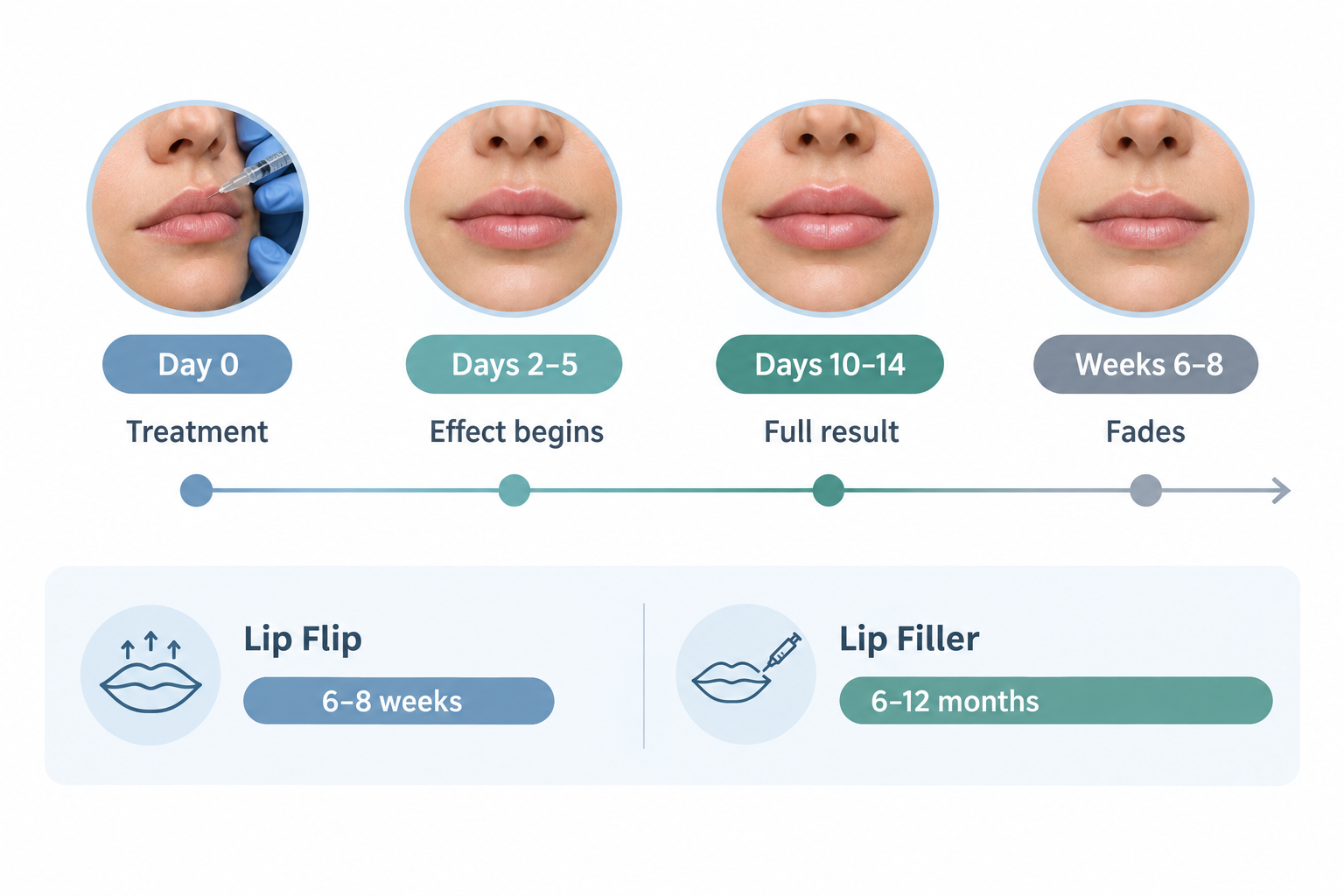
This relatively short duration is a meaningful limitation compared to lip filler, which typically lasts six to twelve months. For someone considering a lip flip as a long-term maintenance treatment, the frequency of repeat appointments required — potentially every six to eight weeks — is worth factoring into the decision alongside cost and convenience.
Results from a lip flip are not immediate. Botulinum toxin takes time to take effect after injection, and most people begin to notice a change within two to five days, with the full effect becoming apparent at around ten to fourteen days. A follow-up appointment at two weeks is common practice, allowing the practitioner to assess the result and address any concerns.
Risks and Side Effects
A lip flip is a medical procedure and carries risks, even though it is minimally invasive. Understanding these risks is part of making an informed decision.
Common and generally temporary side effects include redness, minor swelling, and bruising at the injection sites. These typically resolve within a few days. Headache is occasionally reported after botulinum toxin treatments, though it is not specific to the lip area.
More specific to the lip flip, functional side effects related to orbicularis oris relaxation can include temporary difficulty forming certain sounds, reduced ability to purse the lips, difficulty drinking from a straw or bottle, and changes to the way the lips feel during kissing or eating. These effects are a direct consequence of the muscle relaxation that produces the cosmetic result, and they resolve as the botulinum toxin wears off. However, they can be inconvenient and are worth discussing with a practitioner before treatment, particularly for anyone whose daily activities involve precise lip movement.
Asymmetry is possible if the botulinum toxin does not distribute evenly or if the muscle response differs between sides. In most cases, minor asymmetry can be assessed at a follow-up appointment and addressed if necessary. Significant or persistent asymmetry should be reviewed by the treating practitioner.
Serious complications from botulinum toxin treatment in the lip area are uncommon when the procedure is performed by a qualified and experienced practitioner, but they are not impossible. Vascular complications, though rare, are a risk with any injectable treatment in the face. Choosing a practitioner with appropriate training, qualifications, and a clear understanding of facial anatomy is an important safety consideration.
Alternatives to a Lip Flip
A lip flip is one option among several for people who want to improve the appearance of their lips. The most appropriate alternative depends on the specific concern being addressed.
Lip filler using hyaluronic acid remains the most widely used treatment for lip enhancement. It can add volume, define the lip border, correct asymmetry, and address fine lines around the mouth. Results last longer than a lip flip, and hyaluronic acid filler can be partially or fully dissolved with hyaluronidase if the result is unsatisfactory. Lip filler is generally more suitable than a lip flip when the primary concern is volume loss or significant thinning.
Combination treatment — using both a small amount of lip filler and a lip flip — is sometimes recommended for patients who want both subtle volume and improved lip position. This approach requires careful assessment to avoid over-treatment and should only be undertaken by a practitioner experienced in both techniques.
Skin booster injections in and around the lip area can improve lip hydration, skin quality, and fine line appearance without adding significant volume. These may be relevant for people whose primary concern is lip texture or dryness rather than shape or size.
Topical treatments such as lip plumping glosses or peptide-based serums are non-injectable options that can create a temporary appearance of fuller lips through mild irritation or hydration. Their effects are modest and short-lived compared to injectable treatments, but they carry no medical risk and may suit people who prefer to avoid injections entirely.
A qualified practitioner can help identify which approach, or combination of approaches, is most likely to address a specific concern effectively and safely.
Frequently Asked Questions
Does a lip flip make your lips look bigger?
A lip flip does not add volume to the lips, so it does not make them physically larger. However, by allowing the upper lip to roll slightly outward, it can make more of the lip’s surface visible, which creates the appearance of a fuller upper lip. The effect is subtle and is most noticeable when smiling or speaking. People looking for a significant increase in lip size are generally better suited to lip filler.
Is a lip flip painful?
Most people describe the injections as mildly uncomfortable rather than painful — a brief stinging or pinching sensation at each injection point. The number of injection points is small, and the procedure is quick. Topical numbing cream can be applied beforehand if preferred, though many patients find it unnecessary.
Can a lip flip go wrong?
Like any injectable treatment, a lip flip carries risks. The most common issues are minor and temporary, such as bruising, swelling, or slight asymmetry. Functional side effects — such as difficulty drinking from a straw or forming certain sounds — are a known consequence of orbicularis oris relaxation and resolve as the botulinum toxin wears off. Choosing a qualified, experienced practitioner significantly reduces the risk of complications.
How soon can I see results from a lip flip?
Botulinum toxin takes time to take effect. Most people begin to notice a change within two to five days of treatment, with the full result visible at around ten to fourteen days. A follow-up review at two weeks is standard practice.
Can I have a lip flip if I already have lip filler?
In many cases, yes. Some practitioners recommend a lip flip alongside or after lip filler to refine the position of the upper lip. However, this depends on how much filler is already present, the current lip shape, and individual anatomy. A practitioner will assess whether adding a lip flip is appropriate given the existing treatment.
How long does a lip flip last?
Lip flip results typically last six to eight weeks, though individual variation means some people may notice effects for a shorter or longer period. The orbicularis oris muscle is used constantly during daily activities, which contributes to the relatively short duration compared to botulinum toxin treatments in less active muscle groups.
Is a lip flip suitable for older patients?
Age alone does not determine suitability. However, older patients are more likely to have concerns such as volume loss, vertical lip lines, and changes in lip structure that a lip flip alone cannot adequately address. A practitioner will assess whether a lip flip, lip filler, or a combination approach is most appropriate based on the individual’s anatomy and goals rather than age as a standalone factor.
Is a Lip Flip the Right Choice for Your Goals?
A lip flip can be a well-suited option for people who want a subtle, temporary improvement in upper lip appearance — particularly those with an inward-rolling upper lip, a gummy smile with a muscular component, or a preference for a natural-looking result over visible augmentation. Its minimally invasive nature and relatively low commitment make it an accessible starting point for people new to cosmetic treatments.
At the same time, the lip flip has meaningful limitations. Its results are shorter-lived than lip filler, it cannot address volume loss or significant lip thinning, and the functional side effects of orbicularis oris relaxation may be inconvenient for some individuals. It is not suitable for everyone, and medical history, anatomy, and realistic expectations all play a role in determining whether it is the right approach.
The most reliable way to assess whether a lip flip is appropriate for you is through a consultation with a qualified aesthetic practitioner who can evaluate your lip anatomy, discuss your goals honestly, and recommend the treatment — or combination of treatments — most likely to produce a result you will be satisfied with. A well-informed decision, made with professional guidance, is always preferable to choosing a treatment based on trend or assumption alone.


