
Exosomes for Thinning Hair: What the Treatment Involves and What to Expect
Exosome therapy is attracting growing interest as a non-surgical option for people experiencing hair thinning or early hair loss. The treatment uses cell-derived signalling particles to deliver growth factors and other biological messengers directly to the scalp, with the aim of supporting follicle health and stimulating hair regrowth. While the evidence base is still developing, early clinical data and patient reports suggest it may offer meaningful improvement for certain types of hair loss — though results vary and the treatment is not suitable for everyone.
Key Takeaways
- Exosomes are tiny extracellular vesicles that carry growth factors, proteins, and genetic material capable of influencing cell behaviour in the scalp.
- The treatment is primarily used for androgenetic alopecia (pattern hair loss) and may also be explored for other types of hair thinning, though evidence varies by condition.
- Most patients require a course of sessions rather than a single treatment, and results typically become visible over several months.
- Exosome therapy is generally considered lower-risk than surgical hair restoration, but it is not risk-free and is not a permanent cure for hair loss.
- A thorough clinical assessment is essential before treatment, as suitability depends on the cause and stage of hair loss, medical history, and individual factors.
What Are Exosomes and How Do They Work on the Scalp?
Exosomes are nanoscale extracellular vesicles — essentially tiny membrane-bound packages — released naturally by cells throughout the body. They act as intercellular messengers, carrying proteins, lipids, messenger RNA, microRNA, and growth factors from one cell to another. In the context of hair restoration, exosomes derived from stem cells (most commonly mesenchymal stem cells) are applied to the scalp with the intention of delivering a concentrated payload of regenerative signals to hair follicles.
Hair follicles cycle through phases of growth (anagen), regression (catagen), and rest (telogen). In androgenetic alopecia and some other forms of hair loss, follicles progressively miniaturise — they produce thinner, shorter hairs and spend less time in the active growth phase. The proposed mechanism of exosome therapy is that the growth factors and signalling molecules within the vesicles may help shift follicles back toward the anagen phase, reduce follicular inflammation, improve blood supply to the scalp, and support the survival of follicle stem cells. Key growth factors associated with this process include vascular endothelial growth factor (VEGF), Wnt signalling pathway activators, and various cytokines involved in tissue repair.
It is important to understand that exosomes do not contain living cells and do not integrate into the body’s own tissue in the way a transplant would. They act by delivering biological instructions that may encourage the body’s existing follicles to function more effectively. This distinction matters for both safety and realistic expectations.
What Types of Hair Loss May Exosome Therapy Address?
Exosome therapy for hair is most commonly discussed in relation to androgenetic alopecia, the pattern hair loss that affects both men and women and is driven by a combination of genetic predisposition and the hormone dihydrotestosterone (DHT). This is the most prevalent form of hair thinning and the condition for which the most clinical interest in exosome treatment currently exists.
Some practitioners also explore exosome scalp treatments for alopecia areata (an autoimmune condition causing patchy hair loss), telogen effluvium (diffuse shedding often triggered by stress, illness, or nutritional deficiency), and post-partum hair loss. However, the evidence for exosome therapy in these conditions is considerably more limited than for androgenetic alopecia, and outcomes are less predictable. The underlying cause of hair loss significantly influences whether any regenerative treatment is likely to be beneficial.
Exosome therapy is generally considered most appropriate for people with active but miniaturised follicles — that is, follicles that are still present and potentially responsive, rather than follicles that have been completely lost and replaced by scar tissue. In advanced hair loss where follicles are no longer viable, regenerative treatments including exosomes are unlikely to produce meaningful regrowth.
How Is Exosome Treatment for Hair Performed?
The treatment is typically performed in a clinical setting by a trained practitioner. Before the appointment, a consultation should take place to assess the pattern and cause of hair loss, review medical history, and determine whether exosome therapy is appropriate. Scalp photography or trichoscopy (a magnified examination of the scalp and follicles) may be used to document baseline hair density and follicle health.
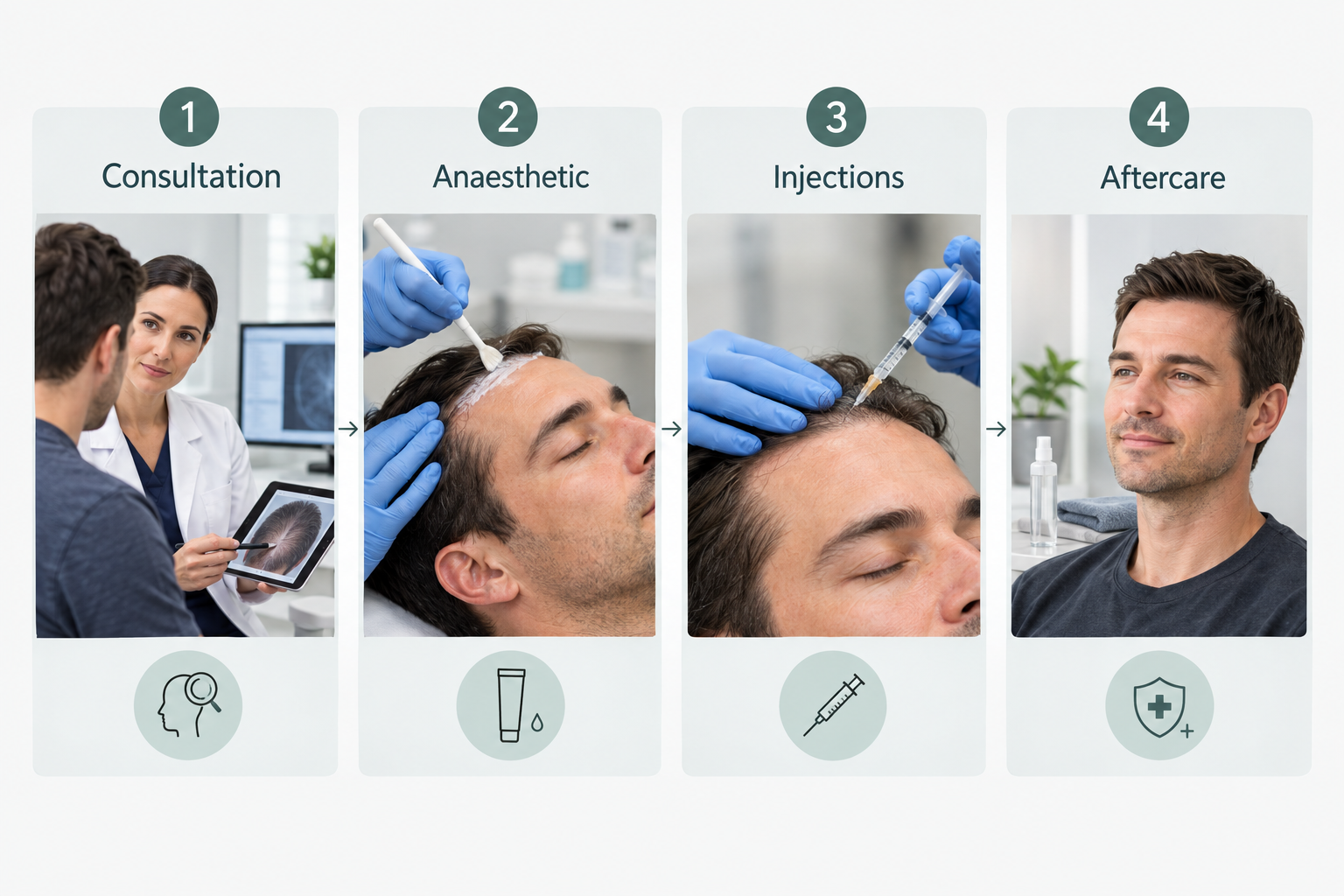
During the treatment itself, the exosome solution is usually delivered into the scalp via microinjections — a technique similar in approach to mesotherapy or platelet-rich plasma (PRP) injections. Some clinics use microneedling devices to create micro-channels in the scalp skin before applying the exosome solution topically, which may enhance absorption. The choice of delivery method can vary between clinics and practitioners, and there is currently no single universally standardised protocol.
The appointment typically takes between 30 and 60 minutes depending on the area being treated and the delivery method used. A topical anaesthetic cream is usually applied beforehand to reduce discomfort, though some patients report mild stinging or pressure during the injections. The scalp may appear slightly red or feel tender immediately after treatment, but this generally settles within a day or two.
How Many Sessions Are Typically Needed?
A single exosome session is unlikely to produce significant or lasting results. Most treatment protocols involve an initial course of two to four sessions, often spaced four to six weeks apart, followed by maintenance treatments at longer intervals — commonly every three to six months — depending on the individual’s response. The exact number of sessions recommended will depend on the severity of hair thinning, the patient’s response to initial treatment, and the practitioner’s clinical judgement.
Because hair follicles cycle slowly and the anagen phase of regrowth takes time, visible improvements in hair density and thickness typically emerge gradually. Many patients begin to notice reduced shedding within the first few weeks, with more visible changes in hair coverage and calibre becoming apparent at three to six months after starting treatment. Full assessment of results is generally not meaningful until at least six months have passed.
What Results Can Patients Realistically Expect?
The evidence for exosome therapy in hair loss is promising but still at an early stage. Several small clinical studies and case series have reported improvements in hair density, hair shaft diameter, and patient-reported satisfaction following exosome scalp treatment. However, large-scale randomised controlled trials — the gold standard for evaluating treatment effectiveness — are limited, and the field lacks the depth of long-term data available for established treatments such as minoxidil or finasteride.
Realistic expectations are important. Exosome therapy may help slow the progression of hair thinning, improve the quality and thickness of existing hairs, and in some cases stimulate regrowth in areas of early loss. It is unlikely to restore a full head of hair in someone with advanced pattern baldness, and it does not address the underlying hormonal or genetic drivers of androgenetic alopecia. Results vary considerably between individuals, and not every patient will respond to treatment.
Patients who tend to respond most favourably are generally those in the earlier stages of hair loss, with miniaturised but still-present follicles, who are otherwise in good health and have realistic expectations about the degree of improvement achievable.
Potential Benefits of Exosome Scalp Treatment
- Non-surgical approach: Exosome therapy does not require incisions, donor sites, or the recovery associated with hair transplant surgery.
- Regenerative mechanism: The treatment targets follicle biology directly, aiming to support the conditions needed for natural hair growth rather than simply masking thinning.
- Minimal downtime: Most patients can return to normal activities within a day or two of treatment.
- May complement other treatments: Exosome therapy can potentially be used alongside topical or oral hair loss treatments, though this should be discussed with a qualified practitioner.
- Suitable for both men and women: Unlike some pharmacological treatments that are primarily indicated for one sex, exosome scalp therapy may be considered for both male and female pattern hair loss.
- No risk of immune rejection: Because exosomes do not contain living donor cells, the risk of an immune reaction is considered lower than with some cell-based therapies, though adverse reactions remain possible.
Limitations and Considerations
- Evidence is still developing: The clinical evidence base for exosome hair treatment is growing but remains limited compared to established medical therapies. Long-term efficacy data are lacking.
- Results are not guaranteed: Individual response varies, and some patients may see little or no improvement.
- Not a permanent solution: Exosome therapy does not cure the underlying cause of hair loss. Maintenance treatments are likely to be needed to sustain any benefit.
- Regulation varies: The regulatory status of exosome products differs between countries. In some regions, exosome preparations for clinical use are subject to strict oversight; in others, regulation is less defined. Patients should ask their practitioner about the source, quality, and regulatory status of the product being used.
- Cost: Exosome hair treatment is typically more expensive than PRP therapy and is not covered by health insurance in most cases.
- Standardisation: There is currently no universally agreed protocol for exosome hair treatment, meaning the concentration, source, and delivery method of exosomes can differ significantly between clinics.
Risks and Side Effects
Exosome scalp treatment is generally considered to carry a low risk of serious adverse effects when performed by a qualified practitioner using a reputable, quality-controlled product. However, no treatment is entirely without risk, and patients should be aware of the following possibilities.
Common and usually temporary side effects include redness, mild swelling, tenderness, and small injection-site marks on the scalp. These typically resolve within 24 to 72 hours. Some patients experience mild itching or a sensation of tightness in the scalp for a short period after treatment.
Less common risks include infection at injection sites, bruising, and an allergic or inflammatory reaction to the exosome preparation. The risk of infection is minimised by proper sterile technique, and the risk of allergic reaction is considered low given that exosomes do not contain foreign cells — but it cannot be entirely excluded. Patients with known hypersensitivity to any component of the preparation should discuss this with their practitioner before proceeding.
Because the field is relatively new, the full long-term safety profile of exosome scalp treatments has not yet been established through large-scale clinical follow-up. Patients should be informed of this uncertainty as part of the consent process.
Who May Be Suitable for Exosome Hair Treatment?
Exosome therapy for hair thinning may be worth discussing with a qualified practitioner if you are experiencing early to moderate androgenetic alopecia, have miniaturised but still-present follicles, are in generally good health, and have realistic expectations about the degree of improvement achievable. It may also be considered for people who have not responded adequately to first-line treatments or who are looking for a complementary approach alongside existing hair loss management.
A thorough clinical assessment is essential before treatment. This should include a review of the pattern and duration of hair loss, relevant medical history, current medications, and any previous treatments. Scalp examination — ideally with trichoscopy — helps determine whether viable follicles are present and whether the pattern of loss is consistent with a condition likely to respond to regenerative treatment.
Who May Not Be Suitable?
Exosome scalp treatment may not be appropriate for everyone. Practitioners will typically advise caution or recommend against treatment in the following circumstances:
- Active scalp infection, inflammation, or skin disease in the treatment area
- Advanced hair loss where follicles are no longer present or viable
- Pregnancy or breastfeeding (due to insufficient safety data)
- Active autoimmune conditions or immunosuppressive therapy (depending on the specific condition and clinical context)
- Known allergy or hypersensitivity to components of the exosome preparation
- Certain blood disorders or clotting abnormalities
- Recent scalp surgery or significant scalp trauma
This list is not exhaustive. A qualified practitioner will assess individual suitability based on a full clinical history and examination.
How Does Exosome Therapy Compare to Other Hair Loss Treatments?
Exosome therapy sits within a broader landscape of options for managing hair thinning. Understanding how it relates to other approaches helps patients make more informed decisions.
Minoxidil and finasteride remain the most extensively studied and widely used medical treatments for androgenetic alopecia. Minoxidil (available topically and in oral form) prolongs the anagen phase and increases follicle size. Finasteride reduces DHT levels and is primarily used in men. Both have substantial long-term evidence supporting their effectiveness, though they require ongoing use to maintain results and carry their own side effect profiles. Exosome therapy does not replace these treatments but may be considered alongside them in some cases.
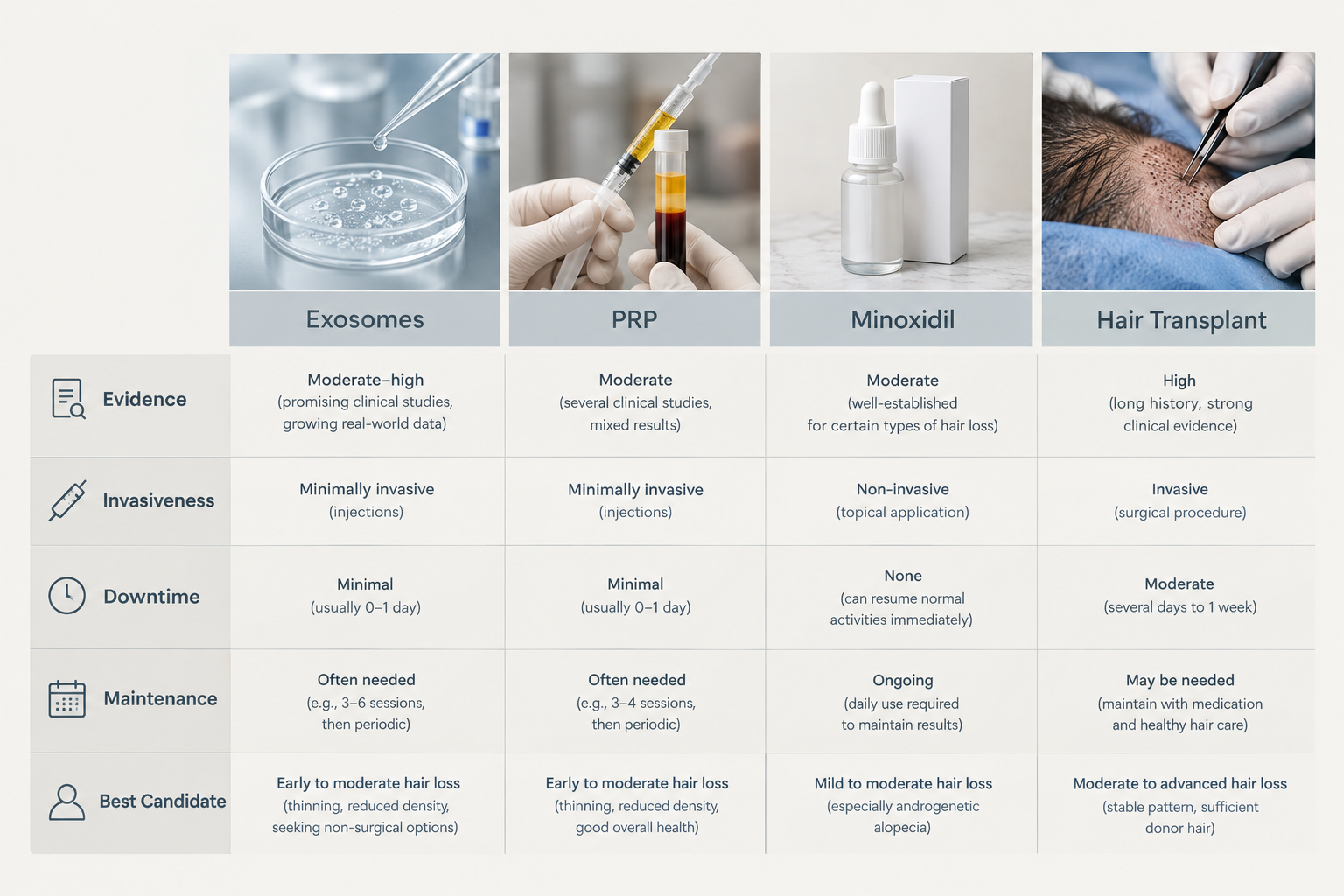
Platelet-rich plasma (PRP) therapy is the regenerative treatment most directly comparable to exosome scalp treatment. PRP involves concentrating growth factors from the patient’s own blood and injecting them into the scalp. Like exosome therapy, PRP aims to support follicle health through biological signalling. PRP has a longer clinical track record and a larger body of published evidence than exosome therapy. Exosomes may offer a more concentrated and consistent payload of growth factors, but the comparative clinical evidence between the two approaches is limited. Some practitioners offer both as part of a combined protocol.
Low-level laser therapy (LLLT) uses specific wavelengths of light to stimulate follicle activity and is available as in-clinic devices and home-use caps or combs. It is generally considered a lower-intensity option with a modest evidence base, and it may be used alongside other treatments.
Hair transplant surgery (follicular unit extraction or follicular unit transplantation) remains the only option capable of restoring hair in areas where follicles are permanently lost. It is a surgical procedure with associated recovery, cost, and the requirement for sufficient donor hair. Exosome therapy is not a substitute for hair transplant surgery in advanced hair loss, but it may be used post-transplant to support graft survival and scalp recovery — an area of growing clinical interest.
Frequently Asked Questions
How long does it take to see results from exosome hair treatment?
Most patients begin to notice a reduction in shedding within the first few weeks, but visible improvements in hair density and thickness typically take three to six months to become apparent. Hair follicles cycle slowly, so patience is required. A full assessment of results is generally not meaningful until at least six months after starting a course of treatment.
Is exosome therapy for hair painful?
A topical anaesthetic cream is usually applied to the scalp before treatment to reduce discomfort. Most patients describe the injections as mildly uncomfortable rather than painful. Some tenderness or sensitivity in the scalp may persist for a day or two after the appointment.
How is exosome therapy different from PRP for hair?
Both treatments aim to deliver growth factors to the scalp to support follicle health. PRP uses growth factors concentrated from the patient’s own blood, while exosome therapy uses cell-derived vesicles — typically from mesenchymal stem cells — that carry a broader range of signalling molecules. Exosome preparations are not derived from the patient’s own blood, which means the product is standardised but also means it comes from an external source. The clinical evidence for PRP in hair loss is more established; exosome therapy is newer with a smaller but growing evidence base.
Can exosome treatment be combined with a hair transplant?
Some practitioners use exosome therapy in conjunction with hair transplant surgery, either to prepare the scalp beforehand or to support graft survival and healing afterwards. This is an area of active clinical interest, though the evidence for combined protocols is still emerging. Any decision to combine treatments should be made in consultation with a qualified hair restoration specialist.
Are the results from exosome hair treatment permanent?
Exosome therapy does not address the underlying genetic or hormonal causes of androgenetic alopecia. The improvements achieved may diminish over time if maintenance treatments are not continued. Most practitioners recommend periodic maintenance sessions to sustain results, though the optimal frequency varies between individuals.
What should I look for when choosing a clinic for exosome hair treatment?
Look for a clinic where treatment is performed or supervised by a qualified medical professional with specific experience in hair loss assessment and scalp treatments. Ask about the source and regulatory status of the exosome product used, the delivery method, the proposed treatment protocol, and what monitoring will be in place to assess your response. A thorough consultation and scalp assessment before committing to treatment is a reasonable expectation.
Is Exosome Therapy Worth Considering for Thinning Hair?
Exosome therapy for hair thinning represents a genuinely interesting development in the field of non-surgical hair restoration. The biological rationale is sound — delivering concentrated growth factors and signalling molecules to the scalp has a plausible mechanism for supporting follicle health — and early clinical results are encouraging for patients in the earlier stages of hair loss. However, the evidence base is not yet at the level of established treatments such as minoxidil or finasteride, and the lack of standardised protocols means that the quality and concentration of exosome preparations can vary significantly between providers.
For patients with early to moderate androgenetic alopecia who have not achieved satisfactory results with first-line treatments, or who are looking for a complementary regenerative approach, exosome scalp therapy may be a reasonable option to explore with a qualified practitioner. It is unlikely to be appropriate as a standalone solution for advanced hair loss, and it should not be approached with the expectation of a permanent cure.
The most important step before pursuing any hair loss treatment is a thorough clinical assessment to identify the cause and pattern of thinning, determine whether viable follicles are present, and discuss which combination of approaches is most likely to be beneficial for your specific situation. A practitioner experienced in hair loss medicine will be best placed to advise whether exosome therapy is a suitable part of your treatment plan.


