
Crow’s Feet Treatment: How to Soften Eye-Corner Lines
Crow’s feet are the fine lines and wrinkles that radiate outward from the outer corners of the eyes. They develop gradually through a combination of repeated facial muscle movement, natural collagen loss, and cumulative sun exposure. For many people, these eye-corner lines are among the first visible signs of skin ageing, and they are one of the most common concerns addressed in aesthetic medicine. Several treatment approaches are available, ranging from botulinum toxin injections to skin resurfacing and topical skincare, each with different mechanisms, timelines, and suitability profiles.
Key Takeaways
- Crow’s feet form primarily from repeated contraction of the orbicularis oculi muscle around the eye, combined with progressive collagen and elastin loss in the skin.
- Botulinum toxin injections are the most widely used clinical treatment for dynamic crow’s feet lines and can produce visible softening within one to two weeks.
- Skin resurfacing treatments such as laser therapy, chemical peels, and microneedling may improve static lines and overall skin texture around the eye area.
- Results from any crow’s feet treatment are temporary and require maintenance; no single treatment permanently eliminates these lines.
- A qualified practitioner assessment is essential to identify which type of lines are present and which treatment approach may be most appropriate for your anatomy and goals.
What Causes Crow’s Feet?
Crow’s feet develop through two overlapping processes. Dynamic crow’s feet are caused by the repeated contraction of the orbicularis oculi, the circular muscle that surrounds the eye and controls blinking, squinting, and smiling. Every time this muscle contracts, the overlying skin folds. In younger skin with abundant collagen and elastin, these folds spring back. Over time, as the skin’s structural proteins break down, the folds begin to persist even when the face is at rest.
Static crow’s feet are lines that remain visible without any muscle movement. These reflect underlying changes in skin quality, including reduced collagen density, thinning of the dermis, and loss of subcutaneous volume around the orbital area. Sun exposure accelerates this process by degrading collagen and elastin through ultraviolet radiation, which is why crow’s feet often appear more pronounced on the sun-exposed outer eye area than on more protected skin nearby.
Understanding whether lines are primarily dynamic, primarily static, or a combination of both is clinically relevant because it influences which treatment approach is most likely to produce a meaningful improvement. A practitioner will assess this during consultation.
Botulinum Toxin for Crow’s Feet
Botulinum toxin injections are the most established and widely used crow’s feet treatment for dynamic lines. The treatment works by temporarily blocking the nerve signals that cause the orbicularis oculi muscle to contract. When the muscle activity is reduced, the overlying skin is no longer repeatedly folded, which allows existing lines to soften and reduces the formation of new creases during the treatment period.
Several botulinum toxin formulations are used in aesthetic practice, including Botox (onabotulinumtoxinA), Dysport (abobotulinumtoxinA), and Azzalure, among others. These products share the same mechanism of action but differ in their formulation, unit dosing, and diffusion characteristics. Units are not interchangeable between brands, and the appropriate product and dose for crow’s feet treatment is determined by the practitioner based on individual muscle anatomy and the degree of movement present.
Results from botulinum toxin treatment for crow’s feet typically become visible within five to fourteen days after injection. The effect is not permanent; most patients find that results last approximately three to four months, though individual variation is common. Some patients with less pronounced dynamic activity may notice effects lasting slightly longer, while others may metabolise the product more quickly. Regular maintenance appointments are required to sustain the improvement.
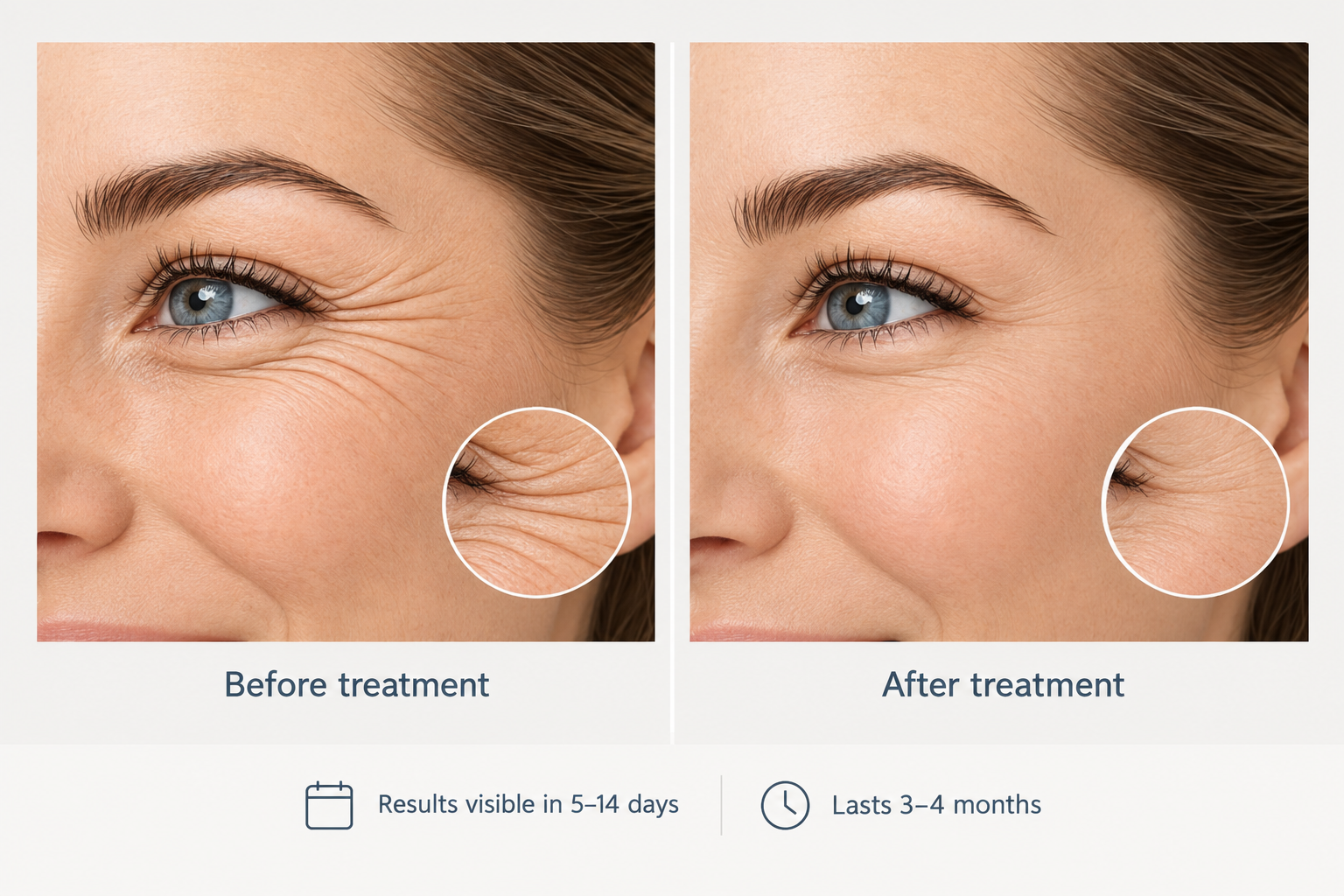
The treatment itself involves a small number of injections placed around the outer eye area. Discomfort is generally mild and brief. There is no significant downtime, though minor redness, swelling, or small bruises at injection sites may occur and typically resolve within a few days. Botulinum toxin treatment for crow’s feet is not suitable during pregnancy or breastfeeding, and certain neuromuscular conditions or medications may affect suitability. A full medical history review is part of any responsible pre-treatment consultation.
Dermal Fillers Around the Eye Area
Dermal fillers are not typically the first-line treatment for crow’s feet lines themselves, but they may play a role in addressing volume loss in the periorbital area that contributes to the overall appearance of ageing around the eyes. Hyaluronic acid fillers can be used to restore volume to the temple region or the upper cheek, which may indirectly reduce the appearance of lateral eye-corner lines by improving the structural support of the surrounding tissue.
Direct injection of filler into the crow’s feet area is technically possible but is approached with considerable caution by experienced practitioners. The skin around the outer eye is thin, and the periorbital region has a complex vascular anatomy. Complications from filler in this area, while uncommon when performed by a skilled and experienced injector, can be serious. Vascular occlusion is a rare but recognised risk that requires immediate management. For this reason, treatment in the periorbital zone should only be undertaken by practitioners with specific training and experience in this anatomy.
Dermal fillers are more commonly used in combination with botulinum toxin as part of a broader facial rejuvenation approach rather than as a standalone crow’s feet treatment.
Skin Resurfacing Treatments for Eye-Corner Lines
For static crow’s feet lines, where the wrinkles are visible even without muscle movement, skin resurfacing treatments may offer meaningful improvement by stimulating collagen production and improving the quality and texture of the skin around the eye area.

Laser Skin Resurfacing
Ablative laser treatments, such as fractional CO2 or erbium laser resurfacing, remove the outer layers of skin in a controlled manner and stimulate the production of new collagen in the dermis. These treatments can produce noticeable improvement in fine lines and skin texture around the eyes, but they involve a recovery period of several days to two weeks depending on the depth of treatment, during which the skin will be red, sensitive, and peeling. Non-ablative laser options cause less surface disruption and have shorter downtime but may require multiple sessions to achieve comparable results.
Laser resurfacing around the eye area requires careful patient selection. Skin type, history of cold sores, use of certain medications such as isotretinoin, and previous treatments are all relevant factors. The periorbital skin is delicate, and treatment parameters must be adjusted accordingly by a qualified practitioner.
Chemical Peels
Chemical peels use acids such as glycolic acid, trichloroacetic acid (TCA), or other exfoliating agents to remove superficial skin layers and encourage cellular renewal. Superficial peels may improve skin texture and mild fine lines with minimal downtime, while medium-depth peels can address more established static lines but require a longer recovery. Chemical peels around the eye area are generally performed with care given the sensitivity of the periorbital skin, and the appropriate peel depth is determined by the practitioner based on skin type and the nature of the lines being treated.
Microneedling
Microneedling uses fine needles to create controlled micro-injuries in the skin, which stimulates the body’s natural wound-healing response and promotes collagen and elastin production. When applied to the crow’s feet area, microneedling may improve skin quality and reduce the appearance of fine lines over a course of treatments. Results develop gradually over several weeks as new collagen forms. Multiple sessions are typically recommended, and the treatment is generally well tolerated with a short recovery period of one to two days of redness and mild sensitivity.
Radiofrequency and Energy-Based Treatments
Radiofrequency (RF) treatments deliver controlled thermal energy into the deeper layers of the skin to stimulate collagen remodelling and skin tightening. Devices that combine radiofrequency with microneedling, sometimes referred to as RF microneedling, deliver energy directly into the dermis and may produce more pronounced collagen stimulation than either modality alone. These treatments can be used around the eye area to address skin laxity and fine lines, though the periorbital region requires careful technique and appropriate device settings.
High-intensity focused ultrasound (HIFU) is another energy-based option that targets deeper tissue layers to stimulate collagen production and lift. HIFU is more commonly used for broader facial lifting than for isolated crow’s feet treatment, but it may be considered as part of a comprehensive approach to periorbital skin quality. Evidence for these technologies continues to develop, and results vary between individuals and devices.
Topical Skincare and Preventive Measures
Topical skincare cannot replicate the results of clinical treatments for established crow’s feet, but it plays a meaningful role in both prevention and maintenance. Retinoids, including prescription tretinoin and over-the-counter retinol, are among the most evidence-supported topical ingredients for stimulating collagen production and improving fine lines. Consistent use over several months may produce a gradual improvement in skin texture and mild lines around the eye area, though the periorbital skin is sensitive and retinoid products formulated for the eye area are generally better tolerated than standard facial formulations.
Broad-spectrum sunscreen applied daily to the periorbital area is one of the most effective preventive measures against the progression of crow’s feet. Ultraviolet radiation is a primary driver of collagen degradation and premature skin ageing, and consistent sun protection can meaningfully slow the development of new lines. Wearing UV-protective sunglasses reduces squinting, which in turn reduces the repetitive muscle movement that contributes to dynamic line formation.
Peptide-containing eye creams and antioxidant serums may support skin health and hydration, though the evidence for their ability to significantly reduce established crow’s feet is more limited than for retinoids or clinical treatments.
Combining Treatments
In practice, many patients benefit from a combination approach rather than a single treatment. Botulinum toxin addresses the dynamic component of crow’s feet by reducing muscle movement, while skin resurfacing or radiofrequency treatments address the static component by improving skin quality and stimulating collagen. A practitioner may recommend a staged or combined plan depending on the nature and severity of the lines, the patient’s skin type, and their goals and tolerance for downtime.
Combination treatment plans should be developed by a qualified practitioner who can assess the full picture of the patient’s periorbital anatomy, skin quality, and treatment history. There is no universally optimal combination, and the right approach varies between individuals.
Who May Be Suitable for Crow’s Feet Treatment?
Most adults who are bothered by visible lines at the outer corners of their eyes may be candidates for one or more of the available treatments, subject to a clinical assessment. Botulinum toxin treatment is generally well suited to patients with predominantly dynamic crow’s feet, where the lines are most visible during expression. Patients with a mix of dynamic and static lines may benefit from a combined approach. Those with primarily static lines and changes in skin quality may be better served by resurfacing or energy-based treatments.
Factors that may affect suitability for specific treatments include:
- Pregnancy or breastfeeding, which contraindicates botulinum toxin and most clinical treatments
- Certain neuromuscular conditions, which may affect suitability for botulinum toxin
- Active skin infections or inflammatory skin conditions in the treatment area
- History of keloid scarring, which may be relevant for resurfacing treatments
- Certain medications, including blood thinners, which may increase bruising risk
- Skin type and phototype, which influence the risk profile for laser and chemical peel treatments
- Previous treatments in the area, including prior filler or surgical procedures
A thorough consultation with a qualified practitioner is the appropriate starting point for any patient considering crow’s feet treatment.
Risks and Side Effects
All aesthetic treatments carry some degree of risk, and crow’s feet treatments are no exception. Understanding the potential side effects of each approach helps patients make an informed decision.
Botulinum toxin injections around the eye area carry a small risk of temporary bruising, swelling, or redness at injection sites. A rare but recognised complication is temporary eyelid drooping (ptosis) or brow heaviness if the product spreads to adjacent muscles. This effect is temporary and resolves as the botulinum toxin wears off, but it underscores the importance of treatment by an experienced and qualified injector who understands the anatomy of the periorbital region.
Skin resurfacing treatments including laser, chemical peels, and microneedling carry risks of temporary redness, swelling, sensitivity, and peeling during recovery. More significant risks include post-inflammatory hyperpigmentation, particularly in patients with darker skin tones, and in rare cases scarring. Choosing an appropriately qualified practitioner and following pre- and post-treatment care instructions reduces these risks.
Energy-based treatments such as radiofrequency and HIFU may cause temporary redness, swelling, or mild discomfort. Rare adverse effects include burns or changes in skin sensation, which are more likely when treatment is performed with inappropriate settings or by inadequately trained operators.
How Long Do Results Last?
The longevity of crow’s feet treatment results depends on the treatment type and individual factors. Botulinum toxin effects for crow’s feet typically last three to four months, after which muscle activity gradually returns and lines may reappear. Patients who maintain regular treatment appointments over time sometimes report that lines appear less deep between sessions, possibly because the reduced muscle activity slows the progression of static line formation, though this observation is not universally consistent.
Skin resurfacing and collagen-stimulating treatments produce results that develop gradually over weeks to months as new collagen forms. These improvements may last longer than botulinum toxin effects, but they are not permanent. The natural ageing process continues, and maintenance treatments are typically recommended to sustain results. The frequency of maintenance depends on the treatment type and the individual’s rate of skin ageing.
No crow’s feet treatment currently available produces permanent elimination of these lines. Realistic expectations and a clear understanding of the maintenance commitment involved are important parts of the decision-making process.
Frequently Asked Questions
At what age do crow’s feet typically appear?
Crow’s feet can begin to appear in the late twenties or early thirties, initially as faint dynamic lines visible only during expression. They tend to become more pronounced and persistent through the thirties and forties as collagen loss accelerates. The timing varies considerably between individuals depending on genetics, sun exposure history, and lifestyle factors such as smoking.
Can crow’s feet be prevented?
While crow’s feet cannot be entirely prevented, their progression can be slowed. Daily broad-spectrum sunscreen use, wearing UV-protective sunglasses to reduce squinting, not smoking, maintaining adequate hydration, and using evidence-supported topical ingredients such as retinoids are among the most practical preventive measures. Starting these habits early in adulthood is more effective than beginning them once lines are already established.
Does botulinum toxin for crow’s feet affect natural facial expression?
When administered by an experienced practitioner at an appropriate dose, botulinum toxin treatment for crow’s feet aims to soften lines while preserving natural expression. Over-treatment can result in a flattened or unnatural appearance around the eyes. The goal of a skilled injector is to reduce the intensity of muscle contraction rather than eliminate movement entirely, maintaining a natural and expressive result.
How many sessions of microneedling or laser are typically needed for crow’s feet?
The number of sessions required varies depending on the treatment type, the severity of the lines, and the individual’s skin response. Microneedling for crow’s feet is commonly performed as a course of three to six sessions spaced four to six weeks apart. Non-ablative laser treatments may similarly require multiple sessions. Ablative laser resurfacing may produce more significant improvement from a single treatment but involves a longer recovery period. A practitioner will recommend a treatment plan based on individual assessment.
Is there downtime after crow’s feet treatment?
Downtime varies significantly by treatment type. Botulinum toxin injections have minimal downtime; most patients return to normal activities immediately, with only minor redness or swelling at injection sites for a short period. Microneedling typically involves one to two days of redness and mild sensitivity. Chemical peels and laser resurfacing involve more significant recovery periods ranging from a few days for superficial treatments to one to two weeks for deeper procedures. A practitioner will explain the expected recovery for the specific treatment being considered.
Can crow’s feet treatments be combined safely?
Combining treatments such as botulinum toxin with skin resurfacing or collagen-stimulating procedures is common in aesthetic practice and can address both the dynamic and static components of crow’s feet. However, treatments are not always performed simultaneously. A practitioner will advise on appropriate timing and sequencing to minimise risk and optimise results. Self-combining treatments without professional guidance is not recommended.
Making an Informed Decision About Crow’s Feet Treatment
Crow’s feet are a natural part of facial ageing, and the decision to seek treatment is a personal one. The range of available options means that most patients can find an approach that aligns with their goals, tolerance for downtime, and maintenance preferences, provided they have a realistic understanding of what each treatment can and cannot achieve.
Botulinum toxin remains the most established option for dynamic crow’s feet and offers a well-characterised safety profile when administered by a qualified practitioner. For patients with static lines or changes in skin quality, resurfacing and collagen-stimulating treatments may provide complementary or alternative benefit. Topical skincare and sun protection are valuable at every stage, both as preventive measures and as part of maintaining treatment results.
No treatment permanently eliminates crow’s feet, and results vary between individuals. A consultation with a qualified and experienced aesthetic practitioner is the most reliable way to assess which approach may be appropriate for your specific anatomy, skin type, and goals. A responsible practitioner will discuss realistic outcomes, the maintenance commitment involved, and any relevant risks before recommending a treatment plan.


