Different Styles of Russian Lip Filler: Variations of the Russian Technique Explained
The Russian lip technique has become one of the most requested approaches in aesthetic lip augmentation, but it is not a single fixed method. Several distinct variations exist, each producing a different shape, projection, and overall aesthetic. Understanding the differences between these styles can help you have a more informed conversation with your practitioner and set realistic expectations before your appointment.
Key Takeaways
- The Russian lip technique is an injection method, not a single look — multiple variations exist, each producing different proportions and projection.
- Styles range from the classic heart-shaped Russian lip to the doll lip, the natural Russian, and the more structured architectural or cupid’s bow variation.
- Each variation requires specific injection technique, product selection, and anatomical suitability — not every style suits every patient.
- Risks associated with Russian lip filler include vascular complications, migration, and uneven results, and these risks are technique-dependent.
- A thorough consultation with a qualified, experienced injector is essential before choosing any style of Russian lip filler.
What Is the Russian Lip Technique?
The Russian lip technique is a method of injecting hyaluronic acid dermal filler into the lips that prioritises vertical height and central projection over the horizontal volume increase associated with traditional lip augmentation. The name refers to the aesthetic ideal popularised in Russian beauty culture — a heart-shaped lip with a pronounced cupid’s bow, a lifted centre, and relatively flat lateral corners. Unlike conventional lip filler, which is often placed along the border and body of the lip to create fullness, the Russian technique uses a series of small, precise injections placed vertically through the lip tissue, building the lip upward rather than outward.
The technique typically involves injecting filler in a fanning or columnar pattern from the base of the lip toward the vermilion border, with the goal of lifting the central lip and defining the cupid’s bow without significantly increasing lip projection in profile. The result, when performed well, can appear more structured and defined than traditional augmentation. However, the outcome depends heavily on the specific variation used, the filler product chosen, the patient’s natural lip anatomy, and the injector’s skill and experience.
Why Are There Different Styles?
The Russian lip technique evolved as practitioners adapted the core injection philosophy to suit different patient goals, lip shapes, and aesthetic preferences. What began as a relatively uniform approach has diversified into several recognisable styles, each with its own injection pattern, product requirements, and intended result. Some patients want a dramatic heart-shaped lift; others want a subtle enhancement that retains a natural appearance. Some want strong cupid’s bow definition; others prioritise overall lip volume with a slight Russian-style lift. These varying goals have driven the development of distinct technique variations that practitioners now offer under the broader Russian lip umbrella.
It is worth noting that terminology is not fully standardised across the industry. Different clinics and practitioners may use slightly different names for similar techniques, or the same name for approaches that differ in detail. This makes it especially important to discuss the specific look you want using reference images and clear communication during your consultation, rather than relying solely on a technique name.
The Main Variations of Russian Lip Filler
Classic Russian Lip
The classic Russian lip style is the most widely recognised variation. It aims to create a pronounced heart shape by lifting the central upper lip, accentuating the two peaks of the cupid’s bow, and adding vertical height to the body of the lip rather than pushing it forward. The philtrum columns — the two ridges running from the nose to the upper lip — are often enhanced as part of this approach to reinforce the heart-shaped appearance. The lower lip typically receives less volume than the upper, maintaining a ratio that emphasises the upper lip’s structure. The result tends to look more defined and sculpted than natural, which suits patients who want a clearly aesthetic, fashion-forward appearance.
This style generally requires a filler with moderate to firm cohesivity to hold the vertical lift without spreading laterally. Softer fillers may not maintain the structured shape over time. The classic Russian lip is among the more technically demanding variations, as precise placement is needed to avoid a flat or unnatural appearance.
Natural Russian Lip
The natural Russian lip variation applies the same vertical injection philosophy but with significantly less product and a focus on subtle enhancement rather than dramatic reshaping. The goal is to add a small amount of lift and definition to the cupid’s bow and central lip without creating an obviously augmented appearance. This style is often preferred by patients who want their first experience with lip filler, those with naturally well-shaped lips who want mild refinement, or those who want a result that colleagues and friends may not immediately identify as filler.
Because less product is used and the injection points are more conservative, the natural Russian variation carries a somewhat lower risk of visible filler migration or an overfilled appearance. However, the results are also more subtle and may not satisfy patients seeking significant volume or projection. Longevity may also be slightly shorter due to the smaller amount of filler placed.
Doll Lip Russian Style
The doll lip variation combines elements of the Russian technique with a rounder, fuller overall lip shape. Rather than emphasising the angular heart shape of the classic Russian style, the doll lip aims for a softer, more symmetrical fullness with a gentle central lift. The cupid’s bow is defined but not sharply peaked, and both the upper and lower lips receive volume to create a balanced, rounded appearance reminiscent of a porcelain doll aesthetic.
This style tends to use a slightly softer filler product to achieve the rounded contour, and the injection pattern may incorporate more lateral placement than the classic Russian approach. The doll lip variation can suit patients who want noticeable volume without the structured, angular look of the classic Russian style. It may also be a more appropriate option for patients with thinner lateral lip borders who would look unbalanced with heavy central projection alone.
Cupid’s Bow Enhancement Variation
Some practitioners offer a targeted cupid’s bow variation of the Russian technique that focuses almost exclusively on defining and lifting the two peaks of the upper lip’s cupid’s bow, with minimal product placed elsewhere. This approach suits patients who feel their cupid’s bow has become less defined with age, or those who have a naturally flat upper lip border and want more shape without significant overall volume increase.
The cupid’s bow variation is among the more conservative Russian-style approaches and may be suitable for patients who are cautious about lip filler but want a specific structural improvement. Because the injection area is limited, the risk of widespread migration may be lower, though precise placement remains essential to avoid asymmetry or an unnatural peak shape.
Architectural or Structured Russian Lip
The architectural variation takes the Russian technique to its most defined extreme, using filler to create a highly structured, almost geometric lip shape with sharp cupid’s bow peaks, strong philtrum column definition, and a clearly lifted central upper lip. This style is sometimes called the structured Russian lip or the editorial Russian lip, and it produces the most dramatic departure from a natural lip appearance.
This variation requires considerable injector expertise, as the placement must be extremely precise to achieve symmetry and avoid an artificial or lumpy result. It also typically requires a firmer, more cohesive filler product. The architectural style is not suitable for all patients — those with very thin lips, significant lip asymmetry, or certain anatomical features may not achieve the intended result, and the risk of visible product or uneven texture may be higher. This style is generally best suited to patients who have previous experience with lip filler and a clear understanding of the dramatic aesthetic they are seeking.
Russian Lip with Lip Flip Combination
Some practitioners combine the Russian lip filler technique with a lip flip — a small amount of botulinum toxin injected into the orbicularis oris muscle around the upper lip border to cause a subtle outward roll of the lip edge. This combination can enhance the appearance of the Russian lift by relaxing the muscle that might otherwise pull the lip downward, potentially making the filler result appear more pronounced and longer-lasting in its lifted position.
The lip flip component typically uses a very small amount of botulinum toxin and takes effect within one to two weeks of injection. It is a temporary addition that requires separate maintenance from the filler itself. Not all practitioners offer this combination, and it may not be appropriate for patients who use their lips extensively for activities such as playing wind instruments or public speaking, as the muscle relaxation can temporarily affect lip movement and articulation.
How the Injection Technique Differs from Traditional Lip Filler
Traditional lip filler is commonly injected using a linear threading or bolus technique along the vermilion border and into the body of the lip, adding volume that pushes the lip outward and forward. The Russian technique, by contrast, uses a series of small vertical injections placed through the lip tissue from the base toward the border, depositing filler in columns that lift the lip upward. This vertical approach is what creates the characteristic height and cupid’s bow definition associated with Russian-style results.
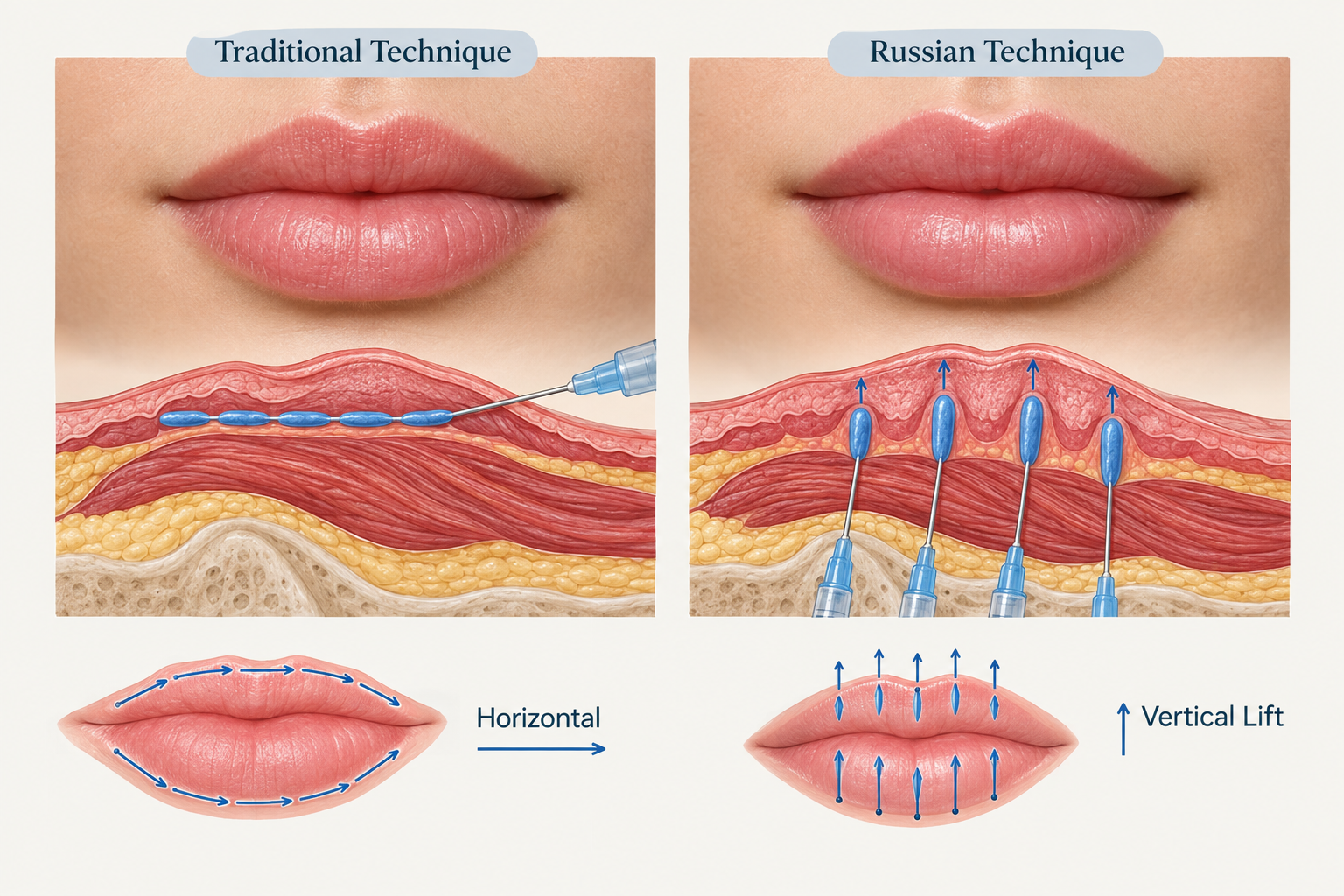
The Russian technique generally requires more injection points than traditional augmentation, which can mean slightly more discomfort during the procedure and potentially more post-treatment bruising or swelling. Topical anaesthetic is typically applied before treatment to reduce discomfort, and some filler products contain lidocaine to further ease the experience. The procedure usually takes between 30 and 60 minutes depending on the complexity of the style chosen.
Filler Product Selection and Its Role in the Result
The choice of hyaluronic acid filler product significantly influences which Russian lip style is achievable and how long the result may last. Firmer, more cohesive fillers tend to hold vertical lift better and are often preferred for the classic and architectural Russian styles. Softer, more fluid fillers may be more appropriate for the natural or doll lip variations, where a rounded, less structured result is the goal.
Hyaluronic acid fillers used in lip augmentation are temporary and are gradually broken down by the body over time. Results from Russian lip filler typically last between six and twelve months, though this varies depending on the product used, the amount placed, the patient’s metabolism, and lifestyle factors such as sun exposure and smoking. Because the Russian technique often uses filler placed at a specific depth and in a specific pattern, the longevity of the shape may differ from traditional lip filler even when the same product is used.
Who May Be Suitable for Russian Lip Filler
Russian lip filler in its various styles may be suitable for adults who want to improve lip definition, add vertical height to the upper lip, enhance the cupid’s bow, or achieve a more structured lip shape. Patients with naturally flat or undefined upper lips, those who have experienced age-related lip thinning, or those who want a specific aesthetic shape rather than simple volume increase are often good candidates for discussion.
Suitability depends on individual anatomy, medical history, and realistic expectations. Patients with very thin lips may have limited capacity for certain dramatic styles. Those with significant pre-existing lip asymmetry may require a tailored approach. A clinical assessment is necessary to determine which variation, if any, is appropriate for a given patient.
Who May Not Be Suitable
Russian lip filler may not be appropriate for patients who are pregnant or breastfeeding, those with active infection or cold sores in or around the lip area, those with certain autoimmune conditions or bleeding disorders, or those taking medications that significantly increase bleeding risk. Patients with a history of severe allergic reactions to hyaluronic acid filler components should discuss this carefully with their practitioner. Those with unrealistic expectations about the degree of change achievable, or those who want a result that their anatomy cannot support, may also not be suitable candidates.
Previous lip filler that has not fully dissolved may affect the outcome of Russian technique injections, as existing product can alter the tissue structure and limit the injector’s ability to place new filler precisely. A practitioner may recommend dissolving previous filler with hyaluronidase before proceeding with a Russian-style treatment in some cases.
Risks and Side Effects
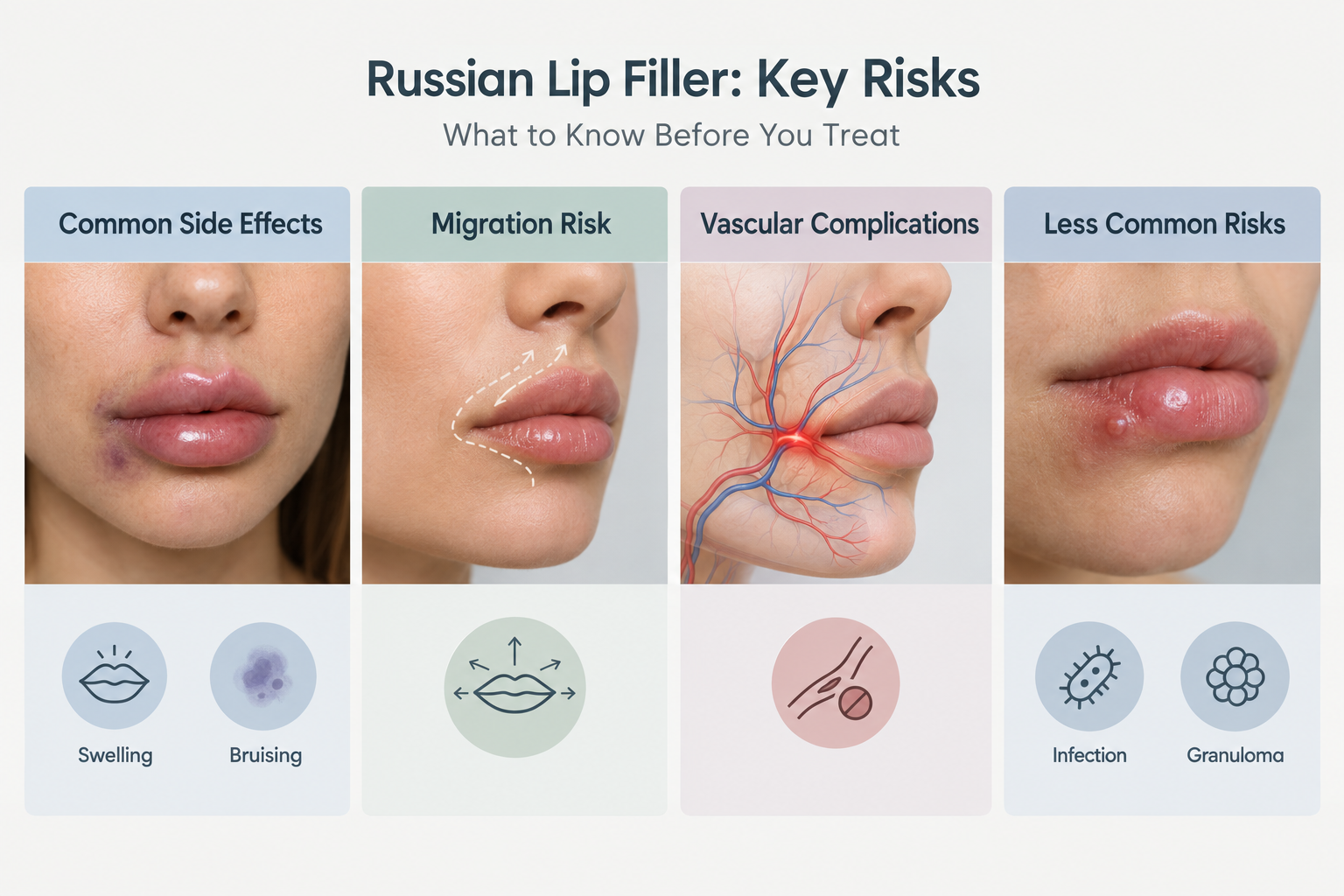
All lip filler carries risks, and the Russian technique is no exception. Common side effects include swelling, bruising, tenderness, and temporary asymmetry in the days following treatment. These typically resolve within one to two weeks. More specific concerns associated with the Russian technique include the risk of filler migration — where product moves from the intended placement area — which can create a blurred or uneven lip border. The vertical injection pattern used in Russian-style techniques places filler at a specific depth, and incorrect depth can increase migration risk or result in visible lumps or irregularities.
Vascular complications, including accidental injection into or compression of a blood vessel, represent the most serious risk associated with any lip filler procedure. This can potentially lead to tissue damage if not identified and treated promptly. Choosing a practitioner with appropriate medical training, a thorough understanding of lip anatomy, and access to hyaluronidase for emergency dissolution is essential. Infection, granuloma formation, and prolonged swelling are less common but possible complications. Patients should be given clear aftercare instructions and know how to contact their practitioner if they have concerns after treatment.
Recovery and What to Expect After Treatment
Swelling is the most noticeable immediate effect after Russian lip filler and is typically more pronounced in the first 24 to 48 hours. The lips may appear larger, uneven, or more dramatic than the intended final result during this period. Most patients find that swelling reduces significantly within five to seven days, with the final shape becoming clearer at around two weeks post-treatment. Bruising, if it occurs, usually fades within one to two weeks.
Practitioners generally advise avoiding strenuous exercise, excessive heat such as saunas or hot baths, alcohol, and pressure on the lips for the first 24 to 48 hours after treatment. Sleeping with the head slightly elevated can help reduce swelling. Patients should avoid massaging the lips unless specifically instructed to do so by their practitioner, as this can displace filler before it has settled. A follow-up appointment at two weeks is common practice to assess the result and address any concerns.
Alternatives to Russian Lip Filler
Patients who want lip enhancement but are not certain about the Russian technique have several alternatives worth discussing with a practitioner. Traditional hyaluronic acid lip filler using a standard technique can add volume and definition with a different aesthetic outcome. A lip flip using botulinum toxin alone — without filler — can create a subtle outward roll of the upper lip border and may suit patients who want a very mild change. Lip blushing, a semi-permanent cosmetic tattooing technique, can enhance the appearance of the lip border and add the impression of colour and definition without adding volume. For patients concerned about age-related changes around the mouth, treatments such as skin boosters, polynucleotides, or resurfacing procedures may address skin quality and fine lines rather than lip shape directly.
Each alternative has its own mechanism, longevity, risk profile, and suitability criteria. A qualified practitioner can help identify which approach, or combination of approaches, may best match a patient’s specific concerns and goals.
Frequently Asked Questions
Which Russian lip style looks the most natural?
The natural Russian lip variation is specifically designed to produce a subtle result that enhances definition without an obviously augmented appearance. The doll lip variation can also appear relatively natural depending on the amount of product used. The classic and architectural styles tend to produce more noticeable, structured results. The most natural-looking outcome for any individual also depends on their starting lip anatomy and how much product is used.
Can the Russian technique be used on the lower lip as well?
The Russian technique is primarily associated with upper lip treatment, as the vertical lift and cupid’s bow definition it creates are upper lip characteristics. However, some practitioners apply elements of the technique to the lower lip to add central projection or definition. The approach is typically modified for the lower lip’s different anatomy. Your practitioner can advise whether lower lip treatment is appropriate for your goals.
How is Russian lip filler different from a lip flip?
Russian lip filler uses hyaluronic acid dermal filler to physically add volume and lift to the lip tissue. A lip flip uses a small amount of botulinum toxin to relax the muscle around the upper lip border, causing the lip edge to roll slightly outward. The lip flip does not add volume and produces a much more subtle change. Some practitioners combine both treatments. The effects of a lip flip typically last two to three months, while filler results generally last six to twelve months.
Will Russian lip filler make my lips look duck-like or overfilled?
When performed correctly by an experienced injector using an appropriate amount of product, Russian lip filler should not produce a duck-like or overfilled appearance. The technique is specifically designed to add height rather than forward projection, which is the characteristic associated with an overfilled look. However, using too much product, choosing an unsuitable style for the patient’s anatomy, or incorrect injection technique can lead to unnatural results. Viewing a practitioner’s portfolio and discussing realistic expectations during consultation helps reduce this risk.
Can Russian lip filler be dissolved if I do not like the result?
Yes. Hyaluronic acid fillers, including those used in Russian lip techniques, can be dissolved using an enzyme called hyaluronidase. This is injected into the treated area and breaks down the hyaluronic acid relatively quickly, usually within 24 to 48 hours. Dissolution is not always complete after a single treatment and may require more than one session. It is important to have dissolution performed by a qualified practitioner rather than attempting any home remedy.
How do I choose between the different Russian lip styles?
The best starting point is to bring reference images to your consultation that represent the aesthetic you are hoping to achieve. A qualified practitioner will assess your natural lip anatomy, discuss which styles are achievable given your individual features, and advise on the amount of product and technique most likely to produce your desired result. Not every style suits every patient, and a practitioner who is honest about what is and is not achievable for your anatomy is a positive sign.
Choosing the Right Russian Lip Style for Your Goals
The different styles of Russian lip filler offer a meaningful range of aesthetic outcomes, from the subtle refinement of the natural variation to the dramatic structure of the architectural approach. No single style is universally superior — the right choice depends on your natural lip anatomy, the specific result you want, and the assessment of a qualified practitioner who can match technique and product to your individual features.
Before committing to any variation, take time to research practitioners with demonstrable experience in Russian lip techniques specifically, review their portfolio of results, and attend a thorough consultation where your goals, anatomy, medical history, and realistic expectations are all discussed. Understanding the risks, the recovery process, and the temporary nature of hyaluronic acid filler will help you make a well-informed decision. If you are uncertain, starting with a more conservative variation and building from there is a reasonable approach that many experienced practitioners recommend for first-time patients.