
How Long Does Nose Filler Last? Longevity, Factors & What to Expect
Non-surgical rhinoplasty using hyaluronic acid dermal filler has become one of the more popular aesthetic procedures for patients who want to refine the shape of their nose without surgery. A common and entirely reasonable question before booking a consultation is: how long does nose filler actually last? The honest answer is that duration varies considerably between individuals, but most patients can expect results to remain visible for somewhere between nine months and two years, depending on several clinical and lifestyle factors. This article explains what influences longevity, what a realistic treatment timeline looks like, how maintenance works, and what risks and alternatives are worth understanding before making a decision.
Key Takeaways
- Nose filler results typically last between 9 and 18 months for most patients, though some may retain visible results for up to two years.
- Longevity depends on the type and volume of filler used, the specific area treated, individual metabolism, and lifestyle factors.
- The nose is a high-movement area with relatively thin skin, which can influence how quickly filler breaks down compared with other facial regions.
- Hyaluronidase can dissolve hyaluronic acid filler if results are unsatisfactory or a complication arises, making the procedure partially reversible.
- Non-surgical rhinoplasty carries specific risks, including rare but serious vascular complications, and should only be performed by a qualified and experienced practitioner.
What Is Non-Surgical Rhinoplasty?
Non-surgical rhinoplasty, sometimes called a liquid nose job or non-surgical nose job, involves the precise injection of dermal filler — most commonly a hyaluronic acid-based product — into specific areas of the nose to alter its apparent shape. The procedure does not remove tissue or change bone structure. Instead, it works by adding volume strategically to create the optical illusion of a smoother profile, a lifted tip, a straighter bridge, or a more symmetrical appearance.
Hyaluronic acid is a naturally occurring substance found in connective tissue throughout the body. When used as a dermal filler, it is formulated into a gel of varying thickness and cross-linking density. Thicker, more highly cross-linked formulations tend to provide greater structural support and are often preferred for the nose, where precise placement and stability matter. The filler integrates with surrounding tissue and gradually breaks down over time as the body metabolises the hyaluronic acid.
Because no incisions are made and no general anaesthesia is required, the procedure is typically performed in a clinic setting within 15 to 30 minutes. Results are visible almost immediately, though some initial swelling may temporarily affect the final appearance.
How Long Does Nose Filler Last on Average?
For most patients, nose filler results last between 9 and 18 months. Some individuals retain noticeable results for closer to two years, while others find that filler breaks down more quickly, with visible changes beginning to fade after six to nine months. These ranges reflect genuine clinical variability rather than inconsistency in the procedure itself.
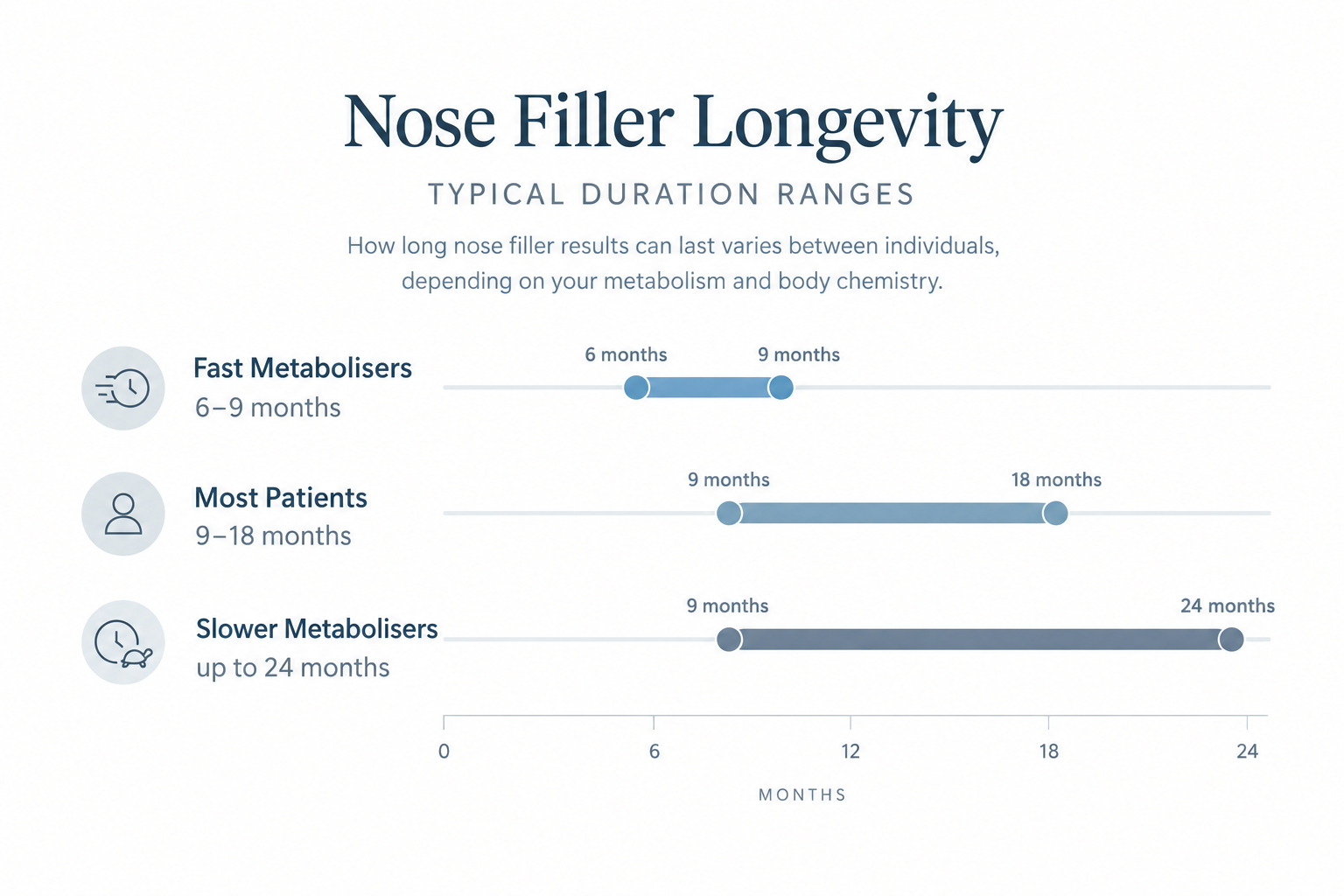
The nose tends to show slightly shorter filler longevity compared with areas such as the cheeks or jawline. This is partly because the nose is a structurally complex area with relatively thin overlying skin and limited subcutaneous fat, meaning there is less surrounding tissue to slow the spread and breakdown of filler. The nose also experiences repeated movement through facial expressions, talking, and sleeping position, all of which can contribute to gradual filler displacement and metabolism over time.
It is worth noting that filler does not disappear suddenly. Results typically fade gradually, and many patients find that a top-up treatment before complete dissolution helps maintain a consistent appearance without requiring the full original volume to be replaced.
Factors That Affect How Long Nose Filler Lasts
Several interconnected factors influence how long nose filler remains visible and effective for an individual patient. Understanding these helps set realistic expectations before treatment.
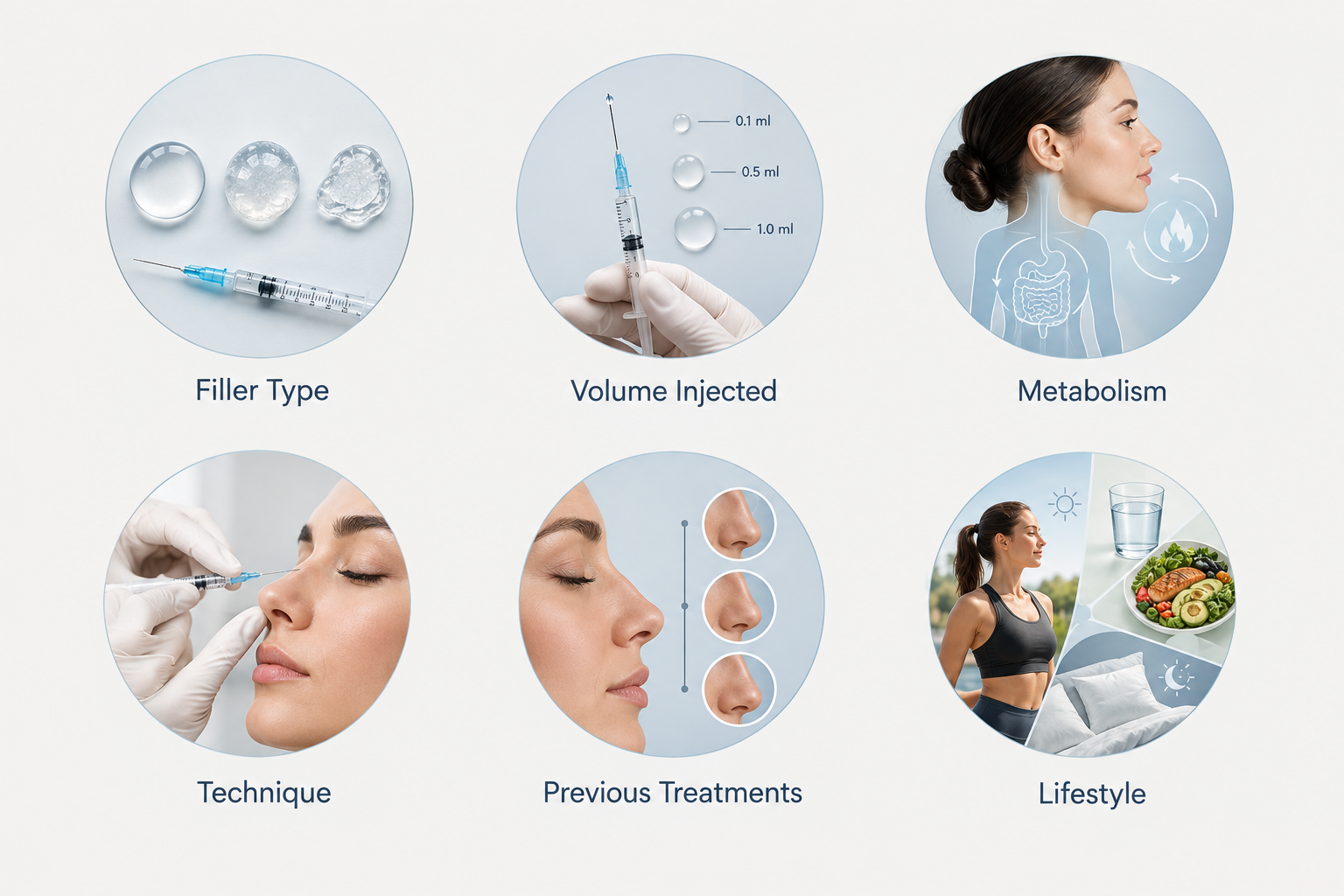
Type and Formulation of Filler Used
Not all hyaluronic acid fillers behave identically. Products vary in their degree of cross-linking, particle size, gel consistency, and concentration of hyaluronic acid. Highly cross-linked, cohesive fillers designed for structural support — such as those commonly used in the nose — tend to resist enzymatic breakdown more effectively than softer, less cross-linked products intended for superficial skin hydration. The specific product chosen by the practitioner, based on the treatment area and desired outcome, will therefore influence how long results persist.
Volume of Filler Injected
Larger volumes of filler generally take longer to metabolise fully, though the relationship is not perfectly linear. In the nose, practitioners typically use conservative volumes — often less than one millilitre — because the anatomy is precise and overfilling carries meaningful risks. The relatively small volumes used in non-surgical rhinoplasty mean that even modest rates of breakdown can produce visible changes within a year.
Individual Metabolism
Individual metabolic rate is one of the most significant variables affecting filler longevity. Patients with faster metabolisms tend to break down hyaluronic acid more quickly. This is not something that can be reliably predicted before treatment, though patients who have previously found that filler in other areas fades quickly may find the same pattern applies to nose filler. Age, hormonal factors, and general health can all influence how the body processes injected hyaluronic acid.
Treatment Area Within the Nose
The nose is not a single uniform treatment zone. Filler placed along the nasal bridge to smooth a dorsal hump may behave differently from filler injected at the nasal tip or columella. The tip of the nose involves more movement and has a tighter, more fibrous tissue structure, which can mean filler in this area is subject to greater mechanical stress. Filler placed higher on the bridge, where movement is minimal, may persist somewhat longer in some patients.
Lifestyle and Physical Activity
High levels of physical activity, particularly cardiovascular exercise, are associated with faster filler metabolism in some patients. Increased circulation and metabolic demand may accelerate the breakdown of hyaluronic acid. Sun exposure, smoking, and poor sleep have also been suggested as factors that may reduce filler longevity, though the evidence for each of these is less robust than for metabolic rate and product formulation.
Practitioner Technique and Placement
Precise placement by an experienced practitioner matters not only for safety but also for how long results last. Filler placed in the correct tissue plane, at the appropriate depth, and in the right anatomical location is more likely to remain stable and produce consistent results over time. Poorly placed filler may migrate, dissolve unevenly, or produce results that appear to fade more quickly than expected.
What Happens as Nose Filler Fades?
As hyaluronic acid filler gradually breaks down, the nose returns progressively toward its pre-treatment appearance. This process is usually slow and incremental rather than sudden. Patients often notice that the refinements they achieved — a smoother bridge, a more lifted tip, improved symmetry — become less pronounced over several months before eventually returning to baseline.
In most cases, the nose does not look worse after filler has dissolved than it did before treatment. However, there are some circumstances where repeated filler treatments over several years may lead to changes in tissue texture or subtle alterations in the overlying skin, particularly if large volumes have been used or if filler has been placed repeatedly in the same location. This is one reason why experienced practitioners often recommend conservative volumes and careful assessment before each top-up session.
If a patient decides they no longer want nose filler, or if the results are unsatisfactory, hyaluronidase — an enzyme that dissolves hyaluronic acid — can be injected to accelerate breakdown. This makes hyaluronic acid nose filler partially reversible, which is a meaningful safety advantage compared with permanent or semi-permanent fillers.
Maintenance and Top-Up Treatments
Most patients who are satisfied with their nose filler results choose to maintain them with periodic top-up treatments. The typical maintenance schedule involves a review appointment at around 9 to 12 months, at which point the practitioner assesses how much filler remains and whether a top-up is appropriate. Some patients find they need less filler at each subsequent session if residual product is still present, which can make maintenance more cost-effective over time.
It is generally advisable not to simply add more filler on top of existing product without first assessing what remains. Cumulative filler build-up in the nose can alter the tissue environment and, in some cases, increase the risk of complications. A practitioner who takes a careful, measured approach to top-up treatments — including considering whether dissolution with hyaluronidase is appropriate before re-treating — is likely to produce safer and more consistent long-term results.
Patients should also be aware that the nose changes naturally with age. The nasal tip may descend slightly, the skin may thin, and the underlying cartilage structure may shift over time. A maintenance plan that accounts for these natural changes, rather than simply replacing the same volume in the same locations, is likely to produce more natural-looking results over the long term.
Risks and Limitations of Nose Filler
Non-surgical rhinoplasty carries a specific risk profile that patients should understand clearly before proceeding. The nose has a complex vascular anatomy, and the nasal area is considered one of the higher-risk zones for dermal filler injection. The most serious potential complication is vascular occlusion — where filler inadvertently enters or compresses a blood vessel, potentially restricting blood supply to the skin of the nose or, in rare cases, to the eye via connected arterial pathways. Vascular occlusion can cause tissue necrosis or, in extremely rare cases, vision changes or blindness.
This risk does not mean the procedure is inappropriate for all patients, but it does mean that practitioner selection is critically important. Treatment should only be performed by a qualified medical professional with specific training in facial anatomy, filler injection technique, and the management of complications. Clinics should have hyaluronidase immediately available to dissolve filler in the event of a vascular emergency.
More common side effects include temporary swelling, bruising, redness, and tenderness at the injection sites. These typically resolve within a few days to two weeks. Less common but possible concerns include asymmetry, visible or palpable filler, skin irregularities, and delayed inflammatory reactions. Infection is rare but possible with any injectable procedure.
Nose filler is not suitable for everyone. Patients who are pregnant or breastfeeding, have active skin infections or inflammation in the treatment area, have certain autoimmune conditions, or have previously experienced complications with dermal filler should discuss their history thoroughly with a practitioner before proceeding. Patients with very thin nasal skin may be at higher risk of visible filler or surface irregularities.
Nose Filler vs Surgical Rhinoplasty: Key Differences
Non-surgical rhinoplasty and surgical rhinoplasty serve different purposes and are not directly interchangeable. Understanding the distinction helps patients identify which option may be more appropriate for their goals.
| Characteristic | Nose Filler (Non-Surgical) | Surgical Rhinoplasty |
|---|---|---|
| Mechanism | Adds volume with hyaluronic acid filler | Reshapes bone and cartilage |
| Anaesthesia | Topical or local anaesthetic | General anaesthesia typically required |
| Downtime | Minimal; usually 1–3 days of swelling | Several weeks to months |
| Longevity | 9–18 months on average | Permanent structural change |
| Reversibility | Partially reversible with hyaluronidase | Not reversible |
| What it can address | Profile smoothing, tip lifting, symmetry refinement | Structural reduction, significant reshaping, functional correction |
| What it cannot address | Reduction of nose size, correction of significant structural issues | N/A — broader range of changes possible |
| Risk profile | Rare but serious vascular risks; generally lower overall surgical risk | Surgical risks including anaesthesia, infection, scarring |
Nose filler is generally better suited to patients who want subtle refinements — smoothing a small dorsal bump, improving tip projection, or correcting minor asymmetry — and who prefer a temporary, lower-commitment option. Surgical rhinoplasty remains the only option for patients seeking significant structural reduction, correction of breathing difficulties, or permanent results. A qualified practitioner should be honest about which approach is more appropriate for a given patient’s anatomy and goals.
Who May Be a Suitable Candidate for Nose Filler?
Nose filler may be worth discussing with a qualified practitioner for patients who have realistic expectations about what the procedure can achieve, are in good general health, and are seeking subtle cosmetic refinement rather than significant structural change. Patients who are uncertain about committing to surgery, or who want to preview a potential change before considering a permanent option, sometimes find non-surgical rhinoplasty a useful intermediate step.
Suitability depends on individual anatomy, skin quality, nasal structure, and medical history. A thorough consultation with a practitioner experienced in facial anatomy and non-surgical rhinoplasty is essential before proceeding. Patients should feel comfortable asking about the practitioner’s training, their experience with nose filler specifically, and what protocols are in place for managing complications.
Frequently Asked Questions
Can nose filler last longer than two years?
In some cases, small amounts of hyaluronic acid filler may remain detectable in tissue for longer than two years, particularly with highly cross-linked products. However, visible cosmetic results typically diminish well before this point for most patients. If a practitioner assesses that residual filler is still present at a top-up appointment, they may recommend a smaller volume or dissolution before re-treating.
Does nose filler hurt?
Most patients describe the procedure as mildly uncomfortable rather than significantly painful. Topical anaesthetic cream is usually applied before treatment, and many filler products contain lidocaine, a local anaesthetic, within the formulation. The nose is a sensitive area, and some patients experience brief sharp sensations during injection, but the procedure is generally well tolerated.
Will my nose look the same after the filler dissolves?
In most cases, the nose returns to its pre-treatment appearance as filler gradually breaks down. There is no evidence that a single course of nose filler permanently alters nasal structure. However, repeated treatments over many years using large volumes may, in some cases, affect the surrounding tissue environment, which is one reason why conservative volumes and careful long-term planning are recommended.
How soon can I have a top-up after nose filler?
Most practitioners recommend waiting at least two to four weeks after the initial treatment before assessing results, as swelling needs to fully resolve before the final outcome can be accurately evaluated. Top-up treatments are generally considered after the initial results have been assessed and, for maintenance purposes, are typically scheduled at 9 to 12 months or when the patient notices results beginning to fade.
Is nose filler safe for everyone?
Nose filler is not appropriate for all patients. Those who are pregnant or breastfeeding, have active infections in the treatment area, have a history of severe allergic reactions to filler components, or have certain medical conditions affecting blood clotting or immune function may not be suitable candidates. A full medical history review at consultation is essential to identify any contraindications.
What should I do if I am unhappy with my nose filler results?
If results are unsatisfactory — whether due to asymmetry, overfilling, or an outcome that does not match expectations — hyaluronidase can be used to dissolve hyaluronic acid filler. This should be performed by a qualified practitioner, not attempted at home. Patients should contact their treating clinic promptly if they notice any unusual symptoms such as skin colour changes, pain, or visual disturbances after treatment, as these may indicate a vascular complication requiring urgent attention.
Planning Nose Filler: What to Consider Before Your Consultation
Nose filler longevity is an important practical consideration, but it is only one part of the decision. Before booking a consultation, it is worth thinking carefully about what you are hoping to achieve, whether those goals are realistic for a non-surgical approach, and whether you are comfortable with the temporary nature of the results and the associated risks.
Choosing a practitioner with specific training and demonstrable experience in non-surgical rhinoplasty is arguably the most important decision a patient can make. The nose is one of the most technically demanding and highest-risk areas for filler injection, and the difference in outcomes between an experienced and an inexperienced injector can be significant — both in terms of aesthetic results and safety. Asking about the practitioner’s qualifications, their approach to complication management, and whether hyaluronidase is available at the clinic are all reasonable and important questions.
For patients who are considering nose filler as a long-term maintenance treatment, it is also worth discussing a realistic plan for top-up sessions, what the cumulative cost is likely to be over several years, and at what point surgical rhinoplasty might become a more practical option if permanent results are ultimately the goal. A practitioner who provides honest, balanced guidance — including acknowledging when a patient’s goals may be better served by a different approach — is a meaningful indicator of clinical integrity.


