
What Is IPL Hair Removal? How Intense Pulsed Light Works
IPL hair removal uses broad-spectrum light energy to target the pigment in hair follicles, gradually reducing hair growth over a course of treatments. It is one of the most widely available light-based hair reduction methods, offered in clinics and, in lower-powered versions, as a home-use device. Understanding how intense pulsed light works — and where its limitations lie — helps you decide whether it is worth discussing with a qualified practitioner.
Key Takeaways
- IPL is a light-based treatment that reduces hair growth by targeting melanin in the hair follicle; it is not a laser, though it works on a similar principle.
- Multiple sessions are required because IPL is only effective on follicles in the active growth phase at the time of treatment.
- Results vary significantly depending on hair colour, skin tone, hormonal factors, and the device used; IPL is generally less effective on very light, grey, or red hair.
- Side effects are usually mild and temporary, but the risk of pigmentation changes is higher in people with darker skin tones if an unsuitable device or setting is used.
- IPL reduces hair density and thickness rather than guaranteeing permanent removal; maintenance sessions may be needed over time.
What Is IPL and How Does It Differ from Laser?
Intense pulsed light, commonly abbreviated as IPL, is a technology that emits a broad spectrum of light wavelengths — typically ranging from around 500 to 1200 nanometres — in a single pulse. This distinguishes it from laser hair removal, which uses a single, precisely defined wavelength of coherent light. Because IPL delivers multiple wavelengths simultaneously, the energy is less concentrated than a laser beam. Filters are used to block shorter wavelengths and direct the remaining light toward the target tissue, but the output remains broader than a dedicated laser system.
In clinical practice, this distinction matters for two reasons. First, IPL devices can be adapted for different skin concerns — including pigmentation, vascular lesions, and skin rejuvenation — by changing the filter or settings, whereas a dedicated hair removal laser is optimised for one purpose. Second, the broader wavelength spread of IPL means that energy is distributed across a wider range of tissue targets, which can affect both efficacy and the precision of treatment on different skin tones.
The Mechanism: How Intense Pulsed Light Targets Hair Follicles
The biological principle underlying IPL hair removal is called selective photothermolysis. This concept, first described in the early 1980s, explains how light energy can be used to selectively damage a specific target — in this case the hair follicle — while minimising injury to the surrounding skin. The process depends on three factors working together: the wavelength of light, the duration of the pulse, and the presence of a chromophore, which is a light-absorbing molecule within the target tissue.
In hair removal, the primary chromophore is melanin, the pigment that gives hair its colour. When IPL energy is absorbed by melanin in the hair shaft and the surrounding follicular structures, it is converted into heat. This heat travels down the hair shaft toward the follicle bulb and the bulge region — the area responsible for producing new hair — and, when sufficient thermal damage occurs, it disrupts the follicle’s ability to generate new hair growth. The goal is to damage the follicle enough to impair regrowth without causing significant injury to the overlying skin.
The effectiveness of this process depends heavily on the contrast between the melanin in the hair and the melanin in the surrounding skin. Higher contrast — darker hair against lighter skin — allows the light energy to be absorbed more selectively by the follicle. When the skin itself contains significant melanin, as in medium to dark skin tones, there is a greater risk that the skin absorbs competing energy, which can reduce efficacy and increase the risk of side effects such as burns or pigmentation changes.
The Hair Growth Cycle and Why Multiple Sessions Are Needed
Hair follicles do not all grow simultaneously. At any given time, follicles on a particular area of the body are distributed across three phases of the hair growth cycle: anagen (active growth), catagen (transition), and telogen (resting). IPL hair removal is only effective on follicles in the anagen phase, because this is when the hair shaft is physically connected to the follicle bulb and melanin is most concentrated in the follicular structures.
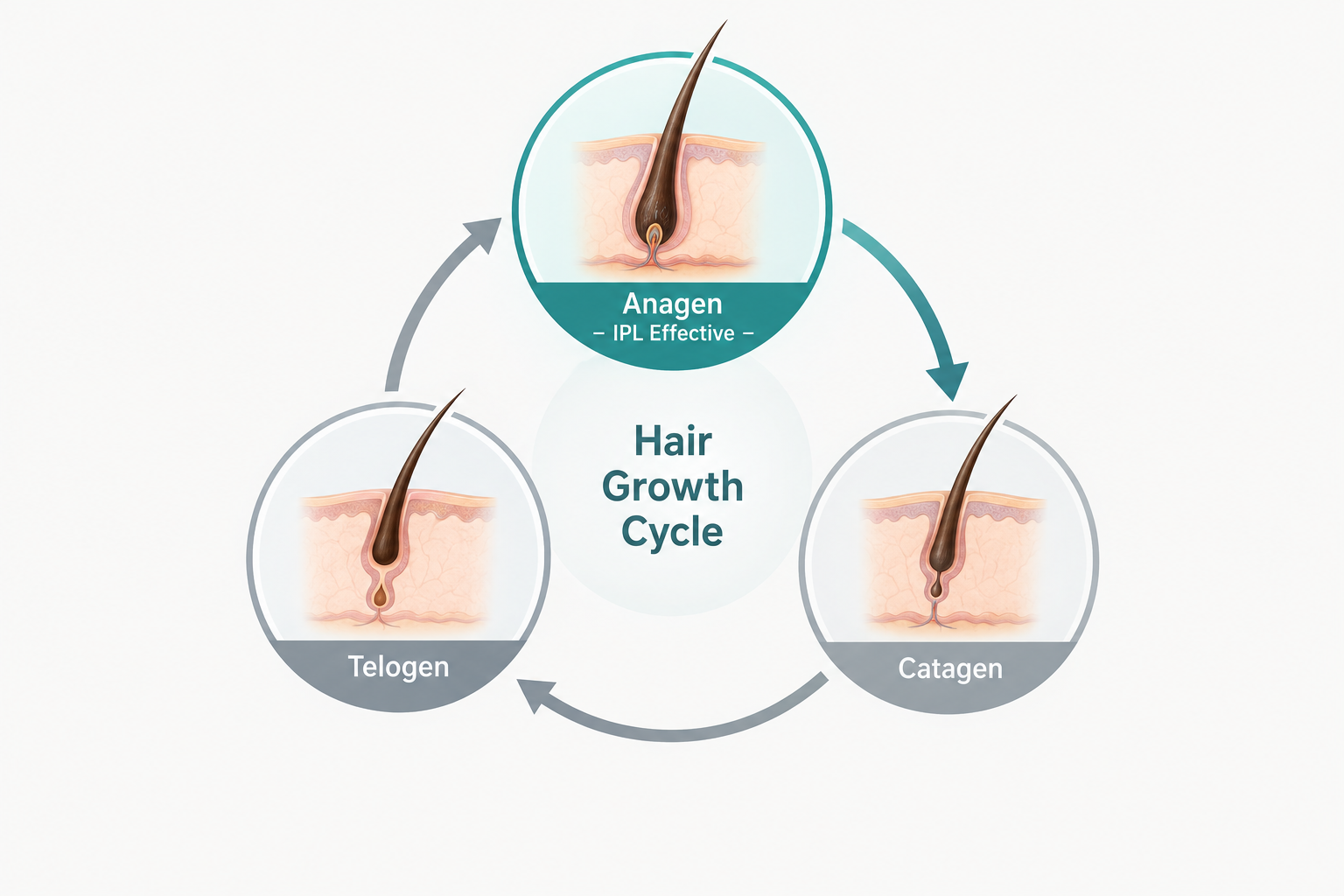
Because only a proportion of follicles are in the anagen phase at any one treatment session, a single IPL appointment cannot address all active follicles in a given area. This is why a course of multiple sessions — typically spaced four to six weeks apart for facial areas and six to eight weeks apart for body areas — is necessary to progressively treat follicles as they cycle into the active growth phase. The number of sessions required varies depending on the treatment area, hair density, individual hair growth patterns, and hormonal factors, but most clinical protocols involve between six and eight initial sessions.
What IPL Hair Removal Can and Cannot Achieve
IPL hair removal is more accurately described as a hair reduction treatment than a permanent hair removal method. Clinical evidence and regulatory guidance in most countries classify light-based hair treatments as achieving long-term hair reduction rather than guaranteed permanent removal. After a full course of treatment, many patients experience a significant reduction in hair density and thickness, and some follicles may not regrow hair for extended periods. However, some regrowth is common over time, and maintenance sessions are often needed to sustain results.
The degree of reduction varies considerably between individuals. Factors that influence outcomes include the natural hair colour and thickness, the skin tone, the body area being treated, hormonal influences such as polycystic ovary syndrome or other androgen-related conditions, and the specific IPL device and settings used. People with coarse, dark hair on lighter skin tend to respond most favourably. IPL is generally considered less effective — and in some cases ineffective — for very fine hair, blonde or light brown hair, red hair, and grey or white hair, because these hair types contain little or no eumelanin, the dark pigment that absorbs IPL energy most efficiently.
Treatment Areas
IPL hair removal can be used on most areas of the body where unwanted hair is a concern. Commonly treated areas include the legs, underarms, bikini line and extended bikini or Brazilian areas, arms, back, chest, abdomen, and facial areas such as the upper lip, chin, and jawline. The face generally requires more frequent sessions and may show slower progress than body areas, partly because facial hair growth cycles differ and hormonal influences on facial hair can be more pronounced.
Some areas require particular care. Treatment close to the eyes requires appropriate protective eyewear for both the patient and the practitioner. Tattooed skin should not be treated with IPL because the ink pigment can absorb light energy unpredictably, potentially causing burns or pigment changes. Areas with active skin conditions, open wounds, or recent sun exposure also require careful assessment before treatment.
Who May Be Suitable for IPL Hair Removal
IPL hair removal may be suitable for adults with unwanted hair who have a hair and skin tone combination that allows adequate contrast for selective photothermolysis. Historically, IPL devices were most reliably used on Fitzpatrick skin types I to III — that is, fair to light-medium skin tones — because the risk of competing melanin absorption in the skin was lower. More recent IPL technology, including devices with longer wavelengths and more sophisticated cooling systems, has expanded the range of skin tones that can be treated more safely, but individual assessment remains essential.
A clinical consultation before treatment should include an assessment of skin type and hair colour, a review of relevant medical history, and a discussion of realistic expectations. Factors that may affect suitability or require additional caution include:
- Active tan or recent significant sun exposure, which increases skin melanin and the risk of adverse reactions
- Use of photosensitising medications, including certain antibiotics, retinoids, or anti-inflammatory drugs
- History of keloid scarring or abnormal wound healing
- Active skin conditions such as eczema, psoriasis, or rosacea in the treatment area
- Pregnancy or breastfeeding, where treatment is generally deferred
- History of herpes simplex in the treatment area, which may require prophylactic antiviral treatment
- Hormonal conditions that drive ongoing hair growth, which may reduce the long-term durability of results
What Happens During an IPL Hair Removal Session
Before the first treatment, a patch test is typically performed to assess how the skin responds to the IPL energy at the proposed settings. This helps identify any unexpected sensitivity and allows the practitioner to calibrate the device appropriately. The treatment area is usually shaved before the session — shaving removes the hair above the skin surface while leaving the follicle intact, which is necessary for the light energy to travel down the hair shaft to the follicle rather than being absorbed by surface hair.
During the appointment, a cool gel may be applied to the skin to improve light transmission and provide some surface cooling. The IPL handpiece is placed against the skin and delivers a series of light pulses across the treatment area. Most patients describe the sensation as a warm snap or flick against the skin, similar to a rubber band. The intensity of the sensation varies depending on the treatment area, the device settings, and individual pain tolerance. Modern IPL devices typically incorporate contact cooling or air cooling to reduce discomfort and protect the skin surface.
Session duration depends on the size of the area being treated. A small area such as the upper lip may take only a few minutes, while larger areas such as both legs can take considerably longer. After the session, the skin may appear slightly red or feel warm, similar to mild sunburn, but this usually settles within a few hours.
Recovery, Downtime, and Aftercare
IPL hair removal generally involves minimal downtime. Most people can return to their normal activities immediately after a session. The most common immediate effects are temporary redness and mild warmth in the treated area, which typically resolve within a few hours to a day. Some patients notice slight swelling around individual follicles, which is a normal response to the thermal effect on the follicle and usually settles quickly.
In the days following treatment, treated hairs do not fall out immediately. Instead, the damaged hairs gradually shed over one to three weeks as the follicle releases them. This shedding can sometimes be mistaken for new hair growth, but it is the treated hair working its way out of the follicle. Gentle exfoliation can help this process.
Standard aftercare advice typically includes avoiding direct sun exposure and applying a broad-spectrum sunscreen to treated areas, avoiding heat-based activities such as saunas or hot baths for 24 to 48 hours, and refraining from waxing, plucking, or epilating between sessions, as these methods remove the hair shaft that IPL needs to conduct energy to the follicle. Shaving between sessions is generally acceptable.
Risks and Side Effects
IPL hair removal has a well-established safety profile when performed by a trained practitioner using appropriate settings for the individual’s skin and hair type. However, side effects and adverse events can occur, and prospective patients should be aware of the realistic risk profile before proceeding.
Common and usually temporary side effects include:
- Redness and warmth in the treated area, typically resolving within hours
- Mild swelling around follicles, usually settling within 24 to 48 hours
- Temporary skin sensitivity
Less common but clinically significant risks include:
- Pigmentation changes: Both hyperpigmentation (darkening) and hypopigmentation (lightening) of the skin can occur, particularly if the device settings are not appropriately matched to the patient’s skin tone or if the skin is tanned at the time of treatment. These changes are often temporary but can occasionally be prolonged.
- Burns or blistering: Excessive energy delivery or treatment of tanned or darker skin with unsuitable settings can cause superficial burns. Proper device calibration and practitioner training significantly reduce this risk.
- Paradoxical hypertrichosis: A small number of patients experience increased hair growth in or around the treated area following IPL. This is a recognised but not fully understood phenomenon that appears to occur more commonly in people with darker skin tones or when subthreshold energy levels are used. It is more frequently reported with IPL than with some laser systems.
- Scarring: Rare, but possible if burns are not managed appropriately.
The risk of adverse effects is meaningfully influenced by the qualifications and experience of the practitioner, the quality and calibration of the device, and the accuracy of the pre-treatment assessment. Choosing a regulated clinic with trained practitioners and appropriate equipment is an important safety consideration.
IPL Hair Removal vs Laser Hair Removal
The most common alternative to IPL for light-based hair reduction is laser hair removal, which uses a single coherent wavelength rather than a broad spectrum. The most widely used laser systems for hair removal include the alexandrite laser (755 nm), the diode laser (800–810 nm), and the Nd:YAG laser (1064 nm). Each wavelength has different absorption characteristics and penetration depths, which influence their suitability for different skin and hair types.
Laser hair removal is generally considered to offer more precise energy delivery than IPL, which can translate to more consistent results in clinical practice, particularly for patients with medium to darker skin tones. The Nd:YAG laser, for example, is often preferred for darker skin because its longer wavelength is less readily absorbed by epidermal melanin, reducing the risk of surface skin damage. IPL, by contrast, may be more versatile across different skin concerns but requires careful device selection and practitioner expertise to achieve comparable safety and efficacy on a wider range of skin tones.
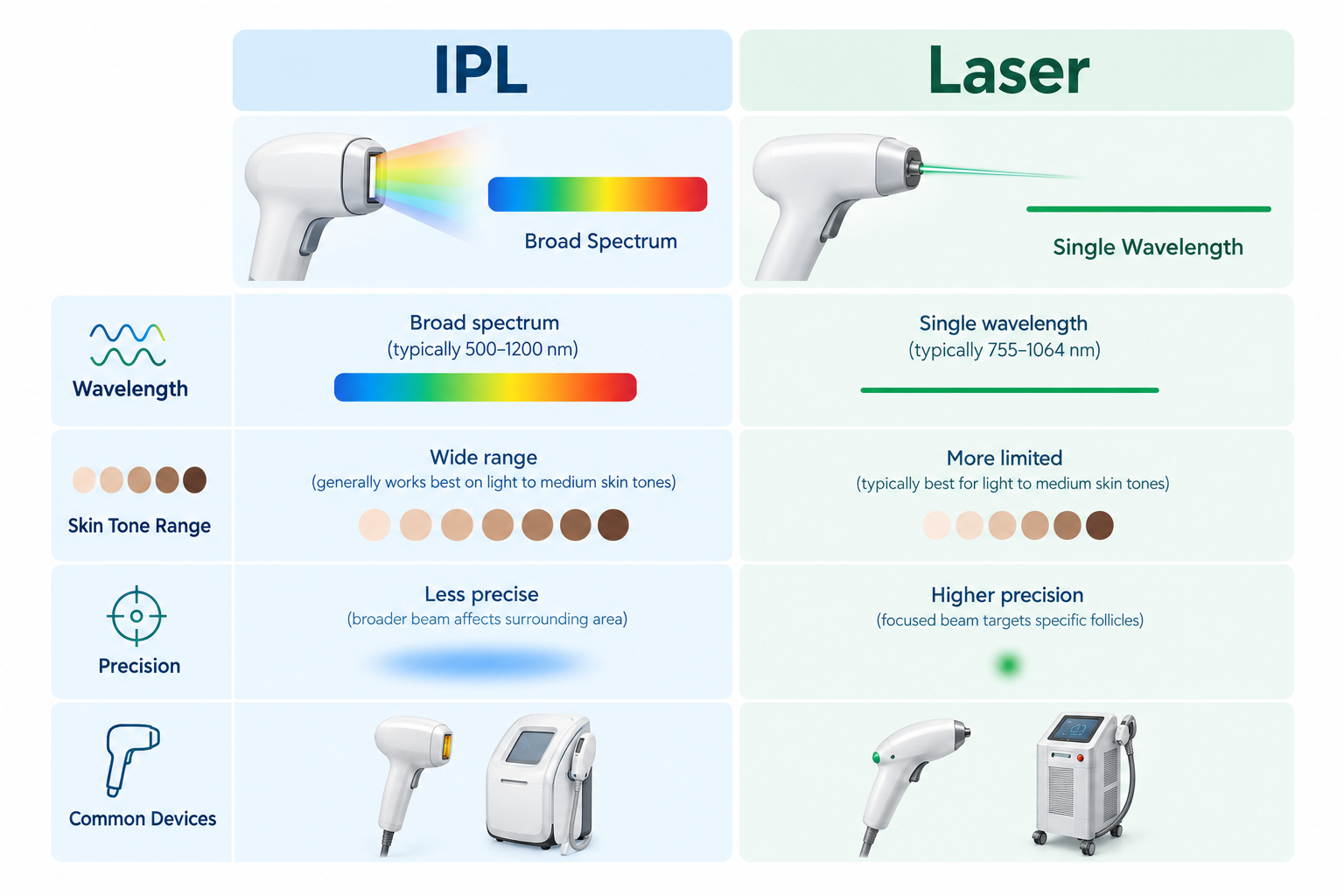
Neither IPL nor laser hair removal is universally superior for every patient. The most appropriate choice depends on the individual’s skin tone, hair colour, treatment area, and the specific devices available at the clinic. A thorough consultation with a practitioner experienced in both modalities is the most reliable way to determine which approach may be better suited to a particular patient’s needs.
Home-Use IPL Devices vs Clinical IPL
Consumer IPL devices are widely available for home use and are marketed for hair reduction on the body and face. These devices operate on the same broad principle as clinical IPL systems but are designed with built-in safety limitations, including lower energy outputs, to reduce the risk of adverse effects in an unsupervised setting. As a result, home-use IPL devices are generally less powerful than clinical systems and may require more frequent and prolonged use to achieve comparable results.
Home devices are typically designed for use on lighter skin tones and lighter to medium hair colours, and most incorporate skin tone sensors that prevent activation on darker skin to reduce burn risk. They are not a substitute for clinical assessment, and people with darker skin tones, hormonal hair growth conditions, or concerns about skin reactions should seek professional advice before using a home device. Clinical IPL treatments offer the advantage of individually calibrated settings, trained oversight, and the ability to adjust the treatment plan based on the skin’s response.
Frequently Asked Questions
How many IPL sessions will I need?
Most clinical protocols recommend an initial course of six to eight sessions, spaced according to the hair growth cycle of the treatment area. The exact number depends on the area being treated, hair density, individual response, and hormonal factors. Some people may need additional sessions beyond the initial course, and periodic maintenance treatments are often recommended to manage regrowth over time.
Does IPL hair removal hurt?
Most patients describe IPL as producing a warm snapping or flicking sensation with each pulse. Discomfort varies depending on the treatment area, device settings, and individual sensitivity. Areas with thinner skin or denser hair, such as the bikini line or upper lip, tend to be more sensitive. Modern devices with integrated cooling systems help manage discomfort during the session.
Can IPL be used on dark skin?
IPL can be used on a wider range of skin tones than older devices allowed, but it requires careful assessment and appropriate device selection. The risk of pigmentation changes and burns is higher when IPL energy is not well matched to the skin tone. For medium to darker skin tones, some laser systems — particularly the Nd:YAG laser — may offer a more favourable safety profile. A consultation with an experienced practitioner is essential to determine the safest and most effective approach for your specific skin type.
Is IPL hair removal permanent?
IPL is classified as a long-term hair reduction treatment rather than a permanent hair removal method. Many patients experience significant and lasting reduction in hair density after a full course of treatment, but some regrowth is common over time, particularly in areas influenced by hormonal activity. Maintenance sessions help sustain results.
Can IPL treat grey or blonde hair?
IPL is generally not effective on grey, white, or very light blonde hair because these hair types contain insufficient melanin to absorb the light energy needed to damage the follicle. People with predominantly light or grey hair are unlikely to achieve meaningful results with IPL and may wish to discuss alternative options with a practitioner.
How soon will I see results after IPL?
Treated hairs shed gradually over one to three weeks after each session rather than falling out immediately. Visible reduction in hair density typically becomes more noticeable after the second or third session, with more significant results accumulating over the full course of treatment. Individual timelines vary.
What should I avoid before an IPL session?
Most practitioners advise avoiding sun exposure, sunbeds, and self-tanning products for at least four weeks before treatment, as tanned skin increases the risk of adverse reactions. Waxing, plucking, and epilating should be avoided in the weeks before treatment because these methods remove the hair shaft that IPL needs to reach the follicle. Shaving the area shortly before the appointment is usually recommended instead.
Is IPL Hair Removal the Right Choice for You?
IPL hair removal is a well-established, light-based approach to reducing unwanted hair that works by using broad-spectrum light to heat and damage melanin-rich hair follicles. For people with darker hair and lighter to medium skin tones, it can offer meaningful, long-lasting reduction in hair density with a manageable side effect profile when performed by a trained practitioner using appropriate equipment. It is not a guaranteed permanent solution, and results depend significantly on individual factors including hair colour, skin tone, hormonal influences, and the quality of the device and treatment protocol used.
IPL is not the right choice for everyone. People with very light, grey, or red hair are unlikely to see significant benefit. Those with darker skin tones require careful device selection and practitioner expertise to reduce the risk of pigmentation changes, and in some cases a dedicated laser system may be a safer and more effective alternative. Hormonal conditions that drive ongoing hair growth can limit the durability of results and may need to be addressed alongside any light-based treatment.
If you are considering IPL hair removal, a thorough consultation with a qualified and experienced practitioner is the most important first step. A good consultation should include an honest assessment of your skin and hair type, a realistic discussion of what IPL can and cannot achieve for your specific situation, and a clear explanation of the treatment plan, risks, and alternatives. This allows you to make an informed decision based on your individual goals rather than general expectations.


