
Smile Line Fillers Gone Wrong: Complications, Causes, and What to Do
Nasolabial fold filler — commonly called smile line filler — is one of the most frequently performed dermal filler treatments worldwide, yet it is also one of the most technically demanding. When the procedure goes well, it can soften deep creases and restore a more rested appearance. When it goes wrong, the results can range from mild asymmetry and visible lumps to rare but serious vascular complications. Understanding what can go wrong, why it happens, and what options exist if you are unhappy with your results is essential reading before you book a consultation — or if you are already dealing with an outcome you did not expect.
Key Takeaways
- Smile line filler complications range from common, self-resolving issues such as bruising and swelling to rare but serious events including vascular occlusion and tissue necrosis.
- Overfilling the nasolabial folds is a frequent aesthetic error that can make the face look heavier or create an unnatural shelf-like appearance rather than a natural softening.
- Hyaluronic acid fillers can be partially or fully dissolved with hyaluronidase, giving patients a meaningful corrective option that is not available with permanent or semi-permanent fillers.
- Vascular complications require immediate emergency treatment; knowing the warning signs — sudden blanching, severe pain, or skin colour changes — can significantly affect the outcome.
- Choosing a qualified, experienced practitioner who understands facial anatomy is the single most important factor in reducing the risk of complications.
Why Smile Line Filler Is Technically Challenging
The nasolabial folds — the lines that run from the sides of the nose down to the corners of the mouth — are surrounded by a complex network of blood vessels, muscles, and fat compartments. The facial artery and its branches run in close proximity to this area, making precise anatomical knowledge essential for safe injection. The depth of injection, the volume used, and the specific product chosen all influence the final result significantly. A practitioner who underestimates this complexity, or who lacks sufficient training in facial anatomy, is more likely to produce an unsatisfactory or unsafe outcome.
Smile line filler also sits in a part of the face that moves constantly during expression, eating, and speaking. This dynamic environment means that filler placed incorrectly — either too superficially, in the wrong tissue plane, or in excessive volume — becomes visible or distorted in ways that may not be apparent immediately after treatment. Many patients only notice problems once the initial swelling has resolved and normal facial movement resumes.
Common Aesthetic Complications
Overfilling and the “Pillow Face” Effect
One of the most frequently reported aesthetic complaints after nasolabial fold treatment is overfilling. When too much filler is placed in or around the smile lines, the result can be a heavy, rounded appearance that distorts the natural contours of the mid-face. Rather than softening a crease, excessive volume can create a shelf-like ridge alongside the nose or push the cheek tissue forward in an unnatural way. This effect is sometimes described informally as contributing to a “pillow face” appearance, particularly when combined with filler placed elsewhere in the face.
Overfilling is not always the result of poor technique alone. Some practitioners and patients underestimate how much existing volume loss in the cheeks contributes to the appearance of nasolabial folds. Treating the fold directly with large volumes, rather than addressing the underlying volume deficit in the mid-face, is a recognised cause of disproportionate or unnatural results. A thorough facial assessment before treatment should identify whether the fold itself or the surrounding structural support is the primary concern.
Asymmetry
Mild facial asymmetry is normal and present in virtually everyone before any treatment. However, filler placed unevenly between the two sides of the face can make pre-existing asymmetry more noticeable, or introduce new asymmetry where little existed before. This can occur if the practitioner does not assess the face carefully in multiple positions and lighting conditions, or if the patient moves during the procedure. Minor asymmetry often improves as swelling resolves, but significant differences in volume or shape between the two sides may require correction with additional filler or, in the case of hyaluronic acid products, partial dissolution.
Lumps, Nodules, and Uneven Texture
Palpable lumps or visible irregularities under the skin are another recognised complication of dermal filler treatment. These can result from filler being placed too superficially, from product migration, from an inflammatory reaction, or from the formation of a granuloma — a chronic inflammatory response to the filler material. Superficial placement is particularly problematic in the nasolabial area because the skin here is relatively thin and mobile, making lumps more visible during expression. Some nodules resolve on their own over weeks to months; others require treatment with hyaluronidase, steroid injection, or in rare cases, surgical removal.
Tyndall Effect
The Tyndall effect refers to a bluish discolouration of the skin caused by light scattering through hyaluronic acid filler placed too close to the skin surface. It is more common in areas with thin skin but can occur in the nasolabial region if the injection depth is insufficient. The discolouration can be subtle or quite noticeable and does not resolve without intervention. Hyaluronidase treatment is generally effective at correcting the Tyndall effect when the filler responsible is a hyaluronic acid product.
Common Short-Term Side Effects
Not every unwanted outcome after smile line filler represents a true complication. Several short-term side effects are expected and typically resolve without treatment. Bruising at the injection site is common and usually fades within one to two weeks. Swelling is almost universal in the first 24 to 72 hours and can temporarily distort the appearance of the result. Tenderness, redness, and mild itching at the injection points are also normal in the immediate post-treatment period.
These expected side effects become a concern only when they are unusually severe, persist beyond the expected timeframe, or are accompanied by other symptoms such as skin colour changes, increasing pain, or fever. Patients who are unsure whether what they are experiencing is a normal side effect or an early warning sign of a more serious complication should contact their treating practitioner promptly rather than waiting.
Serious Complications: Vascular Occlusion and Tissue Necrosis
Vascular occlusion is the most serious acute complication associated with dermal filler injections, including smile line filler. It occurs when filler is inadvertently injected into or compresses a blood vessel, blocking blood flow to the surrounding tissue. The nasolabial region is considered a higher-risk area for this complication because of the proximity of the facial artery and its branches. If blood flow is interrupted for long enough, the affected tissue can undergo necrosis — irreversible cell death — resulting in permanent scarring or tissue loss.
The warning signs of vascular occlusion include sudden blanching or whitening of the skin immediately after injection, followed by a dusky or mottled discolouration, severe or disproportionate pain, and in some cases a sensation of pressure or burning. These signs constitute a medical emergency. Immediate treatment with hyaluronidase — the enzyme that dissolves hyaluronic acid filler — alongside other emergency measures, is required to restore blood flow and minimise tissue damage. Time is critical: the sooner treatment begins, the better the likely outcome. Patients who experience these symptoms after leaving a clinic should return immediately or seek urgent medical attention.
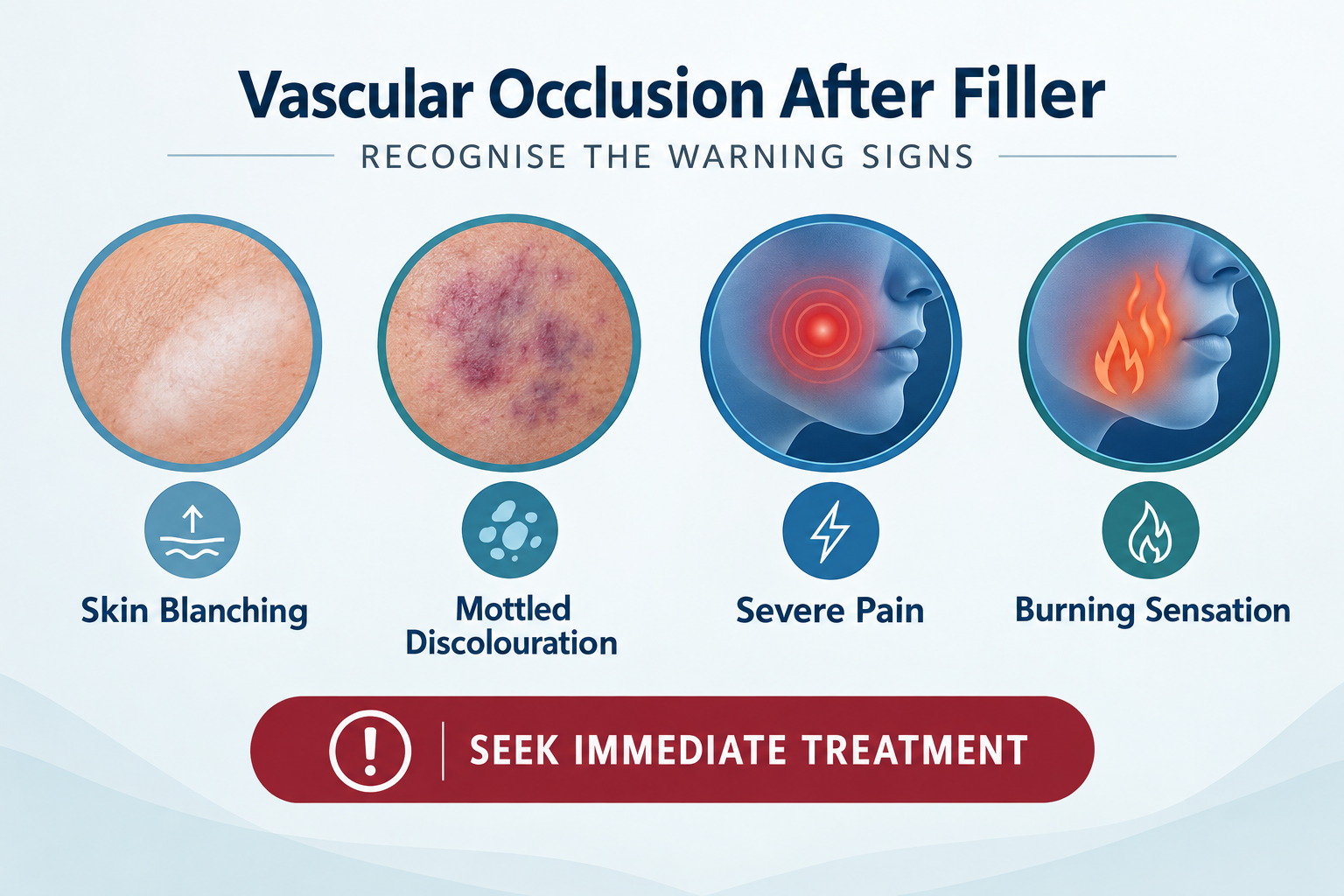
Vascular occlusion can occur even in the hands of experienced practitioners, because blood vessel anatomy varies between individuals and cannot always be predicted from surface landmarks alone. However, the risk is substantially higher when treatment is performed by someone without adequate training in facial anatomy, emergency recognition, and the use of hyaluronidase. Confirming that a practitioner has hyaluronidase available on-site before undergoing any filler treatment is a reasonable and important question to ask.
Infection and Biofilm
Infection following dermal filler injection is uncommon but possible. Bacteria can be introduced at the time of injection, or a pre-existing dormant infection can be reactivated. A biofilm — a structured community of bacteria that adheres to the filler material and is resistant to standard antibiotic treatment — is a recognised cause of delayed inflammatory nodules appearing weeks, months, or even years after treatment. Biofilm-related complications can be difficult to treat and may require a combination of antibiotics, hyaluronidase, and in some cases surgical drainage.
Signs of infection include increasing redness, warmth, swelling, and pain at the injection site, sometimes accompanied by fever or discharge. Any patient who develops these symptoms after filler treatment should seek medical assessment promptly. Attempting to treat a suspected infection without professional guidance is not advisable, as the underlying cause — whether bacterial infection, biofilm, or an inflammatory reaction — affects the appropriate management significantly.
Filler Migration
Dermal filler can move from its original placement site over time, particularly if the product is soft and mobile, if large volumes are used, or if the injection technique does not account for the dynamic forces in the area. In the nasolabial region, migrated filler can contribute to a blurred or indistinct border between the cheek and the fold, or create fullness in areas where it was not intended. Migration is more likely with repeated treatments that add volume on top of existing filler without adequate assessment of what remains from previous sessions.
Dissatisfaction with Natural-Looking Results
Not all cases of smile line fillers gone wrong involve a medical complication. A significant proportion of patients are simply unhappy with the aesthetic outcome — the result looks different from what was discussed, the improvement is less noticeable than expected, or the appearance feels unnatural. Managing expectations before treatment is a shared responsibility between the practitioner and the patient. A thorough consultation should include a realistic discussion of what filler can and cannot achieve, the likely degree of improvement for that individual’s anatomy, and the possibility that the result may not match a reference image or a desired outcome precisely.
What to Do If Something Goes Wrong
Contact Your Practitioner First
If you are concerned about your results — whether immediately after treatment or in the days and weeks that follow — the first step is to contact the clinic or practitioner who performed the procedure. Reputable practitioners expect and welcome follow-up contact after treatment and should be able to assess whether what you are experiencing is within the normal range or requires intervention. Do not delay contact if you notice any of the warning signs of vascular occlusion described above.
Hyaluronidase Dissolution
If your filler is a hyaluronic acid product — which includes the majority of dermal fillers currently used for nasolabial fold treatment, such as those in the Juvederm and Restylane families — it can be dissolved using hyaluronidase. This enzyme breaks down hyaluronic acid and can reduce or eliminate unwanted filler volume, correct asymmetry, treat the Tyndall effect, and address lumps or migration. Dissolution is not instantaneous and may require more than one session, but it provides a meaningful corrective pathway that is not available with permanent or semi-permanent fillers such as those containing calcium hydroxylapatite, poly-L-lactic acid, or polymethylmethacrylate.
Hyaluronidase treatment carries its own small risks, including allergic reaction and temporary over-correction, and should be performed by a qualified practitioner. It is not a guaranteed complete reversal in all cases, particularly where filler has been present for a long time or where significant tissue changes have occurred.
Seeking a Second Opinion
If you are not satisfied with the response from your original practitioner, or if you feel your concerns are not being taken seriously, seeking a second opinion from a qualified aesthetic medicine physician, plastic surgeon, or dermatologist with experience in filler complications is a reasonable course of action. Specialist practitioners who focus on filler complication management exist in most major cities and can provide an independent assessment of your situation and the options available.
Reducing the Risk Before Treatment
The most effective way to reduce the risk of smile line filler complications is careful practitioner selection. Relevant qualifications, specific training in facial anatomy and injectable treatments, experience with the nasolabial area in particular, and the availability of hyaluronidase on-site are all important factors. Asking to see before-and-after photographs of previous patients treated for similar concerns, and reading verified patient reviews, can also provide useful context.
A thorough pre-treatment consultation should include a full facial assessment, a discussion of your medical history and any medications you take, a clear explanation of the risks and realistic outcomes, and an opportunity to ask questions. Patients who are pregnant, breastfeeding, have active skin infections, certain autoimmune conditions, or a history of severe allergic reactions may not be suitable candidates for filler treatment. The consultation is also the appropriate time to discuss whether treating the nasolabial fold directly is the right approach, or whether addressing volume loss in the cheeks or mid-face would produce a more natural and proportionate result.
Alternatives to Direct Nasolabial Fold Filler
For patients who are concerned about the risks of direct nasolabial fold injection, or who have had a previous unsatisfactory experience, several alternative approaches may be worth discussing with a qualified practitioner. Cheek or mid-face filler placed in the deeper tissue planes can lift and support the overlying skin, indirectly reducing the appearance of nasolabial folds without placing product directly in the crease. This approach is considered by many experienced practitioners to produce more natural-looking results, particularly in patients with significant mid-face volume loss.
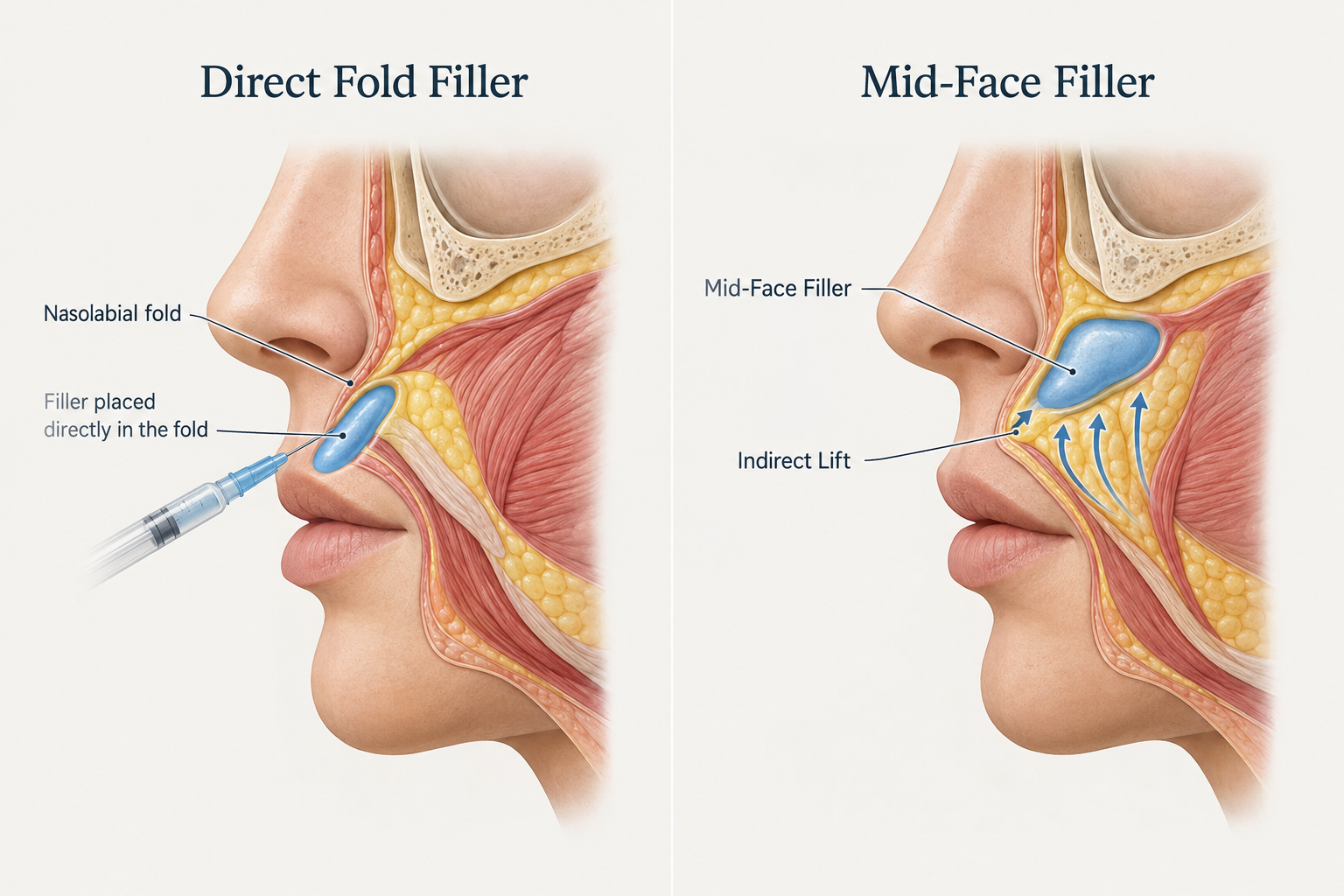
Skin quality treatments such as radiofrequency, ultrasound-based skin tightening, or collagen-stimulating injectables including poly-L-lactic acid or polynucleotides may improve skin laxity and texture in the area, though these treatments address different aspects of the concern and are unlikely to produce the same degree of fold reduction as well-placed volumising filler. Surgical options such as a mid-face lift or fat transfer may be appropriate for patients with more significant structural changes, and a consultation with a plastic surgeon can help clarify whether a surgical approach would offer a more durable solution.
Frequently Asked Questions
Can smile line filler be completely reversed?
If the filler used is a hyaluronic acid product, it can be substantially or fully dissolved using hyaluronidase in most cases. The degree of reversal depends on how long the filler has been in place, the product used, and individual tissue response. Non-hyaluronic acid fillers cannot be dissolved and may require other management strategies.
How long does it take to know if something has gone wrong?
Vascular complications typically present within minutes of injection. Bruising, swelling, and minor asymmetry are usually apparent within the first 24 to 72 hours. Lumps, migration, and inflammatory reactions may become apparent over days to weeks. Delayed nodules related to biofilm or granuloma formation can appear months or even years after treatment.
Is it normal to feel lumps after smile line filler?
Some firmness or subtle irregularity is common in the first few weeks as the filler integrates with surrounding tissue. Persistent, hard, or painful lumps that do not resolve within four to six weeks warrant assessment by a qualified practitioner, as they may indicate superficial placement, product migration, or an inflammatory reaction.
What is the difference between a side effect and a complication?
Side effects are expected, predictable responses to treatment — such as bruising, swelling, and temporary tenderness — that resolve without intervention. Complications are unintended adverse events that may require active treatment, such as vascular occlusion, infection, or significant asymmetry. The distinction matters because complications generally require prompt professional assessment rather than watchful waiting.
Can I get filler again after a complication?
This depends on the nature of the complication, how it was managed, and the individual patient’s anatomy and history. Some patients can safely receive filler again after a complication has fully resolved; others may be advised to avoid further treatment in the affected area. A thorough assessment by an experienced practitioner is necessary before any repeat treatment is considered.
Does the type of filler affect the risk of complications?
Yes. Hyaluronic acid fillers are generally preferred for the nasolabial area partly because they can be dissolved if a complication occurs. Thicker, more cohesive products may carry a different risk profile compared to softer formulations. Permanent fillers carry a higher long-term risk of complications including granuloma formation and are generally not recommended for the nasolabial fold by most aesthetic medicine guidelines.
What to Consider If Your Smile Line Filler Has Gone Wrong
Experiencing an unwanted outcome after nasolabial fold filler — whether an aesthetic disappointment or a more serious complication — is understandably distressing. The important thing to recognise is that most complications, when identified promptly and managed by a qualified practitioner, can be improved or resolved. Hyaluronic acid filler dissolution with hyaluronidase remains the most important corrective tool available, and it is effective for a wide range of issues including overfilling, asymmetry, lumps, and the Tyndall effect. Serious vascular complications require immediate emergency treatment and should never be managed with a wait-and-see approach.
If you are considering smile line filler for the first time, the information in this article is intended to help you ask better questions at your consultation, not to discourage you from a treatment that, when performed correctly by a qualified and experienced practitioner, can produce genuinely useful aesthetic improvements. Selecting a practitioner with appropriate medical training, a thorough consultation process, and hyaluronidase available on-site remains the most meaningful step you can take to reduce your risk. If you have already experienced a complication or are unhappy with your results, seeking prompt professional assessment — from your original practitioner or from a specialist in filler complication management — is the most appropriate next step.


