
Natural-Looking Lip Filler: What to Expect, How It Works, and Whether It’s Right for You
Lip filler has a reputation problem. Many people associate it with overfilled, unnatural results — the kind that look obviously done. Yet when performed by an experienced practitioner using appropriate products and conservative volumes, dermal filler can enhance lip shape, restore lost volume, and improve definition while still looking like your own lips. Understanding what makes the difference between a natural outcome and an overdone one is essential before booking any treatment.
Key Takeaways
- Natural-looking lip filler depends heavily on practitioner technique, product selection, and the volume injected — not just the filler brand itself.
- Hyaluronic acid fillers are the most commonly used products for lip enhancement and can be partially or fully dissolved with hyaluronidase if results are unsatisfactory.
- Starting with a conservative amount and building gradually over multiple sessions is generally considered the safest approach for achieving subtle, proportionate results.
- Risks including bruising, swelling, asymmetry, and rare but serious vascular complications exist with all lip filler treatments and should be discussed thoroughly before proceeding.
- A thorough consultation that considers your facial anatomy, lip structure, and aesthetic goals is the most important step in achieving a result you are happy with.
What Is Lip Filler and How Does It Work?
Lip filler refers to injectable dermal filler placed into or around the lips to add volume, improve shape, define the border, or restore fullness that has diminished with age. The vast majority of lip fillers used in aesthetic practice today are based on hyaluronic acid (HA), a naturally occurring substance found in skin and connective tissue. Hyaluronic acid attracts and retains water molecules, which is what gives it its volumising effect when injected into tissue.
HA fillers are manufactured through a process called cross-linking, which determines how firm, flexible, or spreadable the gel is. Different products within the same brand family — for example, softer formulations versus denser ones — behave differently in lip tissue. Softer, more hydrophilic gels tend to integrate more naturally into the delicate lip tissue and are generally preferred for subtle enhancement, while denser products may be more appropriate for structural definition along the vermilion border. The choice of product is one of several factors that influences whether a result looks natural or artificial.
Unlike permanent fillers, hyaluronic acid is gradually broken down by the body’s own enzymes over time. This temporary nature is considered an important safety advantage, particularly because hyaluronidase — an enzyme-based dissolving agent — can be used to partially or fully reverse HA filler if a patient is unhappy with the outcome or if a complication arises.
What Makes Lip Filler Look Natural?
The most common reason lip filler looks unnatural is excess volume relative to the patient’s facial anatomy. Lips that are disproportionately large compared to the surrounding facial features, or that have lost their natural shape and contour, tend to look obviously treated. Achieving a natural result requires the practitioner to work within the proportions that suit the individual patient’s face rather than applying a standard template.
Several factors contribute to a natural-looking outcome:
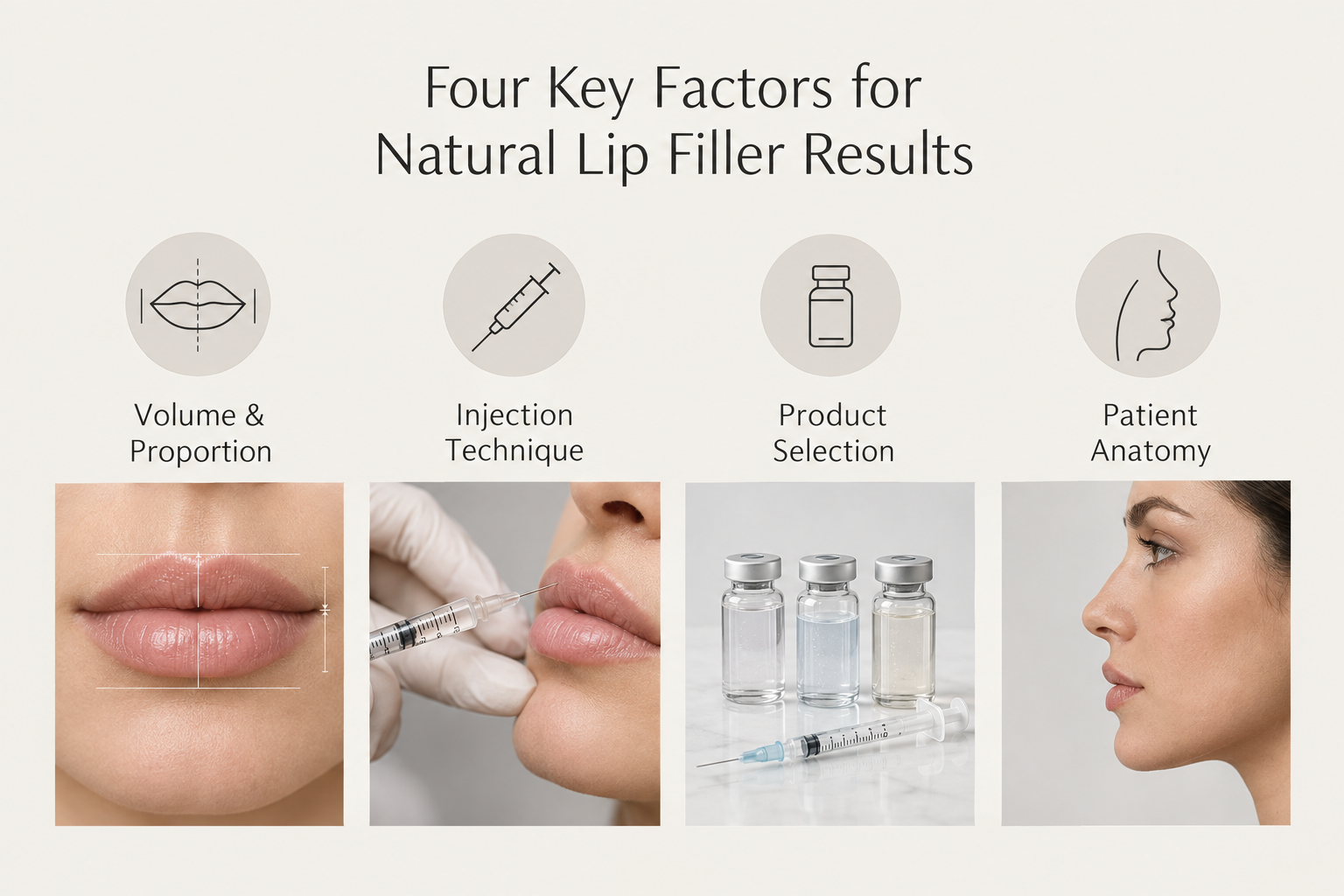
- Conservative volume: Starting with a smaller amount — often 0.5 ml or less for a first treatment — allows the patient to assess the result before committing to more. Gradual enhancement over multiple sessions is widely regarded as a safer and more controllable approach than attempting significant augmentation in a single appointment.
- Appropriate product selection: Softer, lower-viscosity hyaluronic acid formulations tend to integrate more naturally into lip tissue and move more convincingly with facial expression. Stiffer products placed in the wrong plane can create an unnatural firmness or visible irregularity.
- Injection technique: The depth, placement, and distribution of filler within the lip significantly affects the final appearance. Skilled practitioners consider the anatomy of the lip — including the orbicularis oris muscle, the vermilion border, Cupid’s bow, and the philtral columns — when planning injections. Poor technique, such as placing too much product superficially or concentrating volume in one area, is a common cause of unnatural results.
- Respecting natural anatomy: Lips have a natural ratio between the upper and lower lip. Altering this ratio dramatically — for example, making the upper lip significantly larger than the lower — tends to look less natural. Most practitioners aim to preserve or subtly enhance the patient’s existing proportions.
- Avoiding overfill over time: Repeated treatments without allowing previous filler to fully metabolise can lead to gradual accumulation of product, which may distort the lip shape over time. This is sometimes described as filler migration, where product spreads beyond the intended area.
What Can Lip Filler Realistically Achieve?
Lip filler can address a range of aesthetic concerns, though the degree of improvement depends on the individual’s starting anatomy, the volume used, and the technique applied. Realistic goals for lip filler treatment may include:
- Adding subtle volume to naturally thin lips
- Restoring fullness that has reduced with age
- Defining the vermilion border for a more distinct lip outline
- Improving symmetry between the left and right sides of the lips
- Enhancing the Cupid’s bow shape
- Reducing the appearance of fine lines around the lip area (perioral lines)
- Providing a mild lift to the corners of the mouth
Lip filler is not a substitute for surgical procedures such as a lip lift, which addresses the distance between the nose and the upper lip. It also cannot significantly change the fundamental shape of the lips beyond what the existing anatomy allows without risking an unnatural appearance. Patients with very thin lips who want dramatic augmentation may find that the result looks less natural than those seeking modest enhancement.
The Consultation: The Most Important Step
A thorough pre-treatment consultation is the foundation of a natural-looking result. During this appointment, a qualified practitioner should assess your lip anatomy, skin quality, facial proportions, and medical history. They should ask about your aesthetic goals and discuss what is realistically achievable given your individual anatomy.
Important topics to cover during a lip filler consultation include:
- Your specific goals — whether you want more volume, better definition, improved symmetry, or a combination
- The amount of filler likely to achieve a natural result for your anatomy
- Which product the practitioner intends to use and why
- The technique they plan to use and where the filler will be placed
- Realistic expectations for the outcome, including what filler cannot achieve
- All relevant risks, side effects, and what to do if you experience a complication
- Your medical history, including any medications, allergies, previous filler treatments, or history of cold sores
Be cautious of practitioners who do not conduct a thorough consultation, who pressure you toward larger volumes than you requested, or who cannot clearly explain their technique and product choice. The consultation is also the appropriate time to ask to see examples of the practitioner’s previous work, ideally on patients with similar anatomy to your own.
What Happens During a Lip Filler Appointment?
A lip filler appointment typically begins with the application of a topical anaesthetic cream to the lip area, which is left in place for around 20 to 30 minutes to reduce discomfort. Many hyaluronic acid filler products also contain lidocaine — a local anaesthetic — within the gel itself, which helps to further reduce sensation during injection.
The practitioner will then clean the area and proceed with the injections. Depending on the technique used, filler may be placed using a fine needle or a blunt-tipped cannula. Cannulas are associated with a lower risk of bruising and vascular injury in some practitioners’ hands, though both techniques are used in clinical practice and the choice often depends on the practitioner’s training and the specific area being treated.
The appointment itself typically takes between 30 and 60 minutes in total, including consultation time and aftercare advice. Most patients can return to normal daily activities immediately, though strenuous exercise, alcohol, and significant heat exposure are usually advised against for the first 24 to 48 hours.
Recovery, Swelling, and When Results Settle
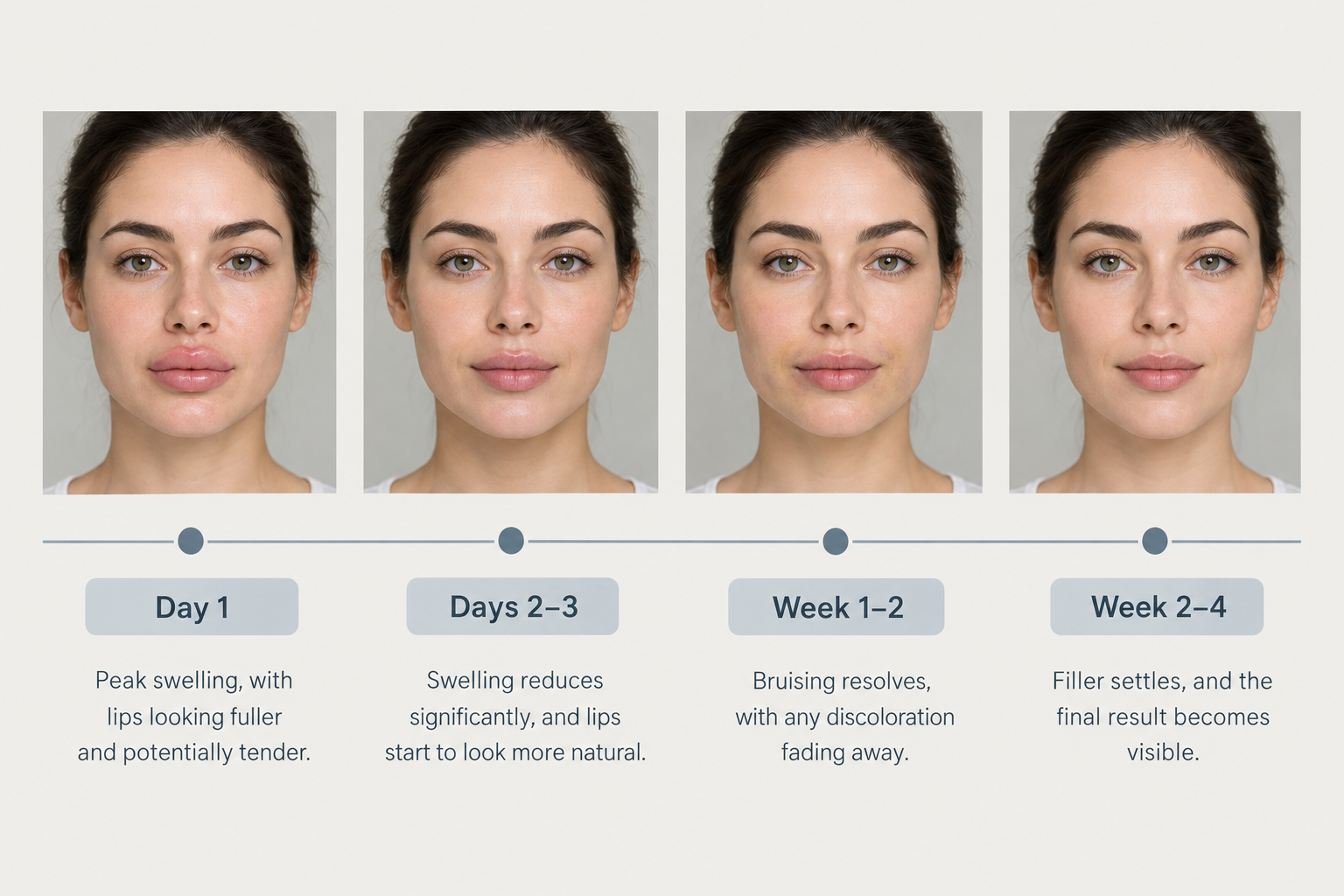
Swelling is a normal and expected response to lip filler injections and is often more pronounced in the lips than in other facial areas due to the high vascularity and loose connective tissue of the lip. Initial swelling can make the lips appear significantly larger than the intended final result, which can be alarming for patients who were hoping for a subtle outcome. It is important to understand that the appearance immediately after treatment is not representative of the final result.
Most of the initial swelling subsides within 48 to 72 hours. Minor residual swelling and any bruising typically resolve within one to two weeks. The filler then continues to settle and integrate into the tissue over the following two to four weeks, after which the final result becomes apparent. Patients are generally advised to wait at least two weeks — and ideally four — before assessing whether they would like any additional volume or adjustment.
Common side effects in the days following treatment include:
- Swelling and puffiness, often asymmetric in the early stages
- Bruising at injection sites
- Tenderness or sensitivity when touching the lips
- Temporary lumps or irregularities that usually resolve as swelling settles
These effects are generally temporary and resolve without intervention. However, if you experience significant pain, skin colour changes, blanching, or any signs of vascular compromise, you should contact your treating practitioner immediately, as these may indicate a rare but serious complication.
Risks and Complications
Lip filler is not a risk-free procedure. While serious complications are uncommon when treatment is performed by a trained and experienced practitioner, they can occur and patients should be fully informed before consenting to treatment.
Common side effects include bruising, swelling, tenderness, and temporary asymmetry. These typically resolve within one to two weeks.
Less common complications include persistent lumps or nodules, filler migration beyond the intended treatment area, and prolonged swelling. Nodules may sometimes require treatment with hyaluronidase to dissolve the filler.
Rare but serious complications include vascular occlusion, which occurs when filler is inadvertently injected into or compresses a blood vessel, potentially restricting blood flow to surrounding tissue. In the lip area, this can affect the labial arteries. Vascular occlusion is a medical emergency that requires immediate treatment with hyaluronidase. Signs include severe pain, blanching of the skin, or a dusky discolouration of the tissue. Practitioners performing lip filler should have hyaluronidase immediately available and be trained in recognising and managing this complication.
Infection is another possible risk, though it is uncommon when proper sterile technique is used. Patients with a history of cold sores (herpes simplex virus) may experience a flare following lip injections; antiviral prophylaxis is sometimes recommended for these patients prior to treatment.
Allergic reactions to hyaluronic acid fillers are rare but possible. A thorough allergy history should be taken before treatment.
How Long Does Natural Lip Filler Last?
Hyaluronic acid lip filler is temporary. The duration of results varies between individuals and depends on factors including the specific product used, the volume injected, the patient’s metabolism, and lifestyle factors such as sun exposure and smoking. In general, lip filler tends to last between six and twelve months, though some patients find results persist longer and others notice a more rapid breakdown of the product.
The lips are a highly mobile area of the face — they move constantly during speaking, eating, and facial expression — which means filler in this area tends to metabolise more quickly than filler placed in less mobile areas such as the cheeks. Maintenance treatments are typically required to sustain results over time. Some practitioners recommend waiting until the filler has substantially metabolised before retreating, to avoid gradual accumulation of product.
Who May Be Suitable for Lip Filler?
Lip filler may be appropriate for adults who are in good general health and have realistic expectations about what the treatment can achieve. Suitable candidates are typically those who want modest enhancement, improved definition, or restoration of volume that has reduced with age, and who understand that results are temporary and maintenance will be required.
Lip filler may not be appropriate for individuals who:
- Are pregnant or breastfeeding
- Have an active infection, cold sore, or inflammation in or around the lips
- Have a known allergy to hyaluronic acid or lidocaine
- Are taking blood-thinning medications (which may increase bruising risk — discuss with your practitioner)
- Have certain autoimmune conditions or connective tissue disorders
- Have unrealistic expectations about the degree of change achievable
- Have previously experienced complications from filler treatment
A qualified practitioner will assess your individual suitability during the consultation and may decline to treat if they consider the treatment inappropriate for your circumstances.
Alternatives to Lip Filler
Lip filler is not the only option for patients interested in improving the appearance of their lips. Depending on the specific concern, the following alternatives may be worth discussing with a practitioner:
- Lip flip with botulinum toxin: A small amount of botulinum toxin injected into the orbicularis oris muscle around the upper lip can cause the lip to roll slightly outward, creating the appearance of a fuller upper lip without adding volume. This is a subtle technique with a short duration of effect — typically two to three months — and is not suitable for patients who need to use their lips precisely, such as musicians who play wind instruments.
- Surgical lip lift: A lip lift is a surgical procedure that shortens the distance between the base of the nose and the upper lip, increasing the visible amount of upper lip. It produces permanent results and may be more appropriate for patients with a long philtrum or those seeking a more significant structural change.
- Perioral skin treatments: For patients whose primary concern is fine lines around the mouth rather than lip volume, treatments such as skin boosters, resurfacing lasers, or chemical peels may be more appropriate than filler.
- Polynucleotides: Polynucleotide injections are an emerging option for improving skin quality and hydration in the perioral area, though evidence for their use specifically in lip enhancement is still developing.
Frequently Asked Questions
How much filler do I need for a natural result?
There is no universal answer, as the appropriate volume depends on your existing lip anatomy, the degree of enhancement you want, and the product being used. Many practitioners recommend starting with 0.5 ml or less for a first treatment to allow you to assess the result before adding more. A conservative, gradual approach is generally considered the safest way to achieve a natural-looking outcome.
Will lip filler hurt?
Most patients experience some discomfort during lip filler injections, though topical anaesthetic cream and the lidocaine contained within most filler products significantly reduce pain. The lips are a sensitive area, and some patients find the injections more uncomfortable than treatments in other facial areas. Discomfort is usually brief and manageable for most people.
Can lip filler be dissolved if I don’t like the result?
Yes. Hyaluronic acid filler can be dissolved using hyaluronidase, an enzyme that breaks down the filler. Dissolving is not always immediate — it may require more than one session — and there is a small risk of allergic reaction to hyaluronidase itself. However, the reversibility of HA filler is considered one of its most important safety advantages over permanent or semi-permanent alternatives.
How do I avoid the ‘duck lip’ look?
The overfilled, projected appearance sometimes called ‘duck lips’ is most commonly the result of too much volume, inappropriate product selection, or poor injection technique. Choosing a practitioner with demonstrable experience in natural lip enhancement, starting with a conservative volume, and clearly communicating that you want a subtle result are the most effective ways to reduce this risk.
Is there a risk of filler migration?
Filler migration — where product spreads beyond the intended treatment area — can occur, particularly with repeated treatments over time or when large volumes are used. It most commonly presents as fullness above the vermilion border, creating a blurred or indistinct lip outline. Using appropriate volumes, choosing the right product, and allowing filler to metabolise between treatments can help reduce this risk.
How soon after treatment will I see the final result?
The final result of lip filler is not visible immediately after treatment due to swelling. Most of the initial swelling resolves within 48 to 72 hours, but the filler continues to settle for up to four weeks. Practitioners generally advise waiting at least two to four weeks before assessing whether any adjustment is needed.
Is Lip Filler the Right Choice for Your Goals?
Natural-looking lip filler is achievable, but it is not guaranteed simply by choosing a particular product or brand. The outcome depends on a combination of factors: the practitioner’s skill and experience, the product selected, the volume used, and how well the treatment plan is matched to your individual anatomy and goals. Patients who approach lip filler with realistic expectations, choose a qualified and experienced practitioner, and opt for a gradual, conservative approach are most likely to be satisfied with their results.
If you are considering lip filler, the most useful first step is a thorough consultation with a practitioner who takes time to understand your goals, explains the options clearly, and is transparent about both the potential benefits and the limitations and risks of treatment. A practitioner who encourages you to start conservatively and build gradually is generally demonstrating good clinical judgement. If at any point you feel pressured toward more volume than you wanted, or if your questions are not answered clearly, it is entirely reasonable to seek a second opinion before proceeding.


