
Types of Eyes: A Complete Guide to Identifying Your Eye Shape
Understanding the different types of eyes is more than a beauty exercise — it informs decisions about makeup application, cosmetic treatments, and even surgical or non-surgical aesthetic procedures. Eye shape is determined by the underlying bone structure, the position of the eyelid crease, the amount of visible lid space, and the angle of the outer corners. Because these factors vary considerably between individuals, there is no single “standard” eye shape, and most people have features that overlap two or more categories.
Key Takeaways
- Eye shape is defined by several anatomical features, including the eyelid crease, the position of the outer corner, the amount of visible lid space, and the prominence of the brow bone.
- The most commonly recognised eye shapes include almond, round, hooded, monolid, downturned, upturned, wide-set, and close-set — and many people have a combination of these characteristics.
- Identifying your eye shape accurately helps with makeup techniques, lash selection, and understanding which aesthetic treatments may be relevant to your concerns.
- Eye shape changes naturally with age due to volume loss, skin laxity, and changes in the brow position, which can affect both appearance and treatment options.
- A qualified aesthetic practitioner or ophthalmologist can provide a clinical assessment if you have concerns about eyelid function, vision, or the suitability of any cosmetic procedure.
What Determines Eye Shape?
Eye shape is primarily determined by anatomy rather than ethnicity alone, although certain structural features are more prevalent in particular populations. The key anatomical factors include the position and depth of the supraorbital ridge (the brow bone), the presence or absence of a visible eyelid crease, the amount of skin that folds over the upper lid, the vertical height of the visible iris, and the angle formed between the inner and outer corners of the eye. The inner corner is called the medial canthus and the outer corner is called the lateral canthus. The relative position of these two points — whether the outer corner sits higher, lower, or level with the inner corner — is one of the most useful reference points when identifying eye shape.
The epicanthic fold, a skin fold that covers the inner corner of the eye, is another important structural feature. It is particularly common in people of East Asian, Central Asian, and some Indigenous descent, and its presence or absence significantly influences how the eye appears and how it is categorised. Recognising these anatomical features helps avoid oversimplified or ethnically reductive descriptions of eye shape.
How to Identify Your Eye Shape
A straightforward method for identifying eye shape involves looking directly into a mirror with a neutral facial expression and assessing several features in sequence. First, look at the outer corner: does it angle upward, downward, or sit level with the inner corner? Second, look at the eyelid crease: is it clearly visible, partially hidden by overhanging skin, or absent? Third, assess how much of the iris (the coloured part of the eye) is visible — if the upper and lower lids cut into the iris, the eye tends to appear rounder; if the iris is fully visible with white showing above or below, the eye has a different set of characteristics. Fourth, consider the distance between the eyes relative to the width of one eye: if the gap is roughly equal to one eye-width, the eyes are considered average-set; wider gaps suggest wide-set eyes and narrower gaps suggest close-set eyes.
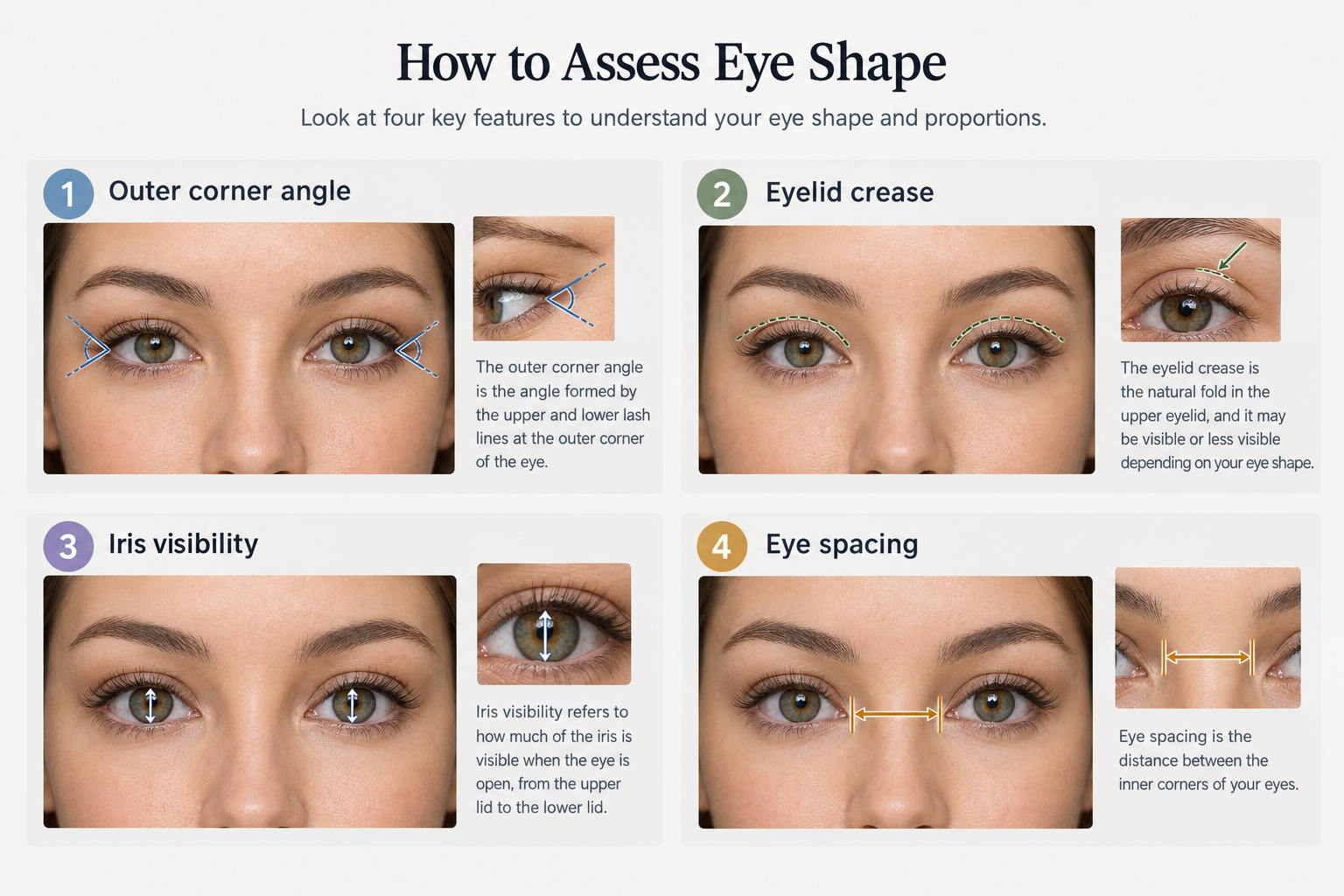
Most people find that their eyes fit broadly into one primary category with secondary characteristics from another. This is entirely normal and means that rigid categorisation has limits — the goal is to understand the dominant features rather than force an exact label.
Almond-Shaped Eyes
Almond-shaped eyes are often described as the most versatile eye shape in terms of makeup application, largely because the proportions are considered balanced. The defining features are a visible eyelid crease, an outer corner that angles slightly upward, and a tapered shape at both the inner and outer corners that resembles the outline of an almond. The iris is typically fully visible without the upper or lower lid cutting across it significantly. The visible lid space — the area between the lash line and the crease — is usually moderate and consistent.
Almond eyes are common across a wide range of ethnic backgrounds and are frequently used as a reference point when describing other eye shapes. If your outer corner sits slightly higher than your inner corner and your eye has a gentle, elongated oval shape, almond is likely the closest category for your eye shape.
Round Eyes
Round eyes have a more circular appearance, with the iris appearing fully exposed and often with a small amount of white (sclera) visible above or below the iris when looking straight ahead. The outer corner tends to sit at roughly the same level as the inner corner rather than angling upward or downward. The eyelid crease is usually visible, and the overall impression is one of openness and prominence.
Round eyes are often associated with a more youthful appearance because the visible iris and open lid space create an impression of alertness. From a makeup perspective, techniques that elongate the eye horizontally — such as extending liner toward the outer corner — are commonly recommended to add the appearance of length. In aesthetic medicine, round eyes may be a consideration when assessing the suitability of certain eyelid procedures, since the existing prominence of the eye affects how changes to the lid will appear.
Hooded Eyes
Hooded eyes are characterised by a fold of skin that descends from the brow bone and partially or fully covers the eyelid crease when the eyes are open. This means that the visible lid space — the area available for eyeshadow or liner — is reduced or absent when looking straight ahead. The degree of hooding varies considerably: some people have a subtle fold that only slightly reduces lid visibility, while others have significant skin overhang that can affect peripheral vision in more pronounced cases.
Hooded eyes can be a natural anatomical feature present from early adulthood, or they can develop or worsen over time as the skin loses elasticity and the brow descends with age. This distinction is clinically relevant because age-related hooding may be associated with dermatochalasis — excess upper eyelid skin — which in some cases can affect the superior visual field. When hooding is significant and affects vision, a functional blepharoplasty (surgical eyelid reduction) may be considered, and in some countries this may be covered by health insurance when a functional impairment is documented. Cosmetic blepharoplasty, performed purely for aesthetic reasons, is a separate consideration. Non-surgical options such as brow-lifting treatments using botulinum toxin or thread lifts may offer modest improvement in mild cases, though results vary and a clinical assessment is essential before any treatment.
Monolid Eyes
Monolid eyes, sometimes called single eyelid eyes, are characterised by the absence of a visible eyelid crease. The upper lid appears as a smooth, uninterrupted surface from the lash line to the brow area. Monolid eyes are most prevalent among people of East Asian descent but can occur in individuals of any background. An epicanthic fold at the inner corner is frequently present alongside a monolid, though the two features are anatomically distinct.
The absence of a crease means that the visible lid space functions differently compared to creased lids, and makeup techniques developed for creased lids often require significant adaptation. In aesthetic medicine, the creation of an upper eyelid crease — known as double eyelid surgery or Asian blepharoplasty — is one of the most commonly performed cosmetic surgical procedures globally. This procedure can be performed surgically or, in some cases, using non-surgical suture techniques. The decision to pursue such a procedure is deeply personal and should be made without external pressure; a qualified surgeon can explain realistic outcomes, risks, and alternatives during a consultation.
Downturned Eyes
Downturned eyes have an outer corner that sits lower than the inner corner, giving the eye a gentle downward angle at the outer edge. This can create an impression of tiredness or sadness even when the person is not experiencing those emotions, which is a common concern raised during aesthetic consultations. The degree of downturn varies, and in some individuals it is subtle enough to be noticed only on close inspection.
Downturned eyes are a natural anatomical variation and are not a medical concern in themselves. From a makeup perspective, techniques that lift the outer corner visually — such as applying darker shadow or liner in an upward direction at the outer corner — are commonly used. In aesthetic medicine, a lateral brow lift or carefully placed botulinum toxin injections around the lateral orbicularis oculi muscle may subtly elevate the outer corner in some patients, though results depend heavily on individual anatomy and the degree of downturn. These are not universal solutions, and a thorough assessment by a qualified practitioner is necessary to determine whether any treatment is appropriate.
Upturned Eyes
Upturned eyes, sometimes described as having a “cat-eye” appearance, have an outer corner that sits noticeably higher than the inner corner. This creates an upward slant that gives the eye an elongated, lifted appearance. The degree of upturn varies between individuals, and the feature can be subtle or pronounced. Upturned eyes are often associated with a more angular facial appearance and are considered a defining feature in certain aesthetic ideals.
From a makeup perspective, upturned eyes offer considerable flexibility, and many liner and shadow techniques are designed to complement or further emphasise the upward angle. In the context of aesthetic treatments, the upturned eye shape is sometimes used as a reference point for procedures such as the “fox eye” look, which aims to elongate and lift the outer corner using thread lifts, botulinum toxin, or a combination of techniques. Patients considering such treatments should be aware that results vary, that not all techniques are appropriate for all anatomies, and that some approaches carry specific risks that should be discussed in detail with a qualified practitioner.
Wide-Set and Close-Set Eyes
The horizontal spacing between the eyes is another important dimension of eye shape assessment. Wide-set eyes have a gap between the inner corners that is greater than the width of one eye, while close-set eyes have a gap that is narrower than one eye-width. Average-set eyes have an inter-eye distance roughly equal to one eye-width, which is often used as a proportional reference in facial aesthetics.
Wide-set eyes can create an impression of openness and a broader facial appearance, while close-set eyes may draw attention toward the centre of the face. Both are natural anatomical variations. Makeup techniques for wide-set eyes often focus on drawing attention inward — for example, applying darker tones at the inner corner — while techniques for close-set eyes typically aim to create the visual impression of greater spacing by emphasising the outer corners. In aesthetic medicine, the horizontal spacing of the eyes is considered when planning treatments that affect the midface, nose, or brow, since changes in these areas can influence the perceived distance between the eyes.
Prominent and Deep-Set Eyes
Beyond the shape of the lid and the angle of the corners, the depth at which the eye sits within the orbit (the bony socket) also influences overall appearance. Prominent eyes project forward from the orbital rim, making the eyeball appear more exposed and the lids more visible. Deep-set eyes sit further back within the orbit, with the brow bone projecting forward and creating a shadow over the upper lid area.
Prominent eyes may be more susceptible to dryness and environmental irritation due to greater corneal exposure, and in some cases prominence can be associated with thyroid eye disease or other medical conditions — a distinction that warrants medical assessment if prominence develops or changes over time. Deep-set eyes, by contrast, often have a naturally shadowed appearance that can make the eyes appear more recessed. Makeup techniques for deep-set eyes typically focus on brightening the lid area and avoiding heavy dark shadow that would increase the impression of depth. In aesthetic medicine, filler treatments to the brow or temporal area can sometimes influence the appearance of deep-set eyes, though this requires careful assessment to avoid unintended effects.
How Eye Shape Changes with Age
Eye shape is not static throughout life. Several age-related changes affect the appearance of the eye area over time. The skin of the upper eyelid loses elasticity and may begin to fold over the lid crease, gradually creating or worsening a hooded appearance. The brow descends as the supporting ligaments and soft tissue volume diminish, which further contributes to upper lid heaviness. Volume loss in the periorbital area — the region around the eye — can cause the under-eye area to appear hollow, creating a tear trough deformity that makes the eyes look more sunken or tired.
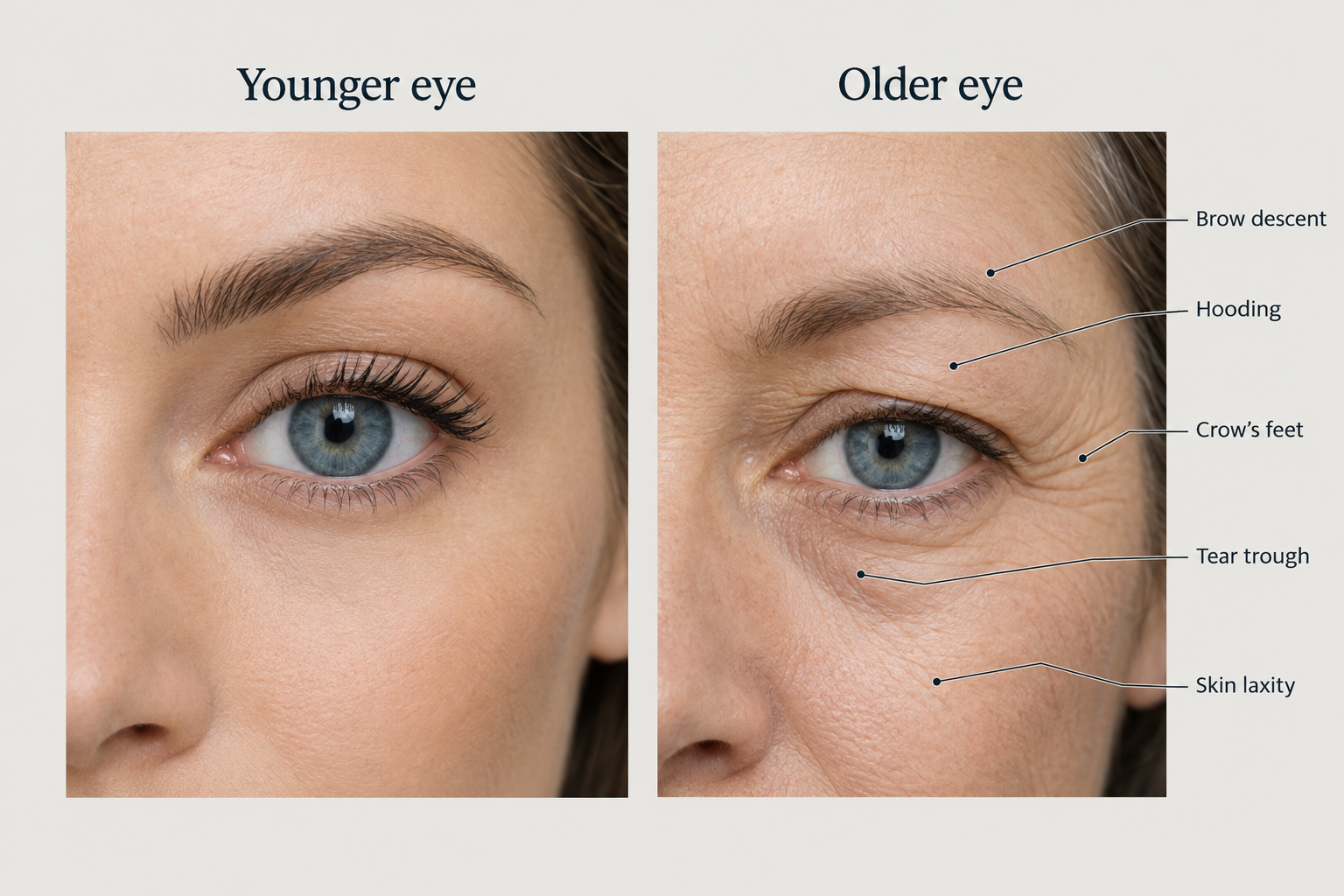
Fat redistribution around the eye can cause puffiness in the lower lids, while thinning of the lower eyelid skin may make underlying blood vessels more visible, contributing to a bluish or purplish discolouration. Fine lines and wrinkles develop at the outer corners (commonly called crow’s feet) and across the lower lid. These changes do not alter the fundamental bone structure of the eye, but they can significantly modify how the eye shape appears and how it is perceived. Understanding these changes is relevant both for realistic expectations about ageing and for assessing which aesthetic treatments, if any, may be appropriate at different life stages.
Eye Shape and Aesthetic Treatments
Identifying eye shape accurately is a practical starting point for several aesthetic considerations. In non-surgical aesthetics, botulinum toxin treatments around the eye area — such as treatment of crow’s feet or brow lifting — need to be tailored to the individual’s eye shape and anatomy to avoid unintended effects such as brow asymmetry, lid ptosis (drooping), or changes to the natural eye contour. What works well for one eye shape may produce an undesirable result in another.
Dermal filler treatments to the tear trough or periorbital area are similarly anatomy-dependent. The tear trough is the groove that runs from the inner corner of the eye toward the cheek, and its depth and position vary with eye shape and age-related volume loss. Filler in this area carries specific risks including vascular occlusion, the Tyndall effect (a bluish discolouration caused by superficially placed filler), and migration, all of which make practitioner experience and anatomical knowledge particularly important. Patients should always seek a qualified and experienced practitioner for any treatment in the periorbital region.
Surgical options such as upper or lower blepharoplasty, brow lift procedures, and canthoplasty (which modifies the angle of the outer corner) are more significant interventions that require consultation with a qualified ophthalmic or plastic surgeon. These procedures can produce lasting changes to eye shape and should be considered carefully, with realistic expectations about outcomes, recovery, and potential risks.
Frequently Asked Questions
Can I have more than one eye shape?
Yes. Most people have eyes that combine features from more than one category. For example, an eye might be almond-shaped in its overall outline but also have a degree of hooding, or it might be round with a slight downturn at the outer corner. Eye shape categories are descriptive tools rather than rigid classifications, and overlap is common.
Does eye shape affect vision?
Eye shape itself does not directly affect visual acuity, but certain structural features associated with eye shape can have functional implications. Significant hooding of the upper lid can reduce the superior visual field in some individuals. Prominent eyes may be more prone to dryness. If you have concerns about your vision or eyelid function, a consultation with an ophthalmologist is appropriate.
Can aesthetic treatments change my eye shape?
Some non-surgical and surgical treatments can modify the appearance of the eye area. Botulinum toxin may subtly lift the brow or outer corner in suitable candidates. Dermal fillers can address hollowness around the eye. Surgical procedures such as blepharoplasty or canthoplasty can produce more significant and lasting changes. Results depend on individual anatomy, the treatment chosen, and practitioner skill. No treatment can guarantee a specific outcome, and all carry potential risks.
Is hooded eye surgery covered by insurance?
In some countries, upper eyelid surgery (blepharoplasty) may be covered by health insurance or public healthcare when there is documented functional impairment — for example, when excess skin significantly reduces the visual field. Purely cosmetic blepharoplasty is generally not covered. Coverage criteria vary by country and insurer, so it is worth checking with your healthcare provider and an ophthalmologist or oculoplastic surgeon.
Do eyes change shape with age?
The underlying bone structure of the eye does not change significantly with age, but the soft tissue around the eye — including skin, fat, and muscle — does change. These changes can make eyes appear more hooded, more hollow, or more downturned over time. The fundamental eye shape category usually remains recognisable, but its appearance can shift noticeably across decades.
What is the difference between a monolid and a hooded eye?
A monolid eye has no visible eyelid crease — the lid surface is smooth from lash line to brow. A hooded eye has a crease, but the skin above the crease folds downward and covers part or all of the lid space when the eye is open. The two can coexist, but they are anatomically distinct features with different causes and different aesthetic considerations.
Should I see a professional to identify my eye shape?
For most people, self-assessment using a mirror is sufficient for makeup and general aesthetic purposes. However, if you are considering any cosmetic treatment in the eye area, a professional assessment by a qualified aesthetic practitioner, dermatologist, or surgeon is strongly recommended. They can evaluate your specific anatomy, discuss realistic outcomes, and identify any contraindications before any procedure is undertaken.
Understanding Your Eye Shape Before Any Aesthetic Decision
Identifying your eye shape is a useful first step, whether your interest is in makeup techniques, lash styling, or exploring aesthetic treatments. The categories described here — almond, round, hooded, monolid, downturned, upturned, wide-set, close-set, prominent, and deep-set — provide a practical framework, but they are descriptive guides rather than definitive labels. Most people will find that their eyes combine features from more than one category, and that is entirely normal.
If you are considering any cosmetic or medical treatment in the eye area, accurate identification of your eye shape is only the starting point. The periorbital region is anatomically complex, and treatments here carry specific risks that require careful assessment by a qualified practitioner. A thorough consultation — one that considers your anatomy, your concerns, your medical history, and your realistic expectations — is essential before any decision is made. Eye shape informs treatment planning, but it does not determine outcomes on its own, and no treatment should be undertaken without a proper clinical evaluation.


