
Identifying Nose Types: A Practical Guide to Nasal Anatomy and Aesthetics
Understanding nose types is more than a matter of curiosity — it can help you communicate more clearly with an aesthetic practitioner, set realistic expectations before any consultation, and make sense of the options available to you. Nasal shape is determined by a combination of bone structure, cartilage arrangement, soft tissue, and skin thickness, all of which vary considerably between individuals and across different ethnic backgrounds. This guide explains the most commonly recognised nose types, the anatomical features that define them, and what those differences mean if you are considering an aesthetic assessment or procedure.
Key Takeaways
- Nose shape is determined by bone, cartilage, soft tissue, and skin thickness — no single feature defines a nose type on its own.
- There is no universally ideal nasal shape; aesthetic assessment should always account for facial harmony, ethnic background, and individual goals.
- Non-surgical rhinoplasty using dermal filler can address certain concerns, but it has clear limitations and is not suitable for every nose type or concern.
- Surgical rhinoplasty remains the most comprehensive option for significant structural changes, though it carries greater risk and recovery time.
- A qualified practitioner should assess your anatomy in person before any treatment is recommended or undertaken.
What Defines a Nose Type?
Nasal shape is the result of several overlapping anatomical structures rather than a single defining characteristic. The nasal bones form the upper third of the nose, creating the bridge. The middle third is supported by the upper lateral cartilages, which influence the width and straightness of the nose in profile. The lower third — including the tip, nostrils, and columella (the strip of tissue between the nostrils) — is shaped primarily by the lower lateral cartilages, also called the alar cartilages. Skin thickness plays an important role too: thicker skin can obscure underlying cartilage definition, while thinner skin tends to reveal structural detail more clearly.
Ethnicity, genetics, age, and previous injury or surgery all influence nasal anatomy. Practitioners who assess nasal shape typically consider the nose in relation to the rest of the face — including the forehead, chin, and cheekbones — rather than evaluating it in isolation. Proportional analysis, sometimes using established facial thirds and fifths as reference points, helps identify which features may be contributing to a patient’s concern.
Common Nose Types and Their Defining Features
Nose classification systems vary between practitioners and researchers, and there is no single universally agreed taxonomy. The following types are among the most frequently described in both clinical and patient-facing literature. Many people have noses that combine features from more than one category.
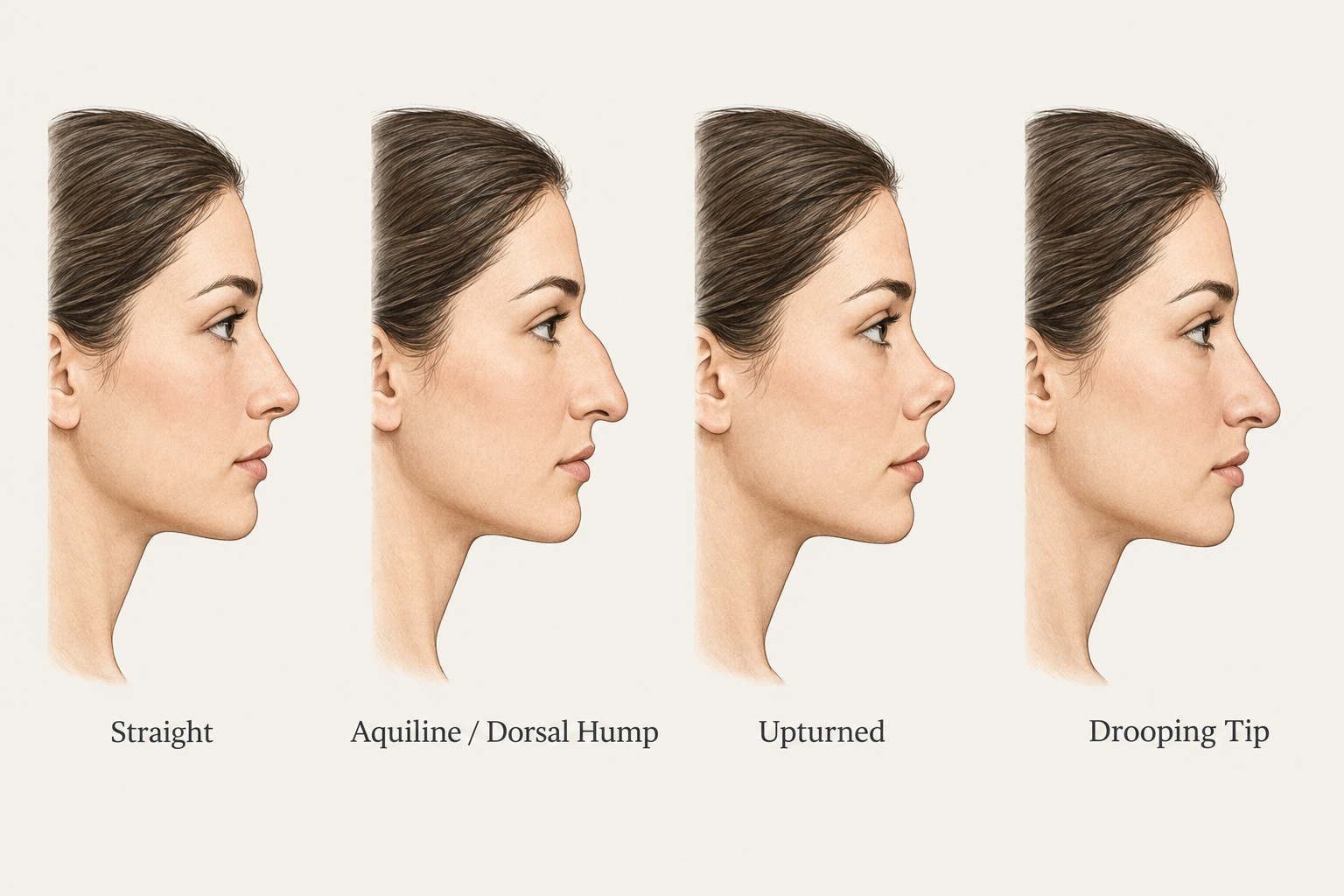
The Straight Nose
A straight nose has a relatively flat, smooth dorsal profile — the line running from the bridge to the tip — with no significant bumps or depressions. The tip is usually proportionate and the nostrils are symmetrical. This shape is often cited as a common aesthetic reference point in Western facial analysis, though it is by no means a universal standard. In practice, very few noses are perfectly straight, and minor asymmetries are normal.
The Dorsal Hump Nose
A dorsal hump, sometimes called a Roman nose or aquiline nose, is characterised by a visible convexity along the nasal bridge when viewed in profile. The hump may be bony, cartilaginous, or a combination of both. It is one of the most common concerns raised in rhinoplasty consultations. The degree of the hump varies considerably — some are subtle and considered a distinctive facial feature, while others are more pronounced and may affect the perceived balance between the nose and the rest of the face. Dorsal humps are particularly common in individuals of Middle Eastern, Southern European, and South Asian heritage.
The Bulbous Tip Nose
A bulbous nasal tip appears rounded, wide, or poorly defined. This is usually caused by the shape and spacing of the lower lateral cartilages, the amount of soft tissue overlying them, or a combination of both. Thicker nasal skin can make tip definition more difficult to achieve through either surgical or non-surgical means. A bulbous tip is one of the more challenging concerns to address non-surgically, as filler cannot reduce volume or reshape cartilage.
The Upturned or Snub Nose
An upturned nose has a tip that rotates upward, increasing the angle between the columella and the upper lip — a measurement known as the nasolabial angle. A nasolabial angle between approximately 90 and 115 degrees is generally considered within a typical aesthetic range, though this varies by sex and individual preference. When the angle is significantly greater than this, the nostrils may appear more visible from the front, which some patients find a concern. This nose type is sometimes described as a snub nose or a celestial nose.
The Drooping or Ptotic Tip Nose
A drooping nasal tip — sometimes called a ptotic tip — points downward rather than forward or upward. This can be a structural characteristic present from early adulthood, or it may develop or worsen with age as the tip support structures weaken and the skin loses elasticity. A drooping tip can make the nose appear longer than it is and may affect the perceived balance of the lower face. In some cases, the tip appears to droop more noticeably when smiling, due to the action of the depressor septi nasi muscle pulling the tip downward.
The Wide or Broad Nose
A wide nose is characterised by nostrils or a nasal base that appear broad relative to the rest of the face. Nasal width is often assessed in relation to the intercanthal distance — the space between the inner corners of the eyes — as a proportional reference. A wide nasal base is a common feature in individuals of African, East Asian, and South-East Asian heritage and is a normal anatomical variation rather than a flaw. Aesthetic assessment of nasal width should always consider the patient’s overall facial structure and ethnic background rather than applying a single universal standard.
The Deviated Nose
A deviated nose is one in which the nasal structure is not centred on the midline of the face. Deviation may affect the bony upper third, the cartilaginous middle third, or the tip, and it can involve the nasal septum internally. Deviation is sometimes the result of trauma, though it can also be a developmental characteristic. A significantly deviated nose may be associated with a deviated nasal septum, which can affect breathing. Any concern about nasal airflow or breathing should be assessed by an ENT (ear, nose, and throat) specialist rather than an aesthetic practitioner alone.
The Saddle Nose
A saddle nose has a concave or depressed dorsal profile, giving the bridge a sunken appearance. This can result from trauma, previous surgery, certain inflammatory conditions, or the overuse of cocaine. The degree of depression varies from subtle to pronounced. Saddle nose deformity is less common than dorsal humps and typically requires surgical correction if treatment is sought, though minor cases may sometimes be addressed with careful filler placement by an experienced practitioner.
The Ethnic Nose
The term ethnic rhinoplasty is used in surgical practice to describe procedures that address nasal concerns while preserving or respecting the patient’s ethnic characteristics. Nasal anatomy varies significantly across different populations — for example, individuals of East Asian heritage may have a lower, flatter bridge and a less projected tip, while individuals of African heritage may have a wider nasal base and thicker skin. Recognising these differences is important both for accurate identification of nose types and for ensuring that aesthetic goals are culturally sensitive and individually appropriate. Practitioners should never apply a single aesthetic template across all patients.
How Nose Shape Is Assessed in a Clinical Setting
A thorough nasal assessment considers the nose from multiple angles: the frontal view, the lateral (side) profile, the oblique (three-quarter) view, and the base view looking upward from below. Each angle reveals different structural information. Practitioners may also assess skin thickness by gently palpating the nose, as this significantly influences what can be achieved non-surgically. Photographs taken under consistent lighting conditions are commonly used to support assessment and to document baseline appearance before any treatment.
Facial proportions are also considered. The nose is evaluated in relation to the forehead, eyes, lips, and chin. A nose that appears large in isolation may look proportionate once the chin is assessed — and vice versa. This is why some patients seeking rhinoplasty are also offered chin augmentation as part of a broader facial balancing approach.
Non-Surgical Options for Nasal Concerns
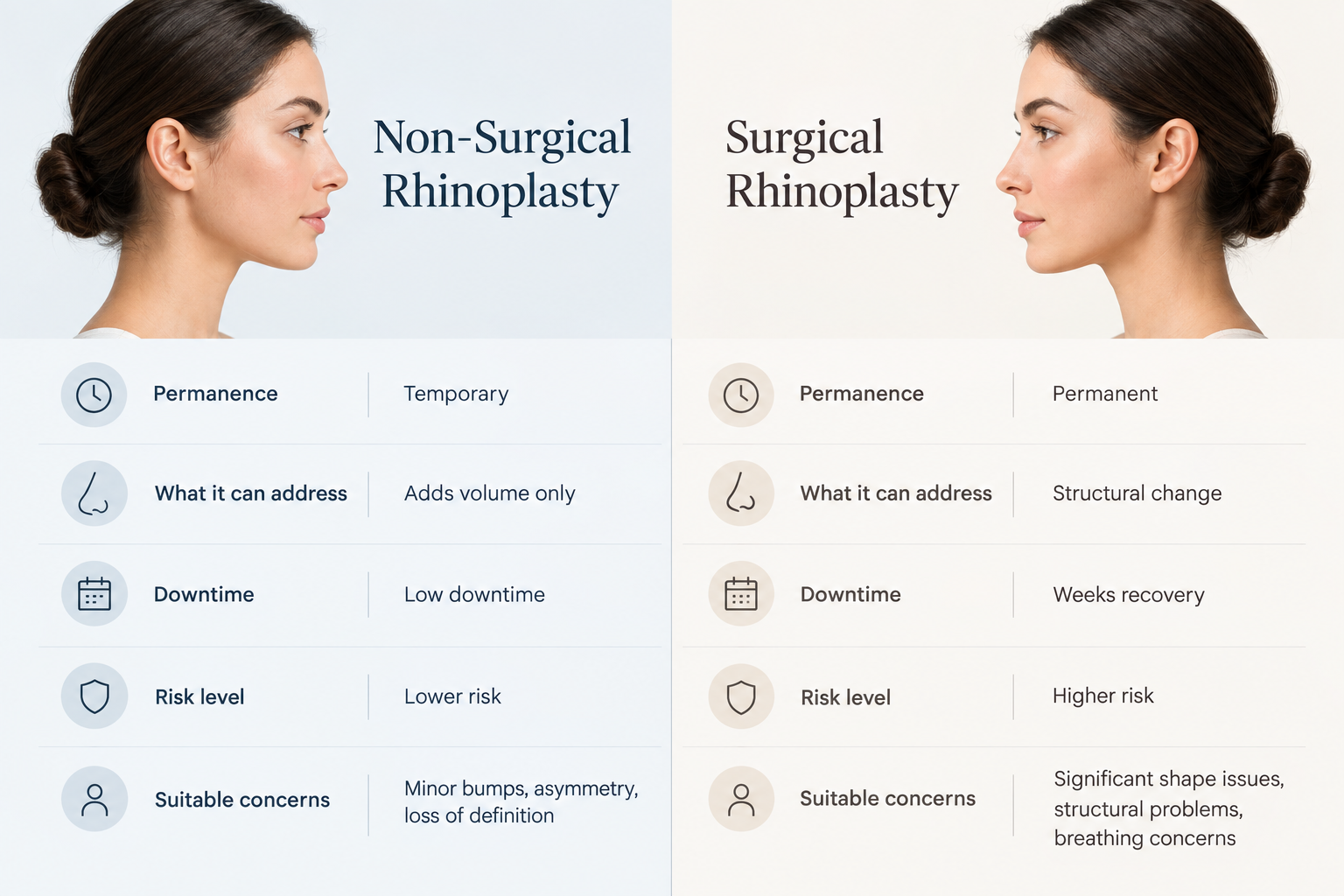
Non-surgical rhinoplasty — sometimes called a liquid nose job or non-surgical nose job — uses injectable dermal filler to alter the appearance of the nose without surgery. Hyaluronic acid fillers are most commonly used for this purpose. The procedure can be used to smooth a dorsal hump by adding volume above and below it to create a straighter profile, to lift a drooping tip, to improve symmetry in mild cases of deviation, or to add projection to a flat bridge.
Non-surgical rhinoplasty has clear limitations that patients should understand before considering it. Filler adds volume — it cannot reduce the size of the nose, narrow a wide nasal base, or refine a bulbous tip. Results are temporary, typically lasting between nine and eighteen months depending on the filler used, the area treated, and individual metabolism. The nose is a high-risk area for filler injection due to its complex vascular anatomy; complications including vascular occlusion, which can lead to skin necrosis or, in rare cases, vision changes, have been reported. This procedure should only be performed by a practitioner with specific training in nasal anatomy and vascular risk management.
Botulinum toxin injections are occasionally used as an adjunct — for example, to relax the depressor septi nasi muscle and reduce the degree to which the tip droops when smiling. This is a targeted application with a modest effect and is not a substitute for structural correction.
Surgical Rhinoplasty: When It May Be Relevant
Surgical rhinoplasty remains the most comprehensive approach for patients seeking significant or permanent changes to nasal shape. It can address structural concerns that non-surgical options cannot, including reducing a dorsal hump, refining a bulbous tip, narrowing a wide nasal base, correcting significant deviation, or improving nasal airflow in combination with septoplasty. Rhinoplasty is one of the most technically demanding procedures in facial surgery, and outcomes depend heavily on the surgeon’s skill, the patient’s anatomy, and the healing process.
Recovery from rhinoplasty typically involves swelling and bruising for two to three weeks, with a splint worn for approximately one week. Residual swelling, particularly at the tip, can persist for twelve months or longer. Final results are not fully visible until swelling has completely resolved. Risks include infection, asymmetry, breathing changes, scarring, and the possibility of revision surgery. Patients considering rhinoplasty should consult with a board-certified or equivalent plastic surgeon or ENT surgeon with specific rhinoplasty experience, and should have realistic expectations about the timeline and limitations of the procedure.
Identifying Your Nose Type: Practical Considerations
Self-identifying your nose type can be a useful starting point for understanding your anatomy and preparing for a consultation, but it has limitations. Photographs taken on a smartphone, particularly with wide-angle lenses, can distort nasal proportions significantly — making the nose appear wider or larger than it is in person. Lighting, angle, and expression all affect how the nose appears in images. Clinical assessment by a qualified practitioner, using standardised photography and in-person evaluation, provides a more accurate basis for treatment planning than self-assessment alone.
It is also worth recognising that many concerns about nasal appearance are influenced by factors beyond anatomy — including the angle from which a person most often sees themselves (typically in a mirror, which reverses the image), the effect of social media filters, and broader cultural pressures around appearance. A practitioner who takes time to understand your specific concern, rather than simply categorising your nose type, is better placed to offer relevant and proportionate advice.
Risks, Limitations, and Realistic Expectations
Whether considering non-surgical or surgical options, realistic expectations are essential. Non-surgical rhinoplasty can create the impression of a smoother profile or a more lifted tip, but the changes are subtle and temporary. It is not appropriate for patients seeking significant size reduction or structural correction. Surgical rhinoplasty can achieve more substantial and lasting changes, but it carries greater risk, longer recovery, and the possibility that results may not fully meet expectations — particularly given the complexity of nasal healing.
Patients with body dysmorphic disorder (BDD) — a condition characterised by excessive preoccupation with perceived flaws in appearance — may not benefit from aesthetic procedures and may experience worsening distress following treatment. Reputable practitioners screen for signs of BDD and other psychological factors as part of the consultation process. If a practitioner does not discuss your motivations and expectations in detail before recommending treatment, this is a concern worth noting.
Frequently Asked Questions
Can I identify my nose type from a photo?
Photographs can give a general indication of nasal shape, but smartphone cameras — especially those with wide-angle lenses — distort facial proportions. A clinical assessment in person, using standardised photography and direct evaluation, is more reliable for treatment planning purposes.
Is there an ideal nose shape?
There is no single ideal nose shape. Aesthetic assessment considers the nose in relation to the whole face, the patient’s ethnic background, and their individual goals. What appears proportionate and harmonious varies considerably between individuals.
Can filler make my nose smaller?
No. Dermal filler adds volume and cannot reduce the size of the nose. Non-surgical rhinoplasty can create the visual impression of a smoother or more balanced nose in certain cases, but it is not a substitute for surgical reduction.
How long does non-surgical rhinoplasty last?
Results from hyaluronic acid filler in the nose typically last between nine and eighteen months, though this varies depending on the product used, the volume injected, and individual factors such as metabolism and activity level.
Is non-surgical rhinoplasty safe?
The nose is considered a high-risk area for filler injection due to its complex blood supply. Serious complications, including vascular occlusion leading to tissue damage, have been reported. The procedure should only be performed by a practitioner with specific training in nasal anatomy and emergency management of vascular complications.
Does nose shape change with age?
Yes. The nose can change with age as skin loses elasticity, soft tissue descends, and tip support structures weaken. This can cause the tip to droop and the nose to appear longer over time. These changes are gradual and vary between individuals.
What is the difference between rhinoplasty and septoplasty?
Rhinoplasty refers to surgery that changes the external appearance of the nose. Septoplasty is a procedure that corrects a deviated nasal septum to improve airflow and breathing. The two procedures are sometimes performed together, in which case the combined surgery is called septorhinoplasty.
Understanding Your Nose Type Before Seeking Aesthetic Advice
Knowing the broad category your nose falls into — whether it has a dorsal hump, a drooping tip, a wide base, or another defining feature — can help you articulate your concerns more clearly when speaking with a practitioner. It can also help you understand why certain options may or may not be appropriate for your anatomy. However, nose type classification is a starting point, not a treatment plan. The same nose type can present very differently depending on skin thickness, overall facial proportions, and individual anatomy, and the same concern can have different underlying causes that require different approaches.
If you are considering any aesthetic procedure involving the nose, seek a consultation with a practitioner who has specific experience in nasal assessment and treatment, who takes time to understand your goals and concerns, and who explains both the realistic benefits and the limitations of any option they recommend. A thorough, unhurried consultation is the most important step before any decision is made.


