
Non-Surgical Rhinoplasty: What to Expect, Benefits, Risks and Limitations
Non-surgical rhinoplasty uses injectable dermal fillers to alter the appearance of the nose without surgery. It has become one of the more frequently requested non-invasive facial procedures, appealing to people who want to address specific cosmetic concerns about their nose shape without committing to a surgical rhinoplasty. Understanding what the treatment can and cannot achieve — and where the genuine risks lie — is essential before deciding whether it is worth discussing with a qualified practitioner.
Key Takeaways
- Non-surgical rhinoplasty involves injecting hyaluronic acid filler into precise areas of the nose to alter its visible shape, without incisions or general anaesthesia.
- Results are temporary, typically lasting between 9 and 18 months depending on the filler used, the area treated, and individual metabolism.
- The nose is a high-risk injection zone; vascular complications, including skin necrosis and, in rare cases, vision changes, are recognised risks that require an experienced, medically qualified injector.
- Non-surgical rhinoplasty can improve the appearance of certain concerns such as a dorsal hump, asymmetry, or a drooping nasal tip, but it cannot reduce the overall size of the nose or correct significant structural issues.
- A thorough consultation with a qualified medical professional is essential to assess suitability, anatomy, and realistic outcomes before proceeding.
What Is Non-Surgical Rhinoplasty?
Non-surgical rhinoplasty — sometimes called a liquid nose job, non-surgical nose job, or filler rhinoplasty — is a cosmetic procedure in which a practitioner injects a small volume of dermal filler into specific areas of the nose to change its contour. The most commonly used fillers are hyaluronic acid-based products, which are gel-like substances that add volume and can be shaped to create the illusion of a smoother, more symmetrical, or differently proportioned nose. Because hyaluronic acid fillers can be dissolved with an enzyme called hyaluronidase, they offer a degree of reversibility that surgical options do not.
The procedure does not involve cutting, bone reshaping, or cartilage modification. Instead, it works through strategic volume placement: adding filler above or below a bump can make the nose appear straighter in profile; placing filler at the nasal tip can create the impression of greater definition; and correcting asymmetry may be possible by balancing volume on either side. These are optical illusions created by changing the light and shadow across the nose’s surface, not structural changes to the underlying anatomy.
Non-surgical rhinoplasty is distinct from surgical rhinoplasty in almost every meaningful clinical way. It is less invasive, requires no general anaesthesia, involves minimal downtime, and produces temporary rather than permanent results. However, it also has significant limitations and carries specific risks that are unique to the nasal anatomy.
What Concerns Can It Address?
Non-surgical rhinoplasty may be suitable for a defined set of cosmetic concerns. It is important to understand that the procedure adds volume rather than removes it, which means it is better suited to certain presentations than others.
Concerns that may respond well to non-surgical nose reshaping include:
- Dorsal hump: A bump on the bridge of the nose can appear less prominent when filler is placed above and below it to create a smoother profile line. The hump itself is not removed; the surrounding areas are built up to reduce the visual contrast.
- Nasal tip refinement: A drooping, flat, or asymmetric nasal tip may be improved with careful filler placement to add projection or lift.
- Asymmetry: Minor asymmetries in the nose bridge or tip may be partially corrected by adding volume to the less prominent side.
- Saddle nose deformity: A depressed or concave nasal bridge, sometimes resulting from previous trauma or surgery, may be improved with filler to restore a more natural contour.
- Post-surgical refinement: Some patients who have had surgical rhinoplasty and are left with minor irregularities may use filler as a non-permanent way to address residual concerns, though this requires careful assessment.
Non-surgical rhinoplasty is generally not appropriate for reducing the overall size of the nose, narrowing wide nostrils, correcting significant structural deviation, or addressing breathing difficulties. Adding volume to an already large nose can make it appear larger, so patient selection and realistic expectation-setting are critical.
How the Procedure Works
A non-surgical rhinoplasty appointment typically begins with a consultation to assess the patient’s nasal anatomy, skin quality, previous procedures, and cosmetic goals. Photographs are usually taken to support treatment planning and to provide a reference point for evaluating results.
Before the injections, a topical anaesthetic cream may be applied to the skin to reduce discomfort, and some practitioners use a local anaesthetic block. The filler itself often contains lidocaine, a local anaesthetic, which can further reduce sensation during the procedure. The injections are placed using either a fine needle or a blunt-tipped cannula, depending on the practitioner’s technique and the specific area being treated. Cannulas are sometimes preferred in high-risk zones because they may reduce the risk of inadvertent intravascular injection, though both techniques carry risks and neither eliminates them entirely.
The procedure itself usually takes between 15 and 30 minutes. Results are visible immediately, though some swelling and minor bruising are common in the first few days and may temporarily affect the appearance. Most patients can return to normal activities the same day or the following day, making downtime relatively minimal compared to surgical alternatives.
After treatment, practitioners typically advise avoiding strenuous exercise, excessive heat, and pressure on the nose for a short period. A follow-up appointment is often recommended to assess the result once initial swelling has settled, usually after one to two weeks.
How Long Do Results Last?
Results from non-surgical rhinoplasty with hyaluronic acid filler are temporary. Most patients can expect results to last between 9 and 18 months, though this varies depending on several factors: the specific filler product used, the volume injected, the area treated, and the individual’s rate of filler metabolism. The nose is an area of relatively low movement compared to, for example, the lips, which may contribute to filler lasting somewhat longer in some patients.
Over time, the hyaluronic acid is gradually broken down by the body’s natural processes, and the nose will return toward its original appearance. Maintenance treatments are required to sustain the result. Some patients choose to have the filler dissolved with hyaluronidase before it fully degrades, either because they are unhappy with the result or because they wish to reassess their goals.
It is worth noting that repeated filler treatments in the same area over time can occasionally lead to changes in tissue texture or filler accumulation, particularly if previous filler has not been fully dissolved before adding more. This is one reason why maintaining an accurate treatment history and working with a consistent, experienced practitioner is advisable.
Risks and Side Effects
Non-surgical rhinoplasty carries a more significant risk profile than many other filler treatments, and this is directly related to the anatomy of the nose. The nasal region has a complex network of small blood vessels, and the nose receives its blood supply from branches of both the facial artery and the ophthalmic artery. This vascular anatomy means that an inadvertent injection into or around a blood vessel can have serious consequences.
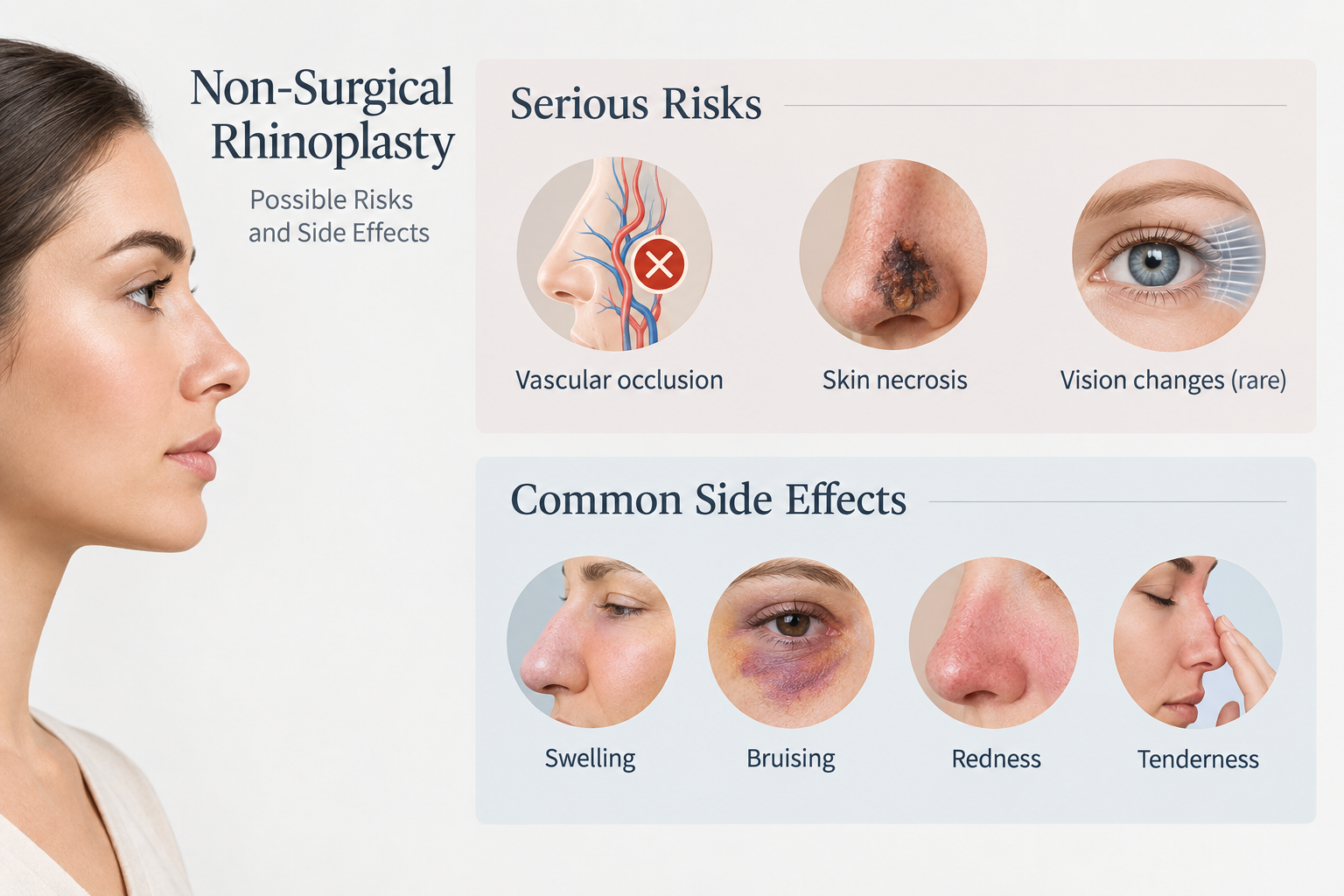
The most serious recognised risks include:
- Vascular occlusion: If filler enters or compresses a blood vessel, it can block blood flow to the surrounding tissue. In the nose, this can lead to skin necrosis — tissue death — which may result in permanent scarring. This is a medical emergency requiring immediate treatment with hyaluronidase.
- Vision changes and blindness: In rare but documented cases, filler injected in the nasal region has migrated retrogradely through vascular connections to the ophthalmic artery, causing partial or complete vision loss. This is one of the most severe known complications of facial filler injection and has been reported in the medical literature. It may be irreversible.
- Infection: As with any injection, there is a risk of localised infection. Rare but serious infections, including abscess formation, have been reported.
- Filler migration: Filler can occasionally move from the intended injection site, altering the appearance of the nose in an unintended way.
- Nodules or irregularities: Lumps or uneven texture can develop, particularly if filler is placed too superficially or if the product is not well-suited to the area.
- Delayed inflammatory reactions: Hyaluronic acid fillers can occasionally trigger delayed hypersensitivity reactions, sometimes months after treatment.
Common, less serious side effects include temporary swelling, bruising, redness, and tenderness at the injection sites. These typically resolve within a few days to two weeks.
Because of the serious vascular risks specific to nasal filler injection, this procedure should only be performed by a medically qualified practitioner with specific training in facial anatomy and filler complication management. The availability of hyaluronidase on-site is considered essential. Patients should ask about their practitioner’s qualifications, experience with nasal filler specifically, and their protocol for managing complications before proceeding.
Who May Be Suitable
Non-surgical rhinoplasty may be worth discussing with a qualified practitioner if you:
- Have specific, defined cosmetic concerns about your nose shape that fall within the scope of what filler can address, such as a dorsal hump, a drooping tip, or minor asymmetry.
- Are not ready for or do not wish to undergo surgical rhinoplasty.
- Want to preview a potential change before committing to a permanent surgical result.
- Have realistic expectations about the temporary nature and limitations of the treatment.
- Are in good general health with no active skin infection or inflammation in the treatment area.
Non-surgical rhinoplasty is generally not recommended for people who:
- Want to reduce the overall size of their nose, as adding volume cannot achieve this.
- Have significant structural concerns, such as a severely deviated septum or breathing difficulties, which require surgical correction.
- Are pregnant or breastfeeding.
- Have a known allergy to hyaluronic acid filler components or lidocaine.
- Have active skin infection, inflammation, or a history of cold sores in the treatment area without appropriate precautions.
- Have previously had permanent or semi-permanent fillers in the nose, which significantly increases the risk of complications and may make the procedure inadvisable.
- Have certain bleeding disorders or are taking medications that significantly affect clotting, depending on clinical assessment.
A thorough pre-treatment consultation is essential to assess individual anatomy, medical history, and suitability. The nose’s vascular anatomy varies between individuals, and a practitioner experienced in nasal filler should assess each patient carefully before proceeding.
Non-Surgical vs Surgical Rhinoplasty: Key Differences
Understanding the differences between non-surgical and surgical rhinoplasty helps clarify which option may be more appropriate for a given patient’s goals. These are fundamentally different procedures with different mechanisms, outcomes, risks, and longevity.
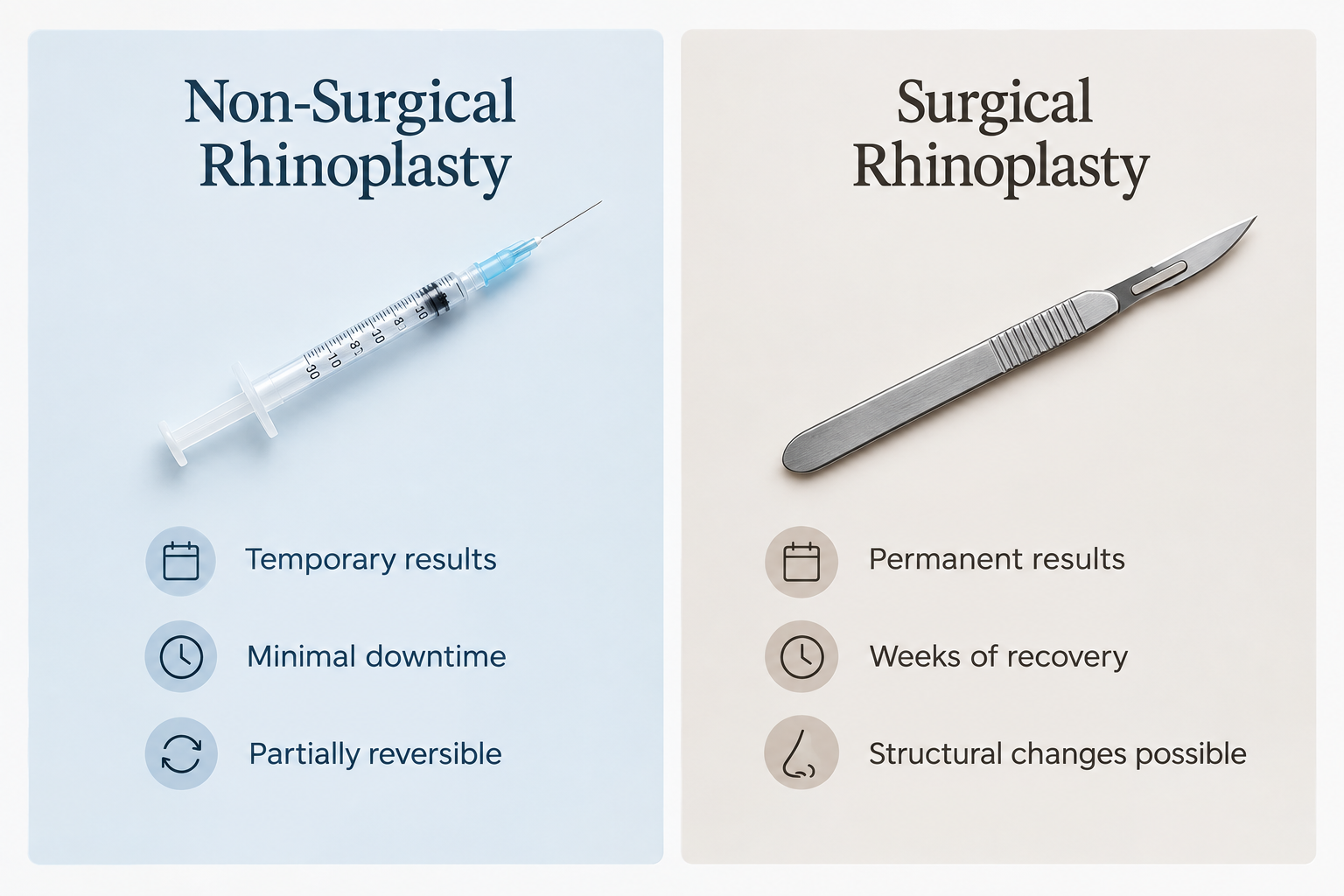
| Characteristic | Non-Surgical Rhinoplasty | Surgical Rhinoplasty |
|---|---|---|
| Method | Injectable dermal filler | Surgery under general or local anaesthesia |
| Anaesthesia | Topical or local anaesthetic | General or sedation anaesthesia |
| Downtime | Minimal; usually 1–2 days | Significant; weeks to months for full recovery |
| Results duration | Temporary; 9–18 months typically | Permanent (though ageing continues) |
| Reversibility | Partially reversible with hyaluronidase | Not reversible |
| What it can change | Contour, profile, minor asymmetry, tip appearance | Size, shape, structure, breathing function |
| What it cannot change | Overall nose size, nostrils, structural issues | N/A — structural changes are possible |
| Risk profile | Vascular complications, necrosis, rare vision risk | Surgical risks, anaesthesia risks, scarring, revision |
| Cost | Lower per session; ongoing maintenance required | Higher upfront; no ongoing maintenance |
Neither option is universally superior. The right choice depends on the patient’s specific concerns, anatomy, goals, tolerance for risk, and willingness to commit to either ongoing maintenance or a surgical recovery. Some patients use non-surgical rhinoplasty as a temporary measure while deciding whether to pursue surgery; others find it sufficient for their goals and continue with maintenance treatments.
Alternatives to Non-Surgical Rhinoplasty
For patients who are not suitable candidates for non-surgical rhinoplasty, or who want to explore other options, several alternatives exist depending on the underlying concern.
Surgical rhinoplasty remains the most comprehensive option for patients who want permanent structural changes to the nose, including size reduction, nostril reshaping, or correction of breathing difficulties. It requires a longer recovery period and carries surgical risks, but the results are lasting and can address concerns that filler cannot.
Septoplasty is a surgical procedure specifically aimed at correcting a deviated septum to improve nasal airflow. It is a functional rather than purely cosmetic procedure and is not an alternative to rhinoplasty for cosmetic concerns, but it is relevant for patients whose primary concern is breathing.
Contouring makeup is a non-invasive, zero-risk option that can create the visual impression of a different nose shape using light and shadow. While it requires skill and is not a permanent solution, it carries no medical risk and can be a useful way to explore how a different nose shape might look before committing to any procedure.
Botulinum toxin injection is occasionally used in a limited way around the nose — for example, to relax the depressor septi nasi muscle, which can cause the nasal tip to drop when smiling. This is a very specific application and is not a substitute for filler rhinoplasty, but it may be relevant for certain patients as a complementary or standalone treatment.
Choosing a Practitioner
The choice of practitioner is arguably the most important decision in non-surgical rhinoplasty, given the serious vascular risks associated with nasal filler injection. This procedure should be performed only by a medically qualified professional — such as a doctor, dentist, or nurse prescriber with appropriate training — who has specific experience in nasal anatomy and filler injection in this area.
Before booking a treatment, it is reasonable to ask:
- What are your medical qualifications and specific training in facial filler injection?
- How many non-surgical rhinoplasty procedures have you performed?
- Do you have hyaluronidase available on-site, and are you trained to manage vascular complications?
- What is your protocol if a complication occurs during or after treatment?
- Can you show me examples of your previous work in this area?
- What results are realistic for my specific anatomy and concerns?
A practitioner who is unwilling to answer these questions clearly, who does not discuss risks in detail, or who does not conduct a thorough pre-treatment assessment should be approached with caution. The low cost of some non-surgical rhinoplasty treatments does not reflect the level of skill and anatomical knowledge required to perform them safely.
Frequently Asked Questions
Is non-surgical rhinoplasty painful?
Most patients describe the procedure as mildly uncomfortable rather than painful. Topical anaesthetic cream is usually applied beforehand, and many filler products contain lidocaine to reduce discomfort during injection. The nose can be a sensitive area, and some patients experience more discomfort than others. A local anaesthetic block can be used if needed.
Can non-surgical rhinoplasty make my nose look smaller?
Non-surgical rhinoplasty adds volume rather than removes it, so it cannot reduce the overall size of the nose. In some cases, strategic filler placement can create the optical illusion of a more proportionate nose — for example, by smoothing a dorsal hump — but patients seeking genuine size reduction are better served by surgical rhinoplasty.
How soon will I see results?
Results are visible immediately after treatment, though initial swelling may temporarily affect the appearance. Most patients have a clearer view of their result after one to two weeks, once swelling has settled. A follow-up appointment at this stage is useful to assess the outcome.
Can the filler be removed if I am unhappy with the result?
Hyaluronic acid filler can be dissolved using an enzyme called hyaluronidase, which breaks down the filler relatively quickly. This partial reversibility is one of the advantages of hyaluronic acid over permanent or semi-permanent fillers. However, dissolution does not always return the nose to its exact pre-treatment state, and the process itself carries a small risk of allergic reaction.
Is non-surgical rhinoplasty safe?
Non-surgical rhinoplasty carries specific and serious risks related to the vascular anatomy of the nose, including the risk of vascular occlusion, skin necrosis, and, in rare cases, vision changes. These risks are not eliminated by any technique, but they can be significantly reduced by choosing a medically qualified, experienced practitioner who has hyaluronidase available and is trained to manage complications. The procedure is not risk-free, and patients should be fully informed before consenting to treatment.
How much does non-surgical rhinoplasty cost?
Costs vary considerably depending on the practitioner’s qualifications and experience, the clinic’s location, and the amount of filler required. Because this is a high-risk procedure requiring specific expertise, very low-cost treatments may reflect a lack of appropriate training or the use of lower-quality products. Cost should not be the primary factor when choosing a practitioner for nasal filler.
Can I have non-surgical rhinoplasty if I have had a surgical rhinoplasty before?
Previous surgical rhinoplasty can alter the nasal anatomy and blood supply in ways that may increase the risk of complications from filler injection. This does not automatically exclude someone from being a candidate, but it requires careful assessment by an experienced practitioner who is aware of the surgical history and any changes to the underlying anatomy.
Is Non-Surgical Rhinoplasty the Right Choice for You?
Non-surgical rhinoplasty can be a genuinely useful option for patients with specific, realistic goals — particularly those who want to address a dorsal hump, refine the nasal tip, or improve minor asymmetry without undergoing surgery. The temporary nature of the results, combined with the partial reversibility of hyaluronic acid filler, makes it an appealing way to explore a change before committing to anything permanent.
However, the procedure has meaningful limitations. It cannot reduce the size of the nose, correct structural problems, or address breathing concerns. Results require ongoing maintenance, and the cumulative cost of repeated treatments over time may approach or exceed the cost of a surgical procedure for some patients. Most importantly, the nasal region carries a higher vascular risk than many other filler treatment areas, and serious complications — while uncommon — are well-documented in the medical literature.
The decision to proceed should be based on a thorough understanding of what the treatment can realistically achieve for your specific anatomy, a clear-eyed assessment of the risks, and confidence in the qualifications and experience of the practitioner you choose. A detailed consultation with a medically qualified professional is the appropriate starting point for anyone seriously considering non-surgical nose reshaping.


