Lip Filler Shape Guide: Different Types of Lip Fillers to Enhance Natural Beauty
Modern lip enhancement has evolved into a sophisticated art form that prioritises individuality over uniformity. This comprehensive guide explores the diverse range of techniques and styles available at our central London aesthetic clinic, helping you understand how professional practitioners can enhance their lips whilst preserving what makes you uniquely beautiful. Understanding lip fillers is essential for anyone considering lip fillers and seeking to achieve their ideal lip shape.

Thousands of satisfied customers

Lip Filler Basics and Aesthetic Goals
Understanding the fundamentals of dermal enhancement begins with recognising that each face tells a different story. Medical-grade hyaluronic acid preparations remain the gold standard for temporary volume restoration, offering predictable outcomes with minimal downtime. According to research published in the Journal of Clinical and Aesthetic Dermatology, patient satisfaction rates exceed 85% when realistic expectations align with clinical capabilities. The type of filler used significantly impacts both immediate results and long-term satisfaction.
Popular Lip Filler Treatment Options
Contemporary practitioners work with several FDA-approved and MHRA-regulated filler products, each formulated with specific cross-linking densities and particle sizes. Juvederm Volbella, Restylane Kysse, and Teosyal Kiss represent three distinct viscosity profiles suited to different anatomical needs. When it comes to lip fillers, selecting the best lip filler depends on your unique anatomy and aesthetic goals.
The selection process considers multiple variables:
- Tissue thickness in both upper and lower lip segments
- Existing asymmetries that require correction or camouflage
- Hydration capacity of the product relative to desired longevity
- Patient lifestyle factors including sun exposure and metabolic rate
Your practitioner will assess your facial architecture during consultation, measuring proportions against established aesthetic principles whilst respecting your personal preferences. This collaborative approach ensures treatments complement rather than compete with your existing features, helping you determine the right lip filler for your needs.
Core Benefits of Enhancing Your Natural Pout
Strategic volume placement offers multiple aesthetic advantages beyond simple size increase. Lip fillers can provide numerous benefits that extend to both aesthetic and psychological wellbeing. Clinical observations demonstrate that properly executed treatments can:
- Restore age-related volume loss without creating artificial appearances
- Improve symmetry between proportions of the upper lip and lower segments
- Refine border definition for clearer separation from surrounding skin
- Enhance hydration through hyaluronic acid’s moisture-binding properties
- Boost confidence through subtle improvements aligned with personal goals
Research from the American Society for Dermatologic Surgery indicates that 72% of patients report improved self-perception following conservative enhancement procedures. These psychological benefits often prove as valuable as the physical changes themselves. Many clients seek to enhance the natural beauty they already possess rather than pursuing dramatic transformations.
Safety Standards and Procedure Expectations
Accredited clinics in the United Kingdom operate under strict regulatory frameworks established by the Care Quality Commission. Your provider should maintain comprehensive insurance, demonstrate continuous professional development, and follow aseptic techniques throughout every appointment. Understanding where filler is injected and how the procedure unfolds helps patients feel more confident.
A standard session typically progresses through these stages:
- Thorough medical history review and contraindication screening
- Digital photography for documentation and analysis
- Topical anaesthetic application for comfort optimisation
- Precise injection using cannula or needle techniques
- Immediate assessment with massage and shaping
- Detailed aftercare instructions and emergency contact provision
Most patients experience moderate swelling that peaks within 48 hours before gradually subsiding over the following week. Temporary bruising may occur but can usually be concealed with mineral-based cosmetics after 24 hours.

Comprehensive Gallery of 16 Popular Lip Filler Shapes
Contemporary aesthetic medicine recognises that standardised approaches rarely yield optimal results. The following styles represent popular lip shapes that patients commonly request, though skilled practitioners frequently blend elements from multiple categories to create bespoke outcomes. Different lip filler shapes offer varied aesthetic possibilities depending on your desired lip outcome.
Classic Proportions and Natural Balance
This timeless approach follows the golden ratio principle, where the lower vermillion measures approximately 1.6 times the height of the upper segment. Product is strategically placed to respect existing architecture whilst adding subtle fullness throughout. This classic lip style suits those seeking refinement rather than transformation.
The technique particularly suits those seeking refinement rather than transformation. A subtle lip enhancement distributed evenly maintains harmony between features, allowing lips to integrate seamlessly within the broader facial context. Many patients appreciate how this style enhances their natural appearance without drawing attention to their lips without making the treatment obvious.
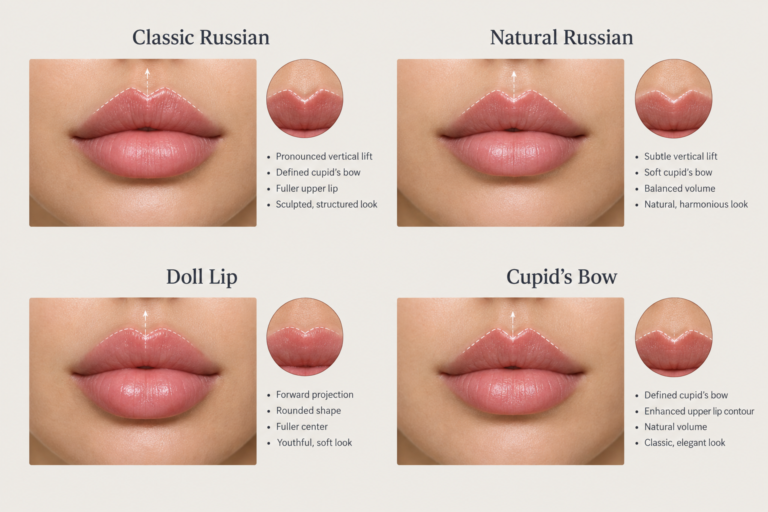
Russian Lip Filler Technique for Vertical Lift
Originating from Eastern European aesthetic practices, the Russian lip technique emphasises vertical height over horizontal projection. Practitioners inject filler perpendicular to the vermillion border, creating distinct pillars of volume that lift tissue upward rather than pushing it forward. This popular method of lip augmentation creates distinctive vertical definition.
This method produces characteristic flattened profiles when viewed from the side, with enhanced definition along the cupid’s bow and pronounced vertical lip lines. The style works particularly well for those seeking a fuller upper lip who desire dramatic height increase whilst keeping the lower lip more natural in proportion.
Clinical studies suggest this approach requires advanced injection skills, as improper placement may compromise blood flow. Always verify your practitioner has received specific training in this demanding technique before proceeding.
Cupid’s Bow Definition and Style
The cupid’s bow—that distinctive M-shaped curve along the upper vermillion border—serves as a focal point for many enhancement strategies. Some patients present with poorly defined peaks, whilst others seek to accentuate naturally prominent features. Choosing the right lip approach here focuses on creating or enhancing this architectural landmark.
Targeted placement in the tubercles creates sharp definition, transforming subtle curves into bold statements. This style often pairs with conservative volume in surrounding areas, allowing the enhanced bow to command attention without overwhelming other features. The approach proves especially effective for photographic contexts where clear definition reads well under varied lighting conditions.
Keyhole Pout and Center Gaps
This unconventional aesthetic deliberately maintains or creates a small gap between the central portions of both segments, forming a keyhole shape when lips rest in neutral position. The look gained attention through celebrity influence and represents a departure from traditional fullness ideals.
Achieving this appearance requires careful assessment of dental positioning and jaw mechanics, as the gap must occur naturally without forcing unnatural postures. The style typically combines fuller lateral sections with deliberately restrained central volumes, producing a distinctive silhouette that divides opinion. This type of lip filler shape requires precise technique.
Heart-Shaped and Baby Doll Filler Styles
The heart shape emphasises fullness in the centre of the bottom lip whilst maintaining delicate proportions in the top segment. When viewed from the front, the overall effect transforms lips into a subtle heart silhouette that appears youthful and playful. Achieving a heart shape with more volume in the lower segment creates this distinctive appearance.
Baby doll interpretations take this concept further, focusing volume predominantly in the lower third whilst keeping the upper lip without excessive enhancement. This distribution can make the bottom lip appear pouty and pillowy, though it requires careful execution to avoid disproportionate results. The approach particularly appeals to those seeking a softer, more innocent aesthetic.
Hollywood Glamour and Supermodel Pout
Classic Hollywood proportions favour balanced fullness with smooth, curved profiles and prominent volume distributed evenly throughout both segments. This approach takes inspiration from golden-era cinema, where fuller, more dramatically proportioned features read well on screen. Many associate this with the perfect pout ideal.
The supermodel interpretation typically emphasises slightly greater fullness in the lower vermillion with crisp definition along all borders. Both styles prioritise symmetry and smooth contours over textural variations, creating polished appearances suited to formal settings and professional photography. When considering various shapes, this remains among the most requested.
Rubina and Goddess Fullness
Rubina refers to maximum volume distributed evenly across all areas, creating a bold lip aesthetic that celebrates fullness as its primary goal. This style requires significant product volumes and multiple treatment sessions to achieve final results.
Goddess variations incorporate similar volume levels but add emphasis to specific architectural points—enhanced peaks, exaggerated cupid’s bow definition, or pronounced projection. These dramatic styles represent the upper boundaries of what you can achieve with lip fillers safely with dermal enhancement, demanding expert assessment of tissue capacity and healing response.
Korean Cherry Lips and Tented Shapes
Korean aesthetic preferences traditionally favour smaller, gradient-effect lips that concentrate colour and volume in the central portions whilst fading toward the corners. Cherry interpretations focus on creating rounded, plump centres that resemble the fruit’s silhouette.
Tented shapes follow similar principles, building maximum height in the middle whilst tapering smoothly toward commissures. These styles often incorporate minimal lateral volume, producing a concentrated, youthful appearance to the lips that differs markedly from Western fullness ideals. The approach typically requires less total product volume than many alternative styles.
Gull Wing and Shelf Lip Corrections
The gull wing describes an upper lip while keeping the lower segment where the tubercles sit lower than the central philtrum, creating a downturned curve reminiscent of the bird’s wing profile. This anatomical variant can be subtly corrected through strategic tubercle augmentation, lifting the outer peaks to create a more neutral or slightly upturned curve.
Shelf lip corrections address situations where excessive upper projection creates an unnatural ledge effect. This issue often arises from previous overfilling or age-related tissue changes. Correction requires dissolving excess product, allowing tissue to settle before implementing conservative replacement strategies focused on proportion restoration.
Pillowy Texture and Round Profiles
Pillowy textures emphasise soft, rounded contours with minimal definition along borders or structural features. This approach creates a plush, cushioned appearance that prioritises tactile appeal alongside visual fullness. The shape and size work together to create comfortable, natural-feeling results.
Round profiles extend this concept, producing circular or oval silhouettes when viewed from the front. These styles deliberately avoid sharp angles or prominent architectural features, instead favouring smooth transitions and gentle curves throughout. The aesthetic particularly suits those seeking comfort and softness over dramatic definition.
Top-Heavy vs. Bottom-Heavy Balance
Top-heavy distributions place greater volume in the upper segment, reversing the naturally occurring proportion where the lower area typically exceeds the top lip in height. This approach can correct naturally bottom-heavy presentations or create intentional fashion-forward asymmetry.
Bottom-heavy styles exaggerate natural proportions, adding significantly more volume to the lower lip while keeping the upper lip relatively modest. This distribution produces a pouty, sensual effect favoured in contemporary beauty standards. Clinical research suggests most patients ultimately prefer balanced approaches, though individual variation remains considerable.
M-Shaped and Double Lobe Variations
M-shaped enhancements exaggerate the natural tubercle structure, creating pronounced peaks separated by a deeper central valley. This dramatic interpretation of the cupid’s bow produces distinctive profiles that read clearly from all angles.
Double lobe variations refer to specialized techniques that highlight or create subtle divisions within the lower segment, producing twin rounded masses separated by a shallow vertical groove. This uncommonly requested style requires precise placement

Advanced Lip Filler Techniques and Injection Methods
Beyond aesthetic goals, the technical approach significantly influences final outcomes, recovery experiences, and longevity. Contemporary practitioners employ multiple methods, often combining techniques within single sessions to achieve optimal results. Different types of fillers require specific injection approaches.
Traditional Volume Augmentation
Standard lip fillers are typically injected using fine-gauge needles inserted at multiple entry points along the vermillion border. The practitioner advances the needle horizontally, depositing product in linear threads whilst withdrawing the instrument. This method offers precise control and allows real-time assessment of volume distribution.
The approach works well for straightforward augmentation where the primary goal involves increasing overall size without addressing specific architectural details. Recovery tends to be predictable, with swelling patterns following established timelines. Most patients require 0.5-1.0ml per session, though requirements vary based on starting anatomy and desired outcomes. Fillers can help restore lost volume effectively through this technique.
Paris Lip Method for Border Definition
The Paris method focuses on enhancing the vermillion border—the sharp transition between lip tissue and surrounding skin. Practitioners place product directly along this junction, creating a defined edge that adds subtle volume whilst primarily improving definition.
This technique particularly benefits those whose borders have blurred due to ageing or sun damage. The approach typically requires less total product than full augmentation strategies, making it appealing for conservative patients. Results appear more subtle than volumetric approaches but can significantly impact overall appearance through improved structure and definition.
Linear Threading and Micro-Droplet Methods
Linear threading involves passing a cannula—a blunt-tipped, flexible instrument—through tissue planes whilst depositing product in continuous streams. This method reduces injection points, potentially minimising bruising risk whilst allowing smooth, even distribution.
Micro-droplet techniques take the opposite approach, placing tiny aliquots of product at numerous locations throughout the tissue. The practitioner builds volume gradually through cumulative effect rather than concentrated deposits. This method offers exceptional control over subtle shaping but requires significant injection skill and time investment. This shape requires exceptional precision from the practitioner.
Non-Surgical Lip Flip with Neurotoxins
The lip flip represents a distinct category of enhancement using botulinum toxin rather than dermal products. Small doses injected into the orbicularis oris muscle cause slight eversion of the upper border, revealing more pink tissue and creating the illusion of increased volume without adding actual mass.
This technique appeals to patients seeking subtle enhancement or those testing their interest in facial aesthetics before committing to semi-permanent options. Effects typically last 2-3 months—shorter than traditional approaches—and the procedure carries different risk profiles and contraindications than volumising treatments.

Choosing Right Lip Filler Shape for Ideal Results
Selecting an appropriate style requires balancing personal preferences against anatomical realities, lifestyle requirements, and long-term maintenance considerations. This complex decision-making process benefits from structured evaluation frameworks. Understanding how to choose the right lip filler shape ensures satisfactory outcomes.
Factors to Determine Right Lip Filler for You
Multiple variables influence which approach will yield satisfaction. Different lip characteristics and goals require tailored approaches:
- Anatomical considerations include tissue thickness, vermillion show at rest, dental relationships, and existing asymmetries. Your practitioner should assess these elements during consultation, explaining how they constrain or enable various options. The shape of your lips fundamentally influences what’s achievable.
- Healing tendencies vary among individuals, with some experiencing minimal post-treatment swelling whilst others develop pronounced inflammation requiring extended recovery periods. Previous experiences with dermal products or surgical procedures may indicate your likely response patterns.
- Aesthetic goals range from subtle refinement to dramatic transformation. Clear communication about desired outcomes—supported by reference photographs—helps align expectations with achievable results. Be specific about which features appeal and which aspects of your current appearance you wish to preserve. Some seek a bold lip statement whilst others prefer understated elegance.
- Budget and maintenance capacity matter, as different styles require varying product volumes and touch-up frequencies. Conservative approaches may cost less initially but potentially require more frequent maintenance, whilst comprehensive transformations demand significant upfront investment but may maintain results longer.
Why Natural Lip Shape Matters in Planning
Your baseline anatomy fundamentally influences which styles will complement your features. Attempting to impose aesthetics that conflict with underlying structure typically produces unsatisfying outcomes. Lip shape plays a crucial role in determining appropriate enhancement strategies.
Those with naturally full lips possess tissue that responds differently to augmentation than individuals with thin lips. Existing volume distributes added material differently, affecting final shapes and textures. Similarly, prominent cupid’s bows react distinctively to enhancement compared to subtle or absent peaks.
Experienced practitioners recognise these patterns, guiding patients toward options that work with rather than against their inherent characteristics. This approach maximises satisfaction whilst minimising risks of appearances that give the lips an unnatural quality that betrays treatment history. Maintaining natural lip shape and volume as the foundation ensures harmonious results.
Facial Symmetry and Golden Ratio Proportions
Classical aesthetic theory proposes that faces exhibiting specific mathematical proportions appear more harmonious. The golden ratio—approximately 1:1.618—appears throughout nature and has been applied to facial analysis for centuries.
In lip aesthetics, this principle suggests the lower segment should measure roughly 1.6 times the height of the upper segment. The width should relate proportionally to facial dimensions, typically aligning with the medial aspects of the iris when looking straight ahead.
Whilst these guidelines provide useful frameworks, rigid adherence can produce cookie-cutter results that ignore individual character. The most skilled practitioners use proportional analysis as a starting point, then adjust recommendations based on ethnic variation, personal features, and expressed preferences. The best lip filler shape respects these principles whilst honouring individuality.
Selecting Ideal Lip Shape Based on Lifestyle
Your daily activities and social contexts should influence style decisions. Choosing the right lip enhancement means considering your practical needs:
- Professional environments often favour conservative approaches that enhance without dramatically altering appearance. Subtle volume restoration and definition enhancement typically integrate well into formal settings without attracting unwanted attention.
- Active lifestyles involving sports, outdoor activities, or physical demands may benefit from styles that minimise projection and reduce trauma risk. Excessive fullness can prove uncomfortable during athletic pursuits or when wearing protective equipment.
- Social media presence and frequent photography may influence preferences toward styles that photograph distinctively. Understanding how different approaches appear under varied lighting conditions and camera angles helps avoid choices that work well in person but translate poorly to digital formats. The ideal lip filler considers how you’ll be seen in various contexts.
Evolution of Different Types of Lip Filler Trends
Aesthetic preferences shift continuously, influenced by celebrity culture, social media exposure, and changing beauty standards. Understanding these patterns helps contextualise current options and anticipate future directions. Lip fillers are a popular choice that continues evolving with cultural trends.
Shift from Extreme Volume to Natural Sophistication
Early adoption of dermal enhancement often emphasised maximum fullness as the primary goal, sometimes resulting in disproportionate outcomes that clearly signalled treatment history. These approaches gained attention but gradually fell from favour as patients sought more sophisticated results.
Contemporary preferences increasingly value refinement over transformation. Many patients now request corrections of previous overfilling, seeking dissolution services to reverse excessive volumes before implementing conservative replacement strategies. This trend reflects maturation within both practitioner communities and patient populations. Creating lips with a natural appearance has become the priority.
Industry surveys conducted in 2024 indicated that requests for “natural-looking enhancement” increased by 43% compared to five years prior, whilst demands for dramatic volume decreased proportionally. This shift suggests growing appreciation for subtle improvements that enhance natural beauty rather than imposing external standards.
Modern Customization and Texture Focus
Current best practices emphasise personalisation over standardised approaches. Rather than requesting named styles, informed patients increasingly describe specific features they wish to modify, allowing practitioners to develop bespoke treatment plans. This helps practitioners get the perfect pout that suits each individual.
Texture considerations have gained prominence alongside shape discussions. Patients now commonly specify preferences regarding firmness, pliability, and tactile qualities. This evolution reflects recognition that enhancement encompasses more than visual appearance, extending to functional and sensory dimensions.
Advanced product formulations now offer varied rheological properties suited to different aesthetic goals. Softer preparations create natural movement and flexible textures, whilst firmer options maintain structural definition under dynamic expression. Matching product characteristics to desired outcomes requires comprehensive understanding of material science principles. Lip filler shapes to enhance your natural features must consider both visual and tactile dimensions.
Current Standards in Personalized Aesthetics
Leading practitioners now approach each case as a unique problem-solving exercise. Rather than categorising patients into predetermined types, they conduct comprehensive analysis covering facial architecture, soft tissue characteristics, animation patterns, and personal lip style preferences. Shapes to enhance your natural features are selected through individualised assessment.
Digital imaging technologies assist this process, allowing virtual simulation of proposed outcomes before treatment commences. Whilst these previews cannot perfectly predict results—individual healing responses introduce unavoidable variation—they facilitate communication and help align expectations.
The emphasis has shifted from achieving specific shapes to optimising harmony within existing facial contexts. This philosophy recognises that identical treatments applied to different individuals yield varying aesthetic outcomes, requiring adaptive strategies that respond to real-time observations during procedures.
Addressing Common Myths about Filler Treatment
Misconceptions about dermal enhancement persist despite increasing mainstream acceptance. Addressing these inaccuracies helps patients make informed decisions based on factual understanding rather than unfounded concerns.
Reality of Pain Management and Recovery
Many prospective patients overestimate treatment discomfort based on anecdotal reports or exaggerated accounts. Modern protocols incorporate multiple pain-reduction strategies that render procedures quite tolerable for most individuals.
Topical anaesthetics applied 20-30 minutes prior to treatment numb surface tissues effectively. Many contemporary products also contain integrated lidocaine, providing additional comfort during injection. For particularly sensitive patients, dental nerve blocks can be administered, though this remains uncommon for routine cases.
Most patients describe the sensation as mild pressure with occasional sharp moments during needle insertion. Discomfort typically registers 3-4 on a 10-point scale, comparable to eyebrow threading or venipuncture. Recovery discomfort usually remains minimal, manageable with standard over-the-counter medications if needed.
Dissolvability and Longevity of Fillers
A significant advantage of hyaluronic acid-based products involves their complete reversibility. The enzyme hyaluronidase can dissolve these materials within hours when complications arise or results disappoint. This safety feature provides reassurance that decisions aren’t permanent. This applies to all different types of fillers in the hyaluronic acid category.
Duration varies based on product type, injection location, and individual metabolism. Most lip enhancements last 6-12 months before requiring maintenance. Active metabolisms, frequent sun exposure, and smoking may accelerate breakdown, whilst sedentary lifestyles and careful sun protection can extend longevity.
The body gradually metabolises hyaluronic acid through natural processes, meaning results fade smoothly rather than disappearing abruptly. Most patients schedule maintenance appointments before complete dissolution occurs, maintaining consistent appearances through strategic timing. The perfect lip filler provides results that degrade gracefully.
Correction of Unnatural or Overfilled Results
The concern about “getting lip fillers” leading to permanently distorted appearance remains common but largely unfounded when working with qualified practitioners. Unnatural outcomes typically result from excessive volumes, poor product selection, or improper injection techniques—all avoidable through practitioner selection diligence.
When overfilling occurs, correction follows straightforward protocols. Hyaluronidase dissolution removes unwanted material within 24-48 hours, allowing tissue to return to baseline. After appropriate healing intervals, conservative re-treatment can commence using refined approaches that avoid previous errors.
Migration—where product shifts from injection sites—occurs rarely with modern materials and proper techniques. When encountered, this complication also responds to enzymatic dissolution followed by strategic replacement once stability returns.
Maintenance and Aftercare for Lip Filler Style
Optimal results require appropriate post-treatment care and long-term maintenance strategies. Following evidence-based protocols maximises outcomes whilst minimising complication risks.
Initial Swelling Stages and Healing Timeline
Immediate post-treatment swelling represents normal inflammatory response rather than complication. Most patients experience peak swelling 24-48 hours after injection, with gradual resolution over the subsequent 5-7 days. This timeline varies based on individual healing tendencies and injection volumes.
During the first 48 hours:
- Apply ice packs intermittently (15 minutes on, 15 minutes off) to reduce inflammation
- Sleep elevated to minimise fluid accumulation
- Avoid strenuous exercise, alcohol consumption, and extreme temperatures
- Take arnica supplements if recommended and not contraindicated
- Resist touching or pressing the treated area unnecessarily
By day three, most obvious swelling subsides, though subtle fullness may persist another week. Final results typically stabilise within 14 days, at which point assessment appointments can accurately evaluate outcomes and determine whether additional refinement is warranted.
Long-term Hydration and Sun Protection
Hyaluronic acid’s moisture-binding properties mean adequate systemic hydration supports optimal aesthetic outcomes. Drinking sufficient water—typically 2-3 litres daily for adults—helps maintain tissue plumpness and may extend filler longevity.
Sun exposure accelerates hyaluronic acid breakdown through oxidative damage. Conscientious use of broad-spectrum SPF 30+ products on and around treated areas helps preserve results. During extended outdoor exposure, physical barriers like wide-brimmed hats provide additional protection.
Some patients incorporate topical hyaluronic acid serums into skincare routines, though evidence for these products extending injectable filler duration remains limited. They may provide independent moisturising benefits that improve overall lip appearance and comfort.
Recommended Follow-up Schedules for Best Results
Most practitioners schedule two-week post-treatment reviews to assess healing, address concerns, and determine whether adjustments are warranted. These appointments prove particularly valuable after initial treatments when baseline response patterns remain unknown.
Maintenance timing depends on longevity observations from previous sessions. Many patients schedule appointments every 8-10 months to refresh volume before complete dissipation occurs. This approach maintains consistent appearances without dramatic fluctuations.
Some individuals prefer intermittent treatments, allowing complete product metabolism between sessions. This pattern may appeal to those uncertain about ongoing commitment or wishing to reassess goals periodically. Neither approach proves inherently superior—the choice reflects personal preference and lifestyle factors.
Frequently Asked Questions
What are minimum age requirements for cosmetic injections?
In the United Kingdom, there exists no statutory minimum age for dermal filler procedures, though professional bodies strongly discourage treating individuals under 18 except for reconstructive purposes. Most reputable practitioners refuse elective cosmetic treatments for minors regardless of parental consent.
How does smoking impact filler longevity?
Tobacco use accelerates hyaluronic acid breakdown through multiple mechanisms. Nicotine constricts blood vessels, reducing oxygen and nutrient delivery to tissues. Oxidative stress from smoke exposure damages molecular structures, accelerating degradation processes.
Are lip fillers compatible with recent dental work?
Recent dental procedures—particularly those involving local anaesthetics or tissue manipulation—require healing intervals before facial aesthetic treatments. Most practitioners recommend waiting 2-4 weeks after significant dental work before proceeding with enhancement.
Can you receive filler treatment during pregnancy or nursing?
Professional guidelines universally recommend deferring elective aesthetic procedures throughout pregnancy and breastfeeding periods. Whilst hyaluronic acid itself likely poses minimal foetal risk—it occurs naturally throughout human tissues—comprehensive safety studies remain ethically impossible to conduct.
Is it safe to fly soon after lip filler procedure?
Air travel shortly after treatment poses theoretical concerns due to cabin pressure changes and altitude effects on inflammation. However, clinical evidence suggests routine commercial aviation rarely causes significant complications when flights occur within days of procedures.
Newsletter Updates
Enter your email address below and subscribe to our newsletter